Page 9 of 664

Contents
Child Safety P. 70Exhaust Gas Hazard P. 83Safety Labels P. 84
Tailgate P. 153 Security System P. 156 Windows P. 159
Operating the Switches Around the Steering Wheel P. 163 Mirrors P. 178
Climate Control System P. 203
Audio Error Messages P. 314 General Information on the Audio System P. 316
Refuel Recommend P. 408
Off-Highway Driving Guidelines P. 416 When Driving P. 418 Honda Sensing® P. 449
Multi-View Rear Camera P. 545 Refueling P. 547 Fuel Economy and CO
2 Emissions P. 550
Maintenance Under the Hood P. 563 Replacing Light Bulbs P. 575
Checking and Maintaining Tires P. 581 Battery P. 592 Remote Transmitter Care P. 594
Cleaning P. 596 Accessories and Modifications P. 601
Engine Does Not Start P. 612If the Battery Is Dead P. 617 Shift Lever Does Not Move P. 619
Emergency Towing P. 634 If You Cannot Unlock the Fuel Fill Door P. 635
Devices that Emit Radio Waves P. 643 Reporting Safety Defects P. 644
Authorized Manuals P. 650 Customer Service Information P. 651 Open Source License P. 652
Quick Reference GuideP. 8
Safe DrivingP. 33
Instrument PanelP. 85
ControlsP. 133
FeaturesP. 211
DrivingP. 409
MaintenanceP. 551
Handling the UnexpectedP. 603
InformationP. 639
IndexP. 653
23 HR-V-313V06000_01.book 7 ページ 2022年4月4日 月曜日 午前10時49分
Page 16 of 664
14
Quick Reference Guide
Safe Driving (P 33)
Airbags (P50)
●Your vehicle is fitted with airbags to help protect you and
your passengers during a moderate-to-severe collision.
Child Safety (P70)
●All children 12 and younger should be seated in the rear seat.●Smaller children should be properly restrained in a forward-facing child seat.●Infants must be properly restrained in a rear-facing child seat.
Exhaust Gas Hazard (P83)
●Your vehicle emits dangerous exhaust gases that contain
carbon monoxide. Do not run the engine in confined spaces
where carbon monoxide gas can accumulate.
Before Driving Checklist (P38)
●Before driving, check that the front seats, head
restraints, steering wheel, and mirrors have been
properly adjusted.
Seat Belts (P39)
●Fasten your seat belt and sit upright well
back in the seat.
●Check that your passengers are wearing
their seat belts correctly.
Fasten your lap belt as
low as possible.
23 HR-V-313V06000_01.book 14 ページ 2022年4月4日 月曜日 午前10時49分
Page 26 of 664
24
Quick Reference Guide
Driving (P409)
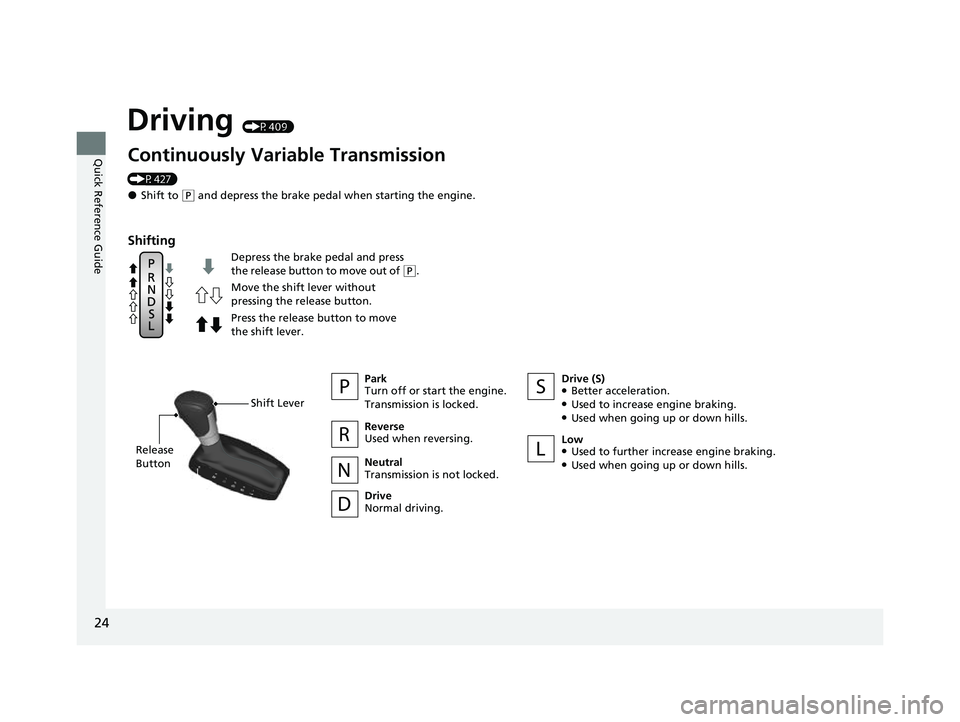
Depress the brake pedal and press
the release button to move out of
(P.
Continuously Variable Transmission
(P427)
●Shift to (P and depress the brake pedal when starting the engine.
Shifting
Park
Turn off or start the engine.
Transmission is locked.
Reverse
Used when reversing.
Neutral
Transmission is not locked.
Drive
Normal driving. Drive (S)●Better acceleration.●Used to increase engine braking.●Used when going up or down hills.
Low
●Used to further increase engine braking.●Used when going up or down hills.
Move the shift lever without
pressing the release button.
Press the release button to move
the shift lever.
Shift Lever
Release
Button
23 HR-V-313V06000_01.book 24 ページ 2022年4月4日 月曜日 午前10時49分
Page 27 of 664

25
Quick Reference Guide
CMBSTM On and Off
(P457)
●When a possible frontal collision is likely
unavoidable, the CMBSTM can reduce the
vehicle speed and the severity of the
collision.
●The CMBSTM is turned on every time you
start the engine.
●To turn the CMBSTM on or off, use the
safety support of th e driver information
interface.
VSA ® On and Off (P435)
●The Vehicle Stability AssistTM (VSA® )
system helps stabilize the vehicle during
cornering and helps maintain traction
while accelerating on loose or slippery
road surfaces.
●VSA ® comes on automatically every time
you start the engine.
●To partially disable or fully restore VSA®
function, press and ho ld the button until
you hear a beep.
Tire Pressure Monitoring
System (TPMS)
(P438)
●Detects a change in tire conditions and
overall dimensions due to decrease in tire
pressures.
●The TPMS is turned on automatically
every time you start the engine.
●A calibration procedure must be
performed when certain conditions arise.
U.S. models only
Refueling (P547)
Fuel recommendation: Unl eaded gasoline, pump octa ne number 87 or higher
Fuel tank capacity: 14.0 US gal (53 L)
aUnlock the driver’s
door.
(P 149)
bPress on the edge of
the fuel fill door to
make it pop up
slightly.
cAfter refueling, wait
for about five
seconds before
removing the filler
nozzle.
23 HR-V-313V06000_01.book 25 ページ 2022年4月4日 月曜日 午前10時49分
Page 30 of 664
28
Quick Reference Guide
Maintenance (P551)
Under the Hood (P563)
●Check engine oil, engine coolant, and windshield washer
fluid. Add when necessary.
●Check brake fluid.●Check the battery condition monthly.
aPull the hood release handle under the corner of the
dashboard.
bLocate the hood latch lever, push it to the side, and then
raise the hood. Once you have raised the hood slightly,
you can release the lever.
cWhen finished, close the hood and make sure it is firmly
locked in place.
Lights (P575)
●Inspect all lights regularly.
Wiper Blades (P577)
●Replace blades if they leave streaks
across the windshield or become noisy.
Tires (P581)
●Inspect tires and wheels regularly.●Check tire pressures regularly.●Install snow tires for winter driving.
23 HR-V-313V06000_01.book 28 ページ 2022年4月4日 月曜日 午前10時49分
Page 85 of 664

83
Safe Driving
Exhaust Gas Hazard
Carbon Monoxide Gas
The engine exhaust from this vehicle contains carbon monoxide, a colorless,
odorless, and highly toxic gas. As long as you properly maintain your vehicle, carbon
monoxide gas will not get into the interior.
■Have the exhaust system in spected for leaks whenever
• The exhaust system is making an unusual noise.
• The exhaust system may have been damaged.
• The vehicle is raised for an oil change.
When you operate a vehicle with the tailga te open, airflow can pull exhaust gas into
the interior and create a hazardous conditio n. If you must drive with the tailgate
open, open all the windows and set the climate control system as shown below.
1. Select the fresh air mode.
2. Select the mode.
3. Set the fan speed to high.
4. Set the temperature control to a comfortable setting.
Adjust the climate control system in the same manner if you sit in your parked
vehicle with the engine running.
1 Carbon Monoxide Gas
An enclosed area such as a garage can quickly fill up
with carbon monoxide gas.
Do not run the engine with the garage door closed.
Even when the garage door is open, drive out of the
garage immediat ely after starting the engine.
3WARNING
Carbon monoxide gas is toxic.
Breathing it can cause unconsciousness and
even kill you.
Avoid any enclosed areas or activities that
expose you to carbon monoxide.
23 HR-V-313V06000_01.book 83 ページ 2022年4月4日 月曜日 午前10時49分
Page 94 of 664

92
uuIndicators u
Instrument Panel
IndicatorNameOn/BlinkingExplanation
Seat Belt
Reminder
Indicator
•Blinks and the beeper sounds for a few
seconds if you are not wearing a seat belt
when you set the power mode to ON, then
the indicator comes on.
• If the front passenger is not wearing a seat
belt, the indicator comes on a few seconds
later.
• Comes on for a while when the rear seat
belt is unfastened while the power mode in
ON.
• Blinks while driving if you and/or any
passenger has not fastened a seat belt. The
beeper sounds and the indicator blinks at
regular intervals.•The beeper stops and the indicator goes off when
you and the passengers fasten their seat belts.
• Stays on after you and/or the passengers has
fastened the seat belt(s) - A detection error may
have occurred in the sensor. Have your vehicle
checked by a dealer.
2 Seat Belt Reminder P. 41
Low Fuel Indicator
(Amber)
•Comes on when the fuel reserve is running
low (approximately 2.1 U.S. gal./8.0 Liter
left).• Comes on - Refuel your vehicle as soon as
possible.
●Blinks if there is a problem with the fuel
gauge.• Have your vehicle checked by a dealer.
Low Temperature
Indicator
•Comes on when the engine coolant
temperature is low.•If the indicator stays on after the engine has
reached normal operating temperature, there may
be a problem with the temperature sensors. Have
your vehicle inspected by a dealer.
23 HR-V-313V06000_01.book 92 ページ 2022年4月4日 月曜日 午前10時49分
Page 106 of 664
104
Instrument Panel
Gauges and Driver Information Interface
Gauges
Gauges include the speedometer, fuel gauge, and other related indicators.
They are displayed when the power mode is in ON.
Displays your driving speed in mph or km/h.
Shows the number of engine revolutions per minute.
Displays the amount of fuel left in the fuel tank.
■Speedometer
■Tachometer
■Fuel Gauge
1Speedometer
You can change the Speed/Distance Units.
2 Speed/Distance Units P. 122
2 Settings
* P. 123
2 Customized Features P. 345
1Tachometer
The tachometer can be tu rned on and off using the
driver information interf ace or audio/information
screen. 2 Settings
* P. 123
2 Customized Features P. 345
1Fuel Gauge
NOTICE
You should refuel when the reading approaches .
Running out of fuel can cause the engine to misfire,
damaging the cata lytic converter.
The actual amount of remain ing fuel may differ from
the fuel gauge reading.E
* Not available on all models
23 HR-V-313V06000_01.book 104 ページ 2022年4月4日 月曜日 午前10時49分