Page 790 of 840
uuIf the Battery Is Dead uJump Starting Procedure
788
Handling the Unexpected
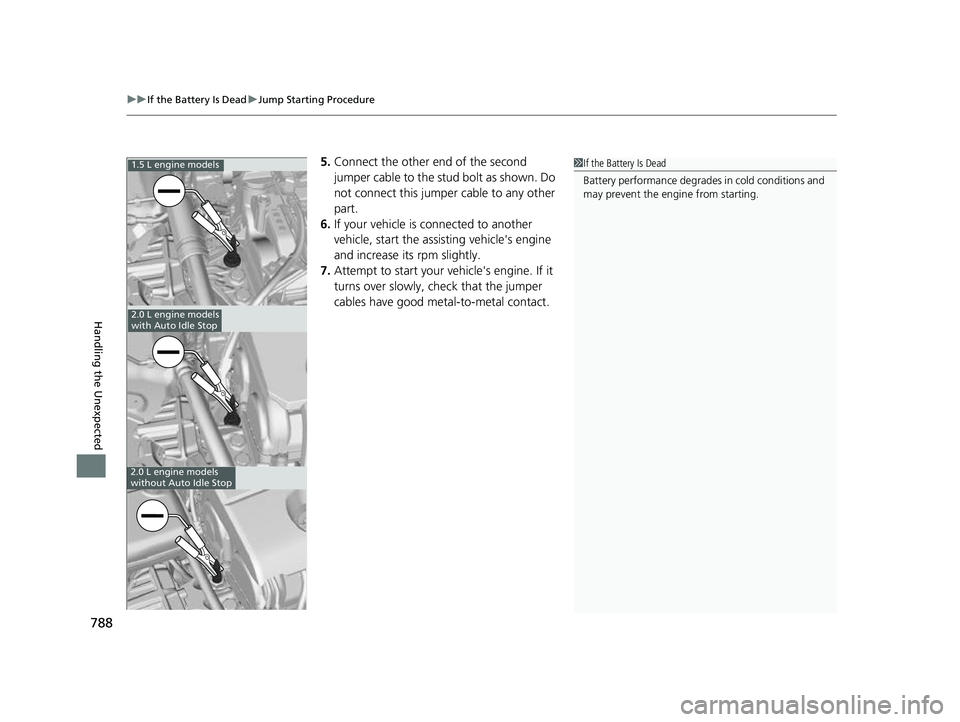
5. Connect the other end of the second
jumper cable to the stud bolt as shown. Do
not connect this jumper cable to any other
part.
6. If your vehicle is connected to another
vehicle, start the assi sting vehicle's engine
and increase its rpm slightly.
7. Attempt to start your vehicle's engine. If it
turns over slowly, check that the jumper
cables have good metal-to-metal contact.1If the Battery Is Dead
Battery performance degrades in cold conditions and
may prevent the engi ne from starting.1.5 L engine models
2.0 L engine models
with Auto Idle Stop
2.0 L engine models
without Auto Idle Stop
23 CIVIC HATCHBACK TYPE R-31T406100_03.book 788 ページ 2022年6月23日 木曜日 午後9時28分
Page 793 of 840
791Continued
Handling the Unexpected
Overheating
How to Handle Overheating
Overheating symptoms are as follows:
•The temperature gauge is at the mark or the engine suddenly loses power.
• The Engine temperature too hot. Do not drive. Allow engine to cool.
message appears on the driv er information interface.
• Steam or spray comes out of the engine compartment.
■First thing to do
1. Immediately park the vehicle in a safe place.
2. Turn off all accessories and turn on the hazard warning lights.
u No steam or spray present: Keep the engine running and open the hood.
u Steam or spray is present: Turn off the engine and wait until it subsides.
Then, open the hood.
Models with Auto Idle Stop
1 How to Handle Overheating
NOTICE
Continuing to drive with the temperature gauge at
the mark may damage the engine.
Continuing to drive with the Engine temperature
too hot. Do not drive. Allow engine to cool.
message on the driver information interface may
damage the engine.
3WARNING
Steam and spray from an overheated
engine can seri ously scald you.
Do not open the hood if steam is coming
out.
Models with B-type meter
H
All models
Models with B-type meter
H
All models
23 CIVIC HATCHBACK TYPE R-31T406100_03.book 791 ページ 2022年6月23日 木曜日 午後9時28分
Page 795 of 840
793
uuOverheating uHow to Handle Overheating
Continued
Handling the Unexpected
How to Handle Overheating
Overheating symptoms are as follows:
• The temperature gauge is at the mark or the engine suddenly loses power.
• The Engine temperature too hot. Do not drive. Allow engine to cool.
message appears on the driv er information interface.
• Steam or spray comes out of the engine compartment.
■First thing to do
1. Immediately park the vehicle in a safe place.
2. Turn off all accessories and turn on the hazard warning lights.
u No steam or spray present: Keep the engine running and open the hood.
u Steam or spray is present: Turn off the engine and wait until it subsides.
Then, open the hood.
Models without Auto Idle Stop
1 How to Handle Overheating
NOTICE
Continuing to drive with the temperature gauge at
the mark may damage the engine.
Continuing to drive with the Engine temperature
too hot. Do not drive. Allow engine to cool.
message on the driver information interface may
damage the engine.
3WARNING
Steam and spray from an overheated
engine can seri ously scald you.
Do not open the hood if steam is coming
out.
H
H
23 CIVIC HATCHBACK TYPE R-31T406100_03.book 793 ページ 2022年6月23日 木曜日 午後9時28分
Page 797 of 840
795
Handling the Unexpected
Indicator, Coming On/Blinking
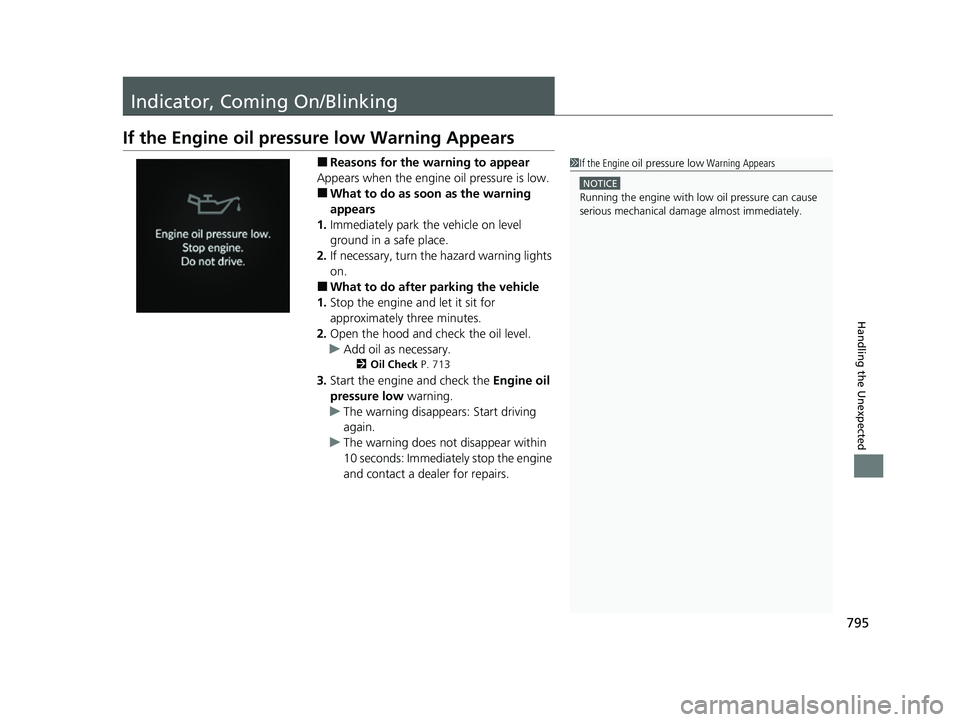
If the Engine oil pressure low Warning Appears
■Reasons for the warning to appear
Appears when the engine oil pressure is low.
■What to do as soon as the warning
appears
1. Immediately park the vehicle on level
ground in a safe place.
2. If necessary, turn the hazard warning lights
on.
■What to do after parking the vehicle
1. Stop the engine and let it sit for
approximately three minutes.
2. Open the hood and ch eck the oil level.
u Add oil as necessary.
2 Oil Check P. 713
3.Start the engine and check the Engine oil
pressure low warning.
u The warning disappears: Start driving
again.
u The warning does not disappear within
10 seconds: Immediately stop the engine
and contact a dealer for repairs.
1If the Engine oil pressure low Warning Appears
NOTICE
Running the engine with low oil pressure can cause
serious mechanical damage almost immediately.
23 CIVIC HATCHBACK TYPE R-31T406100_03.book 795 ページ 2022年6月23日 木曜日 午後9時28分
Page 799 of 840
797
uuIndicator, Coming On/BlinkinguIf the Brake System Indicator (Red) Comes On or Blinks
Handling the Unexpected
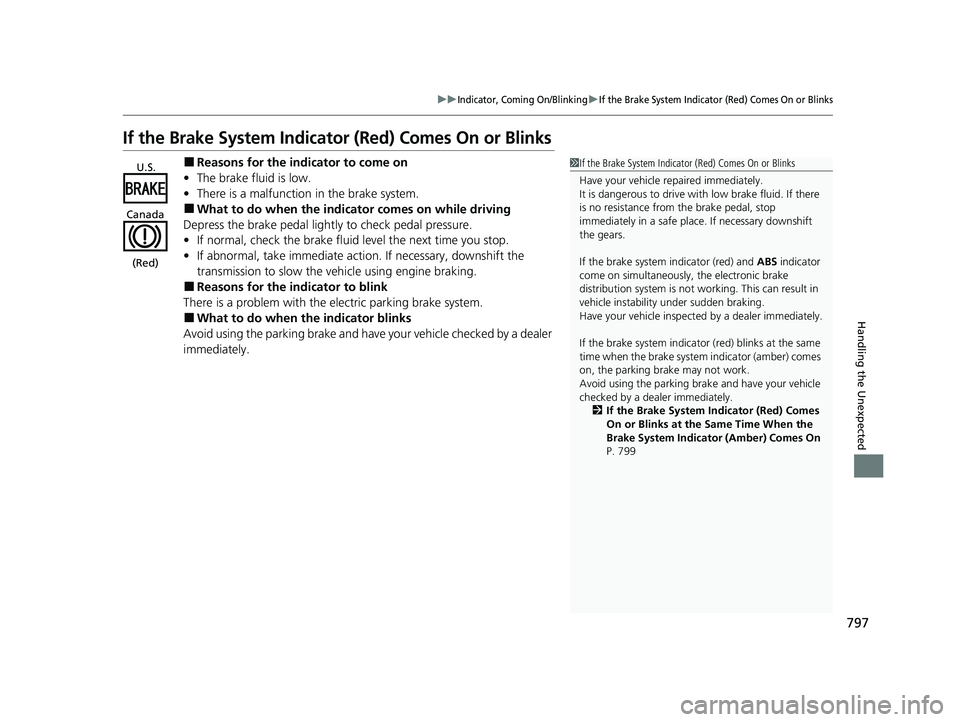
If the Brake System Indicator (Red) Comes On or Blinks
■Reasons for the indicator to come on
• The brake fluid is low.
• There is a malfunction in the brake system.
■What to do when the indicator comes on while driving
Depress the brake pedal lightly to check pedal pressure.
• If normal, check the brake fluid level the next time you stop.
• If abnormal, take immediate acti on. If necessary, downshift the
transmission to slow the vehicle using engine braking.
■Reasons for the indicator to blink
There is a problem with the electric parking brake system.
■What to do when the indicator blinks
Avoid using the parking brake and have your vehicle checked by a dealer
immediately.
1 If the Brake System Indicator (Red) Comes On or Blinks
Have your vehicle re paired immediately.
It is dangerous to drive with low brake fluid. If there
is no resistance from the brake pedal, stop
immediately in a safe plac e. If necessary downshift
the gears.
If the brake system indicator (red) and ABS indicator
come on simultaneously , the electronic brake
distribution system is not wo rking. This can result in
vehicle instability under sudden braking.
Have your vehicle inspecte d by a dealer immediately.
If the brake system indicator (red) blinks at the same
time when the brake system indicator (amber) comes
on, the parking br ake may not work.
Avoid using the parking brak e and have your vehicle
checked by a dealer immediately.
2 If the Brake System Indicator (Red) Comes
On or Blinks at the Same Time When the
Brake System Indicator (Amber) Comes On
P. 799U.S.
Canada
(Red)
23 CIVIC HATCHBACK TYPE R-31T406100_03.book 797 ページ 2022年6月23日 木曜日 午後9時28分
Page 808 of 840
806
uuFusesuInspecting and Changing Fuses
Handling the Unexpected
Inspecting and Changing Fuses
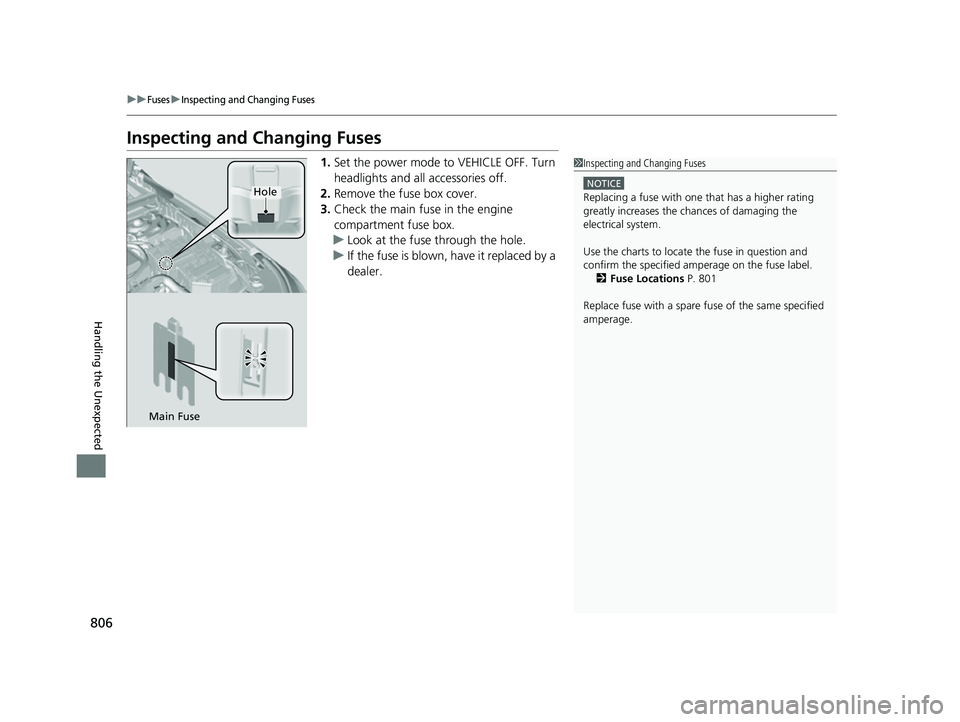
1.Set the power mode to VEHICLE OFF. Turn
headlights and all accessories off.
2. Remove the fuse box cover.
3. Check the main fuse in the engine
compartment fuse box.
u Look at the fuse through the hole.
u If the fuse is blown, have it replaced by a
dealer.1Inspecting and Changing Fuses
NOTICE
Replacing a fuse with on e that has a higher rating
greatly increases the chances of damaging the
electrical system.
Use the charts to locate the fuse in question and
confirm the specified amperage on the fuse label.
2 Fuse Locations P. 801
Replace fuse with a spare fuse of the same specified
amperage.
Main Fuse
Hole
23 CIVIC HATCHBACK TYPE R-31T406100_03.book 806 ページ 2022年6月23日 木曜日 午後9時28分
Page 816 of 840

814
Information
Specifications
■Vehicle Specifications
*1: 1.5 L engine models
*2: 2.0 L engine models with auto idle stop
*3: 2.0 L engine models without auto idle stop
■Air Conditioning
*1: 1.5 L engine models
*2: 2.0 L engine models
ModelCivic*1 *2
Civic TYPE R*3
No. of Passengers:
Front 2
Rear 3
*1 *2
2*3
Total5*1 *2
4*3
Weights:Gross Vehicle
Weight RatingSee the certification label on the driver's
doorjamb
Gross Axle Weight
Rating (Front)See the certification label on the driver's
doorjamb
Gross Axle Weight
Rating (Rear)See the certification label on the driver's
doorjamb
Refrigerant TypeHFO-1234yf (R-1234yf)
Charge Quantity 15.3 - 17.1 oz (435 - 485 g)
Lubricant TypeRL85HM (POE)*1
ND-OIL 14 (POE)*2
Quantity 6.41 - 7.32 cu-in (105 - 120 cm3)*2
6.71 - 7.5 cu-in (110 - 123 cm3)*1
■
Engine Specifications
*1: 1.5 L engine models
*2: 2.0 L engine models with auto idle stop
*3: 2.0 L engine models without auto idle stop
■Fuel
*1: Models with auto idle stop
*2: Models without auto idle stop
■Washer Fluid
*1: Models with auto idle stop
*2: Models without auto idle stop
Displacement91.38 cu-in (1,498 cm3)*1
121.76 cu-in (1,996 cm3)*2*3
Spark Plugs NGKDILKAR8P8SY
*1
DILKAR7H11GS*2
DILKAR7G11GS*2
ILZKAR8J8SY*3
DENSODXE22HQR-D11S*2
Type
Unleaded gasoline, pump octane number
87 or higher*1
Unleaded premium gasoline, pump octane
number 91 or higher*2
Fuel Tank Capacity
12.39 US gal (46.9 L)*1
12.4 US gal (47.0 L)*2
Tank CapacityU.S.:1.6 US qt (1.5 L)
Canada:1.6 US qt (1.5 L)*2
4.8 US qt (4.5 L)*1
■
Light Bulbs
Headlights (Low Beam)LED
Headlights (High Beam) LED
Fog Lights*LED
Parking/Daytime Running Lights LED
Front Side Marker LightsLED
Front Turn Signal Lights LED
Side Turn Signal Lights
(on Door Mirrors)*LED
Brake Lights LED
Rear Turn Signal Lights21 W (Amber)
Rear Side Marker Lights LED
Back-Up Lights16 W
Taillights LED
High-Mount Brake LightLED
Rear License Plate Light LED
Interior LightsMap LightsLEDCeiling LightLEDVanity Mirror Lights*2 WCenter Console Light*LEDGlove Box LightLEDCargo Area Light5 WFoot Lights*LEDAmbient LightsLED
* Not available on all models
23 CIVIC HATCHBACK TYPE R-31T406100_03.book 814 ページ 2022年6月23日 木曜日 午後9時28分
Page 823 of 840
821
uuEmissions Testing uTesting of Readiness Codes
Continued
Information
7. Select a nearby, lightly trav eled major highway where you can maintain a speed
of 50 to 60 mph (80 to 97 km/h) for at least 20 minutes. Drive on the highway
in
(D (continuously variable transmission) or 5th (manual). Do not use cruise
control. When traffic al lows, drive for 90 seconds without moving the
accelerator pedal. (Vehicle speed may vary slightly; this is okay.) If you cannot do
this for a continuous 90 seconds because of traffic conditions, drive for at least
30 seconds, then repeat it two more times (for a total of 90 seconds).
8. Drive in city or suburban traffic for at least 10 minutes. When traffic conditions
allow, let the vehicle coast for severa l seconds without using the accelerator
pedal or the brake pedal.
9. Park the vehicle and leave the engine off for 30 minutes.
1. Fill the gas tank to approximately 3/4 full.
2. Park the vehicle and leave the en gine off for 6 hours or more.
3. Make sure the ambient temperature is between 40°F and 95°F (4°C and 35°C).
4. Start the engine without touching the ac celerator pedal, and let it idle for
20 seconds.
5. Keep the vehicle in
(P (continuously variab le transmission) or (N (manual
transmission). Increase the engine speed to 2,000 rpm, and hold it there for
about 3 minutes.
6. Let the engine idle with your foot off the accelerator for 20 seconds.
7. Drive in city or suburban traffic for at least 10 minutes. When traffic conditions
allow, let the vehicle coast for severa l seconds without using the accelerator
pedal or the brake pedal.
2.0 L engine models
23 CIVIC HATCHBACK TYPE R-31T406100_03.book 821 ページ 2022年6月23日 木曜日 午後9時28分