2023 FORD SUPER DUTY check engine
[x] Cancel search: check enginePage 599 of 738
If your instrument cluster display resetsprematurely or becomes inoperative, youshould perform the oil change interval atsix months or 5,000 mi (8,000 km) fromyour last oil change. Never exceed one yearor 10,000 mi (16,000 km) between oilchange intervals.
You can drive your vehicle in such a waythat may lead to higher oil consumptionincluding extended time at high enginespeeds, high loads, engine braking, hardcornering maneuvers, track and off-roadusage. Under these conditions, oilconsumption of approximately 1 quart per500 miles (1 liter per 800 km) is possible.Check the engine oil level at every refuelingand adjust to maintain proper levels toavoid engine damage.
You can also drive your vehicle in such away that dilutes and increases the level ofoil by frequent short trips that do not allowthe engine to get to operating temperature,extended idling and low speed driving forlong periods of time.
It is important to rely upon your dealershipto properly diagnose and repair yourvehicle.
We strongly recommend only using ourgenuine or our authorized re-manufacturedreplacement parts engineered for yourvehicle.
Additives and Chemicals
We do not recommend using chemicals oradditives not approved by us as part ofyour vehicle’s normal maintenance. Pleaseconsult your warranty information.
Oils, Fluids and Flushing
In many cases, fluid discoloration is anormal operating characteristic and, byitself, does not necessarily indicate aconcern or that the fluid needs to bechanged. Have discolored fluids that alsoshow signs of overheating or foreignmaterial contamination checkedimmediately.
Make sure to change the vehicle’s oils andfluids at the specified intervals or inconjunction with a repair. Flushing is aviable way to change fluid for many vehiclesub-systems during scheduledmaintenance. It is critical that systems areflushed only with new fluid that is the sameas that required to fill and operate thesystem or using our approved flushingchemical.
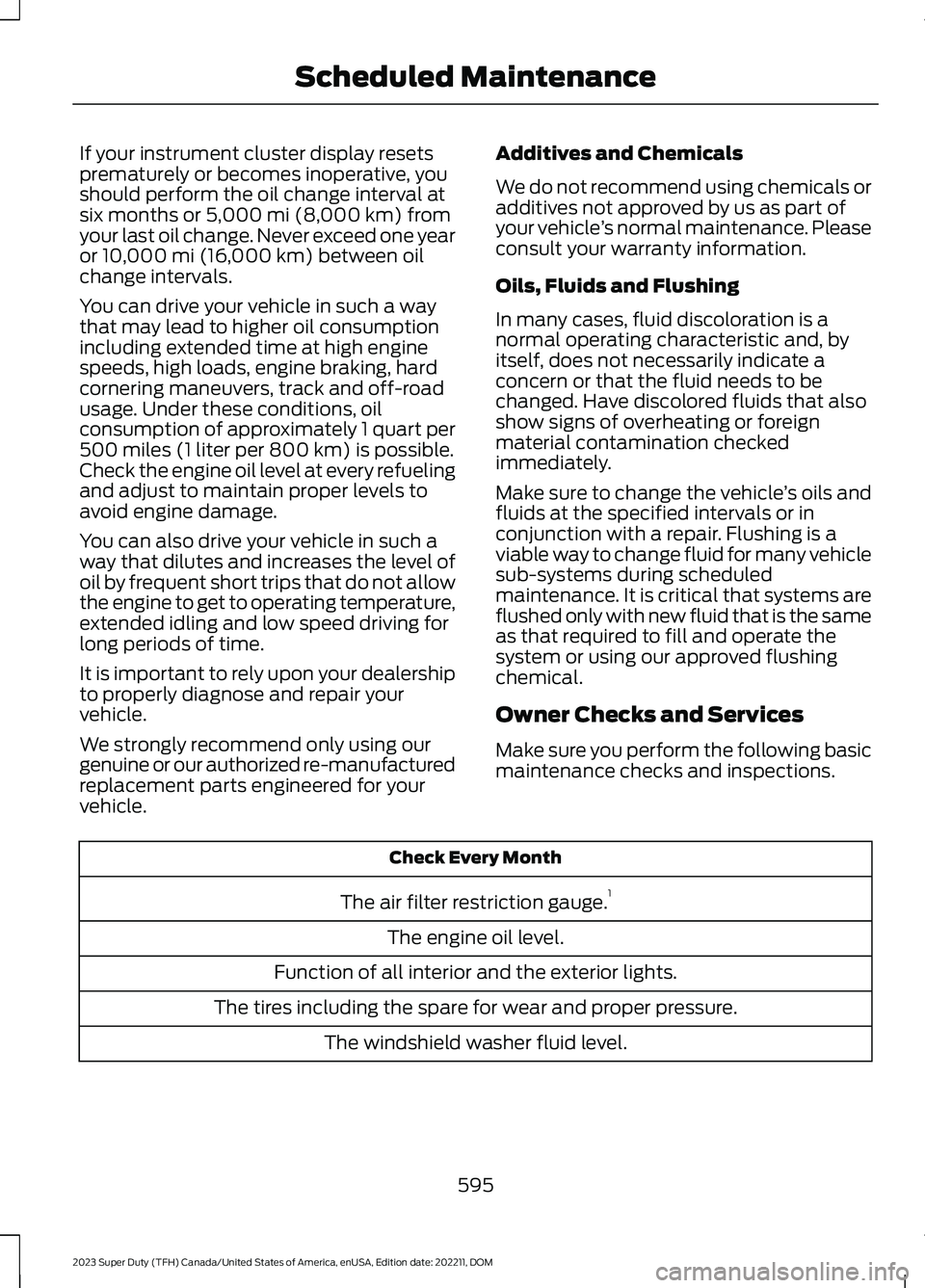
Owner Checks and Services
Make sure you perform the following basicmaintenance checks and inspections.
Check Every Month
The air filter restriction gauge.1
The engine oil level.
Function of all interior and the exterior lights.
The tires including the spare for wear and proper pressure.
The windshield washer fluid level.
595
2023 Super Duty (TFH) Canada/United States of America, enUSA, Edition date: 202211, DOMScheduled Maintenance
Page 600 of 738
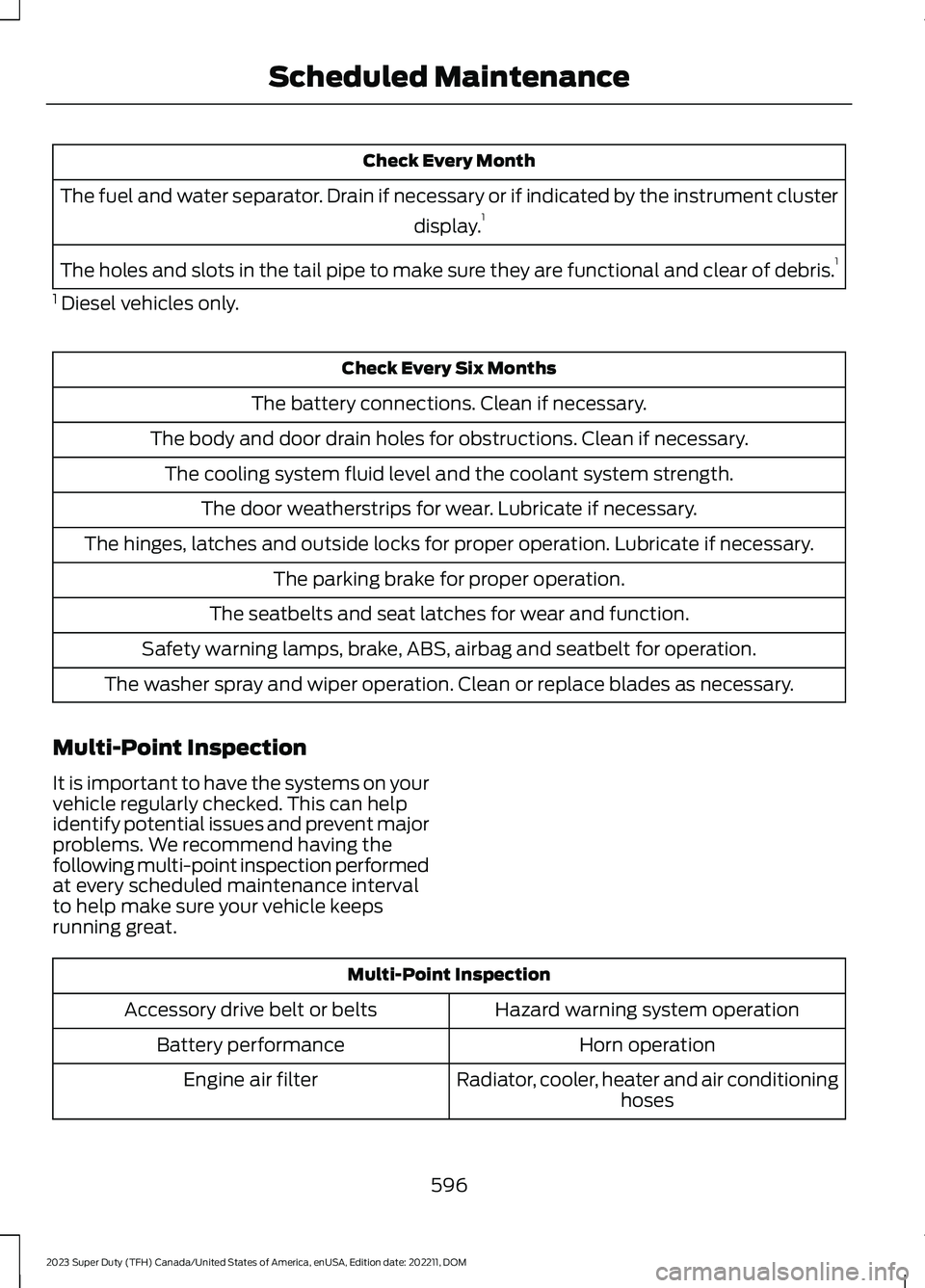
Check Every Month
The fuel and water separator. Drain if necessary or if indicated by the instrument cluster
display.1
The holes and slots in the tail pipe to make sure they are functional and clear of debris.1
1 Diesel vehicles only.
Check Every Six Months
The battery connections. Clean if necessary.
The body and door drain holes for obstructions. Clean if necessary.
The cooling system fluid level and the coolant system strength.
The door weatherstrips for wear. Lubricate if necessary.
The hinges, latches and outside locks for proper operation. Lubricate if necessary.
The parking brake for proper operation.
The seatbelts and seat latches for wear and function.
Safety warning lamps, brake, ABS, airbag and seatbelt for operation.
The washer spray and wiper operation. Clean or replace blades as necessary.
Multi-Point Inspection
It is important to have the systems on yourvehicle regularly checked. This can helpidentify potential issues and prevent majorproblems. We recommend having thefollowing multi-point inspection performedat every scheduled maintenance intervalto help make sure your vehicle keepsrunning great.
Multi-Point Inspection
Hazard warning system operationAccessory drive belt or belts
Horn operationBattery performance
Radiator, cooler, heater and air conditioninghosesEngine air filter
596
2023 Super Duty (TFH) Canada/United States of America, enUSA, Edition date: 202211, DOMScheduled Maintenance
Page 601 of 738
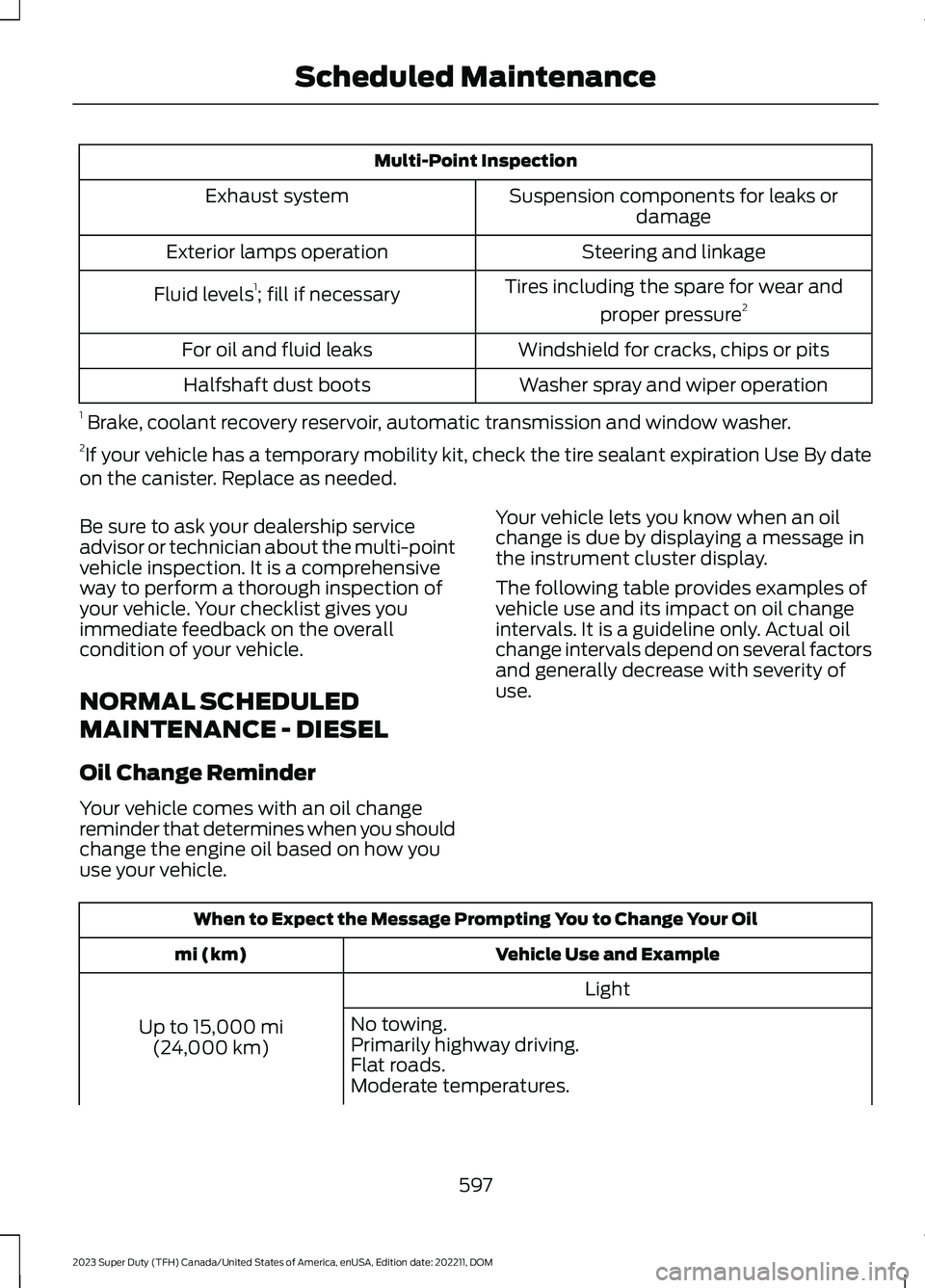
Multi-Point Inspection
Suspension components for leaks ordamageExhaust system
Steering and linkageExterior lamps operation
Tires including the spare for wear and
proper pressure2Fluid levels1; fill if necessary
Windshield for cracks, chips or pitsFor oil and fluid leaks
Washer spray and wiper operationHalfshaft dust boots
1 Brake, coolant recovery reservoir, automatic transmission and window washer.2If your vehicle has a temporary mobility kit, check the tire sealant expiration Use By dateon the canister. Replace as needed.
Be sure to ask your dealership serviceadvisor or technician about the multi-pointvehicle inspection. It is a comprehensiveway to perform a thorough inspection ofyour vehicle. Your checklist gives youimmediate feedback on the overallcondition of your vehicle.
NORMAL SCHEDULED
MAINTENANCE - DIESEL
Oil Change Reminder
Your vehicle comes with an oil changereminder that determines when you shouldchange the engine oil based on how youuse your vehicle.
Your vehicle lets you know when an oilchange is due by displaying a message inthe instrument cluster display.
The following table provides examples ofvehicle use and its impact on oil changeintervals. It is a guideline only. Actual oilchange intervals depend on several factorsand generally decrease with severity ofuse.
When to Expect the Message Prompting You to Change Your Oil
Vehicle Use and Examplemi (km)
Light
Up to 15,000 mi(24,000 km)
No towing.Primarily highway driving.Flat roads.Moderate temperatures.
597
2023 Super Duty (TFH) Canada/United States of America, enUSA, Edition date: 202211, DOMScheduled Maintenance
Page 611 of 738
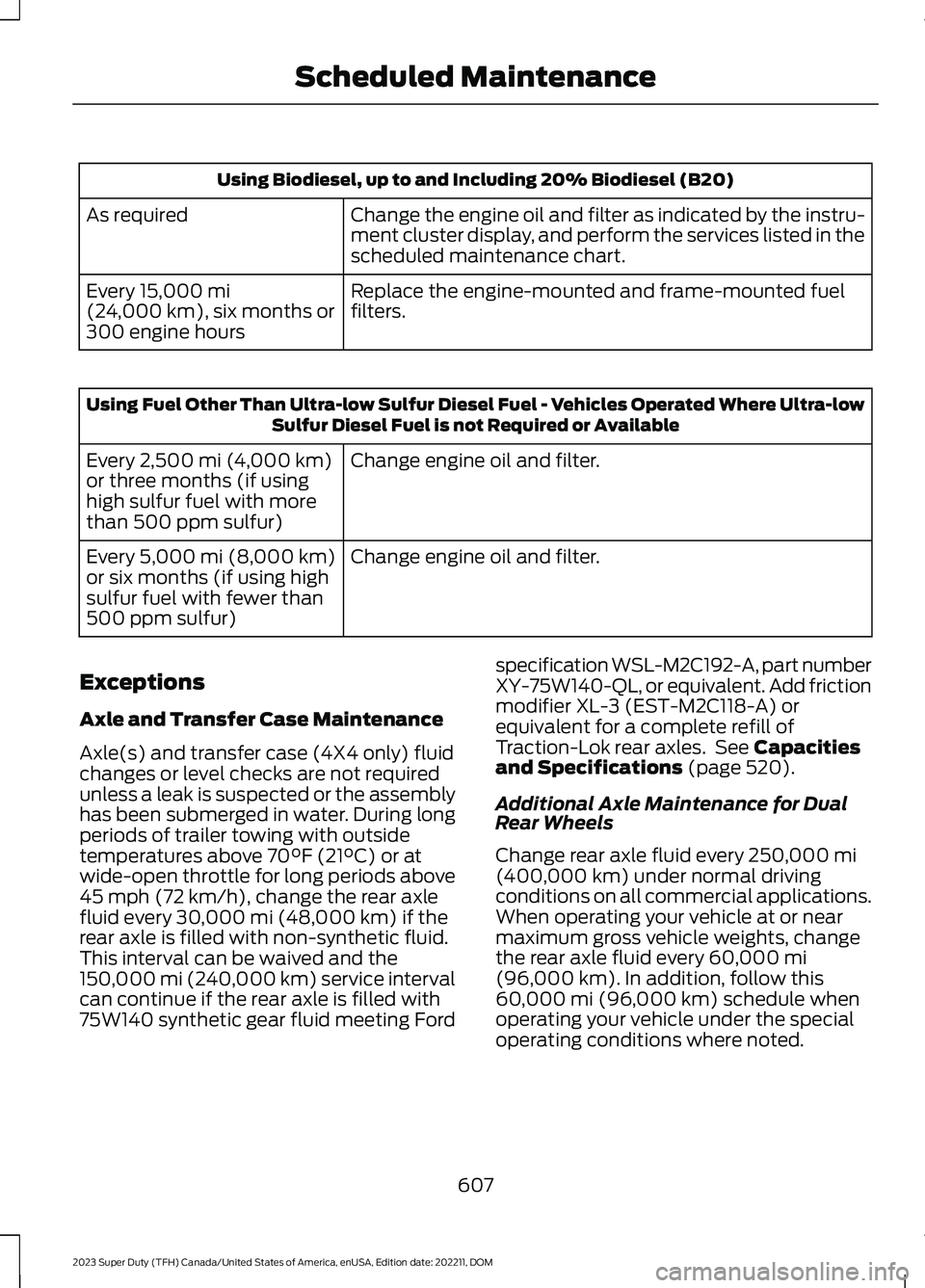
Using Biodiesel, up to and Including 20% Biodiesel (B20)
Change the engine oil and filter as indicated by the instru-ment cluster display, and perform the services listed in thescheduled maintenance chart.
As required
Replace the engine-mounted and frame-mounted fuelfilters.Every 15,000 mi(24,000 km), six months or300 engine hours
Using Fuel Other Than Ultra-low Sulfur Diesel Fuel - Vehicles Operated Where Ultra-lowSulfur Diesel Fuel is not Required or Available
Change engine oil and filter.Every 2,500 mi (4,000 km)or three months (if usinghigh sulfur fuel with morethan 500 ppm sulfur)
Change engine oil and filter.Every 5,000 mi (8,000 km)or six months (if using highsulfur fuel with fewer than500 ppm sulfur)
Exceptions
Axle and Transfer Case Maintenance
Axle(s) and transfer case (4X4 only) fluidchanges or level checks are not requiredunless a leak is suspected or the assemblyhas been submerged in water. During longperiods of trailer towing with outsidetemperatures above 70°F (21°C) or atwide-open throttle for long periods above45 mph (72 km/h), change the rear axlefluid every 30,000 mi (48,000 km) if therear axle is filled with non-synthetic fluid.This interval can be waived and the150,000 mi (240,000 km) service intervalcan continue if the rear axle is filled with75W140 synthetic gear fluid meeting Ford
specification WSL-M2C192-A, part numberXY-75W140-QL, or equivalent. Add frictionmodifier XL-3 (EST-M2C118-A) orequivalent for a complete refill ofTraction-Lok rear axles. See Capacitiesand Specifications (page 520).
Additional Axle Maintenance for DualRear Wheels
Change rear axle fluid every 250,000 mi(400,000 km) under normal drivingconditions on all commercial applications.When operating your vehicle at or nearmaximum gross vehicle weights, changethe rear axle fluid every 60,000 mi(96,000 km). In addition, follow this60,000 mi (96,000 km) schedule whenoperating your vehicle under the specialoperating conditions where noted.
607
2023 Super Duty (TFH) Canada/United States of America, enUSA, Edition date: 202211, DOMScheduled Maintenance
Page 704 of 738

Services even if Intelematics or a Supplierhas been advised of the possibility of suchdamages. You also acknowledge thatneither Intelematics nor any Supplierguarantees nor make any warranties thatrelate to the availability, accuracy orcompleteness of SUNA Products and/orServices, and to the extent which it islawful to do so, both Intelematics and eachSupplier excludes any warranties whichmight otherwise be implied by any Stateor Federal legislation in relation to SUNAProducts and/or Services.
7. Please Note
Great care has been taken in preparing thismanual. Constant product developmentmay mean that some information is notentirely up-to-date. The information in thisdocument is subject to change withoutnotice.
EMISSION LAW
WARNING: Do not remove or alterthe original equipment floor covering orinsulation between it and the metal floorof the vehicle. The floor covering andinsulation protect occupants of thevehicle from the engine and exhaustsystem heat and noise. On vehicles withno original equipment floor coveringinsulation, do not carry passengers in amanner that permits prolonged skincontact with the metal floor. Failure tofollow these instructions may result infire or personal injury.
U.S. federal laws and certain state lawsprohibit removing or rendering inoperativeemission control system components.Similar federal or provincial laws mayapply in Canada. We do not approve of anyvehicle modification without firstdetermining applicable laws.
Tampering with emissionscontrol systems includingrelated sensors or the DieselExhaust Fluid system can result in reducedengine power and the illumination of theservice engine soon light.
Tampering With a Noise ControlSystem
Federal laws prohibit the following acts:
•Removal or rendering inoperative byany person other than for purposes ofmaintenance.
•Repair or replacement of any device orelement of the design incorporated intoa new vehicle for the purpose of noisecontrol prior to its sale or delivery tothe ultimate purchaser or while it is inuse.
•The use of the vehicle after any personremoves or renders inoperative anydevice or element of the design.
The U.S. Environmental Protection Agencymay presume to constitute tampering asfollows:
•Removal of hood blanket, fender apronabsorbers, fender apron barriers,underbody noise shields or acousticallyabsorptive material.
•Tampering or rendering inoperative theengine speed governor, to allow enginespeed to exceed manufacturerspecifications.
If the engine does not start, runs rough,experiences a decrease in engineperformance, experiences excess fuelconsumption or produces excessiveexhaust smoke, check for the following:
•A plugged or disconnected air inletsystem hose.
•A plugged engine air filter element.
•Water in the fuel filter and waterseparator.
700
2023 Super Duty (TFH) Canada/United States of America, enUSA, Edition date: 202211, DOMCustomer InformationE67028
Page 705 of 738

•A clogged fuel filter.
•Contaminated fuel.
•Air in the fuel system, due to looseconnections.
•An open or pinched sensor hose.
•Incorrect engine oil level.
•Incorrect fuel for climatic conditions.
•Incorrect engine oil viscosity forclimactic conditions.
Note:Some vehicles have a lifetime fuelfilter that is integrated with the fuel tank.Regular maintenance or replacement is notneeded.
Note:If these checks do not help youcorrect the concern, have your vehiclechecked as soon as possible.
Noise Emissions Warranty,Prohibited Tampering Acts andMaintenance
On January 1, 1978, Federal regulationbecame effective governing the noiseemission on trucks over 10,000 lb(4,536 kg) Gross Vehicle Weight Rating(GVWR). The preceding statementsconcerning prohibited tampering acts andmaintenance, and the noise warrantyfound in the Warranty Guide, areapplicable to complete chassis cabs over10,000 lb (4,536 kg) GVWR.
EXPORT UNIQUE OPTIONS
For your particular global region, yourvehicle may be equipped with features andoptions that are different from the featuresand options that are described in thisOwner’s Manual. A market uniquesupplement may be supplied thatcomplements this book. By referring to themarket unique supplement, if provided,you can properly identify those features,recommendations and specifications thatare unique to your vehicle. This Owner’s
Manual is written primarily for the U.S. andCanadian markets. Features or equipmentlisted as standard may be different on unitsbuilt for export.Refer to this Owner’sManual for all other requiredinformation and warnings.
WARRANTY INFORMATION
The following warranties may apply to yourvehicle:
•New vehicle limited warranties.
•Emissions warranties, if applicable.(Note: Fully-electric vehicles are noteligible for emissions warranties.)
•Other warranties, if applicable.
Detailed warranty information specific toyour vehicle can be found in the WarrantyGuide at www.owner.ford.com.
The following California WarrantyStatement, required by Californiaregulations, applies to vehicles certified toCalifornia emissions standards andregistered in a state that requires Californiaemissions warranty. If applicable,additional California Emissions Warrantiescan be found in the Warranty Guide atwww.owner.ford.com.
CALIFORNIA EMISSION CONTROLWARRANTY STATEMENT
YOUR WARRANTY RIGHTS ANDOBLIGATIONS
The California Air Resources Board andFord Motor Company are pleased toexplain the emission control systemwarranty on your (year) vehicle. InCalifornia, new motor vehicles must bedesignated, built and equipped to meet
701
2023 Super Duty (TFH) Canada/United States of America, enUSA, Edition date: 202211, DOMCustomer Information
Page 706 of 738
the State's stringent anti-smog standards.Ford Motor Company must warrant theemission control system on your vehiclefor the periods of time listed belowprovided there has been no abuse, neglector improper maintenance of your vehicle.
Your emission control system may includeparts such as the carburetor orfuel-injection system, the ignition system,catalytic converter and engine computer.Also included may be hoses, belts,connectors and other emission-relatedassemblies. Where a warrantable conditionexists, Ford Motor Company will repair yourvehicle at no cost to you includingdiagnosis, parts and labor.
MANUFACTURER'S WARRANTYCOVERAGE:
(For 1990 and subsequent modelpassenger cars, light-duty trucks, andmedium-duty vehicles.)
- For 3 years or 50,000 miles (whicheveroccurs first);
1) If your vehicle fails a Smog Checkinspection, all necessary repairs andadjustments will be made by Ford MotorCompany to ensure that your emissioncontrol system PERFORMANCEWARRANTY.
2) If any emission-related part on yourvehicle is defective, the part will berepaired or replaced by Ford MotorCompany. This is your short-term emissioncontrol system DEFECTS WARRANTY.
- For 7 years or 70,000 miles (whicheveroccurs first);
1) If an emission-related part listed in thiswarranty booklet specially noted withcoverage for 7 years or 70,000 miles isdefective, the part will be repaired orreplaced by Ford Motor Company. This isyour long-term emission control systemDEFECTS WARRANTY.
OWNER'S WARRANTYRESPONSIBILITIES:
- As the vehicle owner, you are responsiblefor the performance of the requiredmaintenance listed in your owner'smanual. Ford Motor Companyrecommends that you retain all receiptscovering maintenance on your vehicle, butFord Motor Company cannot denywarranty solely for the lack of receipts orfor your failure to ensure the performanceof all scheduled maintenance.
- You are responsible for presenting yourvehicle to a Ford or Lincoln dealer as soonas a problem exists. The warranty repairsshould be completed in a reasonableamount of time, not to exceed 30 days.
- As the vehicle owner, you should also beaware that Ford Motor Company may denyyou warranty coverage if your vehicle or apart has failed due to abuse, neglect,improper maintenance or unapprovedmodifications.
If you have any questions regarding yourwarranty rights and responsibilities, youshould contact Ford Customer Service at1-800-392-3673 or the California AirResource Board at 9528 Telstar Avenue,El Monte, CA 91731.
702
2023 Super Duty (TFH) Canada/United States of America, enUSA, Edition date: 202211, DOMCustomer Information
Page 716 of 738

Checking the Coolant Level..........................450Coolant – Information Messages................453Coolant – Warning Lamps.............................452Managing the Coolant Temperature..........452Cooling System Capacity andSpecification - 6.7L Diesel.....................532Cooling System Capacity andSpecification - 6.8L, Gasoline..............533Cooling System Capacity andSpecification - 7.3L, Gasoline...............534Crash and BreakdownInformation.................................................420Automatic Crash Shutoff................................423Fail-Safe Cooling...............................................425Jump Starting the Vehicle...............................421Post-Crash Alert System................................423Recovery Towing................................................423Crash Sensors and Airbag Indicator.......65Creating a Personal Profile.......................577Creating a Vehicle Wi-Fi Hotspot...........551Cross Traffic Alert........................................335Cross Traffic Alert –Troubleshooting.............................................337Cross Traffic Alert Indicators....................337Cross Traffic Alert Limitations................335Cross Traffic Alert Precautions...............335Cross Traffic Alert –Troubleshooting........................................337Cross Traffic Alert – InformationMessages..........................................................337Cross Traffic Braking...................................262Cross Traffic Braking –Troubleshooting............................................263Cross Traffic Braking Indicators.............263Cross Traffic Braking Precautions.........262Cross Traffic Braking –Troubleshooting........................................263Cross Traffic Braking – Frequently AskedQuestions........................................................264Cross Traffic Braking – InformationMessages.........................................................263Cruise Control...............................................294Cruise Control Indicators..........................295Cup Holders....................................................197Cup Holder Precautions...................................197Customer Information...............................623Radio Frequency CertificationLabels...............................................................626
Customizing the Instrument ClusterDisplay - Vehicles With: 12 InchScreen............................................................144Customizing the Instrument ClusterDisplay - Vehicles With: 8 InchScreen............................................................144
D
Data Privacy.....................................................26Deleting a Personal Profile.......................578Department of Transportation UniformTire Quality Grades..................................478Diesel Engine Exhaust Brake...................256Diesel Engine Exhaust Brake –Troubleshooting.............................................257Diesel Engine Exhaust BrakeGauge.............................................................257Diesel Engine Exhaust BrakeIndicators......................................................257Diesel Engine Exhaust Brake –Precautions.................................................256Diesel Engine Exhaust Brake –Troubleshooting.........................................257Diesel Engine Exhaust Brake – WarningLamps................................................................257Diesel Engine Exhaust BrakeVideos............................................................257Diesel Exhaust Fluid Capacity andSpecification..............................................230Diesel Exhaust Fluid Gauge......................138Diesel Particulate Filter...............................221Diesel Particulate Filter ManualRegeneration...................................................222Diesel Particulate Filter –Troubleshooting............................................224Diesel Particulate Filter ManualRegeneration...............................................222Diesel Particulate Filter ManualRegeneration Limitations...........................223Diesel Particulate Filter ManualRegeneration Precautions.........................222Diesel Particulate Filter ManualRegeneration Requirements.....................222Starting Diesel Particulate Filter ManualRegeneration...................................................223What Is Diesel Particulate Filter ManualRegeneration...................................................222
712
2023 Super Duty (TFH) Canada/United States of America, enUSA, Edition date: 202211, DOMIndex