2023 FORD RANGER warning
[x] Cancel search: warningPage 163 of 470

If you use anything other than our parts formaintenance replacements or for serviceof components affecting emission control,such aftermarket parts should beequivalent to our genuine parts inperformance and durability.
Illumination of the service engine soonindicator, charging system warning light orthe temperature warning light, fluid leaks,strange odors, smoke or loss of enginepower could indicate that the emissioncontrol system is not working properly.
An improperly operating or damagedexhaust system may allow exhaust toenter the vehicle. Have a damaged orimproperly operating exhaust systeminspected and repaired immediately.
Do not make any unauthorized changes toyour vehicle or engine. By law, vehicleowners and anyone who manufactures,repairs, services, sells, leases, tradesvehicles, or supervises a fleet of vehiclesare not permitted to intentionally removean emission control device or prevent itfrom working. Information about yourvehicle’s emission system is on the VehicleEmission Control Information Decallocated on or near the engine. This decalalso lists engine displacement.
Please consult your warranty informationfor complete details.
On-Board Diagnostics (OBD-II)
Your vehicle has a computer known as theon-board diagnostics system (OBD-II) thatmonitors the engine’s emission controlsystem. The system protects theenvironment by making sure that yourvehicle continues to meet governmentemission standards. The OBD-II systemalso assists a service technician in properlyservicing your vehicle.
When the service engine soonindicator illuminates, the OBD-IIsystem has detected amalfunction. Temporary malfunctions maycause the service engine soon indicator toilluminate. Examples are:
1.Your vehicle has run out of fuel—theengine may misfire or run poorly.
2.Poor fuel quality or water in thefuel—the engine may misfire or runpoorly.
3.The fuel fill inlet may not have closedproperly. See Refueling (page 153).
4.Driving through deep water—theelectrical system may be wet.
You can correct these temporarymalfunctions by filling the fuel tank withgood quality fuel, properly closing the fuelfill inlet or letting the electrical system dryout. After three driving cycles without theseor any other temporary malfunctionspresent, the service engine soon indicatorshould stay off the next time you start theengine. A driving cycle consists of a coldengine startup followed by mixed city andhighway driving. You do not requireadditional vehicle service.
If the service engine soon indicator remainson, have your vehicle serviced at the firstavailable opportunity. Although somemalfunctions detected by the OBD-II maynot have symptoms that are apparent,continued driving with the service enginesoon indicator on can result in increasedemissions, lower fuel economy, reducedengine and transmission smoothness andlead to more costly repairs.
159
2023 Ranger (TFG) Canada/United States of America, Vehicles Built From: 10-10-2022, enUSA, Edition date: 202208, First-PrintingEngine Emission ControlE67028
Page 165 of 470

AUTOMATIC TRANSMISSION
WARNING: Always fully apply theparking brake and make sure you shiftinto park (P). Failure to follow thisinstruction could result in personal injuryor death.
WARNING: Do not apply the brakepedal and accelerator pedalsimultaneously. Applying both pedalssimultaneously for more than a fewseconds will limit engine performance,which may result in difficulty maintainingspeed in traffic and could lead to seriousinjury.
Note: A cold engine has a higher idlespeed. This increases the tendency for yourvehicle to creep when you have selected adrive gear.
Transmission Selector LeverPositions
Park.P
Reverse.R
Neutral.N
Drive.D
Sport mode and manual shifting.S
To select a position, depress the button(1) then pull back on the selector lever (2)to engage reverse (R), neutral (N) or drive(D). To select sport mode, first engagedrive (D), depress button (1) and then pullback on the selector lever (2). The currentgear displays in the instrument panel.
Park (P)
Note:To move the transmission selectorlever from park (P), apply the brake withthe ignition key in position II.
Note:An audible warning sounds if youopen the driver door and you have notmoved the selector lever to park (P). Thebattery saver deactivates the audiblewarning after a period of time.
In this position, there is no powertransmitted to the driven wheels, and thetransmission locks. You can start theengine with the transmission selector leverin this position.
Reverse (R)
Shift the selector lever to reverse (R) toallow your vehicle to move backward.
Neutral (N)
In this position, there is no powertransmitted to the driven wheels, but thetransmission does not lock. You can startthe engine with the transmission selectorlever in this position.
Drive (D)
Drive (D) is the normal driving position forthe best fuel economy and smoothness.Shift the transmission selector lever todrive (D) to allow your vehicle to moveforward and shift through the forwardgears.
The transmission shifts to the appropriategear for optimum performance based onambient temperature, road slope, vehicleload and your input.
161
2023 Ranger (TFG) Canada/United States of America, Vehicles Built From: 10-10-2022, enUSA, Edition date: 202208, First-PrintingTransmissionE269654
Page 167 of 470

Progressive Range Selection
This system gives you the ability to lockoutgears from the automatic shifting range.This could provide you with an improveddriving experience for example, in slipperyconditions or when experiencing a steepslope.
With the transmission in drive (D), pressthe – button to active progressive rangeselection. The instrument cluster indicatesthe available and selected gears.
All available gears display with the currentgear indicated. Press the – button again tolock out gears beginning with the highestgear. For example, press the – button ortwice to lock out 10th and 9th gears. Onlythe available gears display, and thetransmission shifts between the availablegears. Press the + button to unlock gearsto allow the transmission to shift to highergears. The transmission shifts within thegear range you select.
Brake-Shift Interlock
WARNING: When doing thisprocedure, you need to take thetransmission out of park (P) whichmeans your vehicle can roll freely. Toavoid unwanted vehicle movement,always fully apply the parking brake priorto doing this procedure. Use wheelschocks if appropriate.
WARNING: If the parking brake isfully released, but the brake warninglamp remains illuminated, the brakesmay not be working properly. Have yourvehicle checked as soon as possible.
Note:Some markets disable this feature.
Your vehicle has a feature that preventsmoving the gearshift lever from park (P)when the ignition is on and you do notpress the brake pedal.
The system requires service if you cannotmove the gearshift lever out of park (P)with the ignition on and the brake pedalpressed. It is possible that a fuse hasblown, or your vehicle’s brake lamps arenot operating properly. See Fuses (page249).
If the fuse has not blown and the brakelamps are properly working, the followingprocedure allows you to move the selectorlever from park (P):
Note:See an authorized dealer as soon aspossible if you use this procedure.
10 Speed Transmission
Apply the parking brake and switch theignition off before performing thisprocedure.
1.Insert a screwdriver between the shifterboot material and the trim ring (1) torelease the retainer tabs from the toppanel trim ring.
2.Lift the shifter boot (2) upwards.
163
2023 Ranger (TFG) Canada/United States of America, Vehicles Built From: 10-10-2022, enUSA, Edition date: 202208, First-PrintingTransmissionE269652
Page 169 of 470

PRINCIPLE OF OPERATION
The four-wheel drive system in your vehicleis a part-time system activated using therotary switch mounted in the centerconsole. In normal rear-wheel drive, the 2Hdrive operation system directs torque tothe rear axle. Moving the switch to 4H or4L directs drive torque to both the frontand rear axles, providing four-wheel drive.
Depending on your vehicle, furtherfour-wheel drive options may be availableon the switch panel located on the centerconsole.
USING FOUR-WHEEL DRIVE
Note:There is additional importantinformation regarding the safe operation ofthis type of vehicle in this manual. SeeGeneral Information (page 292).
Note:Do not use 4H or 4L modes on dry,hard surfaced roads. Doing so can produceexcessive noise, increase tire wear and coulddamage drive components. We intend 4Hor 4L modes only for consistently slipperyor loose surfaces. Use of 4L mode on thesesurfaces could produce some noise, suchas occasional clunks, but should notdamage drive components.
Note: When you select 4L when yourvehicle is moving, it does not perform a shiftuntil your vehicle is stationary. This is normaland is no reason for concern.
Note:You can switch on and switch off theelectronic locking differential by pressingthe locking differential button. SeeElectronic Locking Differential (page 173).
4WD Indicator Lights
Note:When a 4X4 system fault is present,the system typically remains in whichever4X4 mode you selected prior to the faultcondition occurring. It should never defaultto 4X2. When the warning displays, haveyour vehicle serviced by an authorizeddealer.
4X4 HIGH
Continuously illuminates whenyou select 4H.
4X4 LOW
Continuously illuminates whenyou select 4L.
CHECK 4X4
Displays when a 4X4 fault ispresent.
Using the Electronic Shift on theFly 4WD system
2H (4X2)
For general on-road driving, this modeprovides optimal smoothness and fueleconomy. Sends power to the rear wheelsonly.
165
2023 Ranger (TFG) Canada/United States of America, Vehicles Built From: 10-10-2022, enUSA, Edition date: 202208, First-PrintingFour-Wheel Drive (If Equipped)E181779 E181780 E277079
Page 170 of 470

Note:2H may engage or disengage basedon terrain mode selection. See Principle ofOperation (page 165).
4H (4X4 HIGH)
Provides mechanically locked four-wheeldrive power to both the front and rearwheels for use in off-road or winterconditions such as deep snow, sand ormud. This mode is not for use on drypavement.
Note:4H may engage or disengage basedon terrain mode selection. See Principle ofOperation (page 165).
4L (4X4 LOW)
Provides mechanically locked four-wheeldrive power to both the front and rearwheels with additional gearing forincreased torque multiplication. Intendedonly for off-road applications such as deepsand, steep slopes, or pulling heavyobjects.
Note:4L may engage or disengage basedon terrain mode selection. See Principle ofOperation (page 165).
Shifting Between 4WD System Modes
Note:Momentarily releasing the acceleratorpedal when performing a shift aids theperformance of engagement ordisengagement.
Note:Do not perform this operation if therear wheels are slipping, or when applyingthe accelerator pedal.
Note:It is normal to hear some noise as thesystem shifts or engages.
You can move the control between 2H to4H at a stop or when driving up to 68 mph(110 km/h). The information display maydisplay a message indicating a 4X4 shiftand the LED for the selected mode flashes.Once the shift is complete, the LED lightfor the selected mode remains illuminated.
Shifting To or From 4L (4X4 Low)
Note:It is normal to hear some noise as thesystem shifts or engages.
1.Stop your vehicle when it is safe to doso.
2.Place the transmission in neutral (N).
3.Move the transfer shift switch to thedesired position.
The information display displays amessage indicating a 4X4 shift is inprogress followed by the system modeselected. If any of the above shiftconditions are not present, the shift doesnot occur and the information displayshows information guiding you through theproper shifting procedures.
How Your Vehicle Differs FromOther Vehicles
WARNING: Vehicles with a highercenter of gravity (utility and four-wheeldrive vehicles) handle differently thanvehicles with a lower center of gravity(passenger cars). Avoid sharp turns,excessive speed and abrupt steering inthese vehicles. Failure to drive cautiouslyincreases the risk of losing control of yourvehicle, vehicle rollover, personal injuryand death.
Truck and utility vehicles can differ fromsome other vehicles. Your vehicle may behigher to allow it to travel over roughterrain without getting hung up ordamaging underbody components.
The differences that make your vehicle soversatile also make it handle differentlythan an ordinary passenger car.
166
2023 Ranger (TFG) Canada/United States of America, Vehicles Built From: 10-10-2022, enUSA, Edition date: 202208, First-PrintingFour-Wheel Drive (If Equipped)
Page 174 of 470
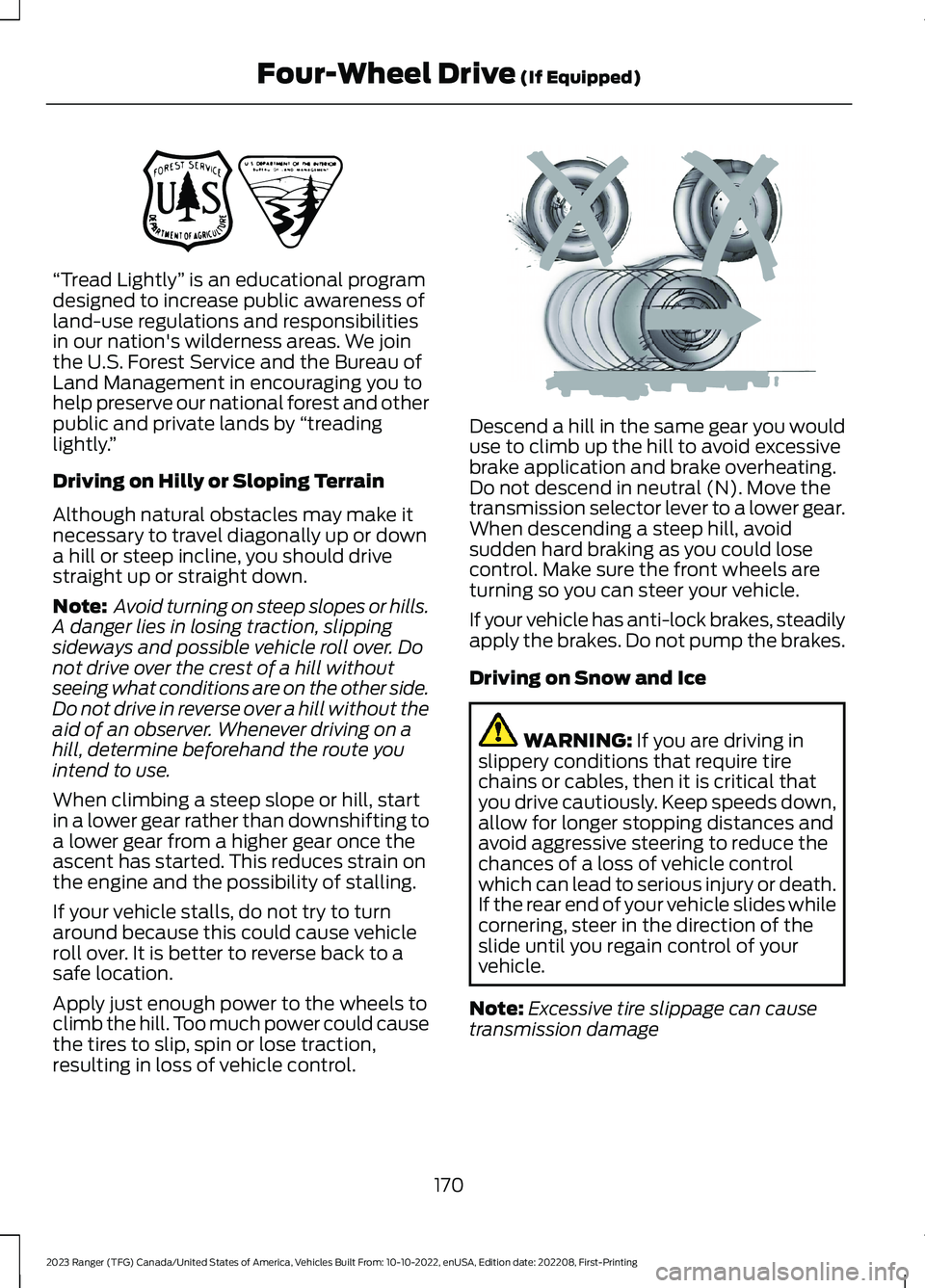
“Tread Lightly” is an educational programdesigned to increase public awareness ofland-use regulations and responsibilitiesin our nation's wilderness areas. We jointhe U.S. Forest Service and the Bureau ofLand Management in encouraging you tohelp preserve our national forest and otherpublic and private lands by “treadinglightly.”
Driving on Hilly or Sloping Terrain
Although natural obstacles may make itnecessary to travel diagonally up or downa hill or steep incline, you should drivestraight up or straight down.
Note: Avoid turning on steep slopes or hills.A danger lies in losing traction, slippingsideways and possible vehicle roll over. Donot drive over the crest of a hill withoutseeing what conditions are on the other side.Do not drive in reverse over a hill without theaid of an observer. Whenever driving on ahill, determine beforehand the route youintend to use.
When climbing a steep slope or hill, startin a lower gear rather than downshifting toa lower gear from a higher gear once theascent has started. This reduces strain onthe engine and the possibility of stalling.
If your vehicle stalls, do not try to turnaround because this could cause vehicleroll over. It is better to reverse back to asafe location.
Apply just enough power to the wheels toclimb the hill. Too much power could causethe tires to slip, spin or lose traction,resulting in loss of vehicle control.
Descend a hill in the same gear you woulduse to climb up the hill to avoid excessivebrake application and brake overheating.Do not descend in neutral (N). Move thetransmission selector lever to a lower gear.When descending a steep hill, avoidsudden hard braking as you could losecontrol. Make sure the front wheels areturning so you can steer your vehicle.
If your vehicle has anti-lock brakes, steadilyapply the brakes. Do not pump the brakes.
Driving on Snow and Ice
WARNING: If you are driving inslippery conditions that require tirechains or cables, then it is critical thatyou drive cautiously. Keep speeds down,allow for longer stopping distances andavoid aggressive steering to reduce thechances of a loss of vehicle controlwhich can lead to serious injury or death.If the rear end of your vehicle slides whilecornering, steer in the direction of theslide until you regain control of yourvehicle.
Note:Excessive tire slippage can causetransmission damage
170
2023 Ranger (TFG) Canada/United States of America, Vehicles Built From: 10-10-2022, enUSA, Edition date: 202208, First-PrintingFour-Wheel Drive (If Equipped)E143950 E143949
Page 175 of 470

Four-wheel drive vehicles have advantagesover two-wheel drive vehicles in snow andice but can skid like any other vehicle.Should you start to slide when driving onsnowy or icy roads, turn the steering wheelin the direction of the slide until you regaincontrol.
Avoid sudden applications of power andquick changes of direction on snow andice. Apply the accelerator slowly andsteadily when starting from a full stop.
Avoid sudden braking. Although afour-wheel drive vehicle may acceleratebetter than a two-wheel drive vehicle insnow and ice, it cannot stop any faster asbraking occurs at all four wheels. Do notbecome overconfident of road conditions.
Make sure you allow sufficient distancebetween you and other vehicles forstopping. Drive slower than usual andconsider using one of the lower gears. Inemergency stopping situations, apply thebrake steadily. Do not pump the brakepedal. See Hints on Driving WithAnti-Lock Brakes (page 175).
If Your Vehicle Gets Stuck In Mud orSnow
WARNING: Do not spin the wheelsat over 34 mph (55 km/h). The tires mayfail and injure a passenger or bystander.
If your vehicle gets stuck in mud or snow,you may rock it out by shifting betweenforward and reverse gears, stoppingbetween shifts in a steady pattern. Presslightly on the accelerator in each gear.
Note:Do not rock your vehicle if the engineis not at normal operating temperature,damage to the transmission could occur.
Note:Do not rock your vehicle for morethan a minute, damage to the transmissionand tires could occur or the engine couldoverheat.
Parking
WARNING: If the parking brake isfully released, but the brake warninglamp remains illuminated, the brakesmay not be working properly. Have yourvehicle checked as soon as possible.
WARNING: Apply the parkingbrake, shift into park (P), switch theignition off and remove the key beforeyou leave your vehicle. Failure to followthis instruction could result in personalinjury or death.
On four-wheel drive vehicles, when thetransfer case is in the neutral (N) position,the engine and transmission disconnectfrom the rest of the driveline. Therefore,your vehicle is free to roll even if theautomatic transmission is in park (P) orthe manual transmission is in gear. Do notleave your vehicle unattended with thetransfer case in the neutral (N) position.Fully set the parking brake and turn off theignition when leaving your vehicle.
Maintenance and Modifications
We designed and tested the suspensionand steering systems on your vehicle toprovide predictable performance whetherloaded or empty. For this reason, westrongly recommend that you do not makemodifications such as adding or removingparts that include lift kits or stabilizer bars,or by using replacement parts notequivalent to the original factoryequipment.
We recommend that you use caution whenyour vehicle has either a high load or devicesuch as ladders or luggage racks. Anymodifications to your vehicle that raise thecenter of gravity could cause your vehicleto roll over when there is a loss of vehiclecontrol.
171
2023 Ranger (TFG) Canada/United States of America, Vehicles Built From: 10-10-2022, enUSA, Edition date: 202208, First-PrintingFour-Wheel Drive (If Equipped)
Page 179 of 470
GENERAL INFORMATION
Note: Occasional brake noise is normal. Ifa metal-to-metal, continuous grinding orcontinuous squeal sound is present, thebrake linings may be worn-out and anauthorized dealer should check them. If thevehicle has continuous vibration or shudderin the steering wheel while braking, anauthorized dealer should check your vehicle.
Note: Brake dust may accumulate on thewheels, even under normal drivingconditions. Some dust is inevitable as thebrakes wear and does not contribute tobrake noise. See Cleaning the Wheels(page 289).
Wet brakes result in reduced brakingefficiency. Gently press the brake pedal afew times when driving from a car wash orstanding water to dry the brakes.
Brake Over Accelerator
In the event the accelerator pedalbecomes stuck or entrapped, apply steadyand firm pressure to the brake pedal toslow the vehicle and reduce engine power.If you experience this condition, apply thebrakes and bring your vehicle to a safestop. Switch the engine off, move thetransmission to park (P) and apply theparking brake. Inspect the acceleratorpedal and the area around it for any itemsor debris that may be obstructing itsmovement. If none are found and thecondition persists, have your vehicle towedto the nearest authorized dealer.
Emergency Brake Assist
Emergency brake assist detects when youbrake heavily by measuring the rate atwhich you press the brake pedal. Itprovides maximum braking efficiency aslong as you press the pedal. Emergencybrake assist can reduce stopping distancesin critical situations.
Anti-lock Brake System
This system helps you maintain steeringcontrol during emergency stops by keepingthe brakes from locking.
This lamp momentarilyilluminates when you switch theignition on. If the light does notilluminate during start up, remains on orflashes, the anti-lock braking system maybe disabled. Have the system checked byan authorized dealer. If the anti-lock brakesystem is disabled, normal braking is stilleffective.
See Warning Lamps and Indicators(page 92).
Note:Indicators vary depending on region.
This lamp also illuminatesmomentarily when you switchthe ignition on to confirm thelamp is functional. If it does notilluminate when you switch theignition on, or begins to flash atany time, have the system checked by anauthorized dealer. If the brake warninglamp illuminates with the parking brakereleased, have the system checkedimmediately.
HINTS ON DRIVING WITH
ANTI-LOCK BRAKES
The anti-lock brake system does noteliminate the risks when:
•You drive too closely to the vehicle infront of you.
•Your vehicle is hydroplaning.
•You take corners too fast.
•The road surface is poor.
175
2023 Ranger (TFG) Canada/United States of America, Vehicles Built From: 10-10-2022, enUSA, Edition date: 202208, First-PrintingBrakesE67020 E270480 E67024