2023 FORD BRONCO wiring
[x] Cancel search: wiringPage 18 of 642

App Requirements.......................................511
Accessing Apps.............................................511
Enabling Apps on an iOS Device............511
Enabling Apps on an Android Device..........................................................................511
Switching Apple CarPlay On and Off.........................................................................512
Switching Android Auto On and Off......512
Navigation
Connected Navigation...............................514
Accessing Navigation.................................514
Navigation Map Updates..........................514
Adjusting the Map.......................................514
Live Traffic......................................................514
Setting a Destination.................................515
Waypoints......................................................515
Route Guidance...........................................516
Vehicle Software Updates
Vehicle Software Updates........................517
Software Update Settings........................517
Software Update Indicators....................518
Vehicle System Reset
Performing a System Reset.....................519
Accessories
Accessories...................................................520
Auxiliary Switches
What Are the Auxiliary Switches...........522
Locating the Auxiliary Switches............522
Locating the Auxiliary Switch Wiring........................................................................522
Identifying the Auxiliary Switch Wiring -Excluding: Raptor...................................524
Identifying the Auxiliary Switch Wiring -Raptor.........................................................525
Ford Protect
What Is Ford Protect.................................526
Scheduled Maintenance
General Maintenance Information......528
Normal Scheduled Maintenance..........531
Special Operating Conditions ScheduledMaintenance............................................533
Customer Information
Rollover Warning........................................538
The Better Business Bureau Auto LineProgram - United States of America........................................................................538
The Mediation and Arbitration Program- Canada....................................................539
Ordering a Canadian French Owner'sManual.......................................................539
Reporting Safety Defects in the UnitedStates.........................................................540
Reporting Safety Defects in Canada.......................................................................540
Third Party Software CopyrightAcknowledgment...................................542
Radio Frequency Certification Labels........................................................................542
Perchlorate....................................................582
Replacement Parts Recommendation........................................................................582
Mobile Communications Equipment........................................................................583
Federal Highway AdministrationRegulation.................................................583
End User License Agreement................584
Emission Law..............................................609
Export Unique Options.............................610
Warranty Information................................610
Appendices
Electromagnetic Compatibility..............612
14
2023 Bronco (TG1) Canada/United States of America, enUSA, Edition date: 202208, DOMTable of Contents
Page 71 of 642
WHAT IS THE PERSONAL
SAFETY SYSTEM
An advanced safety system that protectsoccupants in frontal crashes.
HOW DOES THE PERSONAL
SAFETY SYSTEM WORK
This system provides an improved level offrontal crash protection to front seatoccupants and is designed to reduce therisk of airbag-related injuries. The systemanalyzes occupant conditions and crashseverity before activating the appropriatesafety devices. During a crash, therestraints control module may deploy theseatbelt pretensioners, and one or bothstages of the dual-stage airbags based oncrash severity and occupant conditions.
PERSONAL SAFETY SYSTEM
COMPONENTS
•Driver and passenger dual-stage airbagsupplemental restraints.
•Front seat outermost seatbelts withpretensioners, energy managementretractors and seatbelt usage sensors.
•Front passenger sensing system.
•Passenger airbag off and on indicators.
•Front crash severity sensors.
•Restraints control module with impactand safing sensors.
•Restraint system warning light andtone.
•The electrical wiring for the airbags,crash sensors, seatbelt pretensioners,front seatbelt usage sensors, frontpassenger sensing system andindicator lights.
67
2023 Bronco (TG1) Canada/United States of America, enUSA, Edition date: 202208, DOMPersonal Safety System™
Page 170 of 642

When you start the engine, it remainsrunning until you press the push buttonignition switch, even if your vehicle doesnot detect a valid passive key. If you openand close a door when the engine isrunning, the system searches for a validpassive key.
ENGINE BLOCK HEATER (IF
EQUIPPED)
ENGINE BLOCK HEATERPRECAUTIONS
WARNING: Failure to follow engineblock heater instructions could result inproperty damage or serious personalinjury.
WARNING: Do not use your heaterwith ungrounded electrical systems ortwo-pronged adapters. There is a risk ofelectrical shock.
WARNING: Do not fully close thehood, or allow it to drop under its ownweight when using the engine blockheater. This could damage the powercable and may cause an electrical shortresulting in fire, injury and propertydamage.
We recommend that you do the followingfor a safe and correct operation:
•Use a 16-gauge outdoor extension cordthat is product certified byUnderwriter’s Laboratory (UL) orCanadian Standards Association(CSA). This extension cord must besuitable for use outdoors, in cold
temperatures, and be clearly markedSuitable for Use with OutdoorAppliances. Do not use an indoorextension cord outdoors. This couldresult in an electric shock or become afire hazard.
•Use as short an extension cord aspossible.
•Do not use multiple extension cords.
•Make sure that when in operation, theextension cord plug and heater cordplug connections are free and clear ofwater. This could cause an electricshock or fire.
•If the block heater cord is under thehood, do not remove the wiring fromits original location. Do not close thehood on the extension wiring.
•Make sure your vehicle is parked in aclean area, clear of combustibles.
•Make sure the heater, heater cord andextension cord are firmly connected.
•Check for heat anywhere in theelectrical hookup once the system hasbeen operating for about 30 minutes.
•Make sure the system is unplugged andproperly stowed before starting anddriving your vehicle. Make sure theprotective cover seals the prongs of theblock heater cord plug when not in use.
•Make sure the heater system ischecked for proper operation beforewinter.
HOW DOES THE ENGINE BLOCKHEATER WORK
The engine block heater warms the enginecoolant. This allows the climate controlsystem to quickly respond. The equipmentincludes a heater element installed in theengine block and a wire harness. You canconnect the system to a grounded 110 voltAC electrical source.
166
2023 Bronco (TG1) Canada/United States of America, enUSA, Edition date: 202208, DOMStarting and Stopping the Engine
Page 309 of 642

CONNECTING A TRAILER
PRECAUTIONS
Do not tow a trailer until you drive yourvehicle at least 1,000 mi (1,600 km).
Consult your local motor vehicle laws fortowing a trailer.
See the instructions included with towingaccessories for the proper installation andadjustment specifications.
Service your vehicle more frequently if youtow a trailer. See Normal ScheduledMaintenance (page 531).
If you use a rental trailer, follow theinstructions the rental agency gives you.
When attaching the trailer wiring connectorto your vehicle, only use a proper fittingconnector that works with the vehicle andtrailer functions.
Account for the trailer coupler weight aspart of your vehicle load when calculatingthe total vehicle weight.
Do not exceed the load limits. SeeCalculating the Load Limit (page 298).
CONNECTING A TRAILER
Trailer Towing Connector (If Equipped)
When attaching the trailer wiring connectorto your vehicle, only use a proper fittingconnector that works with the vehicle andtrailer functions.
Trailer Lamps
WARNING: Never connect anytrailer lamp wiring to the vehicle's taillamp wiring; this may damage theelectrical system resulting in fire. Contactyour authorized dealer as soon aspossible for assistance in proper trailertow wiring installation. Additionalelectrical equipment may be required.
Most towed vehicles require trailer lamps.Make sure all running lights, brake lights,turn signals and hazard lights are working.
Safety Chains
Install trailer safety chains to the trailerhitch as recommended by themanufacturer. Cross the chains under thetrailer coupler and allow enough slack forturning tight corners. Do not allow thechains to drag on the ground.
Note:Do not attach safety chains to thebumper. Always connect the safety chainsto the frame or hook retainers of your trailerhitch.
305
2023 Bronco (TG1) Canada/United States of America, enUSA, Edition date: 202208, DOMConnecting a TrailerE163167 E265060
Page 314 of 642
•When stopped in congested or heavytraffic during hot weather, place thetransmission in park (P) to aid engineand transmission cooling and to helpA/C performance.
•Turn off the speed control with heavyloads or in hilly terrain. The speedcontrol may turn off when you aretowing on long, steep slopes.
•Shift to a lower gear when driving downa long or steep hill. Do not continuouslyapply the brakes, as they may overheatand become less effective.
•If your transmission has Grade Assistor Tow/Haul, use this feature whentowing. This provides engine brakingand helps eliminate excessivetransmission shifting for optimum fueleconomy and transmission cooling.
•Your vehicle has AdvanceTrac with rollstability control. When towing a trailer,additional loads could cause theAdvanceTrac system to engage duringcornering maneuvers. Reduce corneringspeeds to make sure that you canmaintain control of the vehicle andtrailer if the AdvanceTrac systemengages.
•Allow more distance for stopping witha trailer attached. Anticipate stops andgradually brake.
•Avoid parking on a slope. However, ifyou must park on a slope, turn thesteering wheel to point your vehicletires away from traffic flow, set theparking brake, place the transmissionin park (P) and place wheel chocks infront and back of the trailer wheels.
Note:Chocks are not included with yourvehicle.
LAUNCHING OR RETRIEVING
A BOAT OR PERSONAL
WATERCRAFT
When backing down a ramp during boatlaunching or retrieval:
•Do not allow the static water level torise above the bottom edge of the rearbumper.
•Do not allow waves to break higherthan 6 in (15 cm) above the bottomedge of the rear bumper.
Exceeding 6 in (15 cm) could allow waterto enter vehicle components, causinginternal damage to the components andaffecting driveability, emissions andreliability.
Note:Replace the rear axle lubricantanytime the rear axle has been submergedin water.
Note:Disconnect the trailer wiringconnector before backing the trailer into thewater.
Note:Reconnect the trailer wiringconnector after removing the trailer fromthe water.
310
2023 Bronco (TG1) Canada/United States of America, enUSA, Edition date: 202208, DOMTowing a Trailer
Page 382 of 642
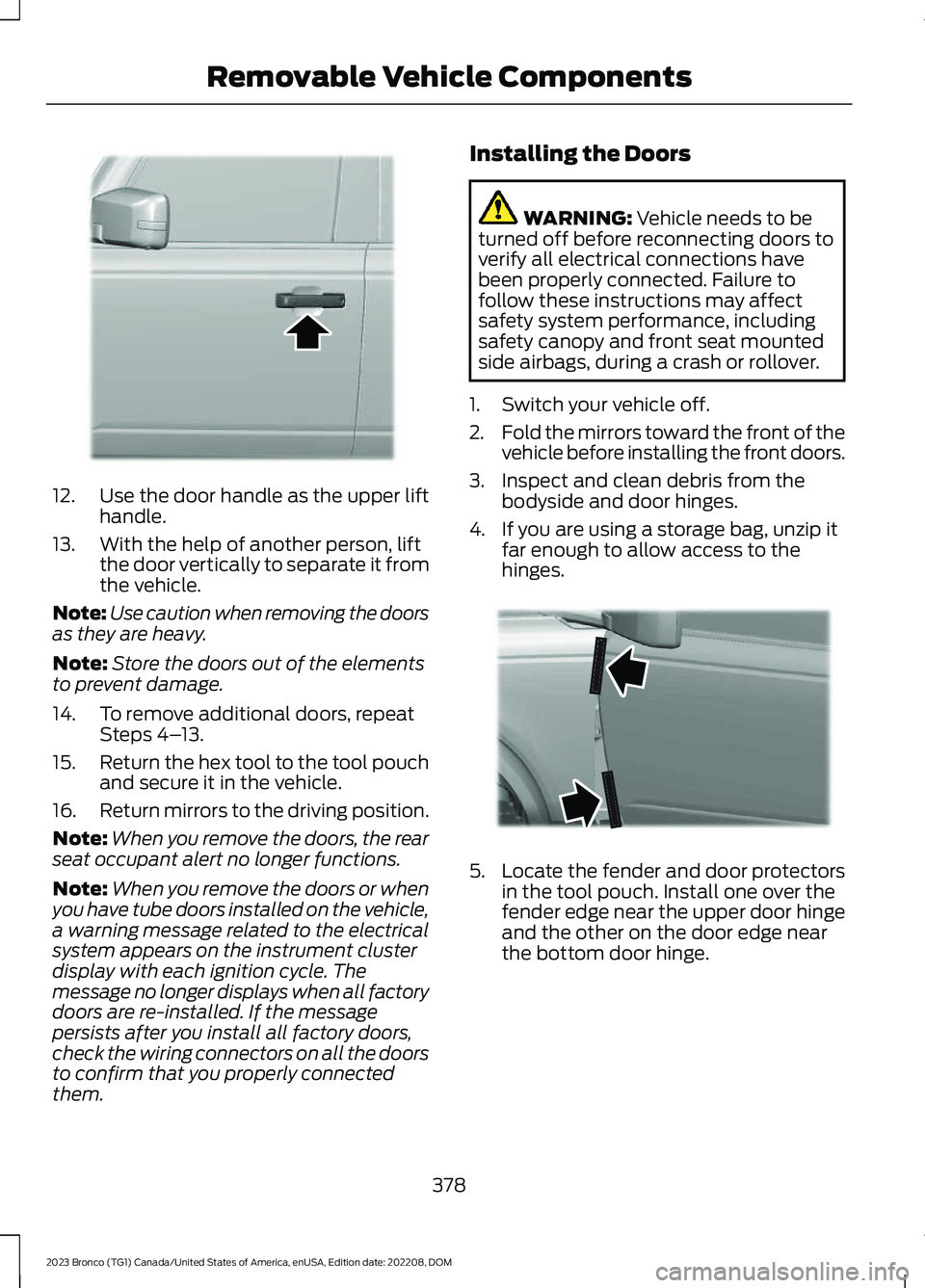
12.Use the door handle as the upper lifthandle.
13.With the help of another person, liftthe door vertically to separate it fromthe vehicle.
Note:Use caution when removing the doorsas they are heavy.
Note:Store the doors out of the elementsto prevent damage.
14.To remove additional doors, repeatSteps 4–13.
15.Return the hex tool to the tool pouchand secure it in the vehicle.
16.Return mirrors to the driving position.
Note:When you remove the doors, the rearseat occupant alert no longer functions.
Note:When you remove the doors or whenyou have tube doors installed on the vehicle,a warning message related to the electricalsystem appears on the instrument clusterdisplay with each ignition cycle. Themessage no longer displays when all factorydoors are re-installed. If the messagepersists after you install all factory doors,check the wiring connectors on all the doorsto confirm that you properly connectedthem.
Installing the Doors
WARNING: Vehicle needs to beturned off before reconnecting doors toverify all electrical connections havebeen properly connected. Failure tofollow these instructions may affectsafety system performance, includingsafety canopy and front seat mountedside airbags, during a crash or rollover.
1.Switch your vehicle off.
2.Fold the mirrors toward the front of thevehicle before installing the front doors.
3.Inspect and clean debris from thebodyside and door hinges.
4.If you are using a storage bag, unzip itfar enough to allow access to thehinges.
5.Locate the fender and door protectorsin the tool pouch. Install one over thefender edge near the upper door hingeand the other on the door edge nearthe bottom door hinge.
378
2023 Bronco (TG1) Canada/United States of America, enUSA, Edition date: 202208, DOMRemovable Vehicle ComponentsE346854 E347604
Page 383 of 642
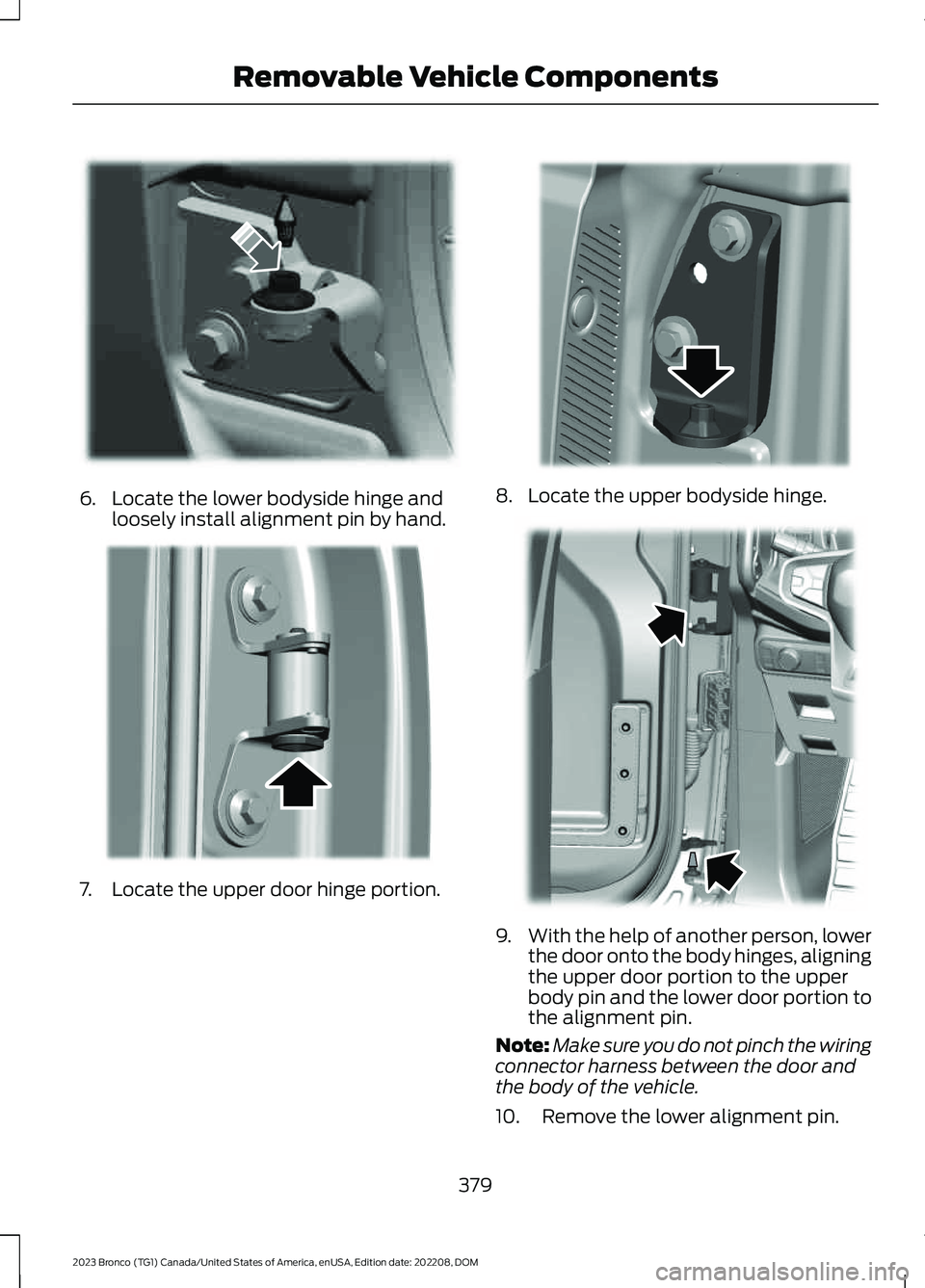
6.Locate the lower bodyside hinge andloosely install alignment pin by hand.
7.Locate the upper door hinge portion.
8.Locate the upper bodyside hinge.
9.With the help of another person, lowerthe door onto the body hinges, aligningthe upper door portion to the upperbody pin and the lower door portion tothe alignment pin.
Note:Make sure you do not pinch the wiringconnector harness between the door andthe body of the vehicle.
10.Remove the lower alignment pin.
379
2023 Bronco (TG1) Canada/United States of America, enUSA, Edition date: 202208, DOMRemovable Vehicle ComponentsE347537 E347540 E347538 E347242
Page 387 of 642

1.Loosen the upper and lower hingemounting bolts.
2.Add or remove shims as necessary toattain proper latch alignment, startwith no shims.
3.Tighten the upper and lower hingemounting bolts, but do not apply finaltorque.
4.Disengage the latch from the strikerand confirm proper alignment.
5.Tighten the upper and lower hingemounting bolts to 41 lb.ft (55 Nm).
Removing the Doors
WARNING: Removal of doors foroff-road use only. Removing the doorsfrom the vehicle will affect protectionprovided by the doors and may affectsafety system performance, includingsafety canopy and front seat mountedside airbags, during a crash or rollover.
1.Switch your vehicle off.
2.Fold the mirrors completely toward thefront of your vehicle before removingthe front doors.
3.Fully open the door you are removing.
4.Use the provided hex tool to loosenand remove the lower hinge bolt.
5.Loosen and remove the upper hingebolt.
Note:You can store the hinge bolts in thetool pouch zipped pocket, if needed.
6.Lift the door vertically to separate itfrom the vehicle.
Note:Use caution when removing the doorsas they are heavy.
Note:Store the doors in a secure area.
Note:Store the doors out of the elementsto prevent damage.
7.To remove additional doors, repeatSteps 3-6.
8.Return the hex tool to the tool kit andsecure the tool kit in the vehicle’scenter console.
9.Return the mirrors to the drivingposition.
Note:When you remove the doors, the rearseat occupant alert no longer functions.
Note:When you remove the doors or whenyou have tube doors installed on the vehicle,a warning message related to the electricalsystem appears on the instrument clusterdisplay with each ignition cycle. Themessage no longer displays when all factorydoors are re-installed. If the messagepersists after you install all factory doors,check the wiring connectors on all the doorsto confirm that you properly connectedthem.
Cleaning the Tube Doors
We recommend that you wash the tubedoors with mild soap and rinse with astandard pressure water hose. Whilerinsing, avoid spraying water directly ontothe latch mechanism. Dry with a microfibercloth or leave to air dry.
383
2023 Bronco (TG1) Canada/United States of America, enUSA, Edition date: 202208, DOMRemovable Vehicle ComponentsE344781