2023 DODGE HORNET torque
[x] Cancel search: torquePage 213 of 288
IN CASE OF EMERGENCY211
10. Lower the jack until it is free. Remove the wheel
blocks. Stow the wheel bolt wrench, jack assembly
and wheel blocks in the provided storage. Secure the
assembly using the means provided. Release the
parking brake before driving the vehicle.
Damaged Tire Stowage
11. After 25 miles (40 km), check the wheel bolt torque with a torque wrench to ensure that all wheel bolts
are properly seated against the wheel.
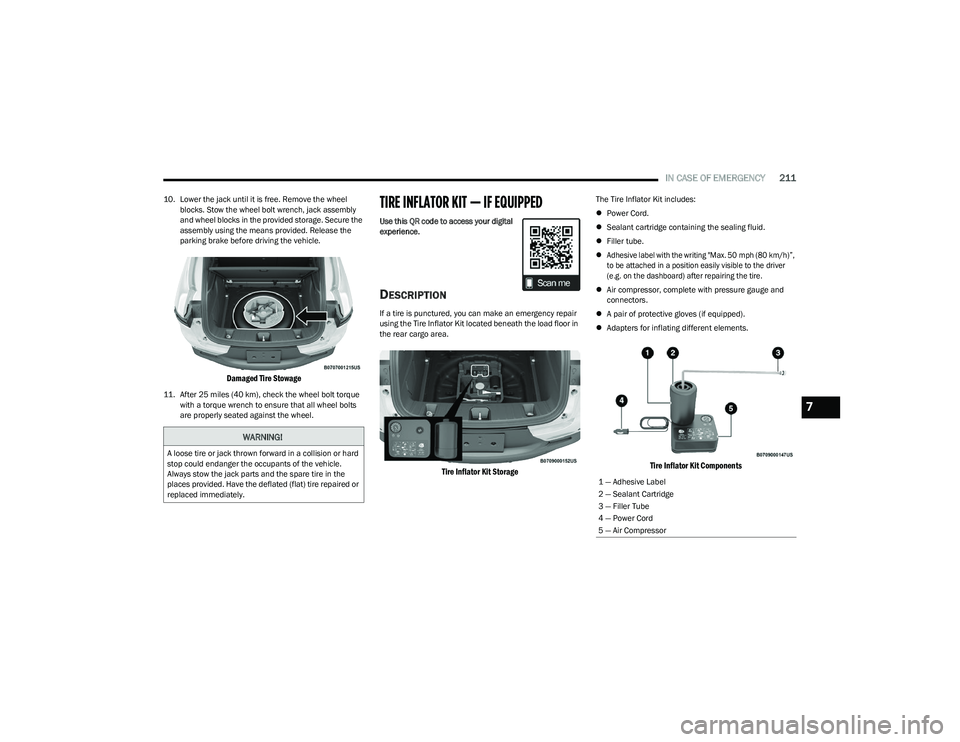
TIRE INFLATOR KIT — IF EQUIPPED
Use this QR code to access your digital
experience.
DESCRIPTION
If a tire is punctured, you can make an emergency repair
using the Tire Inflator Kit located beneath the load floor in
the rear cargo area.
Tire Inflator Kit Storage
The Tire Inflator Kit includes:
Power Cord.
Sealant cartridge containing the sealing fluid.
Filler tube.
Adhesive label with the writing "Max. 50 mph (80 km/h)”,
to be attached in a position easily visible to the driver
(e.g. on the dashboard) after repairing the tire.
Air compressor, complete with pressure gauge and
connectors.
A pair of protective gloves (if equipped).
Adapters for inflating different elements.
Tire Inflator Kit Components
WARNING!
A loose tire or jack thrown forward in a collision or hard
stop could endanger the occupants of the vehicle.
Always stow the jack parts and the spare tire in the
places provided. Have the deflated (flat) tire repaired or
replaced immediately.
1 — Adhesive Label
2 — Sealant Cartridge
3 — Filler Tube
4 — Power Cord
5 — Air Compressor
7
23_GG_OM_EN_USC_t.book Page 211
Page 239 of 288

SERVICING AND MAINTENANCE237
Fluid And Filter Changes
Under normal operating conditions, the fluid installed at
the factory will provide satisfactory lubrication for the life
of the vehicle.
Routine fluid and filter changes are not required. However,
change the fluid and filter if the fluid becomes
contaminated (with water, etc.), or if the transmission is
disassembled for any reason.
Selection Of Lubricant
It is important to use the proper transmission fluid to
ensure optimum transmission performance and life.
Use only the manufacturer specified transmission fluid
Úpage 269. It is important to maintain the transmission
fluid at the correct level using the recommended fluid.
NOTE:No chemical flushes should be used in any transmission;
only the approved lubricant should be used.
FUSES
General Information
The fuses protect electrical systems against excessive
current.
When a device does not work, you must check the fuse
element inside the blade fuse for a break/melt.
Also, please be aware that using power outlets for
extended periods of time with the engine off may result in
vehicle battery discharge.
Blade Fuses
CAUTION!
If a transmission fluid leak occurs, visit an authorized
dealer immediately. Severe transmission damage may
occur. An authorized dealer has the proper tools to
adjust the fluid level accurately.
CAUTION!
Using a transmission fluid other than the manufacturer
recommended fluid may cause deterioration in
transmission shift quality and/or torque converter
shudder. For fluid specifications
Úpage 269.
WARNING!
When replacing a blown fuse, always use an appro -
priate replacement fuse with the same amp rating as
the original fuse. Never replace a fuse with another
fuse of higher amp rating. Never replace a blown
fuse with metal wires or any other material. Do not
place a fuse inside a circuit breaker cavity or vice
versa. Failure to use proper fuses may result in
serious personal injury, fire and/or property damage.
Before replacing a fuse, make sure that the ignition
is off and that all the other services are switched off
and/or disengaged.
If the replaced fuse blows again, contact an autho -
rized dealer.
If a general protection fuse for safety systems
(air bag system, braking system), power unit systems
(engine system, transmission system) or steering
system blows, contact an authorized dealer.
1 — Fuse Element
2 — Blade Fuse with a good/functional fuse element
3 — Blade Fuse with a bad/not functional fuse element
(blown fuse)
8
23_GG_OM_EN_USC_t.book Page 237
Page 267 of 288

265
TECHNICAL SPECIFICATIONS
VEHICLE IDENTIFICATION NUMBER (VIN)
The VIN is found on the left front corner of the windshield
and is visible from outside of the vehicle.
Vehicle Identification Number
NOTE:
It is illegal to remove or alter the VIN.
BRAKE SYSTEM
Your vehicle is equipped with power assisted brakes as
standard equipment. In the event power assist is lost for
any reason (for example, repeated brake applications with
the engine off), the brakes will still function. However, the
effort required to brake the vehicle will be much greater
than that required with the power system operating. If either of the two hydraulic systems lose normal
capability, the remaining system will still function with
some loss of overall braking effectiveness. This will be
evident by increased pedal travel during application and
greater pedal force required to slow or stop. In addition, if
the malfunction is caused by an internal leak, as the brake
fluid in the master cylinder drops, the Brake Warning Light
will illuminate.
WHEEL AND TIRE TORQUE SPECIFICATIONS
Proper lug nut/bolt torque is very important to ensure that
the wheel is properly mounted to the vehicle. Any time a
wheel has been removed and reinstalled on the vehicle,
the lug nuts/bolts should be torqued using a properly
calibrated torque wrench using a six-sided (hex) deep wall
socket.
TORQUE SPECIFICATIONS
**Use only authorized dealer recommended lug nuts/
bolts and clean or remove any dirt or oil before tightening.
Inspect the wheel mounting surface prior to mounting the
tire and remove any corrosion or loose particles.
Wheel Mounting Surface
WARNING!
Driving a vehicle with the Brake Warning Light on is
dangerous. A significant decrease in braking
performance or vehicle stability during braking may
occur. It will take you longer to stop the vehicle or will
make your vehicle harder to control. You could have a
collision. Have the vehicle checked immediately.
Lug Nut/Bolt
Torque
**Lug Nut/Bolt
SizeLug Nut/Bolt
Socket Size
88.5 ft-lb
(120 N·m) M12 x 1.25 17 mm
9
23_GG_OM_EN_USC_t.book Page 265
Page 268 of 288

266TECHNICAL SPECIFICATIONS
First tighten the lug nuts/bolts in a star pattern until each
nut/bolt has been tightened to 14.7 ft-lb (20 N·m). Then
repeat the operation until each lug nut/bolt has been
tightened to 88.5 ft-lb (120 N·m). Ensure that the socket is
fully engaged on the lug nut/bolt (do not insert it halfway).
Torque Pattern
After 25 miles (40 km), check the lug nut/bolt torque to be
sure that all the lug nuts/bolts are properly tightened.
FUEL REQUIREMENTS
While operating on gasoline with the required octane
number, hearing a light knocking sound from the engine is
not a cause for concern. However, if the engine is
heard making a heavy knocking sound, see a dealer
immediately. Use of gasoline with a lower than
recommended octane number can cause engine failure
and may void or not be covered by the New Vehicle Limited
Warranty.
2.0L ENGINE
This engine is designed to meet all emissions
requirements, and provide satisfactory fuel
economy and performance, when using
high-quality unleaded regular gasoline
having an octane rating of 87, as specified by the
(R+M)/2 method. The use of 91 or higher octane premium
gasoline will allow these engines to operate to optimal
performance. This increase in performance is most
noticeable in hot weather or under heavy load conditions
such as while towing.
REFORMULATED GASOLINE
Many areas of the country require the use of
cleaner-burning gasoline referred to as “reformulated
gasoline”. Reformulated gasoline contains oxygenates
and are specifically blended to reduce vehicle emissions
and improve air quality. The use of reformulated gasoline is recommended.
Properly blended reformulated gasoline will provide
improved performance and durability of engine and fuel
system components.
GASOLINE/OXYGENATE BLENDS
Some fuel suppliers blend unleaded gasoline with
oxygenates such as ethanol.
Problems that result from using gasoline containing more
than 15% ethanol (E-15) or gasoline containing methanol
are not the responsibility of the manufacturer and may
void the New Vehicle Limited Warranty.
WARNING!
To avoid the risk of forcing the vehicle off the jack, do
not tighten the lug nuts/bolts fully until the vehicle has
been lowered. Failure to follow this warning may result
in personal injury.
CAUTION!
DO NOT use E-85, gasoline containing methanol, or
gasoline containing more than 15% ethanol (E-15).
Use of these blends may result in starting and
drivability problems, damage critical fuel system
components, cause emissions to exceed the applicable
standard, and/or cause the Malfunction Indicator Light
to illuminate. Please observe pump labels as they
should clearly communicate if a fuel contains greater
than 15% ethanol (E-15).
23_GG_OM_EN_USC_t.book Page 266
Page 285 of 288

283
Selection Of Coolant (Antifreeze) ................................ 269
Sentry Key (Immobilizer).................................................16
Service Assistance ....................................................... 270
Service Contract ........................................................... 272
Service Manuals........................................................... 274
Shift Lever Override ..................................................... 218
ShiftingAutomatic Transmission............................................86
Shoulder Belts .............................................................. 170
Side Distance Warning ................................................ 107
Side View Mirror Adjustment ................................... 34
, 35
Signals, Turn................................................... 42, 77, 201
Snow Chains (Tire Chains)........................................... 259
Snow Tires .................................................................... 257
Spare Tires ................................................................... 258
Specifications Fuel (Gasoline) ........................................................ 269Oil ............................................................................. 269
Speedometer...................................................................69
Starting ..................................................................... 18
, 80
Automatic Transmission............................................80
Button .........................................................................16
Cold Weather ............................................................. 81
Engine Fails To Start..................................................81
Remote ....................................................................... 18
Starting And Operating ...................................................80 Starting Procedures ........................................................80
Steering Tilt Column .................................................................26
Wheel, Heated ...........................................................26
Wheel, Tilt...................................................................26
Steering Wheel Audio Controls ................................... 150
Steering Wheel Mounted Sound System Controls..... 150
Storage ............................................................................50
Storage, Vehicle .............................................................. 50 Stuck, Freeing ............................................................... 219
Sun Roof ................................................................... 56
, 58
Sun Visor ......................................................................... 34
Supplemental Restraint System – Air Bag ..................176
Surround View Camera System ...................................117
Synthetic Engine Oil ...................................................... 228
System, Remote Starting ............................................... 18
TTelescoping Steering Column ........................................ 26
Temperature Control, Automatic (ATC) ......................... 49 Tie Down Hooks, Cargo .................................................. 64
Tilt Steering Column ....................................................... 26
Time Delay Headlight .................................................................... 41
Tire And Loading Information Placard ......................... 251
Tire Inflator Kit — If Equipped
b
................................ 211
Tire Markings ................................................................ 246
Tire Safety Information................................................. 246
Tire Service Kit .............................................................. 211
Tires ................................................... 201
, 254, 258, 260
Aging (Life Of Tires) ................................................. 256
Air Pressure.............................................................. 254
Chains ...................................................................... 259
Changing .................................................................. 206
Compact Spare ........................................................ 258
General Information ...................................... 254
, 258
High Speed .............................................................. 255
Inflation Pressure ....................................................254 Jacking .....................................................................206
Life Of Tires .............................................................. 256
Load Capacity .......................................................... 251
Pressure Monitoring System (TPMS) ..............75
, 165
Quality Grading ........................................................ 260 Radial ....................................................................... 255
Replacement ........................................................... 256
Rotation ................................................................... 260
Safety .............................................................. 246
, 254
Sizes......................................................................... 247
Snow Tires ............................................................... 257 Spare Tires .............................................................. 258Spinning ................................................................... 255
Trailer Towing .......................................................... 124
Tread Wear Indicators ............................................ 256
Wheel Nut Torque ................................................... 265
To Open Hood ................................................................. 58
Tongue Weight/Trailer Weight..................................... 123
Towing ........................................................................... 121 Disabled Vehicle...................................................... 220
Guide........................................................................ 122
Recreational ............................................................ 126
Weight ...................................................................... 122
Towing Behind A Motorhome ...................................... 126
Towing Eyes .................................................................. 221
Traction ......................................................................... 127
Traction Control ...................................................157
, 158
Traffic Sign Recognition System............................. 76, 99
Trailer Towing ............................................................... 121 Minimum Requirements ......................................... 123Tips........................................................................... 125
Trailer And Tongue Weight ..................................... 123
Wiring ....................................................................... 124
Trailer Towing Guide .................................................... 122
Trailer Weight................................................................ 122
Transaxle Automatic .................................................................. 85
Operation ................................................................... 85
Transfer Case Fluid ......................................................................... 269
11
23_GG_OM_EN_USC_t.book Page 283