2023 CHEVROLET SILVERADO 1500 exhaust tip
[x] Cancel search: exhaust tipPage 202 of 463
Chevrolet Silverado 1500 Owner Manual (GMNA-Localizing-U.S./Canada/
Mexico/Paraguay-16515119) - 2023 - CRC - 6/2/22
Driving and Operating 201
Caution
Do not drive through standing water if it
is deep enough to cover the wheel hubs,
axles, or exhaust pipe. Deep water can
damage the axle and other vehicle parts.
If the standing water is not too deep, drive
through it slowly. At faster speeds, water
can get into the engine and cause it to stall.
Stalling can occur if the exhaust pipe is
under water. Do not turn off the ignition
when driving through water. If the exhaust
pipe is under water, the engine will not
start. When going through water, the brakes
get wet and it may take longer to stop. See
“Driving on Wet Roads” later in this section.
After Off-Road Driving
Remove any brush or debris that has
collected on the underbody or chassis,
or under the hood. These accumulations can
be a fire hazard. Reinstall underbody air
deflector and air dam if removed.
After operation in mud or sand, have the
brake linings cleaned and checked. These
substances can cause glazing and uneven
braking. Check the body structure, driveline,
steering, suspension, wheels, tires, and exhaust system for damage and check the
fuel lines and cooling system for any
leakage.
More frequent maintenance service is
required. See the
Maintenance Schedule
0 417.
Driving on Wet Roads
Rain and wet roads can reduce vehicle
traction and affect your ability to stop and
accelerate. Always drive slower in these
types of driving conditions and avoid driving
through large puddles and deep-standing or
flowing water.
{Warning
Wet brakes can cause crashes. They
might not work as well in a quick stop
and could cause pulling to one side. You
could lose control of the vehicle.
After driving through a large puddle of
water or a car/vehicle wash, lightly apply
the brake pedal until the brakes work
normally.
(Continued)
Warning (Continued)
Flowing or rushing water creates strong
forces. Driving through flowing water
could cause the vehicle to be carried
away. If this happens, you and other
vehicle occupants could drown. Do not
ignore police warnings and be very
cautious about trying to drive through
flowing water.
Hydroplaning
Hydroplaning is dangerous. Water can build
up under the vehicle's tires so they actually
ride on the water. This can happen if the
road is wet enough and you are going fast
enough. When the vehicle is hydroplaning, it
has little or no contact with the road.
There is no hard and fast rule about
hydroplaning. The best advice is to slow
down when the road is wet.
Other Rainy Weather Tips
Besides slowing down, other wet weather
driving tips include:
.Allow extra following distance.
.Pass with caution.
Page 220 of 463
Chevrolet Silverado 1500 Owner Manual (GMNA-Localizing-U.S./Canada/
Mexico/Paraguay-16515119) - 2023 - CRC - 6/2/22
Driving and Operating 219
5. The P indicator will turn white and thegear indicator on the shift lever will turn
red when the vehicle is no longer in
P (Park).
6. After releasing the shift lever, it will return to the center position.
If equipped, the Buckle to Drive feature may
prevent shifting from P (Park). See Buckle To
Drive 053.
If the vehicle cannot shift from P (Park), a
Driver Information Center (DIC) message
may be displayed. Ensure the engine is
running, the brake pedal is applied, and the
shift lock release button is pressed when
you are attempting to shift out of P (Park).
If all of these conditions are met but the
vehicle will not shift out of P (Park), see
your dealer for service.
Parking over Things That Burn
{Warning
Things that can burn could touch hot
exhaust parts under the vehicle and
ignite. Do not park over papers, leaves,
dry grass, or other things that can burn.
Active Fuel Management
If equipped, Active Fuel Management allows
a V8, V6, or L4 gasoline engine to operate
on either all of its cylinders, or a reduced
number of cylinders, depending on the
driving conditions. When less power is
required, such as cruising at a constant
vehicle speed, the system will enable
reduced cylinder operation, allowing the
vehicle to achieve better fuel economy.
When greater power is required, such as
accelerating from a stop, passing,
or merging onto a freeway, the system will
maintain full-cylinder operation.
Dynamic Fuel Management
If equipped, Dynamic Fuel Management
calculates the number of cylinders needed to
maximize fuel economy and meet the
driving demands. Dynamic Fuel Management
allows the engine to operate in multiple
possible configurations ranging from
zero-cylinder up to the full 8-cylinder
operation.
Extended Parking
It is best not to park with the vehicle
running. If the vehicle is left running, be
sure it will not move and there is adequate
ventilation.
See Shifting Into Park (Mechanical Shifter)
0 216 orShifting Into Park (Electronic Shifter)
0 217 and Engine Exhaust 0220.
If the vehicle is left parked and running with
the remote key outside the vehicle, it will
continue to run for up to 15 minutes.
If the vehicle is left parked and running with
the remote key inside the vehicle, it will
continue to run for up to 30 minutes.
The vehicle could turn off sooner if it is
parked on a hill, due to lack of
available fuel.
The timer will reset if the vehicle is taken
out of P (Park) while it is running.
When the vehicle was produced, it came
with the auto-shutdown feature enabled.
If you are not the primary owner of your
vehicle, please note that this feature may
have been disabled by a previous owner.
The vehicle owners can have this feature
re-enabled at owner cost at any GM service
center.
Page 221 of 463
Chevrolet Silverado 1500 Owner Manual (GMNA-Localizing-U.S./Canada/
Mexico/Paraguay-16515119) - 2023 - CRC - 6/2/22
220 Driving and Operating
Engine Exhaust{
Warning
Engine exhaust contains carbon monoxide
(CO), which cannot be seen or smelled.
Exposure to CO can cause
unconsciousness and even death.
Exhaust may enter the vehicle if:
.The vehicle idles in areas with poor
ventilation (parking garages, tunnels,
deep snow that may block underbody
airflow or tail pipes).
.The exhaust smells or sounds strange
or different.
.The exhaust system leaks due to
corrosion or damage.
.The vehicle exhaust system has been
modified, damaged, or improperly
repaired.
.There are holes or openings in the
vehicle body from damage or
aftermarket modifications that are not
completely sealed. (Continued)
Warning (Continued)
If unusual fumes are detected or if it is
suspected that exhaust is coming into the
vehicle:
.Drive it only with the windows
completely down.
.Have the vehicle repaired immediately.
Never park the vehicle with the engine
running in an enclosed area such as a
garage or a building that has no fresh air
ventilation.
Running the Vehicle While Parked
It is better not to park with the engine
running.
If the vehicle is left with the engine running,
follow the proper steps to be sure the
vehicle will not move. See Shifting Into Park
(Mechanical Shifter) 0216 or
Shifting Into Park (Electronic Shifter) 0217
and
Engine Exhaust 0220.
If parking on a hill and pulling a trailer, see
Driving Characteristics and Towing Tips
0 299.
Automatic Transmission
Automatic Transmission
(Mechanical Shifter)
There is an electronic shift lever position
indicator within the instrument cluster. This
display illuminates when the vehicle is on.
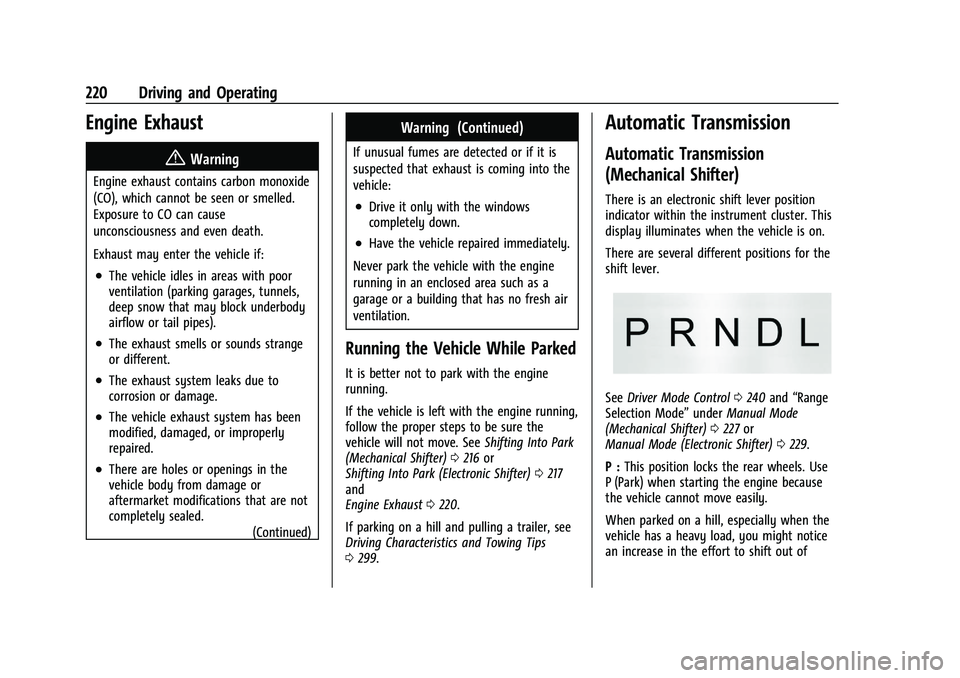
There are several different positions for the
shift lever.
See Driver Mode Control 0240 and “Range
Selection Mode” underManual Mode
(Mechanical Shifter) 0227 or
Manual Mode (Electronic Shifter) 0229.
P : This position locks the rear wheels. Use
P (Park) when starting the engine because
the vehicle cannot move easily.
When parked on a hill, especially when the
vehicle has a heavy load, you might notice
an increase in the effort to shift out of
Page 453 of 463
Chevrolet Silverado 1500 Owner Manual (GMNA-Localizing-U.S./Canada/-
Mexico/Paraguay-16515119) - 2023 - CRC - 6/2/22
452 Index
DiagnosticsConnected Services . . . . . . . . . . . . . . . . . . . . 448
Differential, Limited-Slip . . . . . . . . . . . . . . . . . 243
Disabled Vehicle Transporting . . . . . . . . . . . . . . . . . . . . . . . . . . . 402
Distracted Driving . . . . . . . . . . . . . . . . . . . . . . . . 195
Dome Lamps . . . . . . . . . . . . . . . . . . . . . . . . . . . . . 144
Door Ajar Light . . . . . . . . . . . . . . . . . . . . . . . . . . . . . . 126
Delayed Locking . . . . . . . . . . . . . . . . . . . . . . . . 20
Locks . . . . . . . . . . . . . . . . . . . . . . . . . . . . . . . . . . . 19
Power Locks . . . . . . . . . . . . . . . . . . . . . . . . . . . . 20
Drive Belt Routing, Engine . . . . . . . . . . . . . . . 429
Drive Systems Four-Wheel Drive . . . . . . . . . . . . . . . . . . . . . . 353
Driver
Assistance Systems . . . . . . . . . . . . . . . . . . . . 272
Information Center (DIC) . . . . . . . . . . . 126, 127
Mode Control . . . . . . . . . . . . . . . . . . . . . . . . . . 240
Mode Control Light . . . . . . . . . . . . . . . . . . . . 122
Teen . . . . . . . . . . . . . . . . . . . . . . . . . . . . . . . . . . . 179
Driving Assistance Systems . . . . . . . . . . . . . . . . . . . . 284
Better Fuel Economy . . . . . . . . . . . . . . . . . . . 194
Characteristics and Towing Tips . . . . . . . . 299
Defensive . . . . . . . . . . . . . . . . . . . . . . . . . . . . . . 195
Distracted . . . . . . . . . . . . . . . . . . . . . . . . . . . . . 195
Hill and Mountain Roads . . . . . . . . . . . . . . 202 Driving (cont'd)
If the Vehicle is Stuck . . . . . . . . . . . . . . . . . 203
Impaired . . . . . . . . . . . . . . . . . . . . . . . . . . . . . . . 195
Loss of Control . . . . . . . . . . . . . . . . . . . . . . . . 197
Off-Road . . . . . . . . . . . . . . . . . . . . . . . . . . . . . . . 197
Off-Road Recovery . . . . . . . . . . . . . . . . . . . . . 197
Vehicle Load Limits . . . . . . . . . . . . . . . . . . . . 204
Wet Roads . . . . . . . . . . . . . . . . . . . . . . . . . . . . . 201
Winter . . . . . . . . . . . . . . . . . . . . . . . . . . . . . . . . . 202
Dual Automatic Climate Control System . . . . 187
E
ElectricBrake Boost . . . . . . . . . . . . . . . . . . . . . . . . . . . . 234
Parking Brake . . . . . . . . . . . . . . . . . . . . . . . . . . 235
Parking Brake Light . . . . . . . . . . . . . . . . . . . . . 118
Electrical Equipment, Add-On . . . . . . . . . . . . . . . . . . . . 328
System Overload . . . . . . . . . . . . . . . . . . . . . . 360
Electrical System Engine Compartment Fuse Block . . . . . . . 362
Fuses and Circuit Breakers . . . . . . . . . . . . . 361
Instrument Panel Fuse Block . . . . . . 365, 367
Emergency OnStar . . . . . . . . . . . . . . . . . . . . . . . . . . . . . . . . . 442
Engine Air Cleaner/Filter . . . . . . . . . . . . . . . . . . . . . . 341 Engine (cont'd)
Air Filter Life System . . . . . . . . . . . . . . . . . . 341
Check Light (Malfunction Indicator) . . . . . 116
Compartment Overview . . . . . . . . . . . . . . . . 335
Coolant Temperature Gauge . . . . . . . . . . . . 112
Coolant Temperature Warning Light . . . 122
Cooling System . . . . . . . . . . . . . . . . . . . . . . . . 343
Drive Belt Routing . . . . . . . . . . . . . . . . . . . . . 429
Exhaust . . . . . . . . . . . . . . . . . . . . . . . . . . . . . . . . 220
Fan . . . . . . . . . . . . . . . . . . . . . . . . . . . . . . . . . . . . 348
Heater . . . . . . . . . . . . . . . . . . . . . . . . . . . . . . . . . 214
Oil Life System . . . . . . . . . . . . . . . . . . . . . . . . 340
Oil Pressure Gauge . . . . . . . . . . . . . . . . . . . . . 111
Oil Pressure Light . . . . . . . . . . . . . . . . . . . . . . 123
Overheated Protection
Operating Mode . . . . . . . . . . . . . . . . . . . . . 347
Overheating . . . . . . . . . . . . . . . . . . . . . . . . . . . 346
Power Messages . . . . . . . . . . . . . . . . . . . . . . . 133
Running While Parked . . . . . . . . . . . . . . . . . 220
Starting . . . . . . . . . . . . . . . . . . . . . . . . . . . . . . . . 213
Entry Lighting . . . . . . . . . . . . . . . . . . . . . . . . . . . .145
Equipment, Towing . . . . . . . . . . . . . . . . . . . . . . 307
Event Data Recorders . . . . . . . . . . . . . . . . . . . . 440
Exit Lighting . . . . . . . . . . . . . . . . . . . . . . . . . . . . . .145
Extended Mirrors . . . . . . . . . . . . . . . . . . . . . . . . . .32
Extended Parking . . . . . . . . . . . . . . . . . . . . . . . . 219
Extender, Seat Belt . . . . . . . . . . . . . . . . . . . . . . . 58