2023 CHEVROLET BOLT EV engine
[x] Cancel search: enginePage 240 of 308

Chevrolet BOLT EV Owner Manual (GMNA-Localizing-U.S./Canada-
16404388) - 2023 - CRC - 3/7/22
Vehicle Care 239
for a tire's traction, temperature, and
treadwear. Ratings are determined by
tire manufacturers using government
testing procedures. The ratings are
molded into the sidewall of the tire.
SeeUniform Tire Quality Grading 0247.
Vehicle Capacity Weight
:The number
of designated seating positions
multiplied by 68 kg (150 lbs) plus the
rated cargo load. See Vehicle Load
Limits 0158.
Vehicle Maximum Load on the Tire
:
Load on an individual tire due to curb
weight, accessory weight, occupant
weight, and cargo weight.
Vehicle Placard
:A label permanently
attached to a vehicle showing the
vehicle's capacity weight and the
original equipment tire size and
recommended inflation pressure. See
“Tire and Loading Information Label”
under Vehicle Load Limits 0158.
Tire Pressure
Tires need the correct amount of air
pressure to operate effectively.
{Warning
Neither tire underinflation nor
overinflation is good. Underinflated
tires, or tires that do not have
enough air, can result in:
.Tire overloading and overheating,
which could lead to a blowout
.Premature or irregular wear
.Poor handling
.Reduced fuel economy for
internal combustion engine
vehicles
.Reduced range for electric vehicles
Overinflated tires, or tires that have
too much air, can result in:
.Unusual wear
.Poor handling
.Rough ride
.Needless damage from road
hazards The Tire and Loading Information label
on the vehicle indicates the original
equipment tires and the correct cold
tire inflation pressures. The
recommended pressure is the minimum
air pressure needed to support the
vehicle's maximum load carrying
capacity. See
Vehicle Load Limits 0158.
How the vehicle is loaded affects
vehicle handling and ride comfort.
Never load the vehicle with more
weight than it was designed to carry.
When to Check
Check the pressure of the tires once a
month or more.
How to Check
Use a good quality pocket-type gauge
to check tire pressure. Proper tire
inflation cannot be determined by
looking at the tire. Check the tire
inflation pressure when the tires are
cold, meaning the vehicle has not been
driven for at least three hours or no
more than 1.6 km (1 mi).
Page 260 of 308

Chevrolet BOLT EV Owner Manual (GMNA-Localizing-U.S./Canada-
16404388) - 2023 - CRC - 3/7/22
Vehicle Care 259
Contact a professional towing service if the
disabled vehicle must be transported. GM
recommends a flatbed tow truck to
transport a disabled vehicle. Use ramps to
help reduce approach angles, if necessary.
If equipped, a tow eye may be located near
the spare tire or emergency jack. Do not use
the tow eye to pull the vehicle from the
snow, mud, sand, or ditch. Tow eye threads
may have right or left-hand threads. Use
caution when installing or removing the
tow eye.
The vehicle must be in N (Neutral) and the
electric parking brake must be released
when loading the vehicle onto a flatbed tow
truck.
.If the vehicle is equipped with car wash
mode and has 12-volt battery power, refer
to“Car Wash Mode” underElectric Drive
Unit 0165 to place the vehicle in
N (Neutral).
.If the 12-volt battery is dead and/or the
engine will not start, the vehicle will not
move. Try to jump start the vehicle. Refer
to Jump Starting - North America 0256
and if the jump start is successful, retry
the “Car Wash Mode” procedure.
.If jump starting is unsuccessful, the
vehicle will not move. Tire skates or
dollies must be used under the non-rolling
tires to prevent vehicle damage.
Front Tow Eye Attachment Point
Carefully open the cover in the fascia by
using the small notch that conceals the tow
eye socket.
Install the tow eye into the socket and turn
it until it is fully tightened. When the tow
eye is removed, reinstall the cover with the
notch in the original position.
Page 277 of 308
Chevrolet BOLT EV Owner Manual (GMNA-Localizing-U.S./Canada-
16404388) - 2023 - CRC - 3/7/22
276 Technical Data
Technical Data
Vehicle Identification
Vehicle Identification Number (VIN) . . . 276
Service Parts Identification . . . . . . . . . . . . 276
Vehicle Data
Capacities and Specifications . . . . . . . . . . . 277
Vehicle Identification
Vehicle Identification
Number (VIN)
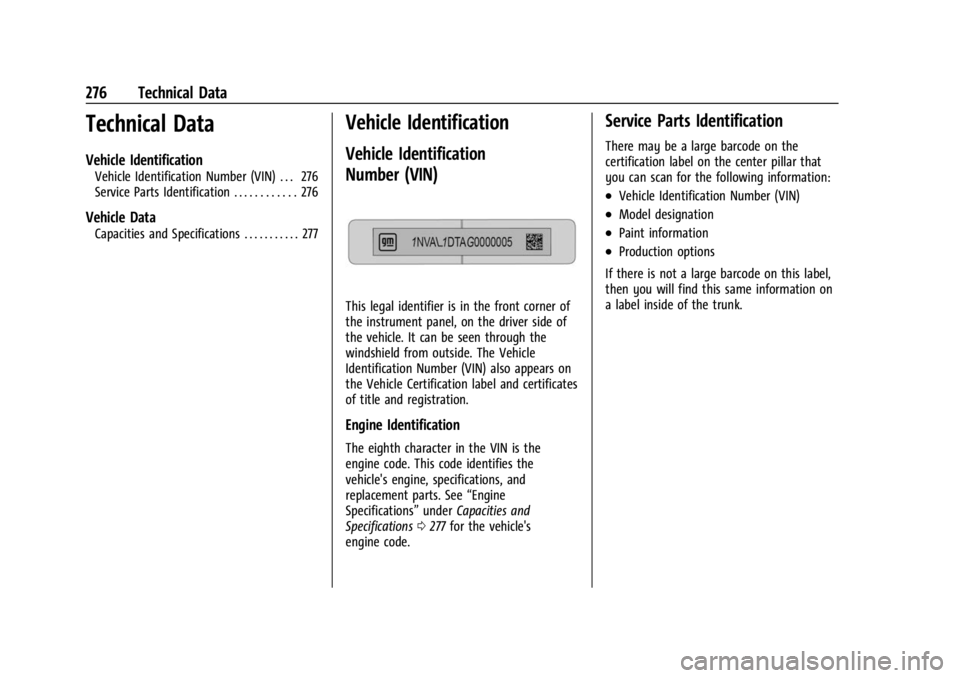
This legal identifier is in the front corner of
the instrument panel, on the driver side of
the vehicle. It can be seen through the
windshield from outside. The Vehicle
Identification Number (VIN) also appears on
the Vehicle Certification label and certificates
of title and registration.
Engine Identification
The eighth character in the VIN is the
engine code. This code identifies the
vehicle's engine, specifications, and
replacement parts. See“Engine
Specifications” underCapacities and
Specifications 0277 for the vehicle's
engine code.
Service Parts Identification
There may be a large barcode on the
certification label on the center pillar that
you can scan for the following information:
.Vehicle Identification Number (VIN)
.Model designation
.Paint information
.Production options
If there is not a large barcode on this label,
then you will find this same information on
a label inside of the trunk.
Page 286 of 308

Chevrolet BOLT EV Owner Manual (GMNA-Localizing-U.S./Canada-
16404388) - 2023 - CRC - 3/7/22
Customer Information 285
Choose a reputable repair facility that uses
quality replacement parts. See“Collision
Parts” earlier in this section.
In a crash, the sensing system may shut
down the high voltage system. See Battery -
North America 0220 for important safety
information. If an airbag has inflated, see
What Will You See after an Airbag Inflates?
0 42.
If the vehicle is damaged from a crash,
flood, fire, or other event it may be
necessary to have the vehicle inspected. See
Battery - North America 0220 for important
safety information.
Managing the Vehicle Damage Repair
Process
In the event that the vehicle requires
damage repairs, GM recommends that you
take an active role in its repair. If you have
a pre-determined repair facility of choice,
take the vehicle there, or have it towed
there. Specify to the facility that any
required replacement collision parts be
original equipment parts, either new
Genuine GM parts or recycled original GM
parts. Remember, recycled parts will not be
covered by the GM vehicle warranty. Insurance pays the bill for the repair, but
you must live with the repair. Depending on
your policy limits, your insurance company
may initially value the repair using
aftermarket parts. Discuss this with the
repair professional, and insist on Genuine
GM parts. Remember, if the vehicle is
leased, you may be obligated to have the
vehicle repaired with Genuine GM parts,
even if your insurance coverage does not
pay the full cost.
If another party's insurance company is
paying for the repairs, you are not obligated
to accept a repair valuation based on that
insurance company's collision policy repair
limits, as you have no contractual limits
with that company. In such cases, you can
have control of the repair and parts choices
as long as the cost stays within reasonable
limits.
Publication Ordering Information
Service Manuals
Service manuals have the diagnosis and
repair information on the engine/propulsion,
transmission, axle, suspension, brakes,
electrical system, steering system, body, etc.
Customer Literature
Owner’s manuals are written specifically for
owners and are intended to provide basic
operational information about the vehicle.
The owner’s manual includes the
Maintenance Schedule for all models.
Customer literature publications available for
purchase include owner’s manuals, warranty
manuals, and portfolios. Portfolios include an
owner’s manual, warranty manual,
if applicable, and zip lock bag or pouch.
Current and Past Models
Service manuals and customer literature are
available for many current and past model
year GM vehicles.
To order, call 1-800-551-4123 Monday–Friday,
8:00 a.m.–6:00 p.m. Eastern Time
For credit card orders only (VISA,
MasterCard, or Discover), see Helm, Inc. at:
www.helminc.com.
To order by mail, write to:
Helm, Incorporated
Attention: Customer Service
47911 Halyard Drive
Plymouth, MI 48170
Make checks payable in U.S. funds.
Page 301 of 308

Chevrolet BOLT EV Owner Manual (GMNA-Localizing-U.S./Canada-
16404388) - 2023 - CRC - 3/7/22
300 Index
Driving (cont'd)One-Pedal . . . . . . . . . . . . . . . . . . . . . . . . . . . . . . 167
Vehicle Load Limits . . . . . . . . . . . . . . . . . . . . 158
Wet Roads . . . . . . . . . . . . . . . . . . . . . . . . . . . . . 156
Winter . . . . . . . . . . . . . . . . . . . . . . . . . . . . . . . . . . 157
Driving for Better Energy Efficiency . . . . . . . 152
E
Electric Drive Unit . . . . . . . . . . . . . . . . . . . . . . . . . . . . . 165
Parking Brake . . . . . . . . . . . . . . . . . . . . . . . . . . 168
Parking Brake Light . . . . . . . . . . . . . . . . . . . . . 85
Electrical Equipment, Add-On . . . . . . . . . . . . . . . . . . . . . 211
Requirements for Battery Charging . . . . 210
System Overload . . . . . . . . . . . . . . . . . . . . . . 227
Electrical System
Fuses and Circuit Breakers . . . . . . . . . . . . . 229
Instrument Panel Fuse Block . . . . . . . . . . . 232
Emergency OnStar . . . . . . . . . . . . . . . . . . . . . . . . . . . . . . . . . 290
Energy Efficiency
Driving . . . . . . . . . . . . . . . . . . . . . . . . . . . . . . . . 152
Energy Information . . . . . . . . . . . . . . . . . . . . . . . 97
Engine Cooling System . . . . . . . . . . . . . . . . . . . . . . . . . 217
Entry Lighting . . . . . . . . . . . . . . . . . . . . . . . . . . . 107
Event Data Recorders . . . . . . . . . . . . . . . . . . . . 287 Exit Lighting . . . . . . . . . . . . . . . . . . . . . . . . . . . . . 108
Extended Parking . . . . . . . . . . . . . . . . . . . . . . . . 164
Extender, Seat Belt . . . . . . . . . . . . . . . . . . . . . . . .37
Exterior
Lamp Controls . . . . . . . . . . . . . . . . . . . . . . . . . 103
Lamps Off Reminder . . . . . . . . . . . . . . . . . . . 104
Lighting Battery Saver . . . . . . . . . . . . . . . . . 109F
Flash-to-Pass . . . . . . . . . . . . . . . . . . . . . . . . . . . . . 105
Flashers, Hazard Warning . . . . . . . . . . . . . . . . 106
Flat Tire . . . . . . . . . . . . . . . . . . . . . . . . . . . . . . . . . 249
Floor Mats . . . . . . . . . . . . . . . . . . . . . . . . . . . . . . . 268
FluidBrakes . . . . . . . . . . . . . . . . . . . . . . . . . . . . . . . . . 219
Washer . . . . . . . . . . . . . . . . . . . . . . . . . . . . . . . . 218
Folding Mirrors . . . . . . . . . . . . . . . . . . . . . . . . . . . . 21
Forward
Collision Alert (FCA) System . . . . . . . . . . . 189
Frequency Statement Radio . . . . . . . . . . . . . . . . . . . . . . . . . . . . . . . . . . 286
Front Heated Seats . . . . . . . . . . . . . . . . . . . . . . . . . . . 29
Pedestrian Braking (FPB) System . . . . . . . . 191
Front Seats Adjustment . . . . . . . . . . . . . . . . . . . . . . . . . . . . . 27
Fuses Fuses and Circuit Breakers . . . . . . . . . . . . . 229 Fuses (cont'd)
Instrument Panel Fuse Block . . . . . . . . . . . 232
Underhood Compartment . . . . . . . . . . . . . . 229
G
Gas Strut(s) . . . . . . . . . . . . . . . . . . . . . . . . . . . . . . 224
Gauges
Battery . . . . . . . . . . . . . . . . . . . . . . . . . . . . . . . . . 81
Driver Efficiency . . . . . . . . . . . . . . . . . . . . . . . . 82
Odometer . . . . . . . . . . . . . . . . . . . . . . . . . . . . . . 81
Power Indicator . . . . . . . . . . . . . . . . . . . . . . . . . 82
Speedometer . . . . . . . . . . . . . . . . . . . . . . . . . . . 81
Trip Odometer . . . . . . . . . . . . . . . . . . . . . . . . . . 81
Warning Lights and Indicators . . . . . . . . . . 79
General Information Service and Maintenance . . . . . . . . . . . . . . 270
Towing . . . . . . . . . . . . . . . . . . . . . . . . . . . . . . . . . 211
Vehicle Care . . . . . . . . . . . . . . . . . . . . . . . . . . . 213
Glove Box . . . . . . . . . . . . . . . . . . . . . . . . . . . . . . . . 69
GM Mobility Reimbursement Program . . . . . . . . . . . . . . . . . . . . . . . . . . . . . . . 280
H
Halogen Bulbs . . . . . . . . . . . . . . . . . . . . . . . . . . . 225
Hazard Warning Flashers . . . . . . . . . . . . . . . . 106
Head Restraints . . . . . . . . . . . . . . . . . . . . . . . . . . . .25
HeadlampsAiming . . . . . . . . . . . . . . . . . . . . . . . . . . . . . . . . 225
Automatic . . . . . . . . . . . . . . . . . . . . . . . . . . . . . 105