2023 CADILLAC LYRIC spare tire
[x] Cancel search: spare tirePage 304 of 424
Cadillac Lyriq Owner Manual (GMNA-Localizing-U.S./Canada-15644413) -
2023 - CRC - 2/23/22
Driving and Operating 303
weight, including the carrier, is
no more than half of the
maximum allowable tongue
weight for the vehicle or
227 kg (500 lb), whichever
is less.
Rear Gross Axle Weight
Rating (GAWR-RR)
The GAWR-RR is the total
weight that can be supported
by the rear axle of the vehicle.
Do not exceed the GAWR-RR
for the vehicle, with the tow
vehicle and trailer fully loaded
for the trip including the
weight of the trailer tongue.
If using a weight-distributing
hitch, do not exceed the
GAWR-RR before applying the
weight distribution
spring bars.
For additional assistance with
trailering or additional
information, see your dealer.
Towing Equipment
Always use the correct hitch
equipment for your vehicle.
Crosswinds, large trucks going
by, and rough roads can affect
the trailer and the hitch.
Proper hitch equipment for
your vehicle helps maintain
control of the vehicle-trailer
combination. Many trailers can
be towed using a
weight-carrying hitch with a
coupler latched to the hitch
ball, or a tow eye latched to a
pintle hook. Other trailers may
require a weight-distributing
hitch that uses spring bars to
distribute the trailer tongue
weight between your vehicle
and trailer axles. See
“Maximum Trailer Tongue
Weight Rating”under Trailer
Towing 0299 for weight limits
with various hitch types.
Never attach rental hitches or
other bumper-type hitches.
Only use frame-mounted
hitches that do not attach to
the bumper. Consider using mechanical
sway controls with any trailer.
Ask a trailering professional
about sway controls or refer
to the trailer manufacturer's
recommendations and
instructions.
Tires
.Do not tow a trailer while
using a compact spare tire
on the vehicle.
.Tires must be properly
inflated to support loads
while towing a trailer. See
Tires
0334 for instructions
on proper tire inflation.
Safety Chains
Always attach chains between
the vehicle and the trailer, and
attach the chains to the holes
on the trailer hitch platform.
Instructions about safety
chains may be provided by the
hitch manufacturer or by the
trailer manufacturer.
Cross the safety chains under
the tongue of the trailer to
help prevent the tongue from
Page 338 of 424

Cadillac Lyriq Owner Manual (GMNA-Localizing-U.S./Canada-15644413) -
2023 - CRC - 2/23/22
Vehicle Care 337
vehicle does not come with a
spare tire or tire changing
equipment.
Low-Profile Tires
If the vehicle has
265/50R20 or 275/40R22
size tires, they are
classified as low-profile
tires.Caution
Low-profile tires are more
susceptible to damage from
road hazards or curb impact
than standard profile tires.
Tire and/or wheel assembly
damage can occur when
coming into contact with
road hazards like potholes,
or sharp edged objects,
or when sliding into a curb.
The warranty does not
cover this type of damage.
Keep tires set to the correct
inflation pressure and when (Continued)
Caution (Continued)
possible, avoid contact with
curbs, potholes, and other
road hazards.
Tire Sidewall Labeling
Useful information about a
tire is molded into its
sidewall. The example
shows a typical passenger
tire sidewall.
Passenger Tire Example
(1) Tire Size:The tire size
is a combination of letters
and numbers used to
define a particular tire's
width, height, aspect ratio,
construction type, and
service description. See the
“Tire Size” illustration later
in this section.
(2) TPC Spec (Tire
Performance Criteria
Specification)
:Original
equipment tires designed
to GM's specific tire
performance criteria have a
TPC specification code
molded onto the sidewall.
GM's TPC specifications
meet or exceed all federal
safety guidelines.
(3) DOT (Department of
Transportation)
:The
Department of
Transportation (DOT) code
indicates that the tire is in
compliance with the U.S.
Page 344 of 424

Cadillac Lyriq Owner Manual (GMNA-Localizing-U.S./Canada-15644413) -
2023 - CRC - 2/23/22
Vehicle Care 343
Remove the valve cap from
the tire valve stem. Press
the tire gauge firmly onto
the valve to get a pressure
measurement. If the cold
tire inflation pressure
matches the recommended
pressure on the Tire and
Loading Information label,
no further adjustment is
necessary. If the inflation
pressure is low, add air
until the recommended
pressure is reached. If the
inflation pressure is high,
press on the metal stem in
the center of the tire valve
to release air.
Recheck the tire pressure
with the tire gauge.
Put the valve caps back on
the valve stems to keep out
dirt and moisture. Use only
valve caps designed for the
vehicle by GM. TPMSsensors could be damaged
and would not be covered
by the vehicle warranty.
Tire Pressure Monitor
System
The Tire Pressure Monitor
System (TPMS) uses radio and
sensor technology to check
tire pressure levels. The TPMS
sensors monitor the air
pressure in your tires and
transmit tire pressure
readings to a receiver located
in the vehicle.
Each tire, including the spare
(if provided), should be
checked monthly when cold
and inflated to the inflation
pressure recommended by the
vehicle manufacturer on the
vehicle placard or tire inflation
pressure label. (If your vehicle
has tires of a different size
than the size indicated on the
vehicle placard or tire inflation
pressure label, you should determine the proper tire
inflation pressure for those
tires.)
As an added safety feature,
your vehicle has been
equipped with a tire pressure
monitoring system (TPMS)
that illuminates a low tire
pressure telltale when one or
more of your tires is
significantly under-inflated.
Accordingly, when the low tire
pressure telltale illuminates,
you should stop and check
your tires as soon as possible,
and inflate them to the proper
pressure. Driving on a
significantly under-inflated tire
causes the tire to overheat
and can lead to tire failure.
Under-inflation also reduces
energy efficiency and tire
tread life, and may affect the
vehicle's handling and
stopping ability.
Please note that the TPMS is
not a substitute for proper tire
maintenance, and it is the
driver's responsibility to
Page 345 of 424

Cadillac Lyriq Owner Manual (GMNA-Localizing-U.S./Canada-15644413) -
2023 - CRC - 2/23/22
344 Vehicle Care
maintain correct tire pressure,
even if under-inflation has not
reached the level to trigger
illumination of the TPMS low
tire pressure telltale.
Your vehicle has also been
equipped with a TPMS
malfunction indicator to
indicate when the system is
not operating properly. The
TPMS malfunction indicator is
combined with the low tire
pressure telltale. When the
system detects a malfunction,
the telltale will flash for
approximately one minute and
then remain continuously
illuminated. This sequence will
continue upon subsequent
vehicle start-ups as long as
the malfunction exists.
When the malfunction
indicator is illuminated, the
system may not be able to
detect or signal low tire
pressure as intended. TPMS
malfunctions may occur for a
variety of reasons, including
the installation of replacementor alternate tires or wheels on
the vehicle that prevent the
TPMS from functioning
properly. Always check the
TPMS malfunction telltale
after replacing one or more
tires or wheels on your vehicle
to ensure that the
replacement or alternate tires
and wheels allow the TPMS to
continue to function properly.
See Tire Pressure Monitor
Operation
0344.
See Radio Frequency
Statement 0395.
Tire Pressure Monitor
Operation
This vehicle may have a Tire
Pressure Monitor System
(TPMS). The TPMS is designed
to warn the driver when a low
tire pressure condition exists.
TPMS sensors are mounted
onto each tire and wheel
assembly, excluding the spare
tire and wheel assembly. The
TPMS sensors monitor the air
pressure in the tires and transmit the tire pressure
readings to a receiver located
in the vehicle.
When a low tire pressure
condition is detected, the
TPMS illuminates the low tire
pressure warning light located
on the instrument cluster.
If the warning light comes on,
stop as soon as possible and
inflate the tires to the
recommended pressure
shown on the Tire and
Loading Information label. See
Vehicle Load Limits
0202.
A message to check the
pressure in a specific tire
displays in the Driver
Information Center (DIC). The
low tire pressure warning light
and the DIC warning message
come on each time the vehicle
is turned on until the tires are
Page 346 of 424

Cadillac Lyriq Owner Manual (GMNA-Localizing-U.S./Canada-15644413) -
2023 - CRC - 2/23/22
Vehicle Care 345
inflated to the correct inflation
pressure. If the vehicle has
DIC buttons, tire pressure
levels can be viewed. For
additional information and
details about the DIC
operation and displays, see
Driver Information Center
(DIC)0132.
The low tire pressure warning
light may come on in cool
weather when the vehicle is
first started, and then turn off
as the vehicle is driven. This
could be an early indicator
that the air pressure is getting
low and needs to be inflated to
the proper pressure.
A Tire and Loading
Information label shows the
size of the original equipment
tires and the correct inflation
pressure for the tires when
they are cold. See Vehicle
Load Limits 0202, for an
example of the Tire and
Loading Information label and
its location. Also see Tire
Pressure 0342. The TPMS can warn about a
low tire pressure condition but
it does not replace normal tire
maintenance. See Tire
Inspection
0347, Tire Rotation
0 348, and Tires 0334.
Caution
Tire sealant materials are
not all the same.
A non-approved tire sealant
could damage the TPMS
sensors. TPMS sensor
damage caused by using an
incorrect tire sealant is not
covered by the vehicle
warranty. Always use only
the GM approved tire
sealant available through
your dealer or included in
the vehicle.
TPMS Malfunction Light
and Message
The TPMS will not function
properly if one or more of the
TPMS sensors are missing or
inoperable. When the system
detects a malfunction, the low tire pressure warning light
flashes for about one minute
and then stays on for the
remainder of the time the
vehicle is on. A DIC warning
message also displays. The
malfunction light and DIC
warning message will come on
each time the vehicle is turned
on until the problem is
corrected. Some of the
conditions that can cause
these to come on are:
.One of the road tires has
been replaced with the
spare tire. The spare tire
does not have a TPMS
sensor. The malfunction light
and the DIC message should
go off after the road tire is
replaced and the sensor
matching process is
performed successfully. See
"TPMS Sensor Matching
Process" later in this section.
.The TPMS sensor matching
process was not done or not
completed successfully after
rotating the tires. The
malfunction light and the DIC
Page 348 of 424

Cadillac Lyriq Owner Manual (GMNA-Localizing-U.S./Canada-15644413) -
2023 - CRC - 2/23/22
Vehicle Care 347
stem. When the recommended
pressure is reached, the horn
sounds once.
If the turn signal lamp does
not flash within 15 seconds
after starting to inflate the
tire, the tire fill alert has not
been activated or is not
working.
If the hazard warning flashers
are on, the tire fill alert visual
feedback will not work
properly.
The TPMS will not activate the
tire fill alert properly under the
following conditions:
.There is interference from
an external device or
transmitter.
.The air pressure from the
inflation device is not
sufficient to inflate the tire.
.There is a malfunction in
the TPMS.
.There is a malfunction in the
horn or turn signal lamps.
.The identification code of
the TPMS sensor is not
registered to the system.
.The battery of the TPMS
sensor is low.
If the tire fill alert does not
operate due to TPMS
interference, move the vehicle
about 1 m (3 ft) back or
forward and try again. If the
tire fill alert feature is not
working, use a tire pressure
gauge.
TPMS Sensor Matching
Process —Auto Learn
Function
Each TPMS sensor has a
unique identification code. The
identification code needs to be
matched to a new tire/wheel
position after rotating the
tires or replacing one or more
of the TPMS sensors. When a
tire is installed, the vehicle
must be stationary for about
20 minutes before the system
recalculates. The following
relearn process takes up to 10 minutes, driving at a
minimum speed of 20 km/h
(12 mph). A dash (-) or pressure
value will display in the DIC.
See Driver Information Center
(DIC)
0132. A warning
message displays in the DIC if
a problem occurs during the
relearn process.
Tire Inspection
We recommend that the
tires, including the spare
tire, if the vehicle has one,
be inspected for signs of
wear or damage at least
once a month.
Replace the tire if:
.The indicators at three or
more places around the
tire can be seen.
.There is cord or fabric
showing through the
tire's rubber.
Page 350 of 424
Cadillac Lyriq Owner Manual (GMNA-Localizing-U.S./Canada-15644413) -
2023 - CRC - 2/23/22
Vehicle Care 349
Warning (Continued)
wheel could come off and
cause a crash. When
changing a wheel, remove
any rust or dirt from
places where the wheel
attaches to the vehicle. In
an emergency, a cloth or
paper towel can be used;
however, use a scraper
or wire brush later to
remove all rust or dirt.
Lightly coat the inner
diameter of the wheel hub
opening with wheel bearing
grease after a wheel
change or tire rotation to
prevent corrosion or rust
build-up.{Warning
Do not apply grease to
the wheel mounting
surface, wheel conical
seats, or the wheel nuts
or bolts. Grease applied
to these areas could
cause a wheel to become
loose or come off,
resulting in a crash.
When It Is Time for
New Tires
Factors, such as maintenance,
temperatures, driving speeds,
vehicle loading, and road
conditions affect the wear
rate of the tires.
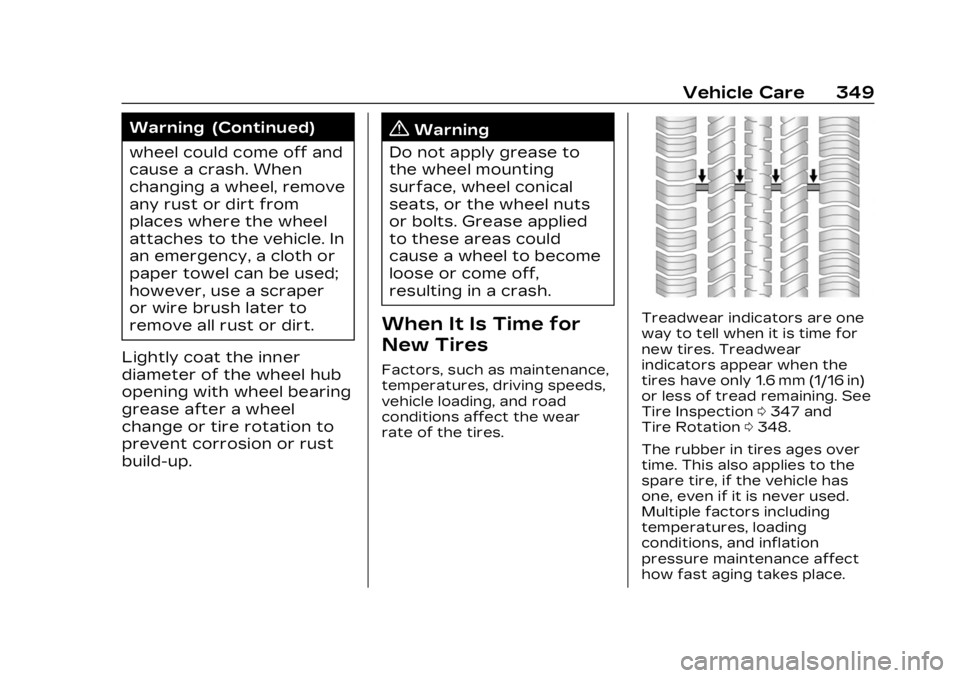
Treadwear indicators are one
way to tell when it is time for
new tires. Treadwear
indicators appear when the
tires have only 1.6 mm (1/16 in)
or less of tread remaining. See
Tire Inspection 0347 and
Tire Rotation 0348.
The rubber in tires ages over
time. This also applies to the
spare tire, if the vehicle has
one, even if it is never used.
Multiple factors including
temperatures, loading
conditions, and inflation
pressure maintenance affect
how fast aging takes place.
Page 351 of 424
Cadillac Lyriq Owner Manual (GMNA-Localizing-U.S./Canada-15644413) -
2023 - CRC - 2/23/22
350 Vehicle Care
GM recommends that tires,
including the spare if
equipped, be replaced after six
years, regardless of tread
wear. To identify the age of a
tire, use the tire manufacture
date, which is the last four
digits of the DOT Tire
Identification Number (TIN)
molded into one side of the
tire sidewall. The last four
digits of the TIN indicate the
tire manufactured date. The
first two digits represent the
week and the last two digits,
the year. For example, the
third week of the year 2020
would have a 4-digit DOT date
of 0320. Week 01 is the first
full week (Sunday through
Saturday) of each year.
Vehicle Storage
Tires age when stored
normally mounted on a parked
vehicle. Park a vehicle that will
be stored for at least a month
in a cool, dry, clean area away
from direct sunlight to slow
aging. This area should be freeof grease, gasoline, or other
substances that can
deteriorate rubber.
Parking for an extended
period can cause flat spots on
the tires that may result in
vibrations while driving. When
storing a vehicle for at least a
month, remove the tires or
raise the vehicle to reduce the
weight from the tires.
Buying New Tires
GM has developed and
matched specific tires for
the vehicle. The original
equipment tires installed
were designed to meet
General Motors Tire
Performance Criteria
Specification (TPC Spec)
system rating. When
replacement tires are
needed, GM strongly
recommends buying tires
with the same TPC Spec
rating.
GM's exclusive TPC Spec
system considers over a
dozen critical specifications
that impact the overall
performance of the vehicle,
including brake system
performance, ride and
handling, traction control,
and tire pressure
monitoring performance.
GM's TPC Spec number is
molded onto the tire's
sidewall near the tire size.
If the tires have an
all-season tread design, the
TPC Spec number will be
followed by MS for mud
and snow. See Tire
Sidewall Labeling
0337 for
additional information.
GM recommends replacing
worn tires in complete sets
of four. Uniform tread
depth on all tires will help
to maintain the
performance of the vehicle.
Braking and handling