2023 CADILLAC LYRIC climate control
[x] Cancel search: climate controlPage 192 of 424
Cadillac Lyriq Owner Manual (GMNA-Localizing-U.S./Canada-15644413) -
2023 - CRC - 2/23/22
Climate Controls 191
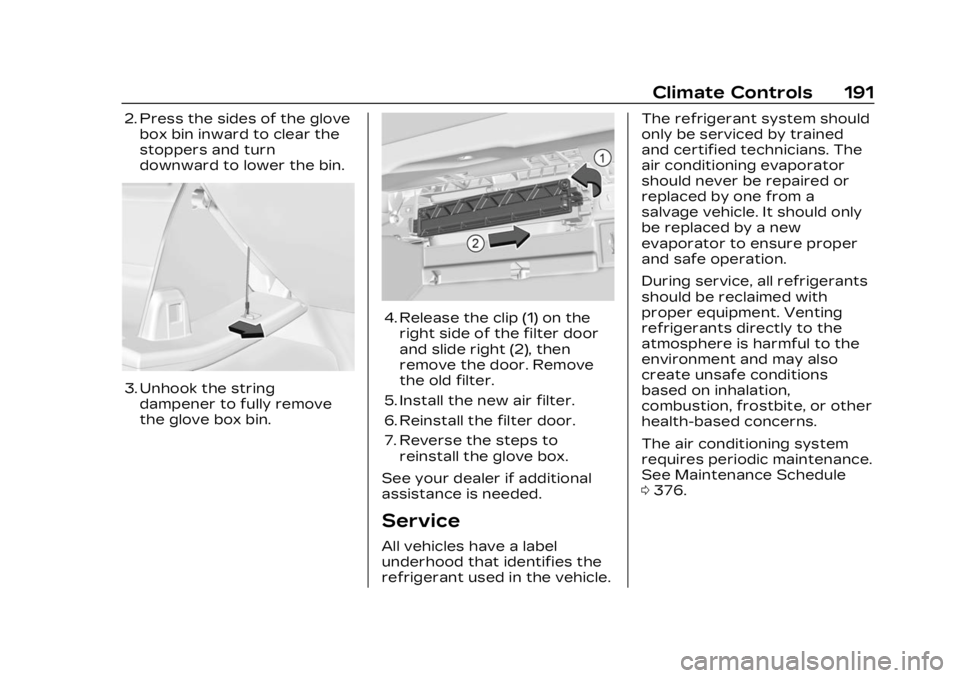
2. Press the sides of the glovebox bin inward to clear the
stoppers and turn
downward to lower the bin.
3. Unhook the stringdampener to fully remove
the glove box bin.
4. Release the clip (1) on theright side of the filter door
and slide right (2), then
remove the door. Remove
the old filter.
5. Install the new air filter.
6. Reinstall the filter door.
7. Reverse the steps to reinstall the glove box.
See your dealer if additional
assistance is needed.
Service
All vehicles have a label
underhood that identifies the
refrigerant used in the vehicle. The refrigerant system should
only be serviced by trained
and certified technicians. The
air conditioning evaporator
should never be repaired or
replaced by one from a
salvage vehicle. It should only
be replaced by a new
evaporator to ensure proper
and safe operation.
During service, all refrigerants
should be reclaimed with
proper equipment. Venting
refrigerants directly to the
atmosphere is harmful to the
environment and may also
create unsafe conditions
based on inhalation,
combustion, frostbite, or other
health-based concerns.
The air conditioning system
requires periodic maintenance.
See Maintenance Schedule
0
376.
Page 195 of 424

Cadillac Lyriq Owner Manual (GMNA-Localizing-U.S./Canada-15644413) -
2023 - CRC - 2/23/22
194 Driving and Operating
Acceleration/Braking/
Coasting
Avoid rapid accelerations and
decelerations.
Use cruise control when
appropriate.
Plan ahead for decelerations,
and coast whenever possible.
Do not rush to traffic signals,
and do not shift to N (Neutral)
to coast.
Use the One-Pedal Driving
feature when appropriate to
help recover energy during
coasting and braking.
One-Pedal mode recovers
more energy while coasting
and braking than D (Drive)
mode. See One-Pedal Driving
0214.
Use the steering wheel Regen
on Demand paddle during
deceleration to help recover
energy. See Regenerative
Braking 0220. Terrain and Vehicle Speed
Higher speeds and grade
changes use more energy and
can significantly reduce
electric range.
Climate Setting
Using the heat and air
conditioning systems
decreases the energy
available for electric driving.
Optimal energy efficiency is
achieved when the heat, air
conditioning, and fan are
turned off.
Use the heated and ventilated
seat features (if equipped)
instead of the climate control
system. Heating and
ventilating the seat uses less
energy than heating and
cooling the interior. See
Heated and Ventilated Front
Seats
045 and
Heated Rear Seats 049.
Use the Remote Start Climate
Control feature to heat or cool
the interior while the vehicle is
plugged in to use electricity from the electrical outlet
instead of using energy from
the battery. See Remote Start
0
15.
In hot weather, avoid parking
in direct sunlight. Use
sunshades inside the vehicle.
Keep the inside of the
windows clean to reduce
fogging. Turn off the front
defroster and rear defogger
when they are not needed.
Avoid driving with the
windows open at highway
speeds.
Use the Battery Gauge on the
Instrument Cluster to view the
effect of climate control
settings on your estimated
range. See Battery Gauge
(High Voltage) 0110.
Outside Temperature
On colder days, it is best to
plug in the vehicle overnight,
and then remote start the
vehicle.
Page 196 of 424
Cadillac Lyriq Owner Manual (GMNA-Localizing-U.S./Canada-15644413) -
2023 - CRC - 2/23/22
Driving and Operating 195
Allow the vehicle to warm up
for 20 minutes before driving.
Vehicle Charging/
Maintenance
Charging
Keep the vehicle plugged in,
even when fully charged, to
keep the battery temperature
ready for the next drive. This
is important when outside
temperatures are extremely
hot or cold.
If possible, use a level 2
(240 volt) high power charge
station for best results. This
allows the interior of the
vehicle and high voltage
battery to warm to optimal
temperature.
Maintenance
Always keep the tires properly
inflated and the vehicle
properly aligned.
The weight of excess cargo in
the vehicle affects efficiency
and range. Avoid carrying
more than is needed.Avoid unnecessary use of
electrical accessories. Power
used for functions other than
propelling the vehicle will
reduce the available range.
Using a rooftop carrier will
reduce efficiency due to
additional weight and drag.
Distracted Driving
Distraction comes in many
forms and can take your focus
from the task of driving.
Exercise good judgment and
do not let other activities
divert your attention away
from the road. Many local
governments have enacted
laws regarding driver
distraction. Become familiar
with the local laws in
your area.
To avoid distracted driving,
keep your eyes on the road,
keep your hands on the
steering wheel, and focus your
attention on driving.
.Do not use a mobile phone in
demanding driving situations.
Use a hands-free method to
place or receive necessary
phone calls.
.Watch the road. Do not read,
take notes, or look up
information on mobile
phones or other electronic
devices.
.Designate a front seat
passenger to handle
potential distractions.
.Become familiar with vehicle
features before driving, such
as programming favorite
radio stations and adjusting
climate control and seat
settings. Program all trip
information into any
navigation device prior to
driving.
.Wait until the vehicle is
parked to retrieve items that
have fallen to the floor.
.Stop or park the vehicle to
tend to children.
.Keep pets in an appropriate
carrier or restraint.
Page 354 of 424
Cadillac Lyriq Owner Manual (GMNA-Localizing-U.S./Canada-15644413) -
2023 - CRC - 2/23/22
Vehicle Care 353
Treadwear 200 Traction AA
Temperature A
All Passenger Car Tires
Must Conform to Federal
Safety Requirements In
Addition To These Grades.
Treadwear
The treadwear grade is a
comparative rating based
on the wear rate of the tire
when tested under
controlled conditions on a
specified government test
course. For example, a tire
graded 150 would wear one
and one-half (1½) times as
well on the government
course as a tire graded
100. The relative
performance of tires
depends upon the actual
conditions of their use,
however, and may depart
significantly from the norm
due to variations in drivinghabits, service practices
and differences in road
characteristics and climate.
Traction
The traction grades, from
highest to lowest, are AA,
A, B, and C. Those grades
represent the tire's ability
to stop on wet pavement
as measured under
controlled conditions on
specified government test
surfaces of asphalt and
concrete. A tire marked C
may have poor traction
performance. Warning: The
traction grade assigned to
this tire is based on
straight-ahead braking
traction tests, and does not
include acceleration,
cornering, hydroplaning,
or peak traction
characteristics.
Temperature
The temperature grades
are A (the highest), B, and
C, representing the tire's
resistance to the
generation of heat and its
ability to dissipate heat
when tested under
controlled conditions on a
specified indoor laboratory
test wheel. Sustained high
temperature can cause the
material of the tire to
degenerate and reduce tire
life, and excessive
temperature can lead to
sudden tire failure. The
grade C corresponds to a
level of performance which
all passenger car tires must
meet under the Federal
Motor Safety Standard
No. 109. Grades B and A
represent higher levels of
performance on the
laboratory test wheel than
the minimum required by
Page 413 of 424

Cadillac Lyriq Owner Manual (GMNA-Localizing-U.S./Canada-15644413) -
2023 - CRC - 2/23/22
412 INDEX
CaliforniaPerchlorate Materials
Requirements . . . . . . . . . . . . . 308
California Proposition 65 Warning . . . . . . . . . . . . . . . . 1, 356
Camera Rear Vision (RVC) . . . . . . . . . . 257
Canadian Vehicle Owners . . . . 2
Capacities and Specifications . . . . . . . . . . . . . . . 383
Car Wash Mode . . . . . . . . . . . . . . . .211
Carbon Monoxide
Liftgate . . . . . . . . . . . . . . . . . . . . . . . . . . 21
Winter Driving . . . . . . . . . . . . . . . 201
Cargo Cover . . . . . . . . . . . . . . . . . . . . . . . . . . . 95
Management System . . . . . . 97
Tie-Downs . . . . . . . . . . . . . . . . . . . . . 97
Caution, Danger, and Warning . . . . . . . . . . . . . . . . . . . . . . . . . . 2
Center Console
Storage . . . . . . . . . . . . . . . . . . . . . . . . 95
Chains, Tire . . . . . . . . . . . . . . . . . . . 355
Charge Cord . . . . . . . . . . . . . . . . . . . . . . . . . . . . 291
Charge Cord Connected Light . . . . . . . . . . . . . . . . . . . . . . . . . . . . .114
Charging . . . . . . . . . . . . . . . . . . . . . . . . 123 Charging (cont'd)
Delay Override . . . . . . . . . . . . . 289
Plug-In . . . . . . . . . . . . . . . . . . . . . . . . 285
Status Feedback . . . . . . . . . . 289
System Light . . . . . . . . . . . . . . . . 114
Utility Interruption . . . . . . . . 294
Wireless . . . . . . . . . . . . . . . . . . . . . . . 104
Child Restraints Infants and YoungChildren . . . . . . . . . . . . . . . . . . . . . . . 75
Lower Anchors and Tethers for Children . . . . . . 80
Older Children . . . . . . . . . . . . . . . . 73
Securing . . . . . . . . . . . . . . . . . . 88, 90
Systems . . . . . . . . . . . . . . . . . . . . . . . . 77
Child Safety Locks . . . . . . . . . . . . 20
Circuit Breakers . . . . . . . . . . . . . 325
Cleaning
Exterior Care . . . . . . . . . . . . . . . 364
Interior Care . . . . . . . . . . . . . . . . 369
Climate Control Systems
Dual Automatic . . . . . . . . . . . . . . 185
Clock . . . . . . . . . . . . . . . . . . . . . . . . . . . . . 102
Cluster, Instrument . . . . . . . . . . 108
Collision Damage Repair . . . . . . . . . . . . . . . . . . . . . . . . . 392
Compartment Underhood . . . . . . . . . . . . . . . . . . . 312 Compartments
Storage . . . . . . . . . . . . . . . . . . . . . . . . 94
Compass . . . . . . . . . . . . . . . . . . . . . . . . 102
Connected Services Connections . . . . . . . . . . . . . . . . 407
Diagnostics . . . . . . . . . . . . . . . . . . 409
Navigation . . . . . . . . . . . . . . . . . . . 407
Connections Connected Services . . . . . . 407
Control Traction and
Electronic Stability . . . . . . . 221
Control of a Vehicle . . . . . . . . . 196
Controls Steering Wheel . . . . . . . . . . . . . 152
Convex Mirrors . . . . . . . . . . . . . . . . 28
Cooling . . . . . . . . . . . . . . . . . . . . . . . . . . 185
Cooling System . . . . . . . . . . . . . . . 313
Cornering Lamps . . . . . . . . . . . . . 146
Courtesy Transportation
Program . . . . . . . . . . . . . . . . . . . . . . . 391
Cover Cargo . . . . . . . . . . . . . . . . . . . . . . . . . . . 95
Cruise Control
Adaptive . . . . . . . . . . . . . . . . . . . . . 225
Light . . . . . . . . . . . . . . . . . . . . . . . . . . . . 122
Super . . . . . . . . . . . . . . . . . . . . . . . . . 236
Page 414 of 424

Cadillac Lyriq Owner Manual (GMNA-Localizing-U.S./Canada-15644413) -
2023 - CRC - 2/23/22
INDEX 413
Cupholders . . . . . . . . . . . . . . . . . . . . . . 95
Customer AssistanceOffices . . . . . . . . . . . . . . . . . . . . . . . . 386
Text Telephone (TTY)Users . . . . . . . . . . . . . . . . . . . . . . . . 387
Customer Information Publications Ordering
Information . . . . . . . . . . . . . . . . 394
Customer Satisfaction Procedure . . . . . . . . . . . . . . . . . . . 384
Cybersecurity . . . . . . . . . . . . . . . . 397
D
Damage Repair,
Collision . . . . . . . . . . . . . . . . . . . . . . . 392
Danger, Warning, and Caution . . . . . . . . . . . . . . . . . . . . . . . . . . . 2
Dashboard . . . . . . . . . . . . . . . . . . . . . . . . . 5
Data Collection Infotainment System . . . . . 399
OnStar . . . . . . . . . . . . . . . . . . . . . . . . 399
Data Recorders, Event . . . . 398
Daytime Running Lamps (DRL) . . . . . . . . . . . . . . . . . 142
Defensive Driving . . . . . . . . . . . . . 196
Delayed Charging Override . . . . . . . . . . . . . . . . . . . . . . 289
Delayed Locking . . . . . . . . . . . . . . . . 18 Destination . . . . . . . . . . . . . . . . . . . . . 164
Diagnostics
Connected Services . . . . . . 409
Digital Key . . . . . . . . . . . . . . . . . . . . . . . 20
Disabled Vehicle Transporting . . . . . . . . . . . . . . . . 359
Distracted Driving . . . . . . . . . . . . 195
Dome Lamps . . . . . . . . . . . . . . . . . . . 147
Door
Ajar Light . . . . . . . . . . . . . . . . . . . . . 122
Delayed Locking . . . . . . . . . . . . . . 18
Locks . . . . . . . . . . . . . . . . . . . . . . . . . . . . . 17
Power Locks . . . . . . . . . . . . . . . . . . . 18
Drive Systems All-Wheel Drive . . . . . . . . . . . . . . 215
Drive Unit
Electric . . . . . . . . . . . . . . . . . . . . . . . . . 211
Driver Assistance Systems . . . . . . 255
InformationCenter (DIC) . . . . . . . . . . . . . . . . 132
Mode Control . . . . . . . . . . . . . . . 223
Mode Control Light . . . . . . . . 120
Teen . . . . . . . . . . . . . . . . . . . . . . . . . . . . 178
Driving
Assistance Systems . . . . . . 270
Characteristics andTowing Tips . . . . . . . . . . . . . . . 296 Driving (cont'd)
Defensive . . . . . . . . . . . . . . . . . . . . . 196
Hill and Mountain
Roads . . . . . . . . . . . . . . . . . . . . . . . 200
If the Vehicle is Stuck . . . . 202
Impaired . . . . . . . . . . . . . . . . . . . . . . . 196
Loss of Control . . . . . . . . . . . . . 198
Off-Road Recovery . . . . . . . . 198
One-Pedal . . . . . . . . . . . . . . . . . . . . 214
Vehicle Load Limits . . . . . . . 202
Wet Roads . . . . . . . . . . . . . . . . . . . 199
Winter . . . . . . . . . . . . . . . . . . . . . . . . . 201
Driving for Better Energy Efficiency . . . . . . . . . . . 193
Dual Automatic Climate
Control System . . . . . . . . . . . . 185
E
ElectricBrake Boost . . . . . . . . . . . . . . . . . . 216
Drive Unit . . . . . . . . . . . . . . . . . . . . . . 211
Parking Brake . . . . . . . . . . . . . . . 217
Parking Brake Light . . . . . . . 116
Electrical Equipment, Add-On . . . . . . . 306
Requirements for
Battery Charging . . . . . . . . 295