2023 ALFA ROMEO STELVIO fuel pressure
[x] Cancel search: fuel pressurePage 159 of 268

157
Driving on a significantly underinflated tire will
cause the tire to overheat, and can lead to tire
failure. Underinflation also reduces fuel
efficiency and tire tread life, and may affect the
vehicle’s handling and stopping ability.
The TPMS is not a substitute for proper tire
maintenance, and it is the driver’s responsi-
bility to maintain correct tire pressure using an
accurate tire pressure gauge, even if underin -
flation has not reached the level to trigger
illumination of the TPMS Warning Light.
Seasonal temperature changes will affect tire
pressure, and the TPMS will monitor the actual
tire pressure in the tire
Ú
page 259.
OCCUPANT RESTRAINT
SYSTEMS
Some of the most important safety features in
your vehicle are the restraint systems:
OCCUPANT RESTRAINT SYSTEMS
F
EATURES
Seat Belt Systems
Supplemental Restraint Systems (SRS)
Air Bags
Child Restraints
Some of the safety features described in this
section may be standard equipment on some
models, or may be optional equipment on others.
If you are not sure, ask an authorized dealer.
IMPORTANT SAFETY PRECAUTIONS
Please pay close attention to the information in
this section. It tells you how to use your restraint
system properly, to keep you and your
passengers as safe as possible.
Here are some simple steps you can take to
minimize the risk of harm from a deploying
air bag:
1. Children 12 years old and under should always ride buckled up in the rear seat of a
vehicle with a rear seat.
2. A child who is not big enough to wear the vehicle seat belt properly must be secured in
the appropriate child restraint or belt-posi -
tioning booster seat in a rear seating position
Ú
page 170.
3. If a child from 2 to 12 years old (not in a rear-facing child restraint) must ride in the
front passenger seat, move the seat as far
back as possible and use the proper child
restraint
Ú
page 170.
4. Never allow children to slide the shoulder belt behind them or under their arm.
5. You should read the instructions provided with your child restraint to make sure that you
are using it properly.
6. All occupants should always wear their lap and shoulder belts properly. 7. The driver and front passenger seats should
be moved back as far as practical to allow the
front air bags room to inflate.
8. Do not lean against the door or window. If your vehicle has side air bags, and deploy -
ment occurs, the side air bags will inflate
forcefully into the space between occupants
and the door and occupants could be injured.
9. If the air bag system in this vehicle needs to be modified to accommodate a disabled
person, see
Ú
page 255 for customer
service contact information.
WARNING!
Never place a rear-facing child restraint in
front of an air bag. A deploying passenger
front air bag can cause death or serious
injury to a child 12 years or younger,
including a child in a rear-facing child
restraint.
Never install a rear-facing child restraint in
the front seat of a vehicle. Only use a
rear-facing child restraint in the rear seat.
If the vehicle does not have a rear seat, do
not transport a rear-facing child restraint in
that vehicle.
23_GU_OM_EN_USC_t.book Page 157
Page 184 of 268

SAFETY
182
PERIODIC SAFETY CHECKS YOU SHOULD
M
AKE OUTSIDE THE VEHICLE
Tires
Examine tires for excessive tread wear and
uneven wear patterns. Check for stones, nails,
glass, or other objects lodged in the tread or
sidewall. Inspect the tread for cuts and cracks.
Inspect sidewalls for cuts, cracks, and bulges.
Check the wheel nuts for tightness. Check the
tires (including spare) for proper cold inflation
pressure.
Lights
Have someone observe the operation of brake
lights and exterior lights while you work the
controls. Check turn signal and high beam
indicator lights on the instrument panel.
Door Latches
Check for proper closing, latching, and locking.
Fluid Leaks
Check area under the vehicle after overnight
parking for fuel, coolant, oil, or other fluid leaks.
Also, if gasoline fumes are detected or if fuel, or
brake fluid leaks are suspected, the cause should
be located and corrected immediately.
EXHAUST GAS
The best protection against carbon monoxide
entry into the vehicle body is a properly
maintained engine exhaust system.
Whenever a change is noticed in the sound of the
exhaust system, when exhaust fumes can be
detected inside the vehicle, or when the
underside or rear of the vehicle is damaged, have
a competent mechanic inspect the complete
exhaust system and adjacent body areas for
broken, damaged, deteriorated, or mispositioned parts. Open seams or loose connections could
permit exhaust fumes to seep into the passenger
compartment. In addition, inspect the exhaust
system each time the vehicle is raised for
lubrication or oil change. Replace as required.
CARBON MONOXIDE WARNINGS
WARNING!
Exhaust gases can injure or kill. They contain
carbon monoxide (CO), which is colorless and
odorless. Breathing it can make you
unconscious and can eventually poison you. To
avoid breathing (CO), follow these safety tips:
Do not run the engine in a closed garage or in
confined areas any longer than needed to
move your vehicle in or out of the area.
If you are required to drive with the trunk/
liftgate/rear doors open, make sure that all
windows are closed and the climate control
BLOWER switch is set at high speed. DO NOT
use the recirculation mode.
If it is necessary to sit in a parked vehicle with
the engine running, adjust your heating or
cooling controls to force outside air into the
vehicle. Set the blower at high speed.
WARNING!
Carbon monoxide (CO) in exhaust gases is
deadly. Follow the precautions below to
prevent carbon monoxide poisoning:
Do not inhale exhaust gases. They contain
carbon monoxide, a colorless and odorless
gas, which can kill. Never run the engine in a
closed area, such as a garage, and never sit
in a parked vehicle with the engine running
for an extended period. If the vehicle is
stopped in an open area with the engine
running for more than a short period, adjust
the ventilation system to force fresh, outside
air into the vehicle.
Guard against carbon monoxide with proper
maintenance. Have the exhaust system
inspected every time the vehicle is raised.
Have any abnormal conditions repaired
promptly. Until repaired, drive with all side
windows fully open.
When exiting the vehicle, always make sure
the ignition is in the off position, remove the
key fob from the vehicle, and lock your
vehicle.
23_GU_OM_EN_USC_t.book Page 182
Page 201 of 268

199
Correct servicing permits the performance of the
vehicle to be maintained over time, as well as
limited running costs and safeguarding the
efficiency of the safety systems.
SCHEDULED SERVICING
Correct servicing is crucial for guaranteeing a
long life for the vehicle under the best conditions.
For this reason, Alfa Romeo has planned a series
of checks and services for your vehicle at fixed
intervals based on distance and time, as
described in the Scheduled Servicing Plan.
Before each service, it is always necessary to
carefully follow the instructions in the Scheduled
Servicing Plan (e.g. periodically check level of
fluids, tire pressure, etc.).
Scheduled Servicing is offered by an authorized
dealer according to a set time schedule. If, during
each operation, in addition to the ones
scheduled, the need arises for further
replacements or repairs, these may be carried
out with the owner’s explicit consent only.
NOTE:
Scheduled Servicing intervals are required by the
manufacturer. Failure to have them carried out
may invalidate the New Vehicle Limited Warranty.
You are advised to inform an authorized dealer of
any small operating irregularities without waiting
for the next service.
PERIODIC CHECKS
Every month or every 620 miles (1,000 km) or
before long trips check and, if necessary, top off:
Engine coolant level.
Brake fluid level (if insufficient, see an
authorized dealer as soon as possible).
Windshield washer fluid level.
Tire inflation pressure and condition.
Operation of lighting system (headlights,
direction indicators, hazard warning lights,
etc.).
Operation of windshield washing/wiping
system and positioning/wear of wiper blades.
Inspect the CV/Universal joints.
Oil consumption of the engine depends on
conditions and driving style. For this reason, the
engine oil level must be checked every
1,860 miles (3,000 km), and top off if necessary;
for further information
Ú
page 205.
HEAVY USAGE OF THE VEHICLE
If the vehicle is used under one of the following
conditions:
Dusty roads.
Short, repeated journeys less than 4 miles
(7 km) at sub-zero outside temperatures.
Engine often idling or driving long distances at
low speeds or long periods of inactivity.
In the event of a long period of inactivity.
The following checks must be carried out more
often than indicated in the Scheduled Servicing
Plan:
Check cleanliness of hood and liftgate locks,
cleanliness and lubrication of linkage.
Visually inspect conditions of: engine,
transmission, pipes and hoses (exhaust/fuel
system/brakes) and rubber elements
(sleeves/bushes, etc.).
Check battery charge and battery fluid level
(electrolyte).
Visually inspect conditions of the accessory
drive belts.
Check and, if necessary, change engine oil and
replace oil filter.
Check and, if necessary, replace cabin air
filter.
Check and, if necessary, replace air cleaner.
Severe Duty All Models
Change engine oil at 4,000 miles (6,500 km) if the vehicle is operated in a dusty and off-road
environment or is operated predominately at idle
or only very low engine RPM. This type of vehicle
use is considered Severe Duty.
23_GU_OM_EN_USC_t.book Page 199
Page 202 of 268
SERVICING AND MAINTENANCE
200
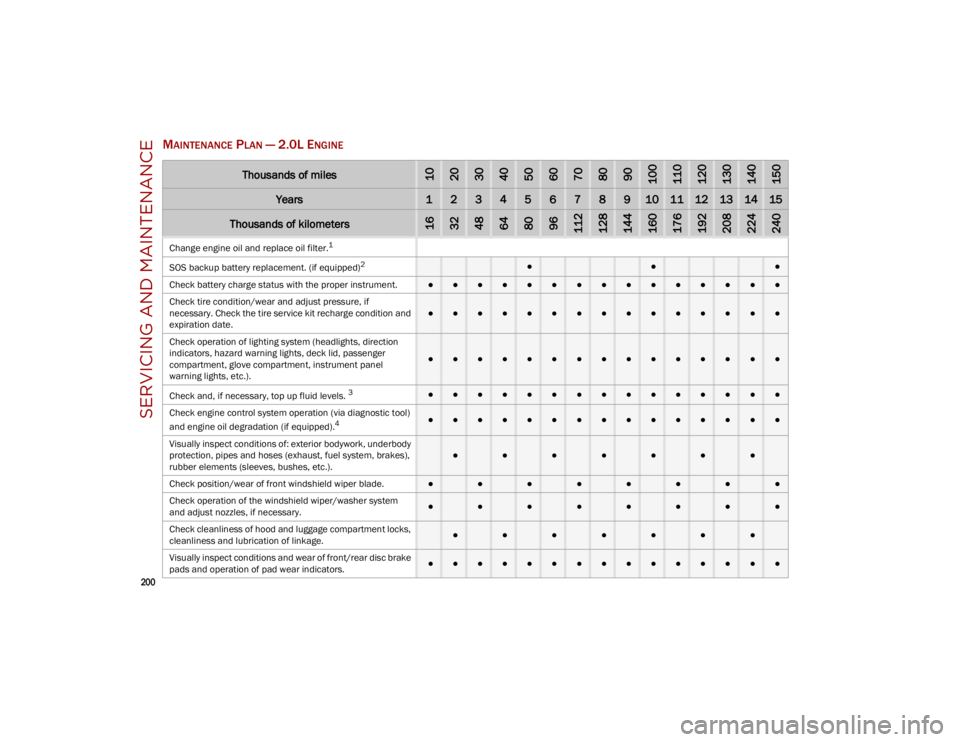
MAINTENANCE PLAN — 2.0L ENGINE
Thousands of miles102030405060708090100110120130140150
Years123456789101112131415
Thousands of kilometers163248648096112128144160176192208224240
Change engine oil and replace oil filter.1
SOS
backup battery replacement. (if equipped)
2 ●●●
Check battery charge status with the proper instrument.
●●●●●●●●●●●●●●●
Check tire condition/wear and adjust pressure, if
necessary. Check the tire service kit recharge condition and
expiration date.
●●●●●●●●●●●●●●●
Check operation of lighting system (headlights, direction
indicators, hazard warning lights, deck lid, passenger
compartment, glove compartment, instrument panel
warning lights, etc.).
●●●●●●●●●●●●●●●
Check and, if necessary, top up fluid levels.
3●●●●●●●●●●●●●●●
Check engine control system operation (via diagnostic tool)
and engine oil degradation (if equipped).
4●●●●●●●●●●●●●●●
Visually inspect conditions of: exterior bodywork, underbody
protection, pipes and hoses (exhaust, fuel system, brakes),
rubber elements (sleeves, bushes, etc.).
●●●●●●●
Check position/wear of front windshield wiper blade.●●●●●●●●
Check operation of the windshield wiper/washer system
and adjust nozzles, if necessary.
●●●●●●●●
Check cleanliness of hood and luggage compartment locks,
cleanliness and lubrication of linkage.
●●●●●●●
Visually inspect conditions and wear of front/rear disc brake
pads and operation of pad wear indicators.●●●●●●●●●●●●●●●
23_GU_OM_EN_USC_t.book Page 200
Page 204 of 268
SERVICING AND MAINTENANCE
202
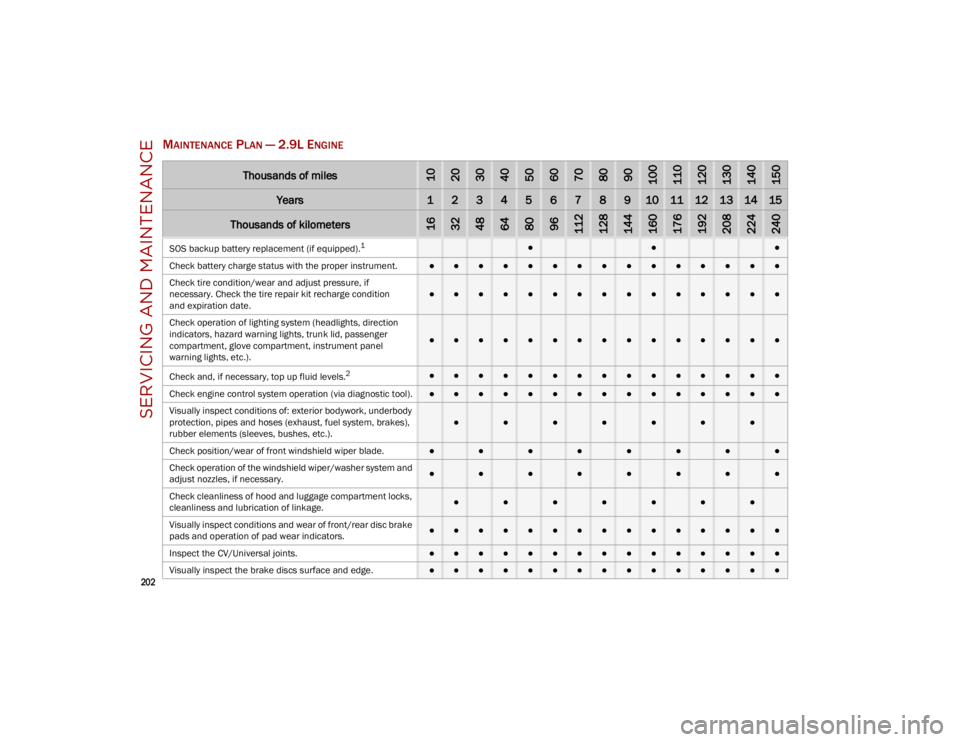
MAINTENANCE PLAN — 2.9L ENGINE
Thousands of miles102030405060708090100110120130140150
Years123456789101112131415
Thousands of kilometers163248648096112128144160176192208224240
SOS backup battery replacement (if equipped).1●●●
Check battery charge status with the proper instrument.
●●●●●●●●●●●●●●●
Check tire condition/wear and adjust pressure, if
necessary. Check the tire repair kit recharge condition
and expiration date.
●●●●●●●●●●●●●●●
Check operation of lighting system (headlights, direction
indicators, hazard warning lights, trunk lid, passenger
compartment, glove compartment, instrument panel
warning lights, etc.).
●●●●●●●●●●●●●●●
Check and, if necessary, top up fluid levels.
2●●●●●●●●●●●●●●●
Check engine control system operation (via diagnostic tool).
●●●●●●●●●●●●●●●
Visually inspect conditions of: exterior bodywork, underbody
protection, pipes and hoses (exhaust, fuel system, brakes),
rubber elements (sleeves, bushes, etc.).
●●●●●●●
Check position/wear of front windshield wiper blade.●●●●●●●●
Check operation of the windshield wiper/washer system and
adjust nozzles, if necessary.
●●●●●●●●
Check cleanliness of hood and luggage compartment locks,
cleanliness and lubrication of linkage.
●●●●●●●
Visually inspect conditions and wear of front/rear disc brake
pads and operation of pad wear indicators.●●●●●●●●●●●●●●●
Inspect the CV/Universal joints.
●●●●●●●●●●●●●●●
Visually inspect the brake discs surface and edge.
●●●●●●●●●●●●●●●
23_GU_OM_EN_USC_t.book Page 202
Page 232 of 268
SERVICING AND MAINTENANCE
230
TIRES — GENERAL INFORMATION
Tire Pressure
Proper tire inflation pressure is essential to the
safe and satisfactory operation of your vehicle.
Four primary areas are affected by improper
tire pressure:
Safety
Fuel Economy
Tread Wear
Ride Comfort and Vehicle Stability
Safety Both underinflation and overinflation affect the
stability of the vehicle and can produce a feeling
of sluggish response or over responsiveness in
the steering.
NOTE:
Unequal tire pressures from side to side may
cause erratic and unpredictable steering
response.
Unequal tire pressure from side to side may
cause the vehicle to drift left or right.
Fuel Economy
Underinflated tires will increase tire rolling
resistance resulting in higher fuel consumption.
Tread Wear
Improper cold tire inflation pressures can cause
abnormal wear patterns and reduced tread life,
resulting in the need for earlier tire replacement.
Ride Comfort And Vehicle Stability
Proper tire inflation contributes to a comfortable
ride. Overinflation produces a jarring and
uncomfortable ride.
Tire Inflation Pressures
The proper cold tire inflation pressure is listed on
the driver's side B-pillar or rear edge of the
driver's side door.
At least once a month:
Check and adjust tire pressure with a good
quality pocket-type pressure gauge. Do not
make a visual judgement when determining
proper inflation. Tires may look properly
inflated even when they are underinflated.
Inspect tires for signs of tire wear or visible
damage. Inflation pressures specified on the placard are
always “cold tire inflation pressure”. Cold tire
inflation pressure is defined as the tire pressure
after the vehicle has not been driven for at least
three hours, or driven less than 1 mile (1.6 km)
after sitting for a minimum of three hours. The
cold tire inflation pressure must not exceed the
maximum inflation pressure molded into the tire
sidewall.
Check tire pressures more often if subject to a
wide range of outdoor temperatures, as tire
pressures vary with temperature changes.
Tire pressures change by approximately 1 psi
(7 kPa) per 12°F (7°C) of air temperature
change. Keep this in mind when checking tire
pressure inside a garage, especially in the Winter.
Example: If garage temperature = 68°F (20°C)
and the outside temperature = 32°F (0°C) then
the cold tire inflation pressure should be
increased by 3 psi (21 kPa), which equals 1 psi
(7 kPa) for every 12°F (7°C) for this outside
temperature condition.
Tire pressure may increase from 2 to 6 psi
(13 to 40 kPa) during operation. DO NOT reduce
this normal pressure build up or your tire
pressure will be too low.
WARNING!
Improperly inflated tires are dangerous and
can cause collisions.
Underinflation increases tire flexing and can
result in overheating and tire failure.
Overinflation reduces a tire's ability to
cushion shock. Objects on the road and
chuckholes can cause damage that result in
tire failure.
Overinflated or underinflated tires can affect
vehicle handling and can fail suddenly,
resulting in loss of vehicle control.
Unequal tire pressures can cause steering
problems. You could lose control of your
vehicle.
Unequal tire pressures from one side of the
vehicle to the other can cause the vehicle to
drift to the right or left.
Always drive with each tire inflated to the
recommended cold tire inflation pressure.
CAUTION!
After inspecting or adjusting the tire pressure,
always reinstall the valve stem cap. This will
prevent moisture and dirt from entering the
valve stem, which could damage the valve
stem.
23_GU_OM_EN_USC_t.book Page 230
Page 262 of 268

260
INDEX
A
Accessories Purchased By The Owner.......... 4
Active Blind Spot Assist .............................146
Active Safety Systems ................................ 140
Active Speed Limiter ..................................101
Active Torque Vectoring (ATV) System ......140
Adaptive Cruise Control (ACC)
(Cruise Control) .................................102, 105Off ........................................................... 106
On............................................................106
Additives, Fuel ............................................ 250
Adjust Forward.............................................. 31, 34
Rearward ........................................... 31, 34
Air Bag......................................................... 163 Air Bag Operation ...................................165Air Bag Warning Light ............................162
Driver Knee Air Bag................................ 165Enhanced Accident Response .....168, 198
Event Data Recorder (EDR) ...................198
Front Air Bag...........................................163
If Deployment Occurs ............................167
Knee Impact Bolsters ............................165
Maintaining Your Air Bag System.......... 170
Maintenance ..........................................170
Redundant Air Bag Warning Light.........163
Side Air Bags ..........................................165
Transporting Pets...................................180
Air Bag Light ......................................162, 180
Air Pressure Tires ........................................................230
Alfa Active Suspension (AAS)....................... 99
Alfa DNA System .......................................... 97
Antifreeze (Engine Coolant) ....................... 251
Anti-Lock Braking (ABS) System ................ 140 Anti-Lock Warning Light ...............................76
Automatic Climate Controls .........................50
Automatic Dimming Mirror...........................38
Automatic Door Locks ..................................28
Automatic Headlights ...................................44
Automatic Temperature Control (ATC) ........50
Automatic Transmission ..............................91
Auxiliary Driving Systems .......................... 144
Auxiliary Power Outlet ..................................57
B
Battery ..................................................79, 207 Charging System Light .............................79
Keyless Key Fob Replacement ................20
Battery Recharging .................................... 208
Belts, Seat .................................................. 180
Blind Spot Monitoring ............................... 144
Bodywork (Cleaning And Maintenance) ... 239
B-Pillar Location......................................... 227
Brake System Warning Light .................................... 75, 76
Brakes ........................................................ 244 Brake Fluid Level................................... 207
Brightness, Interior Lights............................47
Bulbs, Light ................................................ 182
C
Camera, Rear ............................................. 128
Capacities, Fluid ........................................ 251
Carbon Monoxide Warning ....................... 182
Cargo Compartment .....................................66
Certification Label ..................................... 132
Chart, Tire Sizing........................................ 225
Check Engine Light
(Malfunction Indicator Light) .......................85 Checking Levels ................................ 204, 205
Checking Your Vehicle For Safety ............. 180
Checks, Safety ........................................... 180
Child Restraint ........................................... 170
Child Restraints
Booster Seats ........................................ 173
Child Seat Installation ........................... 178
How To Stow An unused ALR Seat Belt ..................................... 176
Infant And Child Restraints ................... 172
LATCH Positions ..................................... 174
Lower Anchors And Tethers For Children ....................................... 174
Older Children And Child Restraints ..... 172
Seating Positions ................................... 173
Clean Air Gasoline ..................................... 249
Cleaning Wheels.................................................... 235
Climate Control ......................................49, 55 Automatic ................................................. 50
Compact Spare Tire ................................... 234
Contract, Service........................................ 257
Cooling System Cooling Capacity .................................... 251
Selection Of Coolant (Antifreeze) ......... 251
Cruise Control (Speed Control) ........ 102, 105
Customer Assistance ................................. 255
D
Daytime Running Lights .............................. 43
Defroster, Windshield ................................ 180
Dimensions ................................................ 246
Disabled Vehicle Towing............................ 196
Door Ajar.................................................79, 80
Door Ajar Light .......................................79, 80
23_GU_OM_EN_USC_t.book Page 260
Page 264 of 268

262
INDEX
Instrument PanelFeatures ................................................... 68
Intelligent Speed Control System..............119
Interior Lights ............................................... 45
Interiors (Cleaning)..................................... 240
J
Jump Starting ............................................. 192
K
Keyless Enter 'n Go™ ................................... 26 Passive Entry ............................................ 26
Keys .............................................................. 19
L
Lane Change And Turn Signals ................... 45
Lane Departure Warning System ..............123
Lane Keep Assist System ..........................125
Lap/Shoulder Belts ....................................158
Latches .......................................................182
Leaks, Fluid ................................................182
Life Of Tires.................................................233
Liftgate .......................................................... 62
Light Bulbs ..................................................182 Types Of Bulbs ....................................... 220
Lights .......................................................... 182 Air Bag .................................... 75, 162, 180Automatic Headlights .............................. 44
Brake Warning .................................. 75, 76Courtesy/Reading ............................. 46, 47Daytime Running ..................................... 43 Electronic Stability Program (ESP)
Indicator......................................... 76, 80
Exterior ................................................... 182
Fog...................................................... 45, 77
Headlight Switch ............................... 43, 44
Headlights.......................................... 43, 44
High Beam ................................................44
Instrument Cluster ............................ 43, 44
Intensity Control .......................................47
Interior................................................ 46, 47
Low Fuel ....................................................82
Malfunction Indicator (Check Engine) .....................................77
Map ...........................................................46
Oil Temperature........................................ 76
Park .................................................... 45, 78
Reading .....................................................46
Seat Belt Reminder ..................................76
Turn Signals .............................. 45, 78, 182
Warning Instrument Cluster Descriptions .................................. 78, 80
Loading Vehicle ......................................... 132 Tires........................................................ 227
Locks Automatic Door.........................................28
Child Protection ........................................ 29
M
Maintenance .................................................61
Malfunction Indicator Light
(Check Engine)....................................... 77, 85
Manual Service ................................................... 258 Memory Feature (Memory Seats) ............... 30
Memory Seat ................................................ 30
Methanol .................................................... 249
Mirrors .......................................................... 38
Automatic Dimming ................................. 38
Electric Powered ...................................... 38
Electric Remote ....................................... 38
Heated...................................................... 39
O
Occupant Restraints .................................. 157
Oil Pressure Light ......................................... 80
Oil, Engine Capacity.................................................. 251
Pressure Warning Light ........................... 80
Recommendation .................................. 251
Viscosity ................................................. 251
Opener, Garage Door (HomeLink) .............. 40
Operator Manual Owner's Manual ..................................... 258
Outlet Power........................................................ 57
Overheating, Engine .................................. 195
P
Paintwork (Cleaning And Maintenance) ... 239
Panic Brake Assist (PBA) System.............. 143
Park Assist.................................................. 120
ParkSense System ..................................... 120
Passive Entry ................................................ 26
Performance (Top Speed) ......................... 254
Pets ............................................................. 180
Placard, Tire And Loading Information ..... 227
23_GU_OM_EN_USC_t.book Page 262