2023 ALFA ROMEO GIULIA weight
[x] Cancel search: weightPage 166 of 248
SAFETY
164
The seat belts in the passenger seating positions
are equipped with a Switchable Automatic
Locking Retractor (ALR) that is designed to keep
the lap portion of the seat belt tight around the
child restraint so that it is not necessary to use a
locking clip. The ALR retractor can be “switched”
into a locked mode by pulling all of the webbing
out of the retractor and then letting the webbing
retract back into the retractor. If it is locked, the
ALR will make a clicking noise while the webbing
is pulled back into the retractor.
See the “Automatic Locking Mode” description
Ú
page 149 for additional information on ALR.
Please see the table below and the following
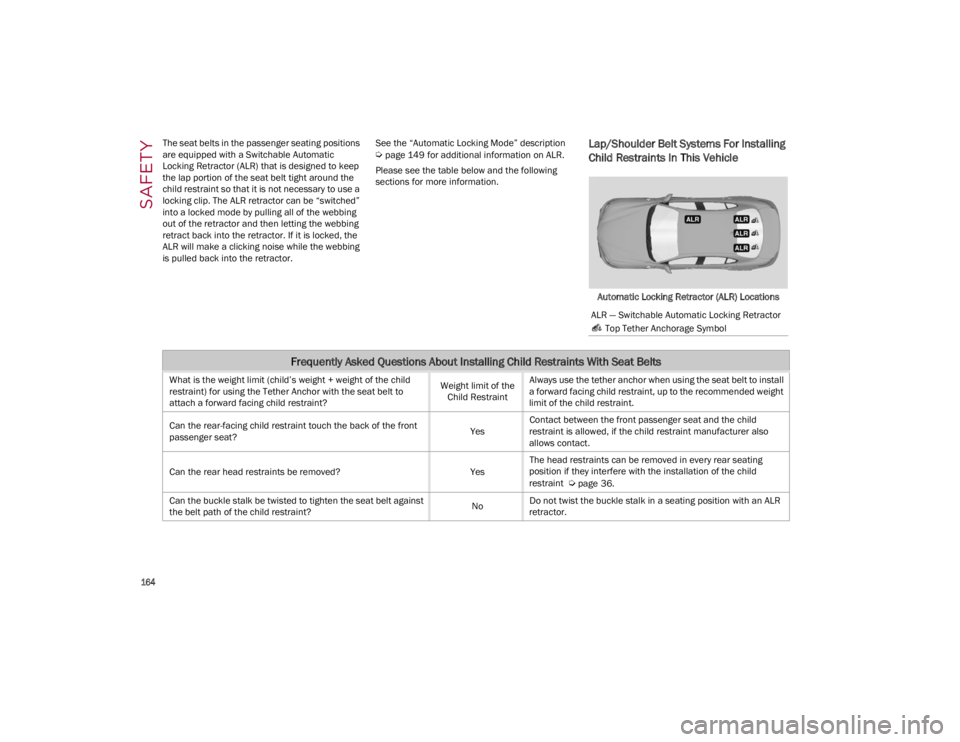
sections for more information.Lap/Shoulder Belt Systems For Installing
Child Restraints In This Vehicle
Automatic Locking Retractor (ALR) Locations
ALR — Switchable Automatic Locking Retractor Top Tether Anchorage Symbol
Frequently Asked Questions About Installing Child Restraints With Seat Belts
What is the weight limit (child’s weight + weight of the child
restraint) for using the Tether Anchor with the seat belt to
attach a forward facing child restraint? Weight limit of the
Child Restraint Always use the tether anchor when using the seat belt to install
a forward facing child restraint, up to the recommended weight
limit of the child restraint.
Can the rear-facing child restraint touch the back of the front
passenger seat? YesContact between the front passenger seat and the child
restraint is allowed, if the child restraint manufacturer also
allows contact.
Can the rear head restraints be removed? YesThe head restraints can be removed in every rear seating
position if they interfere with the installation of the child
restraint
Ú
page 36.
Can the buckle stalk be twisted to tighten the seat belt against
the belt path of the child restraint? NoDo not twist the buckle stalk in a seating position with an ALR
retractor.
23_GA_OM_EN_USC_t.book Page 164
Page 211 of 248
209
Tire Loading And Tire Pressure
NOTE:
The proper cold tire inflation pressure is listed on
the driver’s side B-pillar or the rear edge of the
driver's side door.
Check the inflation pressure of each tire,
including the spare tire (if equipped), at least
monthly and inflate to the recommended
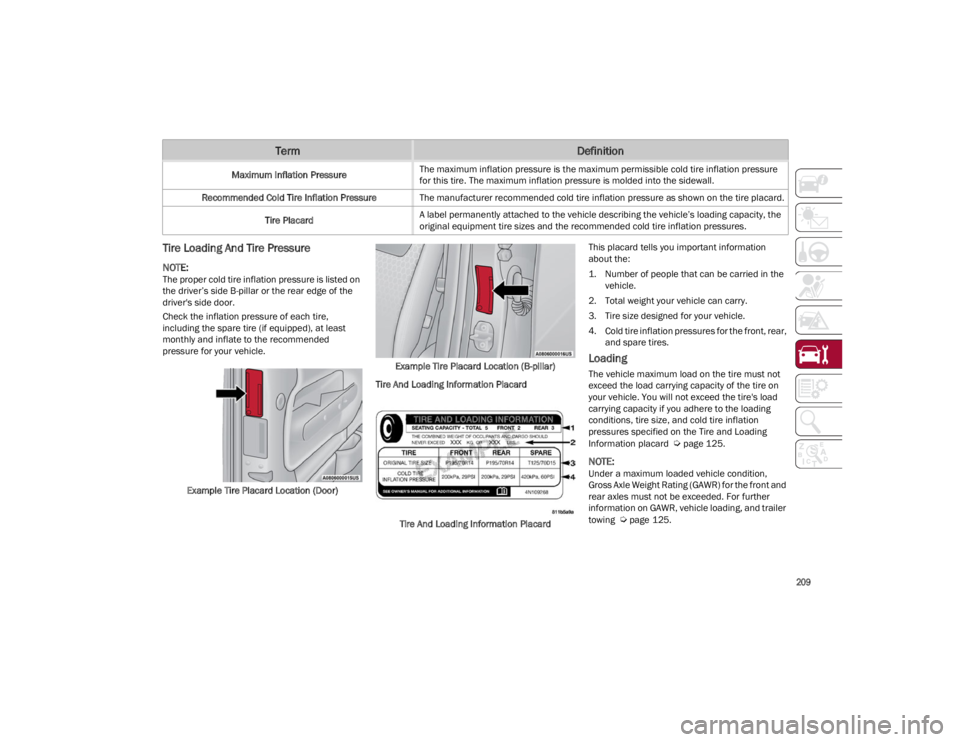
pressure for your vehicle.Example Tire Placard Location (Door) Example Tire Placard Location (B-pillar)
Tire And Loading Information Placard
Tire And Loading Information Placard This placard tells you important information
about the:
1. Number of people that can be carried in the
vehicle.
2. Total weight your vehicle can carry.
3. Tire size designed for your vehicle.
4. Cold tire inflation pressures for the front, rear, and spare tires.
Loading
The vehicle maximum load on the tire must not
exceed the load carrying capacity of the tire on
your vehicle. You will not exceed the tire's load
carrying capacity if you adhere to the loading
conditions, tire size, and cold tire inflation
pressures specified on the Tire and Loading
Information placard
Ú
page 125.
NOTE:
Under a maximum loaded vehicle condition,
Gross Axle Weight Rating (GAWR) for the front and
rear axles must not be exceeded. For further
information on GAWR, vehicle loading, and trailer
towing
Ú
page 125.
Maximum Inflation Pressure
The maximum inflation pressure is the maximum permissible cold tire inflation pressure
for this tire. The maximum inflation pressure is molded into the sidewall.
Recommended Cold Tire Inflation Pressure The manufacturer recommended cold tire inflation pressure as shown on the tire placard.
Tire Placard A label permanently attached to the vehicle describing the vehicle’s loading capacity, the
original equipment tire sizes and the recommended cold tire inflation pressures.
TermDefinition
23_GA_OM_EN_USC_t.book Page 209
Page 212 of 248

SERVICING AND MAINTENANCE
210
To determine the maximum loading conditions of
your vehicle, locate the statement “The combined
weight of occupants and cargo should never
exceed XXX kg or XXX lbs” on the Tire and Loading
Information placard. The combined weight of
occupants, cargo/luggage and trailer tongue
weight (if applicable) should never exceed the
weight referenced here.
Steps For Determining Correct Load
Limit—
(1) Locate the statement “The
combined weight of occupants and
cargo should never exceed XXX kg or
XXX lbs.” on your vehicle's placard.
(2) Determine the combined weight of
the driver and passengers that will be
riding in your vehicle.
(3) Subtract the combined weight of the
driver and passengers from XXX kg or
XXX lbs.(4) The resulting figure equals the
available amount of cargo and luggage
load capacity. For example, if “XXX”
amount equals 1400 lbs. and there will
be five 150 lb passengers in your
vehicle, the amount of available cargo
and luggage load capacity is 650 lbs.
(1400-750 (5x150) = 650 lbs.)
(5) Determine the combined weight of
luggage and cargo being loaded on the
vehicle. That weight may not safely
exceed the available cargo and luggage
load capacity calculated in Step 4.
(6) If your vehicle will be towing a trailer,
load from your trailer will be transferred
to your vehicle. Consult this manual to
determine how this reduces the
available cargo and luggage load
capacity of your vehicle.
Metric Example For Load Limit
For example, if “XXX” amount equals 635 kg and
there will be five 68 kg passengers in your vehicle,
the amount of available cargo and luggage load
capacity is 295 kg (635-340 (5x68) = 295 kg) as
shown in step 4.
NOTE:
If your vehicle will be towing a trailer, load from
your trailer will be transferred to your vehicle.
The following table shows examples on how to
calculate total load, cargo/luggage, and
towing capacities of your vehicle with varying
seating configurations and number and size of
occupants. This table is for illustration
purposes only and may not be accurate for the
seating and load carry capacity of your vehicle.
For the following example, the combined
weight of occupants and cargo should never
exceed 865 lbs (392 kg).
23_GA_OM_EN_USC_t.book Page 210
Page 226 of 248

224
TECHNICAL SPECIFICATIONS
For the enthusiasts, the technician, or those who
just want to know every detail of their vehicle,
useful information on understanding how your
vehicle works is contained in this chapter and
illustrated with data, tables, and graphics.
VEHICLE IDENTIFICATION
NUMBER (VIN)
The VIN is stamped on a plate on the front left
corner of the dashboard cover, which can be seen
from outside the vehicle, through the windshield.Windshield VIN Location
VEHICLE IDENTIFICATION NUMBER (VIN)
P
LATE
The plates are located on the left side A-pillar and
contain data about:
Vehicle Identification Number (VIN).
Vehicle type (USA and Canada only).
Color code.
Place of manufacturing of the vehicle (USA and
Mexico only).
Vehicle manufacturing date.
Maximum permitted weights.
Permitted tire inflation pressure (USA and
Canada only).
ENGINE
2.0L Engine
Cycle Four
Number and position of cylinders 4 inline
Piston bore and stroke (mm) 84 / 90
Total displacement (cm³) 1,995
Compression ratio 10:1
Maximum power (SAE) (HP) 280
Maximum power (kW) 209
Corresponding engine speed (RPM) 5,200
Maximum torque (SAE) (ft-lb) 295
Maximum torque (Nm) 400
Corresponding engine speed (RPM) 2,250 – 4,000
Fuel 87 Octane (R+M)/2 Method Minimum, 91 Recommended, ethanol
percentage is 0–15%
23_GA_OM_EN_USC_t.book Page 224
Page 231 of 248
229
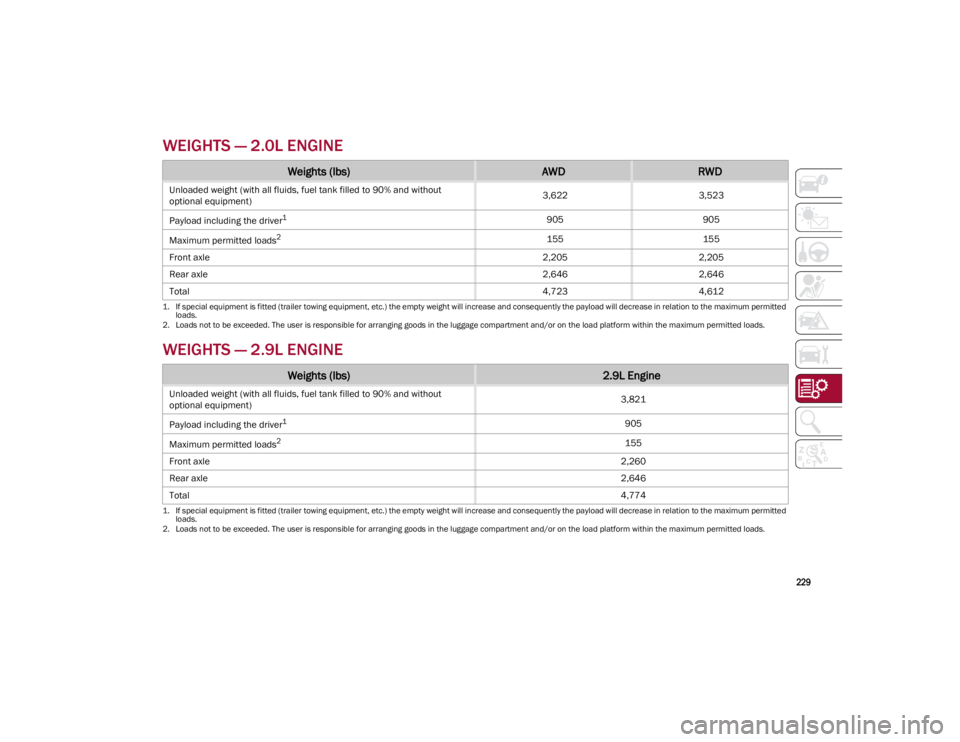
WEIGHTS — 2.0L ENGINE
WEIGHTS — 2.9L ENGINE
Weights (lbs)AWDRWD
Unloaded weight (with all fluids, fuel tank filled to 90% and without
optional equipment) 3,622
3,523
Payload including the driver
1
1. If special equipment is fitted (trailer towing equipment, etc.) the empty weight will increase and consequently the payload will decrease in relation to the maximum permitted loads.
905 905
Maximum permitted loads
2
2. Loads not to be exceeded. The user is responsible for arranging goods in the luggage compartment and/or on the load platform within the maximum permitted loads.
155 155
Front axle 2,2052,205
Rear axle 2,6462,646
Total 4,7234,612
Weights (lbs)2.9L Engine
Unloaded weight (with all fluids, fuel tank filled to 90% and without
optional equipment) 3,821
Payload including the driver
1
1. If special equipment is fitted (trailer towing equipment, etc.) the empty weight will increase and consequently the payload will decrease in relation to the maximum permitted loads.
905
Maximum permitted loads
2
2. Loads not to be exceeded. The user is responsible for arranging goods in the luggage compartment and/or on the load platform within the maximum permitted loads.
155
Front axle 2,260
Rear axle 2,646
Total 4,774
23_GA_OM_EN_USC_t.book Page 229
Page 246 of 248

244
INDEX
Tires .................................168, 212, 216, 219Aging (Life Of Tires) ................................ 215Air Pressure ............................................ 212
Compact Spare ...................................... 216
Flat Changing .........................................171
General Information......................212, 216
High Speed ............................................. 213
Inflation Pressure...................................212Life Of Tires ............................................ 215
Load Capacity.........................................209
Pressure Monitoring System (TPMS) .................................................. 73
Quality Grading....................................... 219
Radial......................................................214
Replacement ..........................................215
Safety .............................................206, 212
Sizes .......................................................207
Snow Tires ..............................................218
Spare Tires ............................................. 216
Spinning..................................................214
Tread Wear Indicators ...........................215
Tow Hooks ..................................................180
Towing Disabled Vehicle ....................................179
Towing Trailers ...........................................126
TPMS (Tire Pressure Monitoring
System) .......................................................142 Traction Control System (TCS) .................. 131
Traffic Jam Assist System ......................... 110
Traffic Sign Recognition System ............... 113
Transmission ............................................. 225
Transporting Animals ................................ 127
Transporting Passengers .......................... 127
Transporting Pets ...................................... 166
Tread Wear Indicators ............................... 215
Trunk Lid (Deck Lid) .....................................61
Turn Signals ........................................... 45, 74
U
Uconnect Settings Customer Programmable Features.........26
Passive Entry Programming.....................26
Uniform Tire Quality Grades...................... 219
Universal Garage Door Opener
(HomeLink®)
S..........................................39
Universal Transmitter ...................................39
Untwisting Procedure, Seat Belt............... 147
Use Of The Owner’s Manual .......................... 5
V
Vehicle Changes/Alterations ......................... 4
Vehicle Identification Number .................. 224
Vehicle Loading ................................ 125, 209 W
Warning Lights (Instrument Cluster
Descriptions) ................................................ 72
Warnings, Roll Over ........................................ 3
Warranty Information ................................ 238
Washer Fluid For Windshield/
Headlights .................................................. 189
Washers, Windshield ................................... 47
Weights ....................................................... 229
Wheel And Wheel Tire Care....................... 217
Wheel And Wheel Tire Trim ....................... 217
Wheels And Tires ....................................... 206
Wind Buffeting ............................................. 58
Windows (Cleaning) ................................... 222
Windshield Defroster ................................. 167
Windshield Washers .................................... 47
Windshield Wiper
Replacing Blades ................................... 194
Windshield Wipers ....................................... 47
Wipers, Intermittent ..................................... 47
Wipers, Rain Sensitive................................. 47
Wireless Charging Pad ................................ 57
23_GA_OM_EN_USC_t.book Page 244