2023 ALFA ROMEO GIULIA washer fluid
[x] Cancel search: washer fluidPage 190 of 248
SERVICING AND MAINTENANCE
188
CHECKING LEVELS — 2.9L ENGINE
E
NGINE OIL
The engine oil level can be seen on the
instrument cluster display every time the engine
is started, or on the Information and
Entertainment system display by activating on
the main menu (MENU button) the following
functions in sequence: “Vehicle Information”;
“Engine Oil”. Check on the display using the 6 notches that the
oil level is between the MIN and MAX level:
1 notch MIN level, 6 notches MAX level.
NOTE:
Use care when filling under hood fluids such as
engine oil, windshield washer fluid, antifreeze
etc. to minimize spillage onto the top of the
engine. Any excess fluid that is spilled onto the
top of the engine should be removed using
compressed air or an absorbent cloth.If the oil level is close to or below the MIN mark,
add oil gradually through the filler, (refer to
“Top-Up And Oil Level Indication Update On
Display” in this section) considering that each
notch shown on the display corresponds to
approximately 8.8 fl oz (250 ml).
The oil level can also be checked manually on
2.9L Engines.
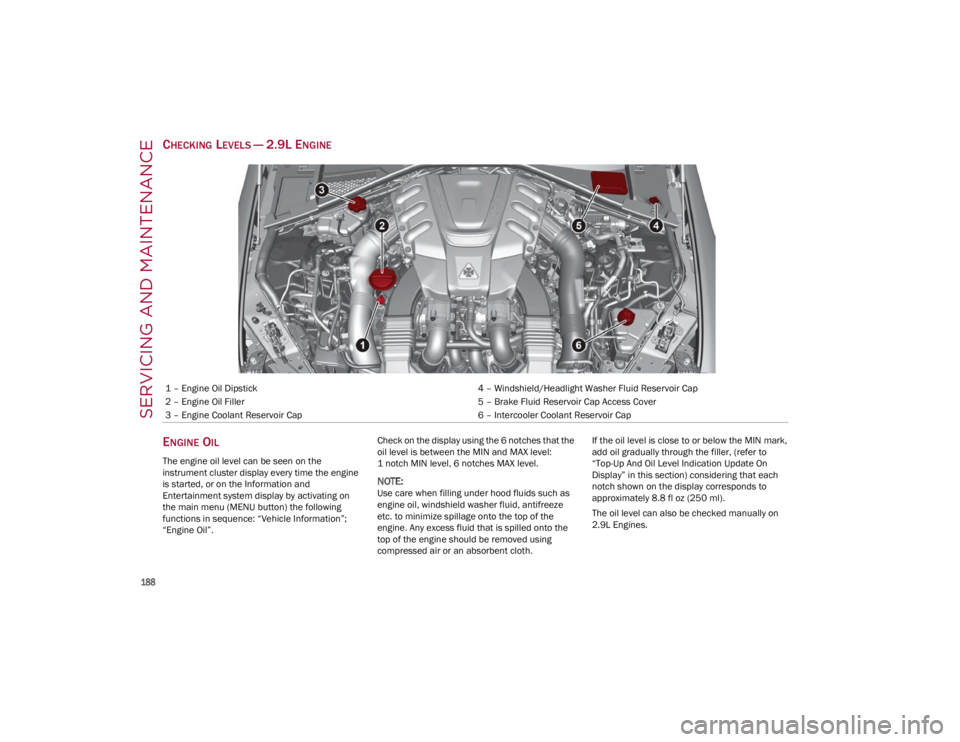
1 – Engine Oil Dipstick
4 – Windshield/Headlight Washer Fluid Reservoir Cap
2 – Engine Oil Filler 5 – Brake Fluid Reservoir Cap Access Cover
3 – Engine Coolant Reservoir Cap 6 – Intercooler Coolant Reservoir Cap
23_GA_OM_EN_USC_t.book Page 188
Page 191 of 248
189
NOTE:
Always reinstall the oil cap and tighten to proper
torque whenever it is removed to add oil to
engine. Never run the engine with cap removed
as this could cause oil to leak from engine.
Manual Oil Level Checking Procedure —
2.9L Engine
Check that the oil level is between the MIN and
MAX marks on dipstick, clean it with a lint-free
cloth and reinsert it. Extract the dipstick again
and check that the level is between the MIN and
MAX marks.
Top-Up And Oil Level Indication Update On
Display — 2.9L Engine
If an engine oil top-off is needed, in order to
ensure the correct indication of the oil level on
the display, proceed with the following process:
Leave the car on flat ground with the engine
running for approximately five minutes
(temperature higher than 198°F (90°C) and
shut the engine off.
Wait for five minutes, turn the ignition to the
ON mode without starting the engine and wait
for a few seconds.
NOTE:
If the level indication is not updated after the
previously described procedure, repeat the
engine adjustment, shut the engine off and wait
another five minutes before starting it again. If
the indication is not updated after the second
start, contact an authorized dealer.
Top-Up And Oil Level Indication Update On
Display — 2.0L Engine
If an engine oil top-off is needed, in order to
ensure the correct indication of the oil level on
the display, proceed with the following process:
Leave the car on flat ground with the engine
running for approximately five minutes
(temperature higher than 176°F (80°C) and
shut the engine off.
Start the engine again and idle it for about two
minutes.
NOTE:
If you have added the specified amount of oil and
the indicator is not reading “Full”, please contact
an authorized dealer.
ENGINE COOLANT
If the level is too low, remove the cap of reservoir
and add the fluid described on
Ú
page 233.
WASHER FLUID FOR WINDSHIELD/
H
EADLIGHTS
The windshield and headlights washer fluid
reservoir has a telescopic filler.
If the level is too low, remove reservoir cap and lift
the filler. Then, add the fluid described on
Ú
page 233.
NOTE:
Use care when filling under hood fluids such as
engine oil, windshield washer fluid, antifreeze
etc. to minimize spillage onto the top of the
engine. Any excess fluid that is spilled onto the
top of the engine should be removed using
compressed air or an absorbent cloth.
CAUTION!
Make sure not to add too much oil when
topping off the engine. Engine oil in excess
may damage the engine. Have the vehicle
checked. Never exceed the MAX level when
topping off engine oil. It is advisable to check
the oil level in intermediate steps using the oil
dipstick (2.9L Engine Only).
CAUTION!
The oil level is not refreshed immediately on
the display after topping off. Consequently,
wait for the oil level to be refreshed on the
display and see the following procedures.
WARNING!
If the engine oil is being topped up, wait for the
engine to cool down before loosening the filler
cap, particularly for vehicles with aluminum
cap (if equipped). WARNING: risk of burns!
CAUTION!
The oil level must never exceed the MAX mark.
If the MAX mark is exceeded (last notch on the
right turns red) after the fill-up, go to an
authorized dealer as soon as possible to have
the oil in excess removed.
Do not add oil with specifications different
from those of the oil already in the engine.
Used engine oil and oil filters contain
substances which are harmful to the
environment. To change the oil and filters, we
advise you to contact an authorized dealer.
23_GA_OM_EN_USC_t.book Page 189
Page 192 of 248
SERVICING AND MAINTENANCE
190
NOTE:
The headlight washing system will not work if the
liquid level is low (as indicated by the symbol on
the instrument cluster display). On vehicles
equipped with headlight washers, there is a refer-
ence notch on the dipstick: ONLY the windshield/
rear window washer operates with the level below
this reference.
BRAKE FLUID
Check that the fluid is at the maximum level. If
the fluid level in the tank is low, contact an
authorized dealer to have the system checked.
AUTOMATIC TRANSMISSION ACTIVATION
S
YSTEM OIL
The transmission control oil level should only be
checked at an authorized dealer.
USEFUL ADVICE FOR EXTENDING THE
L
IFE OF YOUR BATTERY
To avoid draining your battery and make it last
longer, observe the following instructions:
When you park the car, ensure that the doors
and trunk are closed properly to prevent any
lights from remaining on inside the
passenger's compartment.
Do not keep accessories (e.g. radio, hazard
warning lights, etc.) switched on for a long time
when the engine is not running.
Before performing any operation on the
electrical system, disconnect the negative
battery cable. If you wish to install electrical accessories after
purchasing the car that require permanent
electrical supply (e.g. alarm, etc.), or accessories
which influence the electrical supply
requirements, contact an authorized dealer,
whose qualified staff will evaluate the overall
electrical consumption.
NOTE:
After the battery is disconnected, the steering
must be initialized. The warning light on the
instrument panel switches on to indicate this. To
carry out this procedure, simply turn the steering
wheel all the way from one end to the other, and
then turn it back to the central position.
BATTERY
The battery does not require the electrolyte to be
topped up with distilled water. A periodic check
carried out at an authorized dealer, however, is
necessary to check efficiency.
Follow the battery manufacturer's instructions for
maintenance.
Replacing The Battery
If necessary, replace the battery with another
original battery with the same specifications.
Follow the battery manufacturer’s instructions for
maintenance.
NOTE:
It will not be possible to open the trunk with a key
or by pushing the button in the passenger
compartment when the battery is disconnected.
So, always position the manual trunk opening
strap on the trunk lock before disconnecting the
battery
Ú
page 220.
CAUTION!
If the charge level remains under 50% for a
long time, the battery may be damaged by
sulphation, reducing its capacity and
efficiency during a vehicle start. The battery is
also more prone to the risk of freezing (at
temperatures as high as 14°F (-10°C).
WARNING!
Battery acid is a corrosive solution and can
burn or even blind you. Do not allow battery
acid to contact your eyes, skin, or clothing.
Do not lean over a battery when attaching
clamps
Ú
page 177. If acid splashes in eyes
or on skin, flush the area immediately with
large amounts of water.
Battery gas is flammable and explosive.
Keep flame or sparks away from the battery.
Do not use a booster battery or any other
booster source with an output greater than
12 Volts. Do not allow cable clamps to touch
each other.
Battery posts, terminals, and related
accessories contain lead and lead
compounds. Wash hands after handling.
23_GA_OM_EN_USC_t.book Page 190
Page 196 of 248
SERVICING AND MAINTENANCE
194
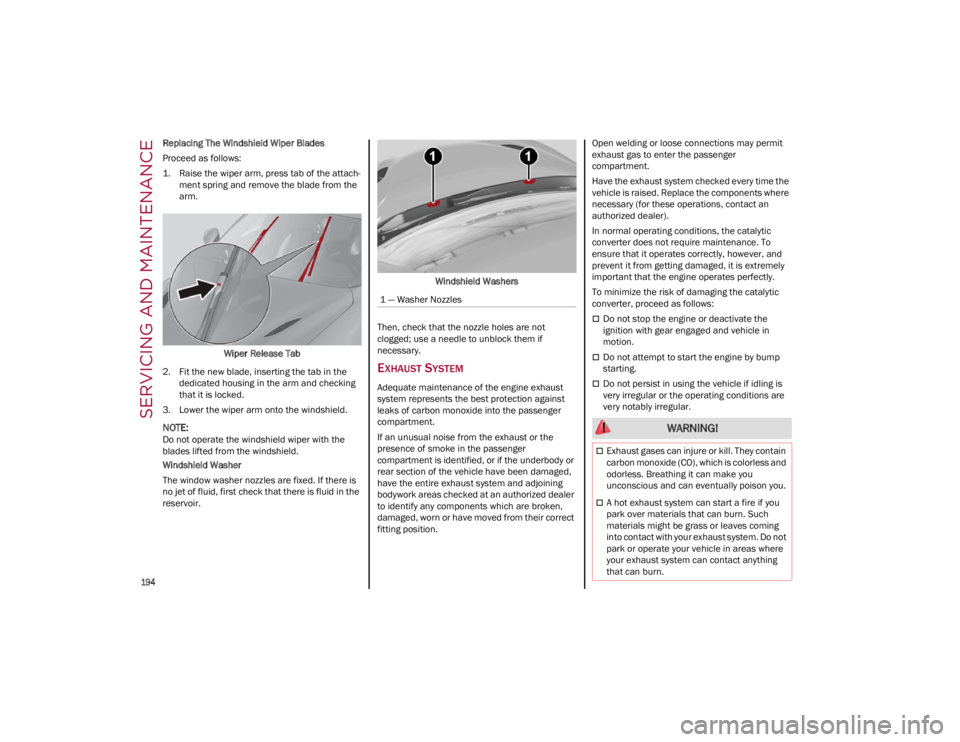
Replacing The Windshield Wiper Blades
Proceed as follows:
1. Raise the wiper arm, press tab of the attach -
ment spring and remove the blade from the
arm.
Wiper Release Tab
2. Fit the new blade, inserting the tab in the dedicated housing in the arm and checking
that it is locked.
3. Lower the wiper arm onto the windshield.
NOTE:
Do not operate the windshield wiper with the
blades lifted from the windshield.
Windshield Washer
The window washer nozzles are fixed. If there is
no jet of fluid, first check that there is fluid in the
reservoir. Windshield Washers
Then, check that the nozzle holes are not
clogged; use a needle to unblock them if
necessary.
EXHAUST SYSTEM
Adequate maintenance of the engine exhaust
system represents the best protection against
leaks of carbon monoxide into the passenger
compartment.
If an unusual noise from the exhaust or the
presence of smoke in the passenger
compartment is identified, or if the underbody or
rear section of the vehicle have been damaged,
have the entire exhaust system and adjoining
bodywork areas checked at an authorized dealer
to identify any components which are broken,
damaged, worn or have moved from their correct
fitting position. Open welding or loose connections may permit
exhaust gas to enter the passenger
compartment.
Have the exhaust system checked every time the
vehicle is raised. Replace the components where
necessary (for these operations, contact an
authorized dealer).
In normal operating conditions, the catalytic
converter does not require maintenance. To
ensure that it operates correctly, however, and
prevent it from getting damaged, it is extremely
important that the engine operates perfectly.
To minimize the risk of damaging the catalytic
converter, proceed as follows:
Do not stop the engine or deactivate the
ignition with gear engaged and vehicle in
motion.
Do not attempt to start the engine by bump
starting.
Do not persist in using the vehicle if idling is
very irregular or the operating conditions are
very notably irregular.
1 — Washer Nozzles
WARNING!
Exhaust gases can injure or kill. They contain
carbon monoxide (CO), which is colorless and
odorless. Breathing it can make you
unconscious and can eventually poison you.
A hot exhaust system can start a fire if you
park over materials that can burn. Such
materials might be grass or leaves coming
into contact with your exhaust system. Do not
park or operate your vehicle in areas where
your exhaust system can contact anything
that can burn.
23_GA_OM_EN_USC_t.book Page 194
Page 197 of 248
195
ENGINE COOLING SYSTEM
Coolant Check
Your vehicle has two cooling systems and they
both need to be checked to ensure they are at
proper fill levels.
Check the engine coolant and intercooler coolant
level every oil change or before long trips.
If there are impurities in the engine coolant, the
system must be drained, flushed and refilled:
contact an authorized dealer.
Check the front part of the condenser for any
buildup of insects, leaves or other debris. Should
it be dirty, clean it by spraying delicately with
water.Check the hoses of the engine/intercooler
cooling system to ensure that the rubber has not
deteriorated and that there are no cracks, tears,
cuts or obstructions in the expansion tank side
and radiator side connectors. Should there be
any doubt regarding leaks from the system (e.g. if
frequent top ups are required), have the seal
checked at an authorized dealer.
With the engine off and at normal operating
temperature, check that the cooling system
radiator cap is closed properly.
NOTE:
Before removing the coolant reservoir cap, wait
for the system to cool down.
Topping Up / Draining / Flushing The Engine/
Intercooler Coolant
If the engine coolant (antifreeze) is dirty, have
cleaning and flushing carried out at an authorized
dealer.
For the correct servicing intervals
Ú
page 182.
NOTE:
For topping up, use a fluid with the same
characteristics as those indicated on
Ú
page 233.
Do not use pure water, alcohol-based coolants,
corrosions inhibitors or additional anti-rust
products because they may be incompatible
with the engine coolant and cause the clogging
of the radiator. The use of propylene
glycol-based coolant is also not recommended.
Use care when filling under hood fluids such as
engine oil, windshield washer fluid, antifreeze
etc. to minimize spillage onto the top of the
engine. Any excess fluid that is spilled onto the
top of the engine should be removed using
compressed air or an absorbent cloth.
Engine Cooling/Intercooler System Cap
To prevent loss of engine coolant, make sure that
the expansion tank cap is closed. If it is open,
screw it completely until you reach/hear the click.
Periodically check the cap and clean it from any
foreign bodies that may have deposited on the
external surface.
WARNING!
You or others can be badly burned by hot
engine coolant (antifreeze) or steam from
your radiator. If you see or hear steam
coming from under the hood, do not open the
hood until the radiator has had time to cool.
Never open a cooling system pressure cap
when the radiator or coolant bottle is hot.
Keep hands, tools, clothing, and jewelry away
from the radiator cooling fan when the hood
is raised. The fan starts automatically and
may start at any time, whether the engine is
running or not.
When working near the radiator cooling fan,
disconnect the fan motor lead or turn the
ignition to the OFF position. The fan is
temperature controlled and can start at any
time the ignition is in the ON position.
WARNING!
Do not open hot engine cooling system.
Never add engine coolant (antifreeze) when
the engine is overheated. Do not loosen or
remove the cap to cool an overheated
engine. Heat causes pressure to build up in
the cooling system. To prevent scalding or
injury, do not remove the pressure cap while
the system is hot or under pressure.
Do not use a pressure cap other than the one
specified for your vehicle. Personal injury or
engine damage may result.
WARNING!
Never add coolant with the engine hot or
overheated.
Do not attempt to cool an overheated engine
by loosening or removing the cap. The heat
causes a considerable increase in pressure
in the cooling system.
To prevent damage to the engine, only use
the engine cooling circuit caps provided.
23_GA_OM_EN_USC_t.book Page 195
Page 233 of 248
231
FUEL SYSTEM CAUTIONS
NOTE:
Intentional tampering with the emissions control system can result in civil penalties being assessed against you.
FLUID CAPACITIES
2.0L ENGINE
CAUTION!
Follow these guidelines to maintain your vehicle’s performance:
The use of leaded gasoline is prohibited by Federal law. Using leaded gasoline can impair engine performance and damage the emissions control
system.
An out-of-tune engine or certain fuel or ignition malfunctions can cause the catalytic converter to overheat. If you notice a pungent burning odor or some
light smoke, your engine may be out of tune or malfunctioning and may require immediate service. Contact an authorized dealer for service assistance.
The use of fuel additives, which are now being sold as octane enhancers, is not recommended. Most of these products contain high concentrations of
methanol. Fuel system damage or vehicle performance problems resulting from the use of such fuels or additives is not the responsibility of the
manufacturer and may void or not be covered under the New Vehicle Limited Warranty.
ComponentUSMetric
Fuel Tank15.3 gal58 L
Fuel Tank Reserve 2.3 gal9 L
Engine Cooling Cystem 2.2 gal8.6 L
Intercooler Cooling System 1.1 gal4.3 L
Engine Oil Sump And Filter 5.5 qt5.2 L
Hydraulic Brake Circuit 0.9 qt0.9 L
Windshield Washer Fluid Reservoir 1.1 gal4.2 L
Automatic Transmission 9.9 qt (RWD Model) /
9.8 qt (AWD Model) 9.4 L (RWD Model) /
9.3 L (AWD Model)
Differentials And Reduction Gears RDU 195 0.9 qt0.9 L
23_GA_OM_EN_USC_t.book Page 231
Page 234 of 248

TECHNICAL SPECIFICATIONS
232
2.9L V6 ENGINE
Differentials And Reduction Gears RDU 230-TV––
RDU 230-LSD Differential - If Equipped 0.9 qt0.9 L
RDU 210/215-LSD Differential - If Equipped 1.1 qt1.1 L
AWD System FAD Transfer Case 0.5 qt0.5 L
AWD System Transfer Case 0.7 qt0.7 L
ComponentUSMetric
Fuel Tank 15.3 gal58 L
Fuel Tank Reserve 2.3 gal9 L
Engine Cooling System 2.95 gal11.2 L
Intercooler Cooling System 1.4 gal5.5 L
Engine Sump And Filter 7.2 qt7 L
Hydraulic Brake Circuit 0.9 qt0.9 L
Windshield Washer Fluid Reservoir 1.1 gal4.2 L
Automatic Transmission ––
Differentials And Reduction Gears RDU 195 ––
Differentials And Reduction Gears RDU 230-TV Main body: 0.8 qt
Left TV: 0.5 qt
Right TV: 0.6 qt Main body: 0.8 L
Left TV: 0.5 L
Right TV: 0.6 L
RDU 230-LSD Differential ––
RDU 210-eLSD Differential (If Equipped) ––
RDU 210/215-LSD Differential ––
ComponentUSMetric
23_GA_OM_EN_USC_t.book Page 232
Page 236 of 248

TECHNICAL SPECIFICATIONS
234
CHASSIS FLUIDS AND LUBRICANTS
2.0L Engine
2.9L Engine
UseFeaturesSpecificationApplications
Lubricants and greasesZF 8HP 50 - Synthetic ATF
–Automatic transmission
SAE 75W-85 Synthetic lubricant FPW9.55550-DA9Differential and reduction units
RDU 195; RDU 230-LSD; RDU
210-eLSD; RDU 210/215-LSD
SAE 75W-80 APL GL-5 Synthetic lubricant FPW9.55550-DA10
AWD System FAD transfer case
SAE 75W Synthetic lubricant FPW9.55550-DA11AWD System TRANSFER CASE
Brake fluid DOT 4MS.90039Hydraulic brakes
Engine coolant CUNA NC 956-16
ASTMD3306 MS.90032Use rate 50% Not mixable with
different formulation products.
1
1. For particularly harsh climate conditions, a mixture of 60% product and 40% distilled water is recommended.
Windshield washer fluid CUNA NC 956-11MS.90043To be used diluted or undiluted in
windshield washer/wiper systems
HVAC R1234yf ––
UseFeaturesSpecificationApplications
Lubricants and greasesZF 8HP 50 - Synthetic ATF
–Automatic transmission
SAE 75W-85 API GL-5 Synthetic lubricant FPW9.55550-DA8Differential and reduction units
RDU 230-TV / 2.9 V6 engine
Brake fluid DOT 4MS.90039Hydraulic brakes
Engine coolant CUNA NC 956-16
ASTMD3306 MS.90032Use rate 50% Not mixable with
different formulation products.
1
23_GA_OM_EN_USC_t.book Page 234