2022 TOYOTA VENZA HYBRID wheel
[x] Cancel search: wheelPage 2 of 548

2TABLE OF CONTENTS
For your information...................6
Reading this manual ................ 11
How to search .......................... 12
Pictorial index .......................... 14
1-1. For safe use Before driving ................... 26
For safe driving ................ 27
Seat belts ......................... 29
SRS airbags ..................... 33
Front passenger occupant classification system ...... 43
Exhaust gas precautions.. 48
1-2. Child safety Riding with children .......... 49
Child restraint systems..... 50
1-3. Emergency assistance Safety Connect ................ 65
1-4. Hybrid system Hybrid system features .... 70
Hybrid system precautions ....................................... 74
1-5. Theft deterrent system Immobilizer system .......... 79
Alarm................................ 80
2-1. Instrument cluster Warning lights and indicators....................................... 84
Gauges and meters (Vehi- cles with 4.2-inch display)
....................................... 89Gauges and meters (Vehi-
cles with 7-in ch display) .93
Multi-information display (4.2-inch display) ............ 96
Multi-information display (7- inch display) ................ 107
Head-up display ............ 118
Energy monitor/consumption screen.......................... 123
3-1. Key information Keys .............................. 130
3-2. Opening, closing and lock- ing the doors
Side doors ..................... 133
Back door ...................... 138
Smart key system .......... 150
3-3. Adjusting the seats Front seats .................... 155
Rear seats ..................... 156
Driving position memory 158
Head restraints .............. 162
3-4. Adjusting the steering wheel and mirrors
Steering wheel............... 164
Inside rear view mirror ... 165
Digital Rear-view Mirror . 166
Outside rear view mirrors .................................... 177
3-5. Opening, closing the win- dows
Power windows ............. 179
1For safety and security
2
Vehicle status
information and
indicators
3Before driving
Page 3 of 548

3TABLE OF CONTENTS
1
2
3
4
5
6
7
8
9
4-1. Before drivingDriving the vehicle......... 184
Cargo and luggage ....... 191
Vehicle load limits ......... 194
Trailer towing ................ 195
Dinghy towing ............... 196
4-2. Driving procedures Power (ignition) switch .. 197
EV drive mode .............. 202
Hybrid transmission ...... 204
Turn signal lever ........... 208
Parking brake ................ 209
Brake Hold .................... 212
4-3. Operating the lights and wipers
Headlight switch ............ 215
AHB (Automatic High Beam) .................................... 218
Fog light switch ............. 221
Windshield wipers and washer......................... 222
Rear window wiper and washer......................... 225
4-4. Refueling Opening the fuel tank cap.................................... 227
4-5. Using the driving support
systems
Toyota Safety Sense 2.0 230
PCS (Pre-Collision System) .................................... 236
LTA (Lane Tracing Assist) .................................... 244
RSA (Road Sign Assist) 254Dynamic radar cruise control
with full-speed range ... 257
BSM (Blind Spot Monitor) .................................... 268
Intuitive parking assist ... 278
PKSB (Parking Support Brake) .......................... 286
Parking Support Brake func- tion (static objects) ...... 291
Parking Support Brake func- tion (rear-crossing vehicles).................................... 293
Driving mode s elect switch
.................................... 295
Driving assist systems ... 296
4-6. Driving tips Hybrid Electric Vehicle driv-ing tips ......................... 302
Winter driving tips .......... 304
Utility vehicle precautions .................................... 307
5-1. Using the ai r conditioning
system and defogger
Automatic air conditioning system (vehicles with 8-inch
display) ........................ 312
Automatic air conditioning system (vehicl es with 12.3-
inch display) ................ 31
9
Heated stee
ring wheel/seat
heaters/seat ventilators 329
5-2. Using the interior lights Interior lights list ............ 333
5-3. Using the storage features List of storage features .. 337
4Driving
5Interior features
Page 4 of 548
4TABLE OF CONTENTS
Luggage compartment fea-tures ............................ 340
5-4. Using the other interior fea- tures
Toyota multi-operation touch
(vehicle with the 12.3-inch
display) ........................ 344
Panoramic fixed moon roof with one-touch frosted glass
control ......................... 346
Other interior features ... 349
Garage door opener...... 360
6-1. Maintenance and care Cleaning and protecting the vehicle exterior ............ 370
Cleaning and protecting the vehicle interior ............. 373
6-2. Maintenance Maintenance requirements.................................... 377
General maintenance.... 379
Emission inspection and maintenance (I/M) pro-
grams .......................... 381
6-3. Do-it-yourself maintenance Do-it-yourself service pre-cautions ....................... 383
Hood ............................. 385
Positioning a floor jack .. 386
Engine compartment ..... 388
12-volt battery ............... 394
Tires .............................. 397
Tire inflation pressure ... 409
Wheels ......... .................411 Air conditioning filter ......
413
Cleaning the hybrid battery (traction battery) air intake
vent and filter ............... 415
Wiper insert replacement .................................... 419
Electronic key battery .... 422
Checking and replacing fuses ............................ 424
Headlight aim ................ 427
Exterior lights................. 428
7-1. Essential information Emergency flashers....... 430
If your vehicle has to be stopped in an emergency.................................... 431
If the vehicle is submerged or water on the road is rising.................................... 432
7-2. Steps to take in an emer- gency
If your vehicle needs to be towed ........................... 433
If you think something is wrong........................... 436
If a warning light turns on or a warning buzzer sounds.................................... 438
If a warning message is dis- played .......................... 449
If you have a flat tire ...... 453
If the hybrid system will not start ............................. 460
If you lose your keys...... 462
6Maintenance and care
7When trouble arises
Page 19 of 548
19Pictorial index
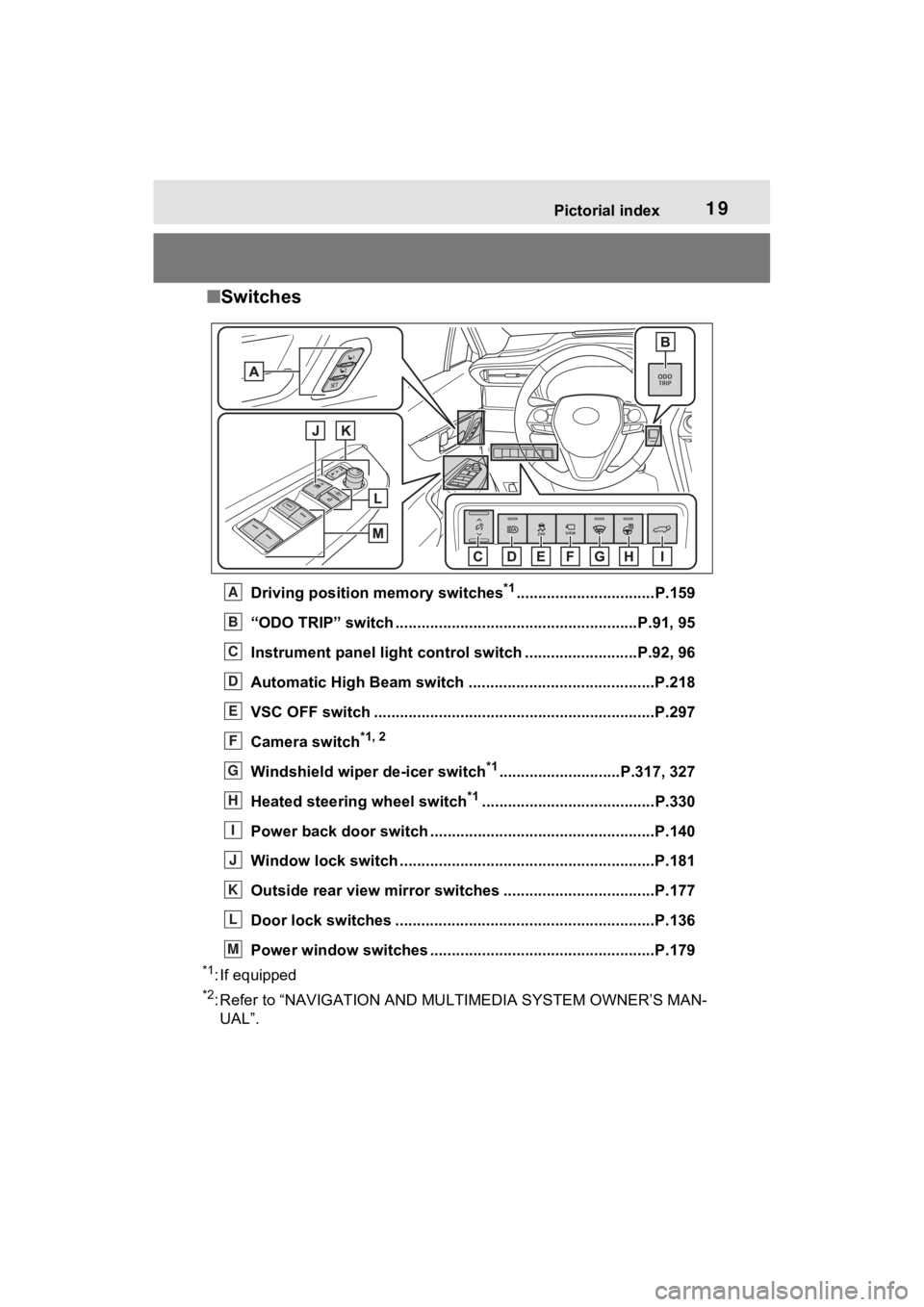
■Switches
Driving position memory switches*1................................P.159
“ODO TRIP” switch .............................................. ..........P.91, 95
Instrument panel light cont rol switch ..........................P.92, 96
Automatic High Beam switch ..................................... ......P.218
VSC OFF switch .................................................................P.297
Camera switch
*1, 2
Windshield wiper de-icer switch*1............................P.317, 327
Heated steering wheel switch
*1........................................P.330
Power back door switch ... .................................................P.140
Window lock switch ............................................. ..............P.181
Outside rear view mirror swi tches ...................................P.177
Door lock switches ............................................................P.136
Power window switches ....... .............................................P.179
*1: If equipped
*2: Refer to “NAVIGATION AND MULTIMEDIA SYSTEM OWNER’S MAN-
UAL”.
A
B
C
D
E
F
G
H
I
J
K
L
M
Page 27 of 548
271-1. For safe use
1
For safety and security
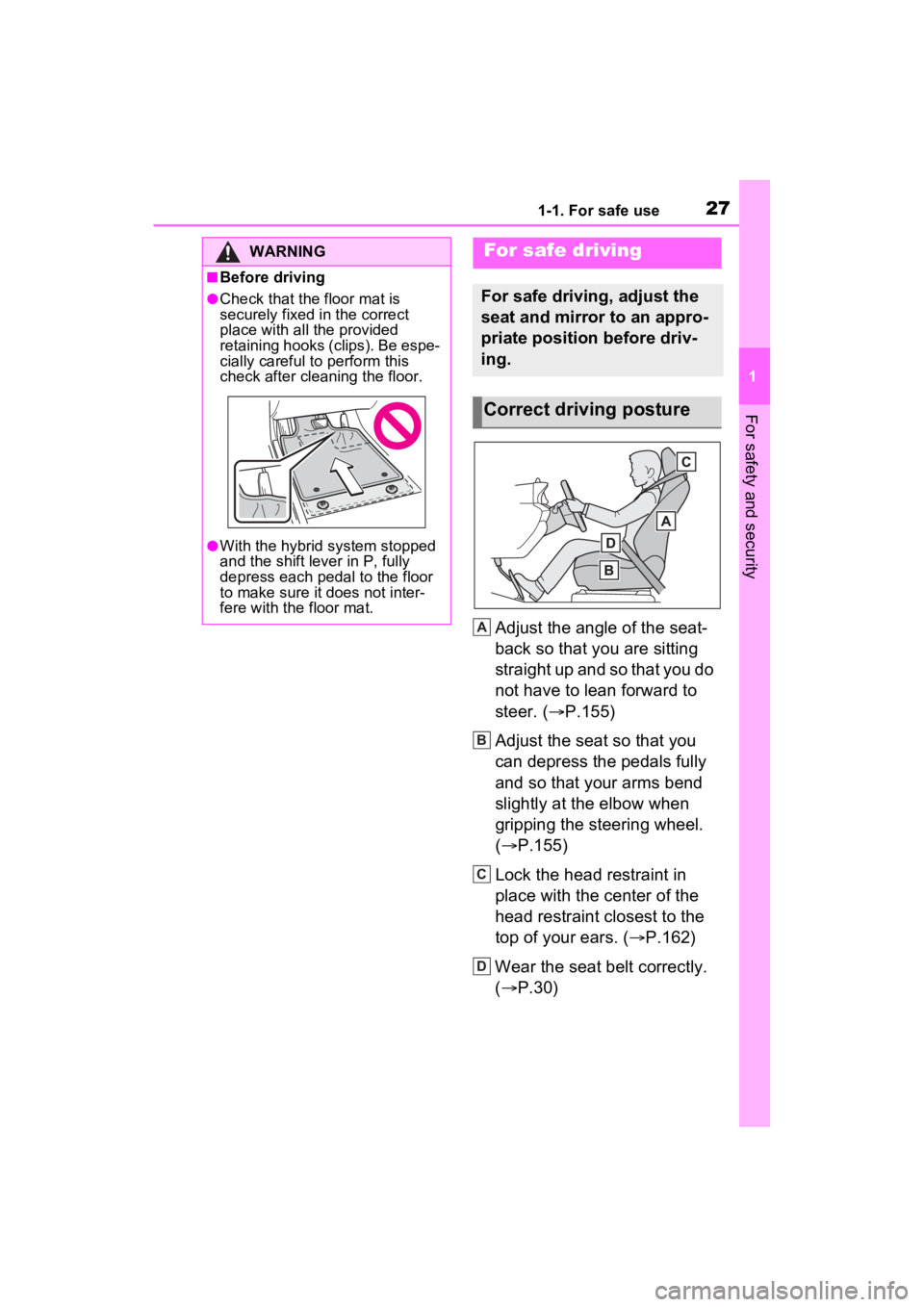
Adjust the angle of the seat-
back so that you are sitting
straight up and so that you do
not have to lean forward to
steer. (P.155)
Adjust the seat so that you
can depress the pedals fully
and so that your arms bend
slightly at the elbow when
gripping the steering wheel.
( P.155)
Lock the head restraint in
place with the center of the
head restraint closest to the
top of your ears. ( P.162)
Wear the seat belt correctly.
( P.30)
WARNING
■Before driving
●Check that the floor mat is
securely fixed in the correct
place with all the provided
retaining hooks (clips). Be espe-
cially careful to perform this
check after cleaning the floor.
●With the hybrid system stopped
and the shift lever in P, fully
depress each pedal to the floor
to make sure it does not inter-
fere with the floor mat.
For safe driving
For safe driving, adjust the
seat and mirror to an appro-
priate position before driv-
ing.
Correct driving posture
A
B
C
D
Page 35 of 548

351-1. For safe use
1
For safety and security
Front passenger occupant classification sensors
Knee airbag
SRS warning light
Airbag sensor assembly
Your vehicle is equipped with ADVANCED AIRBAGS designed
based on the US motor vehicle safety standards (FMVSS208). The
airbag sensor assembly (ECU) cont rols airbag deployment based on
information obtained from the sensors etc. shown in the system
components diagram above. This in formation includes crash sever-
ity and occupant information. As the airbags deploy, a chemical
reaction in the inflators quickly fills the airbags with non-toxic gas to
help restrain the motion of the occupants.
■If the SRS airbags deploy
(inflate)
●Slight abrasions, burns, bruising
etc., may be sustained from SRS
airbags, due to the extremely high
speed deployment (inflation) by
hot gases.
●A loud noise and white powder will
be emitted.
●Parts of the airbag module (steer-
ing wheel hub, airbag cover and
inflator) as well as the front seats,
parts of the front and rear pillars,
and roof side rails, may be hot for
several minutes. T he airbag itself
may also be hot.
●The windshield may crack.
●The hybrid system will be stopped
and fuel supply to the engine will
be stopped. ( P.78)
●All of the doors will be unlocked.
( P.134)
●The brakes and st op lights will be
controlled automatically.
( P.297)
●The interior lights will turn on auto-
matically. ( P.334)
●The emergency flashers will turn
on automatically. ( P.430)
●For Safety Connect subscribers, if any of the following situations
occur, the system is designed to
send an emergency call to the
response center, notifying them of
the vehicle’s location (without
needing to push the “SOS” button)
and an agent will attempt to speak
with the occupants to ascertain
the level of emergency and assis-
tance required. If the occupants
are unable to communicate, the
agent automatically treats the call
as an emergency and helps to dis-
patch the necessary emergency
services. (
P.65)
• An SRS airbag is deployed.
• A seat belt pretensioner is acti- vated.
• The vehicle is involved in a severe rear-end collision.
■SRS airbag deployment condi-
tions (SRS front airbags)
●The SRS front airbags will deploy
in the event of an impact that
exceeds the set threshold level
(the level of forc e corresponding
to an approximately 12 - 18 mph
[20 - 30 km/h] frontal collision with
a fixed wall that does not move or
deform).
However, this threshold velocity will
be considerably higher in the follow-
ing situations:
N
O
P
Q
Page 38 of 548
381-1. For safe use
vehicle was involved in an acci-
dent that was not severe enough
to cause the SRS side and curtain
shield airbags to inflate.
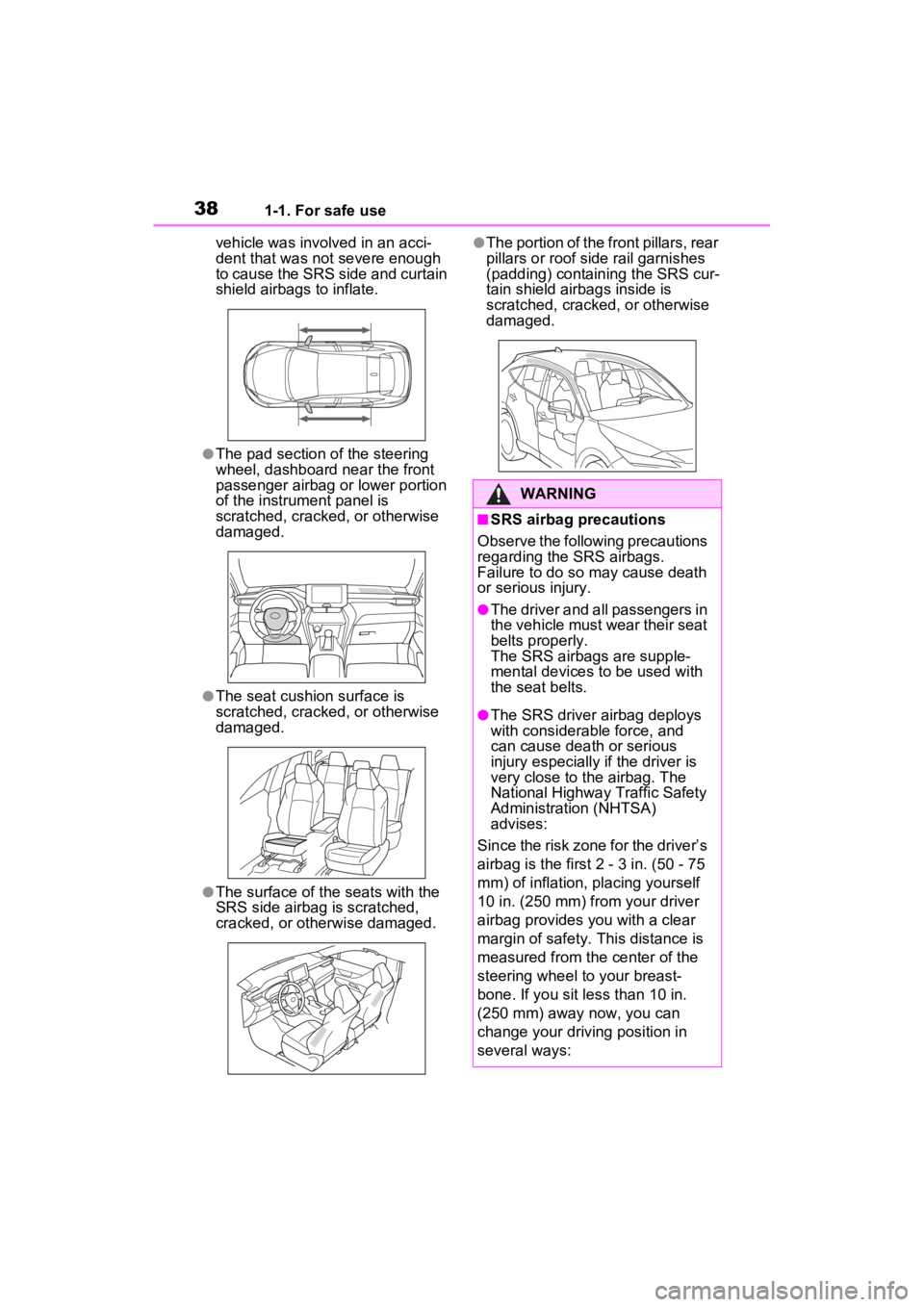
●The pad section of the steering
wheel, dashboard near the front
passenger airbag o r lower portion
of the instrument panel is
scratched, cracked, or otherwise
damaged.
●The seat cushion surface is
scratched, cracked, or otherwise
damaged.
●The surface of the seats with the
SRS side airbag is scratched,
cracked, or otherwise damaged.
●The portion of the front pillars, rear
pillars or roof side rail garnishes
(padding) containing the SRS cur-
tain shield airbags inside is
scratched, cracked, or otherwise
damaged.
WARNING
■SRS airbag precautions
Observe the following precautions
regarding the SRS airbags.
Failure to do so may cause death
or serious injury.
●The driver and all passengers in
the vehicle must wear their seat
belts properly.
The SRS airbags are supple-
mental devices to be used with
the seat belts.
●The SRS driver airbag deploys
with considerable force, and
can cause death or serious
injury especially if the driver is
very close to the airbag. The
National Highway Traffic Safety
Administration (NHTSA)
advises:
Since the risk zone for the driver’s
airbag is the first 2 - 3 in. (50 - 75
mm) of inflation, placing yourself
10 in. (250 mm) from your driver
airbag provides you with a clear
margin of safety. This distance is
measured from the center of the
steering wheel to your breast-
bone. If you sit less than 10 in.
(250 mm) away now, you can
change your driving position in
several ways:
Page 40 of 548
401-1. For safe use
WARNING
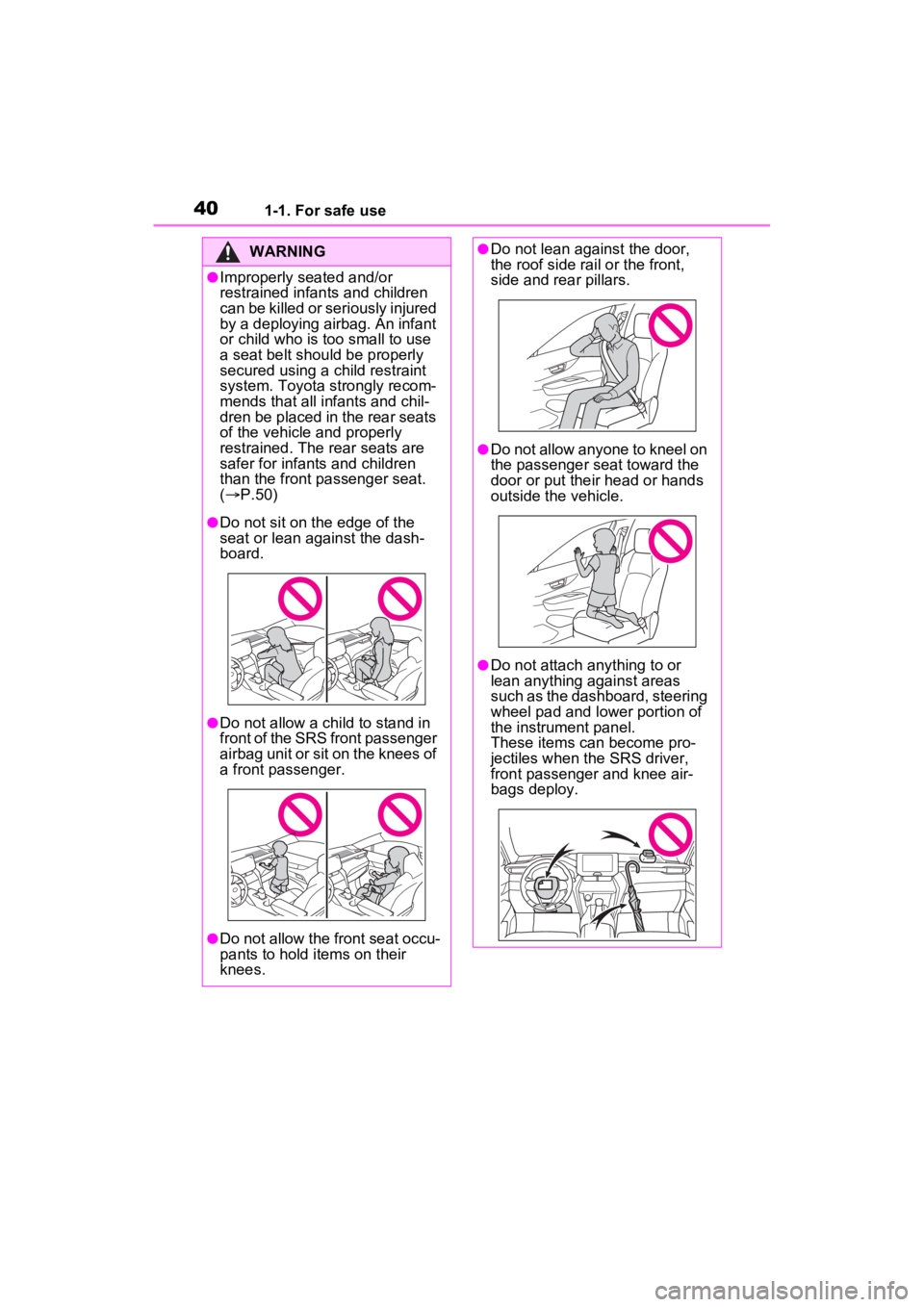
●Improperly seated and/or
restrained infants and children
can be killed or seriously injured
by a deploying airbag. An infant
or child who is too small to use
a seat belt should be properly
secured using a child restraint
system. Toyota strongly recom-
mends that all infants and chil-
dren be placed in the rear seats
of the vehicle and properly
restrained. The rear seats are
safer for infants and children
than the front pa ssenger seat.
( P.50)
●Do not sit on the edge of the
seat or lean against the dash-
board.
●Do not allow a child to stand in
front of the SRS front passenger
airbag unit or sit on the knees of
a front passenger.
●Do not allow the front seat occu-
pants to hold items on their
knees.
●Do not lean against the door,
the roof side rail or the front,
side and rear pillars.
●Do not allow anyone to kneel on
the passenger seat toward the
door or put their head or hands
outside the vehicle.
●Do not attach anything to or
lean anything against areas
such as the dashboard, steering
wheel pad and lower portion of
the instrument panel.
These items can become pro-
jectiles when the SRS driver,
front passenger and knee air-
bags deploy.