2022 TOYOTA SUPRA radio
[x] Cancel search: radioPage 168 of 498
1663-1. CONTROLS
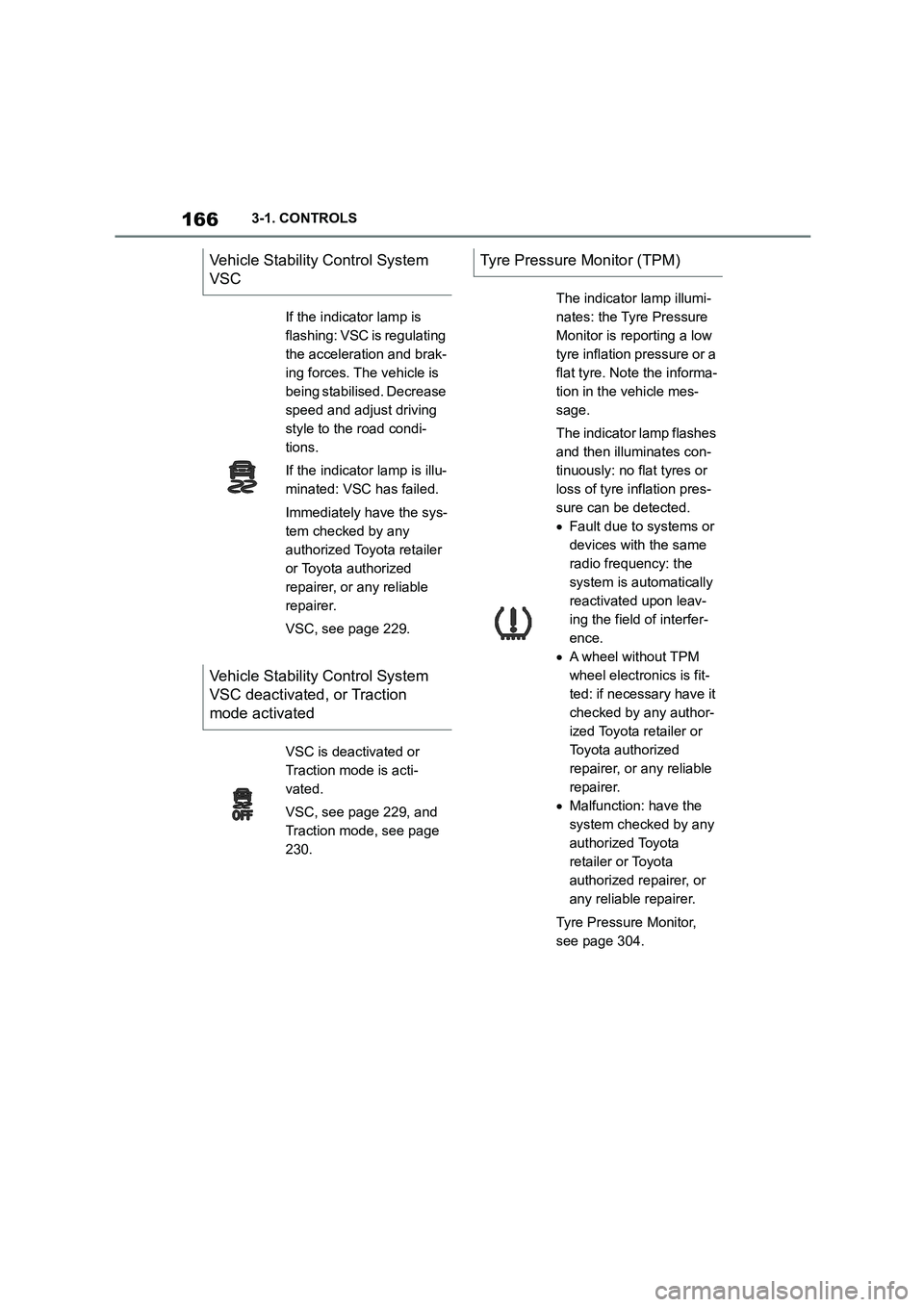
Vehicle Stability Control System
VSC
If the indicator lamp is
flashing: VSC is regulating
the acceleration and brak-
ing forces. The vehicle is
being stabilised. Decrease
speed and adjust driving
style to the road condi-
tions.
If the indicator lamp is illu-
minated: VSC has failed.
Immediately have the sys-
tem checked by any
authorized Toyota retailer
or Toyota authorized
repairer, or any reliable
repairer.
VSC, see page 229.
Vehicle Stability Control System
VSC deactivated, or Traction
mode activated
VSC is deactivated or
Traction mode is acti-
vated.
VSC, see page 229, and
Traction mode, see page
230.
Tyre Pressure Monitor (TPM)
The indicator lamp illumi-
nates: the Tyre Pressure
Monitor is reporting a low
tyre inflation pressure or a
flat tyre. Note the informa-
tion in the vehicle mes-
sage.
The indicator lamp flashes
and then illuminates con-
tinuously: no flat tyres or
loss of tyre inflation pres-
sure can be detected.
Fault due to systems or
devices with the same
radio frequency: the
system is automatically
reactivated upon leav-
ing the field of interfer-
ence.
A wheel without TPM
wheel electronics is fit-
ted: if necessary have it
checked by any author-
ized Toyota retailer or
Toyota authorized
repairer, or any reliable
repairer.
Malfunction: have the
system checked by any
authorized Toyota
retailer or Toyota
authorized repairer, or
any reliable repairer.
Tyre Pressure Monitor,
see page 304.
Page 284 of 498
2824-1. DRIVING HINTS
temperatures to clean the exhaust
gas particle filter as necessary.
The cleaning process takes a few
minutes, during which the following
may occur:
Engine temporarily runs a bit
roughly.
A slightly higher engine speed is
required to achieve the usual
power output.
A small amount of smoke from
the exhaust, even after stopping
the engine.
Noise, for example from radiator
fan operation, may be heard,
even some minutes after stop-
ping the engine.
It is normal for the radiator fan to
keep running for several minutes,
even after short trips.
The self-cleaning function of the
exhaust particle filter is an auto-
matic process that is supported by
different measures, for example
additional heating.
General
Cleaning the exhaust gas
particle filter while driving
Radio signals
WA R N I N G
Certain vehicle functions may be
affected by interference from high-fre- quency radio signals. Such signals
are output from a series of transmis-
sion systems, for example from air traffic beacons or relay stations for
mobile telecommunications.
We recommend you consult any
authorized Toyota retailer or Toyota authorized repairer, or any reliable
repairer should you experience any
difficulties in this regard.
Mobile communication in the
vehicle
WA R N I N G
There is a possibility of reciprocal
interference between the vehicle elec- tronics and mobile radio devices.
Radiation is generated when mobile
radio devices are transmitting. There
is a danger of injury or damage to property. If possible, only use mobile
radio devices, for example mobile
telephones, in the interior if they are connected directly to an external
antenna in order to eliminate recipro-
cal interference and to dissipate the radiation from vehicle's interior.
Page 314 of 498
3125-1. MOBILITY
■Final tyre failure
Vibration or loud noises during the
journey may be an indication that
the tyre has finally failed.
Reduce your speed and stop the
vehicle. Parts of the tyre could
detach, which might lead to an acci-
dent.
Do not continue driving, but contact
any authorized Toyota retailer or
Toyota authorized repairer, or any
reliable repairer.
The tyre inflation pressure depends
on the temperature of the tyre.
The tyre inflation pressure
increases as the tyre temperature
increases, for example during driv-
ing or due to exposure to sunlight.
Tyre inflation pressure decreases if
the tyre temperature drops.
Due to the given warning thresh-
olds, therefore, this behaviour may
trigger a warning if there are major
temperature drops.
After a temperature-related warn-
ing, the specified pressures are dis-
played again on the Control Display
after driving a short distance.
No warning can be given in the
event of extreme, sudden tyre fail-
ure caused by external factors.
Tyres with special approval: the
system will not function correctly if
a reset has not been carried out, for
example, a flat ty re is reported in
spite of the correct tyre pressure.
• A wheel without TPM wheel elec-
tronics is fitted, for example
emergency wheel: have the
wheels checked if necessary.
• Malfunction: have the system
checked.
• Fault due to systems or devices
with the same radio frequency:
the system is automatically reac-
tivated upon leaving the field of
interference.
• Tyre Pressure Monitor malfunc-
tion: have the system checked
by any authorized Toyota retailer
or Toyota authorized repairer, or
System limits
Temperature
Sudden loss of tyre inflation pres-
sure
Reset not carried out
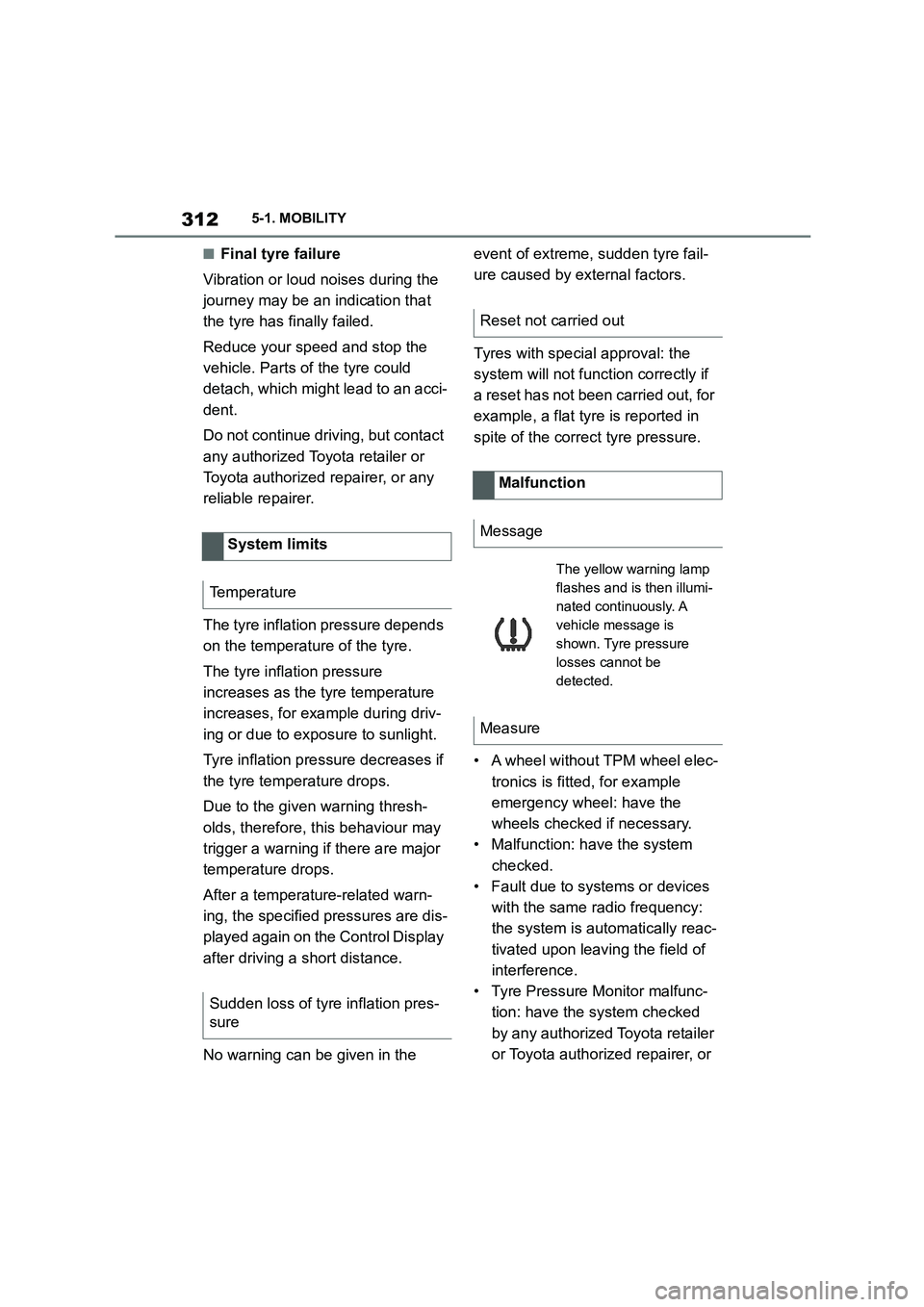
Malfunction
Message
The yellow warning lamp
flashes and is then illumi-
nated continuously. A
vehicle message is
shown. Tyre pressure
losses cannot be
detected.
Measure
Page 360 of 498
3585-1. MOBILITY
3Switch off any power consumers
in both vehicles.
The jump-starting connection in the
engine compartment serves as the
battery positive terminal.
A special connection on the body
serves as the negative battery ter-
minal in the engine compartment.
For further information:
Overview of the engine compart-
ment, see page 320.
Open the lid of the positive battery
terminal.
Before starting, switch off all unnec-
essary power consumers, for
example the radio, on both vehi-
cles.
1 Open the cover of the
jump-starting connection.
2 Connect a terminal clamp on the
positive/+ jump lead to the posi-
tive terminal of the battery or the
corresponding jump-starting
connection on the donor vehicle.
3 Connect the second terminal
clamp to the battery's positive
terminal or to the corresponding
jump-starting connection on the
vehicle to be started.
4 Connect a terminal clamp on the
negative/– jump lead to the neg-
ative terminal of the battery or
the corresponding engine or
body earth connection on the
donor vehicle.
5 Connect the second terminal
clamp to the negative terminal of
the battery or to a corresponding
engine or body earth connection
on the vehicle to be started.
Do not use spray products sold as
starting aids.
1 Start the engine of the donor
vehicle and allow it to run for a
few minutes at a slightly
increased idle speed.
2 Start the engine of the vehicle to
be started as normal.
If an initial attempt to start the engine
fails, wait several minutes until the dis-
charged battery has been recharged somewhat.
3 Allow both engines to run for a
few minutes.
4 Disconnect the jump leads in
reverse order to connection.
Check the battery and have it
recharged if necessary.
Jump-starting connections
Connecting the cables
Starting the engine
Page 378 of 498

3766-1. REFERENCE
The following note is for all
radio-based Components of the
vehicle and the vehicle integrated
information systems and communi-
cation devices:
The radio-based components of
this vehicle are in accordance with
the basic requirements and the rest
relevant provisions of the Directive
2014/53 / EU. Further information is
available from any authorized
Toyota retailer or Toyota authorized
repairer, or any reliable repairer.
Certification
Information
Alarm System
Page 493 of 498

491Alphabetical Index
P
Paintwork, vehicle ........................ 364
Parking aid, see Parking Sensors248
Parking brake................................ 148
Parking lights................................ 186
Parking Sensors ........................... 248
Parking Sensors with emergency
braking function, see Emergency
braking function ......................... 251
Part replacement .......................... 339
Particle filter, see Exhaust gas parti-
cle filter ....................................... 281
Parts and accessories ..................... 7
Pedestrian protection, active ...... 204
Personal profile, see Driver profiles
....................................................... 76
Petrol ............................................. 322
Petrol grade .................................. 323
Petrol particle filter, see Exhaust gas
particle filter................................ 281
Place for children ......................... 122
Plastic parts, care......................... 367
Positioning, vehicle position ......... 73
Power display, see Sport displays
..................................................... 180
Power failure ................................. 343
Power window switches .............. 105
Pre-Collision System ................... 207
Pre-Collision System (for pedestri-
ans and bicycles) ....................... 212
Pressure Monitor, see Tyre Pressure
Monitor ........................................ 304
Pressure, tyres ............................. 292
Prevention of rear collision ......... 224
Profiles, see Driver profiles ........... 76
Protection function, windows, see
Anti-trap mechanism ................. 106
R
Racing track driving ..................... 285
Radar sensors, see Sensors of the
vehicle ........................................... 50
Radiator fan, see Exhaust gas parti-
cle filter........................................281
Radio remote control, see Remote
control ........................................... 88
Rain sensor ...................................152
RCTA (Rear cross traffic alert) func-
tion ............................................... 256
Rear collision warning, see Preven-
tion of rear collision ................... 224
Rear fog light................................. 190
Rear fog light, see Bulbs and lights
..................................................... 340
Rear light, see Bulbs and lights ..340
Rear-view camera, without Sur-
round View .................................. 253
Rear-view mirror, automatic-dim . 118
Recirculating air filter, see Microfil-
ter/activated carbon filter ..........266
Recommended makes of tyre ...... 297
Recycling ....................................... 333
Refuelling ......................................290
Remedying flat tyres .................... 299
Remote control of the vehicle,
replacing the battery .................... 92
Remote control, additional ............ 93
Remote control, integrated key ..... 94
Remote control, loss ...................... 93
Remote control, malfunction ......... 93
Remote control, opening/closing .. 88
Replacement of parts ................... 339
Replacement of wheels/tyres ...... 296
Replacement wheel, see Emergency
wheel ...........................................318
Replacing bulbs, see Bulbs and
lights ............................................340
Replacing LEDs, see Bulbs and
lights ............................................340
Replacing light-emitting diodes, see
Bulbs and lights ......................... 340
Replacing lights, see Bulbs and
lights ............................................340
Replacing parts .............................339
Replacing the battery, remote con-
trol of the vehicle.......................... 92
Replacing the wiper blades .........339