Page 47 of 592

471-1. For safe use
1
For safety and security
SEQUOIA_OM_USA_OM0C047U■
SRS airbag deployment condi tions (SRS front airbags)
● The SRS front airbags will deploy in the event of an impact tha t exceeds the
set threshold level (the level of force corresponding to an approximately 12 -
18 mph [20 - 30 km/h] frontal collision with a fixed wall that does not move or
deform).
However, this threshold velocity will be considerably higher in the following
situations:
• If the vehicle strikes an object, such as a parked vehicle or sign pole,
which can move or deform on impact
• If the vehicle is involved in an underride collision, such as a collision in
which the front of the vehicle “underrides”, or goes under, the bed of a
truck
● The SRS front airbags for the front passenger will not activate if there is no
passenger sitting in the front passenger seat. However, the SRS front air-
bags for the front passenger may deploy if luggage is put in the seat, even if
the seat is unoccupied.
■ SRS airbag deployment conditions (SRS side and curtain shield a irbags)
● The SRS side and curtain shield airbags will deploy in the even t of an
impact that exceeds the set threshold level (the level of force corresponding
to the impact force produced by an approximately 3300 lb. [1500 kg] vehicle
colliding with the vehicle cabin from a direction perpendicular to the vehicle
orientation at an approximate speed of 12 - 18 mph [20 - 30 km/ h]).
● Both SRS curtain shield airbags will deploy in the event of veh icle rollover.
● Both SRS curtain shield airbags may also deploy in the event of a severe
frontal collision.
Page 49 of 592

491-1. For safe use
1
For safety and security
SEQUOIA_OM_USA_OM0C047U■
Types of collisions that may not deploy the SRS airbags (SRS si de and
curtain shield airbags)
The SRS side and curtain shield airbags may not activate if the vehicle is
subjected to a collision from the side at certain angles, or a collision to the
side of the vehicle body other than the passenger compartment.
The SRS side airbags do not generally inflate if the vehicle is involved in a
frontal or rear collision, if it rolls over, or if it is involv ed in a low-speed side
collision.
The SRS curtain shield airbags do not generally inflate if the vehicle is
involved in a rear collision, if it pitches end over end, or if it is involved in a
low-speed side or low-speed frontal collision. ● Collision from the side to the vehicle
body other than the passenger compart-
ment
● Collision from the side at an angle
● Collision from the front
● Collision from the rear
● Vehicle rollover
●Collision from the rear
● Pitching end over end
Page 51 of 592
511-1. For safe use
1
For safety and security
SEQUOIA_OM_USA_OM0C047U
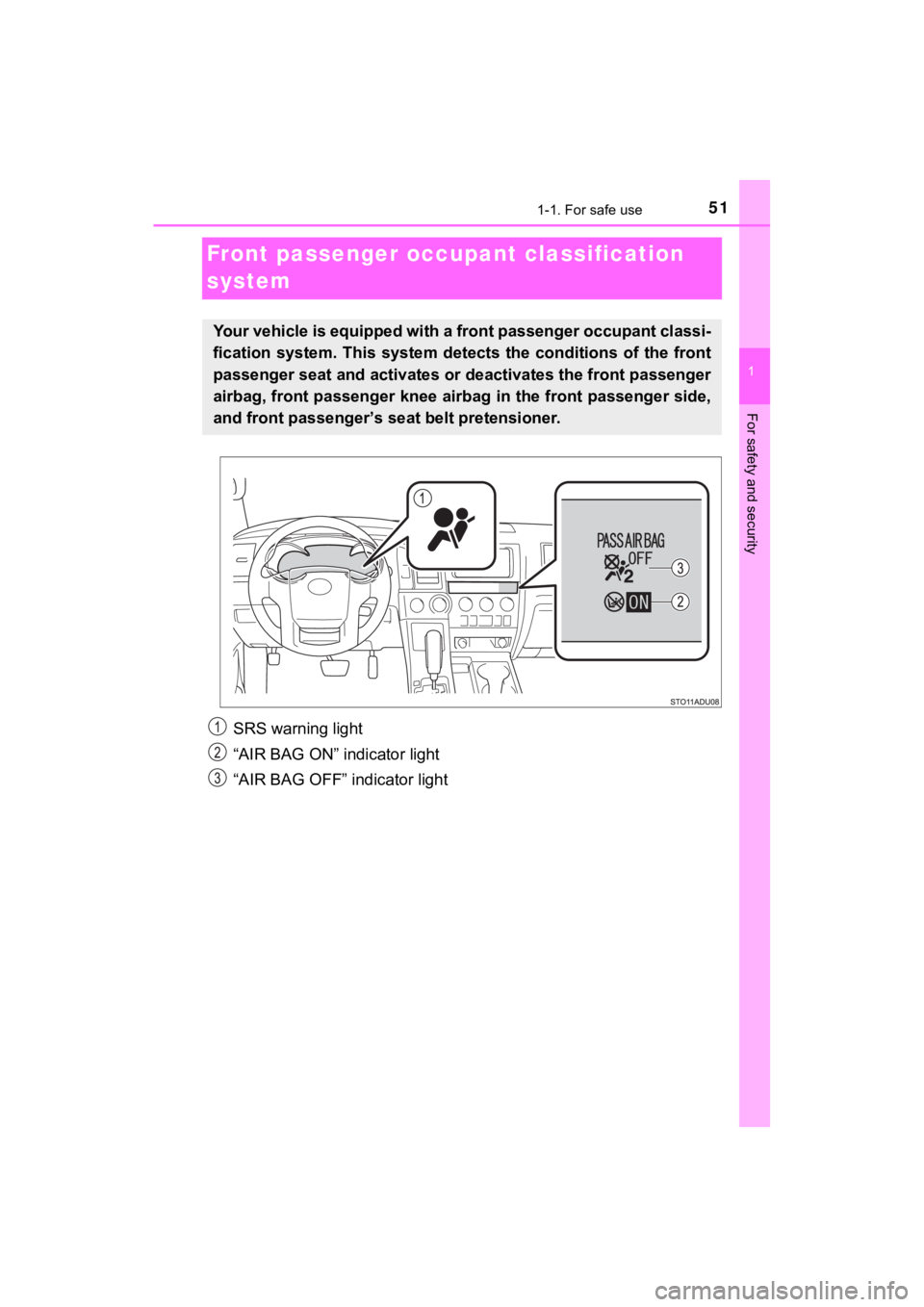
Front passenger occupant classification
system
Your vehicle is equipped with a front passenger occupant classi -
fication system. This system det ects the conditions of the front
passenger seat and activates or deactivates the front passenger
airbag, front passenger knee airbag in the front passenger side ,
and front passenger’s seat belt pretensioner.
SRS warning light
“AIR BAG ON” indicator light
“AIR BAG OFF” indicator light
Page 53 of 592
531-1. For safe use
1
For safety and security
SEQUOIA_OM_USA_OM0C047U■
Unoccupied
Indicator/
warning light
“AIR BAG ON” and “AIR BAG OFF” indicator lightsNot illuminated
SRS warning light
Off
Front passenger’s seat belt reminder light
Devices
Front passenger airbag
Deactivated
Front passenger knee airbag
Front passenger’s seat belt pretensionerActivated*7 or
deactivated
*8
Page 55 of 592

551-1. For safe use
1
For safety and security
SEQUOIA_OM_USA_OM0C047U
WARNING
■Front passenger occupant classification system precautions
Observe the following precautions regarding the front passenger occupant
classification system.
Failure to do so may cause death or serious injury.
● Wear the seat belt properly.
● Make sure the front passenger’s seat belt plate has not been le ft inserted
into the buckle before someone sits in the front passenger seat .
● Make sure the “AIR BAG OFF” indicator light is not illuminated when using
the seat belt extender for the front passenger seat. If the “AI R BAG OFF”
indicator light is illuminated, disconnect the extender tongue from the seat
belt buckle, and reconnect the seat belt. Reconnect the seat belt extender
after making sure the “AIR BAG ON” indicator light is illuminated. If you
use the seat belt extender while the “AIR BAG OFF” indicator light is illumi-
nated, the SRS airbags for the front passenger will not activate, which
could cause death or serious injury in the event of a collision.
● Do not apply a heavy load to the front passenger seat or equipment (e.g.
seatback pocket).
● Do not put weight on the front passenger seat by putting your hands or
feet on the front passenger seat seatback from the rear passenger seat.
● Do not let a rear passenger lift the front passenger seat with their feet or
press on the seatback with their legs.
● Do not put objects under the front passenger seat.
Page 57 of 592

571-1. For safe use
1
For safety and security
SEQUOIA_OM_USA_OM0C047U
Safety information for children
●It is recommended that children sit in the rear seats to avoid acci-
dental contact wit h the shift lever, wiper lever, etc.
● Use the rear door child-protector lock or the window lock switc h to
avoid children opening the door while driving or operating the
power window accidentally.
● Do not let small children operate equipment which may catch or
pinch body parts, such as the power window, hood, back door,
seats, etc.
Observe the following precautions when children are in the vehi -
cle.
Use a child restraint system appropriate for the child, until the
child becomes large enough to properly wear the vehicle’s seat
belt.
WARNING
Never leave children unattended in the vehicle, and never allow children to
have or use the key.
Children may be able to start the vehicle or shift the vehicle into neutral.
There is also a danger that children may injure themselves by playing with
the windows, the moon roof or other features of the vehicle. In addition, heat
build-up or extremely cold temperatures inside the vehicle can be fatal to
children.
Page 59 of 592
591-1. For safe use
1
For safety and security
SEQUOIA_OM_USA_OM0C047U
Child restraint systems are classified into the following 3 types
according to the age a nd size of the child:
■Selecting an appropriate child restraint system
●Use a child restraint system appropriate for the child until the child becomes
large enough to properly wear the vehicle’s seat belt.
● If the child is too large for a child restraint system, sit the child on a rear seat
and use the vehicle’s seat belt. ( P. 30)
Types of child restraints
Rear facing Infant seat/con-
vertible seatForward facing Convertible
seat
Booster seat
Page 60 of 592

601-1. For safe use
SEQUOIA_OM_USA_OM0C047U
WARNING
■Child restraint precautions
● For effective protection in automobile accidents and sudden stops, a child
must be properly restrained, using a seat belt or child restrai nt system
depending on the age and size of the child. Holding a child in your or
someone else’s arms is not a substitute for a child restraint s ystem. In an
accident, the child can be crushed against the windshield or between the
holder and the interior of the vehicle.
● Toyota strongly urges the use of a proper child restraint system that con-
forms to the size of the child, installed on the rear seat. According to acci-
dent statistics, the child is safer when properly restrained in the rear seat
than in the front seat.
● Never install a rear-facing child restraint system on the front passenger
seat even if the “AIR BAG OFF” i ndicator light is illuminated.
In the event of an accident, the force of the rapid inflation of the front pas-
senger airbag can cause death or serious injury to the child if the rear-fac-
ing child restraint system is installed on the front passenger seat.
● A forward-facing child restraint system may be installed on the front pas-
senger seat only when it is unavoidable. A child restraint syst em that
requires a top tether strap should not be used in the front passenger seat
since there is no top tether strap anchor for the front passeng er seat.
Adjust the seatback as upright as possible and always move the seat as
far back as possible even if the “AIR BAG OFF” indicator light is illumi-
nated, because the front passenger airbag could inflate with considerable
speed and force. Otherwise, the child may be killed or seriously injured.
● Do not use the seat belt extender when installing a child restr aint system
on the front or rear passenger seat. If installing a child restraint system
with the seat belt extender connected to the seat belt, the seat belt will not
securely hold the child restraint system, which could cause dea th or seri-
ous injury to the child or other passengers in the event of an accident.