2022 TOYOTA MIRAI air condition
[x] Cancel search: air conditionPage 75 of 556

752-1. Fuel cell vehicle
Owners Manual_USA_M62084_en
2
Fuel cell system
Tailpipe
*: If equipped
■Sounds unique to the fuel cell vehicle
Due to the design of y our fuel cell vehicle, there are various relays, valves
and pumps which under normal driving conditions will produce so unds. This
is a normal characteristic of th e vehicle and does not indicate a malfunction.
Furthermore, these sounds may differ based on usage environment or con-
dition.
■Maintenance, repair, recycling,
and disposal
Contact your Toyota dealer regard- ing maintenance, repair, recycling,
and disposal. Do n
ot dispose of the
vehicle or any of its components
Noticeable soundsSource of the sounds
Clunking, clicking and
clackingOperation of relays and hydrogen tank valves
(Sounds may be heard wh en starting or stop-
ping the fuel cell system.)
Knocking
The parking lock is engaged
(Sounds may be heard when pressing the P
position switch or stopp ing the fuel cell sys-
tem.)
Whooshing, squealingGas is flowing through the nozzle and valves
(Sounds may be heard when filling the fuel.)
High pitch sound
Pulsing sound
Whooshing sound
Operation of the pumps
(In particular, sounds may be heard when
starting the fuel cell s ystem, accelerating from
a stop, or pressing the H
2O switch. The sound
may be louder when in Br mode or when the
vehicle decelerates during dynamic radar
cruise control.)
Humming sound
High pitch soundOperation of the motor
(In particular, sounds may be heard when
accelerating or decelerating.)
Blowing and draining
sound
Exhaust water or air is being purged
May also occur periodically while parked when
it is cold to p revent freezing.
(Sounds may be hear d when vehicle is
stopped, fuel cell system is stopped or while
parked)
Page 81 of 556

812-1. Fuel cell vehicle
Owners Manual_USA_M62084_en
2
Fuel cell system
High-voltage cables (orange)
Fuel cell stack (fuel cell and hydrogen pump)
Air compressor
Air conditioning compressor
■If “Hydrogen Leakage Detected
Visit Your Dealer” is displayed
on the multi-information display
A small amount of hydrogen gas
may be leaking. Have the vehicle
inspected immediately at the near-
est Toyota dealer.
■If “FCV System Shutdown Due
to Hydrogen Leakage Stop in a
Safe Place See Owner’s Man-
ual” is displayed on the multi-
information display
●Hydrogen gas may be leaking.
When hydrogen gas is leaking or
some other malfunction is
detected: P. 8 5
●The air conditioning system will
shut off automatically.
■Running out of fuel
When the vehicle has run out of fuel
and the fuel cell system cannot be
started, refuel the vehicle until the
low fuel level warning light ( P.447)
turns off before try ing to restart. It
may not be able to restart if the refu-
eled amount is too low.
■Fuel cell stack
●Depending on the usage environ-
ment, the fuel ce ll power output
may decline over the life of the
vehicle. However, this will have
almost no effect on driving perfor-
mance.
●In the following situations, the fuel
cell power output may decline
faster than normal driving:
• Extended use in areas with high amounts of dust
• Extended use in areas with high levels of sulfur (such as volcanoes
or hot springs). • Extended use in areas with high
concentrations o f the following
substances:
-Organic solvents, such as paint and
thinner
-Amine-related materials such as
ammonia
-Chlorinated substances such as
salt air and snow-melting agent
• Salt water gets into the air cleaner filter
It is recommended to replace the
air cleaner filter and clean the sur-
rounding components. Have the
vehicle inspected at your Toyota
dealer
• The number of times the fuel cell system is started and stopped is
excessively high
• Extended use in freezing tem- peratures
• Fill fuel with impurities which do not follow ISO-14687
■Hydrogen tanks
●The hydrogen tanks are the high-
pressure storage containers that
are filled with co mpressed hydro-
gen gas. The vehicle can be refu-
eled at hydrogen stations.
●The hydrogen tanks have an expi-
ration date. Vehicles with expired
hydrogen tanks must not be
driven or refueled until the hydro-
gen tanks are replaced. The expi-
ration date is written on the inside
of the fuel door. Consult your Toy-
ota dealer.
●Consult your Toyota dealer if the
hydrogen tanks or valves need to
be disposed.
Page 83 of 556
832-1. Fuel cell vehicle
Owners Manual_USA_M62084_en
2
Fuel cell system
fuel cell vehicles have an electro-
magnetic shielding configuration,
and therefore emi t approximately
the same amount of electromag-
netic waves as conventional gaso-
line-powered vehicles or home
electronic appliances.
●Your vehicle may cause sound
interference in so me third party-
produced radio parts.
■Starting the fuel cell system in
an extremely col d environment
When the tracti on battery is
extremely cold (below approxi- mately -22˚F [-30˚C]) under the
influence of outsi
de temperature, it
may not be possible to start the fuel
cell system. In this case, try to start
the fuel cell system again after the
temperature of the traction battery
increases due to the outside tem-
perature increase etc.
■Traction battery
The traction battery has a limited
service life. The lifespan of the trac-
tion battery can change according to
driving style and driving conditions.
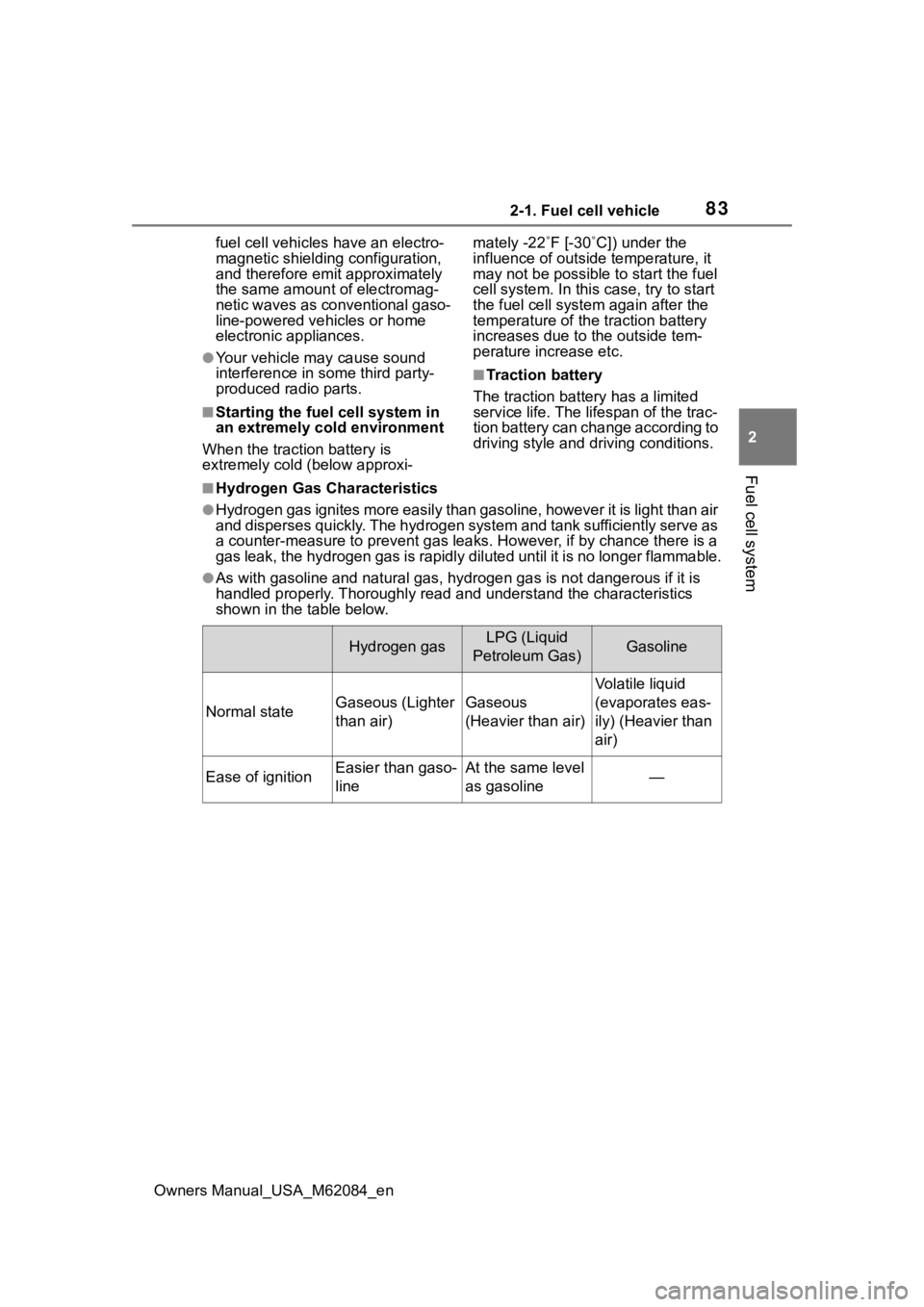
■Hydrogen Gas Characteristics
●Hydrogen gas ignites more easily than gasoline, however it is l ight than air
and disperses quickly. The hydrogen system and tank sufficientl y serve as
a counter-measure to prevent gas leaks. However, if by chance there is a
gas leak, the hydrogen gas is rapidly diluted until it is no lo nger flammable.
●As with gasoline and natural gas, hydrogen gas is not dangerous if it is
handled properly. Thoroughly rea d and understand the characteristics
shown in the table below.
Hydrogen gasLPG (Liquid
Petroleum Gas)Gasoline
Normal stateGaseous (Lighter
than air)Gaseous
(Heavier than air)
Volatile liquid
(evaporates eas-
ily) (Heavier than
air)
Ease of ignitionEasier than gaso-
lineAt the same level
as gasoline—
Page 89 of 556
892-1. Fuel cell vehicle
Owners Manual_USA_M62084_en
2
Fuel cell systemMaintaining the fuel cell system
indicator to Eco area on the
multi-information display can
extend your driving range.
( P.102)
Drive your vehicle smoothly.
Avoid abrupt acceleration and
deceleration.
Mild acceleration and decelera-
tion can help curb wasteful fuel
consumption.
If the brakes are operated gently
and in a timely manner, a
greater amount of electrical
energy can be regenerated
when slowing down.
Repeated acceleration and
deceleration, as well as long
waits at traffic lights, will lead to decreased fuel economy. Check
traffic reports before leaving and
avoid delays as much as possi-
ble. When driving in a con-
gested traffic situations, gently
release the brake pedal to allow
the vehicle to move forward
slightly while avoiding overuse
of the accelerator pedal. Doing
so can help control excessive
fuel consumption.
Similar to an electric vehicle, a
fuel cell vehicle uses the most
fuel in high output driving such
as driving on a steep uphill or at
high speeds. Moderate the vehi-
cle speed and maintain a steady
speed.
When using Eco drive mode, the
torque corresponding to the
accelerator pedal depression
amount can be generated more
smoothly than it is in normal
conditions. In addition, the oper-
ation of the air conditioning sys-
tem (heating/cooling) will be
minimized, improving the fuel
economy. (
P.313)
Use the air conditioning only
when necessary. Doing so
Fuel cell vehicle driv-
ing tips
To maximize fuel economy
and range, pay attention to
the following:
Use of fuel cell system
Indicator
Accelerator pedal/brake
pedal operation
When braking
Delays
Driving with high power
output
Using Eco drive mode
Air conditioning
Page 90 of 556

902-1. Fuel cell vehicle
Owners Manual_USA_M62084_en
can help reduce excessive
fuel consumption.
In summer: When the ambient
temperature is high, use the
recirculated air mode. Doing
so will help to reduce the bur-
den on the air conditioning
system and reduce fuel con-
sumption as well.
In winter: Avoid excess heat-
ing. Use the seat heater (if
equipped) or steering heater
(if equipped) to minimize the
need for cabin heating
(P.342).
Using eco air conditioning
mode, this helps curb fuel
consumption even with the air
conditioning system turned
on. ( P.326, 334)
Make sure to check the tire infla-
tion pressure frequently.
Improper tire inflation pressure
can cause poor fuel economy.
Also, as snow tires can cause
large amounts of friction, their
use on dry roads can lead to
poor fuel economy. Use tires
that are appropriate for the sea-
son.
Carrying heavy luggage will lead
to reduced fuel economy. Install-
ing a large roof rack will also reduce fuel economy.
Checking tire inflation
pressure
Luggage
Page 99 of 556
993-1. Instrument cluster
Owners Manual_USA_M62084_en
3
Vehicle status information and indicators
1 Brighter
2 Darker
■Instrument cluster brightness
adjustment
The instrument cluster brightness
levels when the tail lights are on and
off can be adjusted individually.
However, when the surroundings
are bright (daytime, etc.), turning on
the tail lights will not chan ge the
instrument cluster brightness.
■Fuel gauge
Displays the quantity of fuel
remaining in the tank
■Driving range
Displays the possible driving
distance computed from the
fuel consumption studied from
the driving history and the
current remaining amount of
fuel.
When the air conditioning sys-
tem is operating, is dis-
played below the driving
range and this will be the driv-
ing range with the air condi- tioning system on is
displayed.
■When the low fuel level warning
light turns on
The low fuel level warning light turns
on ( P.447) when the fuel gets low.
In that case, refuel the vehicle.
■Possible Drivi ng Distance
●The actual possible driving dis-
tance may differ as fuel consump-
tion changes, depending on
driving environment (weather, traf-
fic, etc.) and conditions (sudden
acceleration, air conditioning,
etc.).
●The driving range may shorten
even when not driving due to
power consumption by the sys-
tem.
●The possible driving distance will
be displayed as “--- miles (--- km)”
in the following cases:
• When the remaining fuel is being calculated (short time).
• When the remaining fuel total
reaches “E”.
• When a malfunction occurs where the possible driving distance can-
not be calculated.
Fuel gauge and driving
range
Page 115 of 556

1153-1. Instrument cluster
Owners Manual_USA_M62084_en
3
Vehicle status information and indicators
Displays the instant air cleaning
amount per unit of time.
Air cleaning amount estima-
tion display
Displays the total amount of air
cleaning from starting the fuel cell
system.
Air cleaning amount between
resets
Displays the total air cleaning esti-
mated amount after resets.
Runner display
Runners increase depending on the
estimated amount of air cleaning
between resets.
Resetting the data
Clear all the history up to now.
The image is an example only, and
may vary slightly f rom actual condi-
tions.
■Data in Air purification is
reseted when
“Clear” is selected to reset data in
air cleaning amount between resets
and runner display.
■Display Runner
When ten runners are collected,
they are absorbed into a runner
mark.
■Display
●The actual amount of air may dif-
fer because the amount of air
required for power generation
changes due to usage environ-
ment (climate, altitude, etc.) and
the status of power generation, as
well as driving conditions.
●The instant air cleaning amount
may operate slowly and may be
delayed in operating, but this is
not a malfunction.
Page 132 of 556

1324-2. Opening, closing and locking the doors and trunk
Owners Manual_USA_M62084_en
●Electronic keys that will not be
used for long periods of time can
be set to the battery-saving mode
in advance.
■Conditions affecting operation
The smart key system uses weak
radio waves. In the following situa-
tions, the communication between
the electronic key and the vehicle
may be affected, preventing the
smart key system, wireless remote
control and immobilizer system from
operating properly. (Ways of coping:
P.468)
●When the electronic key battery is
depleted
●Near a TV tower, electric power
plant, gas station , radio station,
large display, airpo rt or other facil-
ity that generates strong radio
waves or electrical noise
●When carrying a portable radio,
cellular phone, cordless phone or
other wireless communication
device
●When the electronic key is in con-
tact with, or is covered by the fol-
lowing metallic objects
• Cards to which al uminum foil is
attached
• Cigarette boxes that have alumi- num foil inside
• Metallic wallets or bags
• Coins
• Hand warmers made of metal
• Media such as CDs and DVDs
●When other wireless keys (that
emit radio waves) are being used
nearby
●When carrying the electronic key
together with the following devices that emit radio waves
• Another electronic key or a wire- less key that emits radio waves
• Personal computers or personal digital assistants (PDAs)
• Digital audio players
• Portable game systems
●If window tint wit h a metallic con-
tent or metallic objects are
attached to the rear window
●When the electronic key is placed
near a battery charger or elec-
tronic devices
●When the vehicle is parked in a
pay parking spot where radio
waves are emitted.
■Note for the entry function
●Even when the electronic key is
within the effective range (detec-
tion areas), the system may not
operate properly in the following
cases:
• The electronic key is too close to the window or outside door han-
dle, near the ground, or in a high
place when the doors are locked
or unlocked.
• The electronic key is near the ground or in a high place, or too
close to the center of the rear
bumper when the trunk is opened.
• The electronic key is on the instru- ment panel, rear package tray or
floor, or in the door pockets or
glove box when the fuel cell sys-
tem is started or power switch
modes are changed.
●Do not leave the electronic key on
top of the instrument panel or near
the door pockets when exiting the
vehicle. Depending on the radio
wave reception conditions, it may
be detected by the antenna out-
side the cabin and the doors will
become lockable from the outside,
possibly trapping the electronic
key inside the vehicle.
●As long as the electronic key is
within the effective range, the
doors may be locked or unlocked
by anyone. However, only the