2022 TOYOTA COROLLA flat tire
[x] Cancel search: flat tirePage 452 of 678
4507-3. Do-it-yourself maintenance
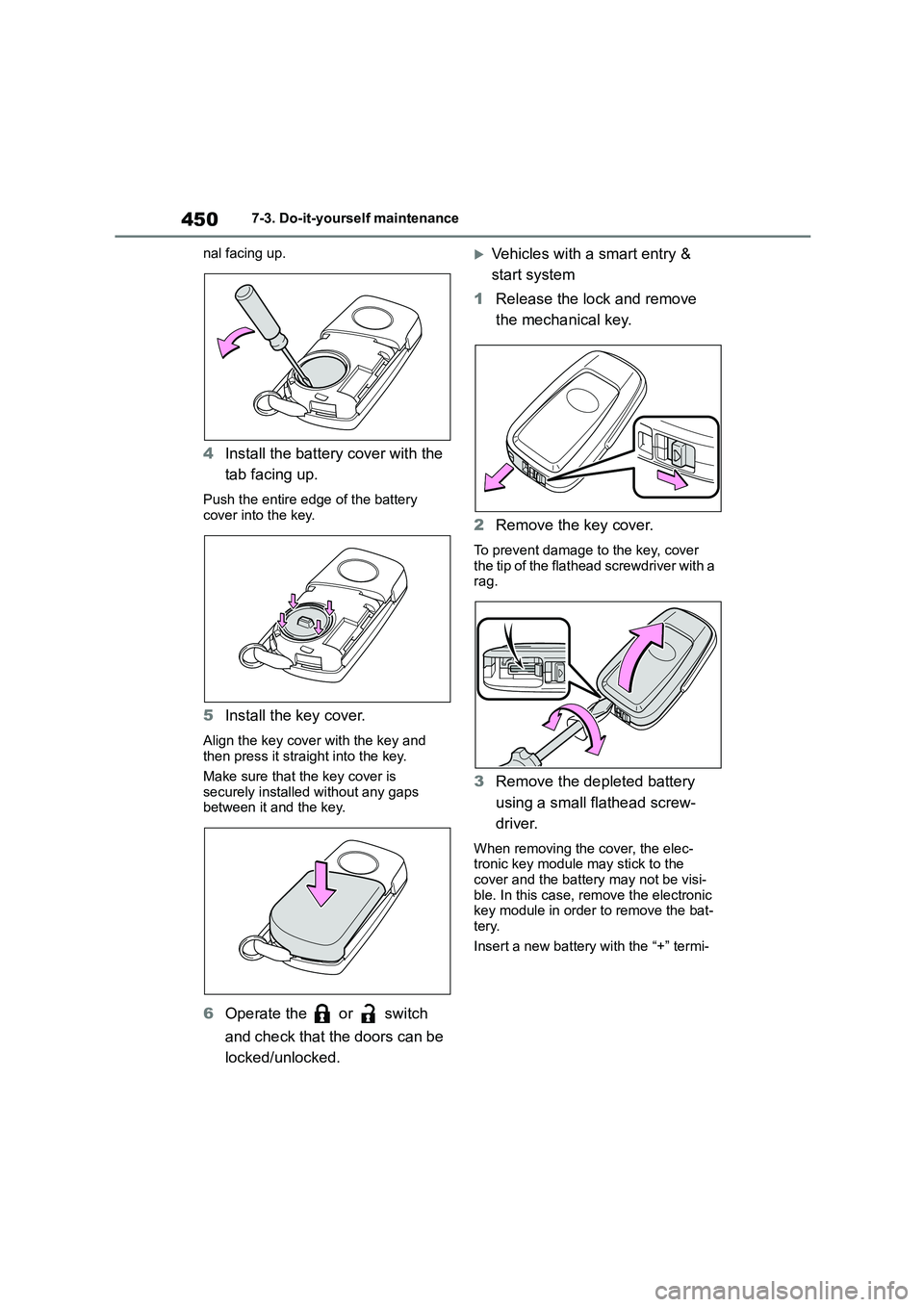
nal facing up.
4 Install the battery cover with the
tab facing up.
Push the entire edge of the battery
cover into the key.
5 Install the key cover.
Align the key cover with the key and
then press it straight into the key.
Make sure that the key cover is securely installed without any gaps
between it and the key.
6 Operate the or switch
and check that the doors can be
locked/unlocked.
Vehicles with a smart entry &
start system
1 Release the lock and remove
the mechanical key.
2 Remove the key cover.
To prevent damage to the key, cover
the tip of the flathead screwdriver with a rag.
3 Remove the depleted battery
using a small flathead screw-
driver.
When removing the cover, the elec- tronic key module may stick to the
cover and the battery may not be visi-
ble. In this case, remove the electronic key module in order to remove the bat-
tery.
Insert a new battery with the “+” termi-
Page 463 of 678
8
461
When trouble arises
8
When trouble arises
.8-1. Essential information
Emergency flashers .......... 462
If your vehicle has to be
stopped in an emergency
....................................... 462
If the vehicle is submerged or
water on the road is rising
....................................... 464
8-2. Steps to take in an emer-
gency
If your vehicle needs to be
towed .............................. 465
If you think something is wrong
....................................... 469
Fuel pump shut off system
....................................... 470
If a warning light turns on or a
warning buzzer sounds... 471
If a warning message is dis-
played ............................. 480
If you have a flat tire (vehicles
with an emergency tire punc-
ture repair kit) ................. 482
If you have a flat tire (vehicles
with a spare tire) ............. 498
If the engine will not start .. 509
If you lose your keys ......... 511
If the electronic key does not
operate properly ............. 511
If the vehicle battery is dis-
charged .......................... 513
If your vehicle overheats ... 518
If the vehicle becomes stuck
....................................... 520
Page 468 of 678
4668-2. Steps to take in an emergency
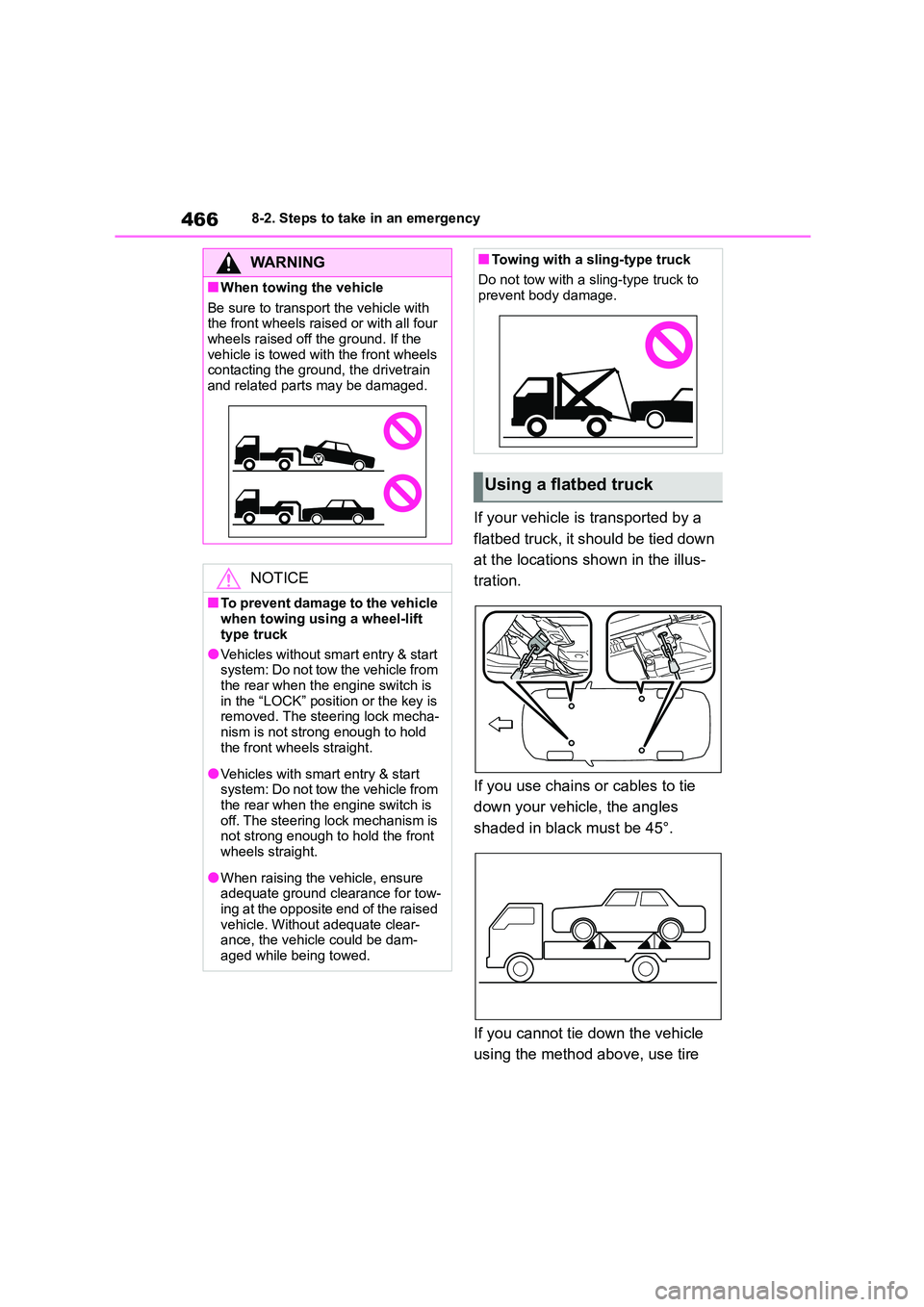
If your vehicle is transported by a
flatbed truck, it should be tied down
at the locations shown in the illus-
tration.
If you use chains or cables to tie
down your vehicle, the angles
shaded in black must be 45°.
If you cannot tie down the vehicle
using the method above, use tire
WA R N I N G
■When towing the vehicle
Be sure to transport the vehicle with
the front wheels raised or with all four wheels raised off the ground. If the
vehicle is towed with the front wheels
contacting the ground, the drivetrain and related parts may be damaged.
NOTICE
■To prevent damage to the vehicle
when towing using a wheel-lift
type truck
●Vehicles without smart entry & start
system: Do not tow the vehicle from
the rear when the engine switch is in the “LOCK” position or the key is
removed. The steering lock mecha-
nism is not strong enough to hold
the front wheels straight.
●Vehicles with smart entry & start
system: Do not tow the vehicle from the rear when the engine switch is
off. The steering lock mechanism is
not strong enough to hold the front wheels straight.
●When raising the vehicle, ensure adequate ground clearance for tow-
ing at the opposite end of the raised
vehicle. Without adequate clear- ance, the vehicle could be dam-
aged while being towed.
■Towing with a sling-type truck
Do not tow with a sling-type truck to
prevent body damage.
Using a flatbed truck
Page 471 of 678
469
8
8-2. Steps to take in an emergency
When trouble arises
Fluid leaks under the vehicle.
(Water dripping from the air con-
ditioning after use is normal.)
Flat-looking tires or uneven tire
wear
Engine coolant temperature
gauge needle continually points
higher than normal.
Changes in exhaust sound
Excessive tire squeal when cor-
nering
Strange noises related to the
suspension system
Pinging or other noises related to
the engine
Engine missing, stumbling or
running roughly
Appreciable loss of power
Vehicle pulls heavily to one side
when braking
Vehicle pulls heavily to one side
when driving on a level road
Loss of brake effectiveness,
spongy feeling, pedal almost
touches the floor
If you think something is
wrong
If you notice any of the follow-
ing symptoms, your vehicle
probably needs adjustment or
repair. Contact any authorized
Toyota retailer or Toyota
authorized repairer, or any reli-
able repairer as soon as possi-
ble.
Visible symptoms
Audible symptoms
Operational symptoms
Page 477 of 678
475
8
8-2. Steps to take in an emergency
When trouble arises
that his or her seat belt is not fastened. If the seat belt is unfastened, the buzzer
sounds intermittently for a certain period of time after the vehicle reaches a certain
speed.
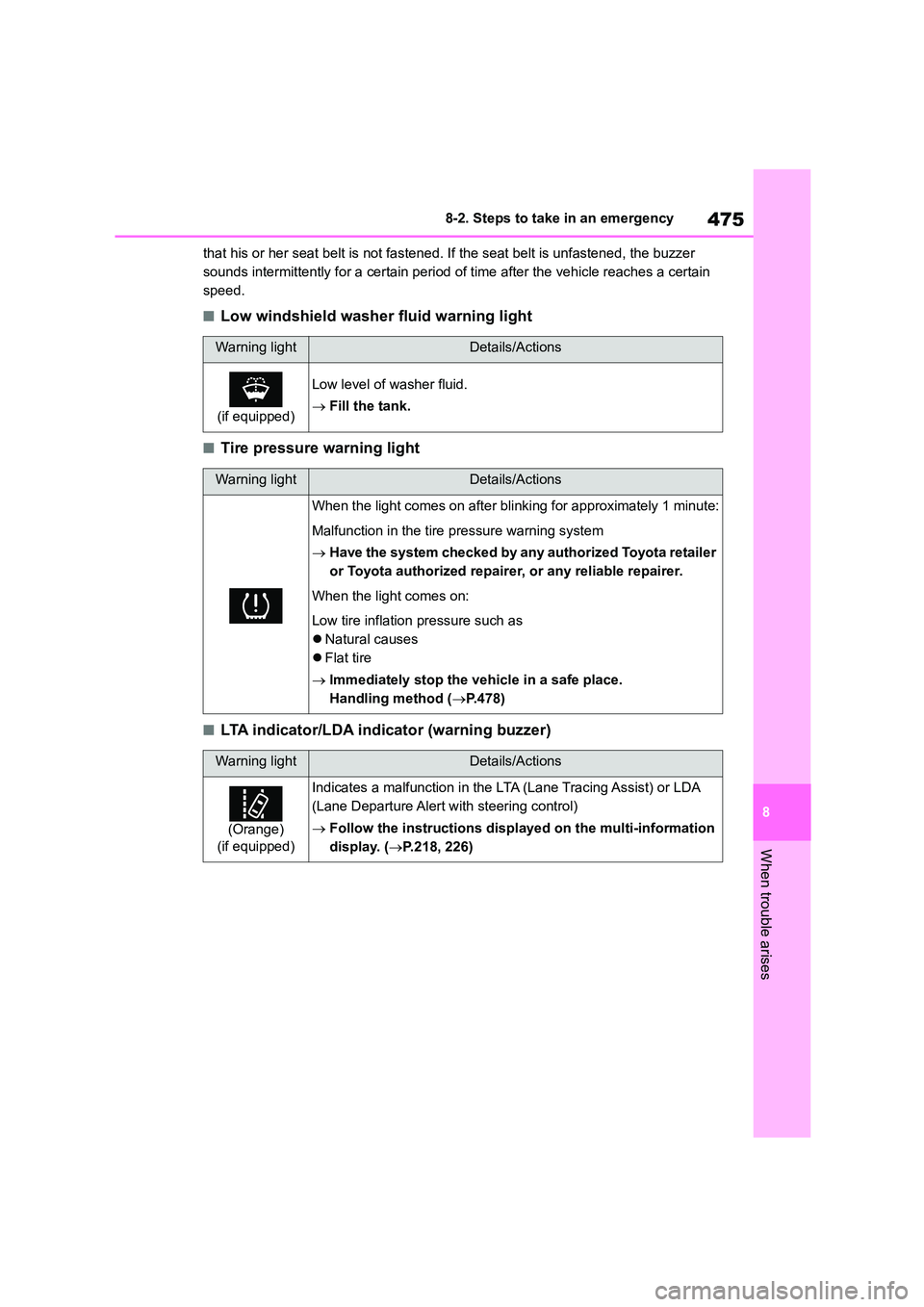
■Low windshield washer fluid warning light
■Tire pressure warning light
■LTA indicator/LDA indicator (warning buzzer)
Warning lightDetails/Actions
(if equipped)
Low level of washer fluid.
Fill the tank.
Warning lightDetails/Actions
When the light comes on after blinking for approximately 1 minute:
Malfunction in the tire pressure warning system
Have the system checked by any authorized Toyota retailer
or Toyota authorized repairer, or any reliable repairer.
When the light comes on:
Low tire inflation pressure such as
Natural causes
Flat tire
Immediately stop the vehicle in a safe place.
Handling method ( P.478)
Warning lightDetails/Actions
(Orange)
(if equipped)
Indicates a malfunction in the LTA (Lane Tracing Assist) or LDA
(Lane Departure Alert with steering control)
Follow the instructions displayed on the multi-information
display. ( P.218, 226)
Page 481 of 678
479
8
8-2. Steps to take in an emergency
When trouble arises
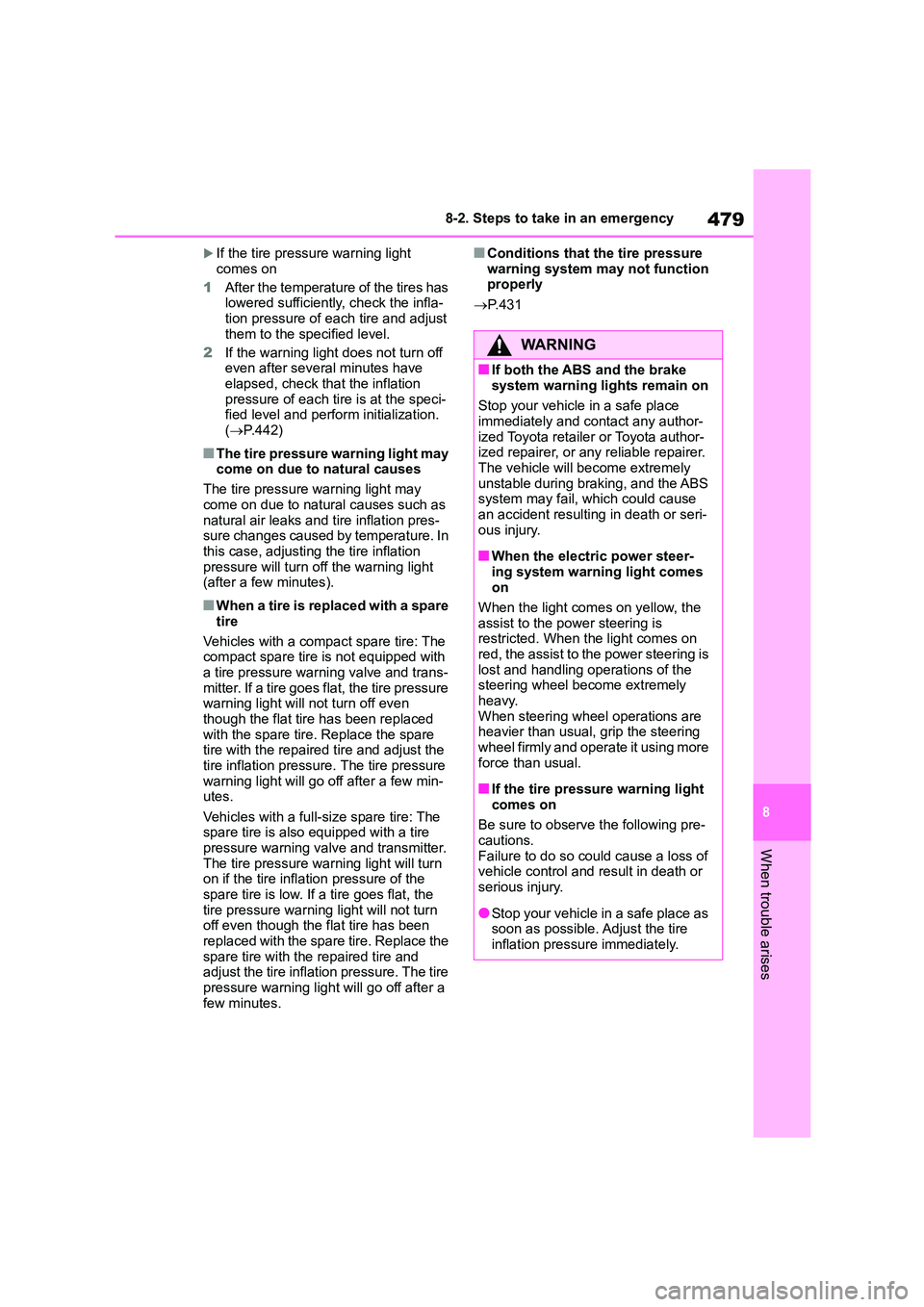
If the tire pressure warning light
comes on
1 After the temperature of the tires has lowered sufficiently, check the infla-
tion pressure of each tire and adjust
them to the specified level.
2 If the warning light does not turn off even after several minutes have
elapsed, check that the inflation
pressure of each tire is at the speci- fied level and perform initialization.
( P.442)
■The tire pressure warning light may
come on due to natural causes
The tire pressure warning light may
come on due to natural causes such as
natural air leaks and tire inflation pres- sure changes caused by temperature. In
this case, adjusting the tire inflation
pressure will turn off the warning light (after a few minutes).
■When a tire is replaced with a spare
tire
Vehicles with a compact spare tire: The compact spare tire is not equipped with
a tire pressure warning valve and trans-
mitter. If a tire goes flat, the tire pressure warning light will not turn off even
though the flat tire has been replaced
with the spare tire. Replace the spare tire with the repaired tire and adjust the
tire inflation pressure. The tire pressure
warning light will go off after a few min- utes.
Vehicles with a full-size spare tire: The
spare tire is also equipped with a tire pressure warning valve and transmitter.
The tire pressure warning light will turn
on if the tire inflation pressure of the spare tire is low. If a tire goes flat, the
tire pressure warning light will not turn
off even though the flat tire has been
replaced with the spare tire. Replace the spare tire with the repaired tire and
adjust the tire inflation pressure. The tire
pressure warning light will go off after a few minutes.
■Conditions that th e tire pressure
warning system may not function properly
P. 4 3 1
WA R N I N G
■If both the ABS and the brake system warning lights remain on
Stop your vehicle in a safe place
immediately and contact any author-
ized Toyota retailer or Toyota author- ized repairer, or any reliable repairer.
The vehicle will become extremely
unstable during br aking, and the ABS system may fail, which could cause
an accident resulting in death or seri-
ous injury.
■When the electric power steer-
ing system warning light comes on
When the light comes on yellow, the
assist to the power steering is restricted. When th e light comes on
red, the assist to the power steering is
lost and handling operations of the steering wheel become extremely
heavy.
When steering wheel operations are heavier than usual, grip the steering
wheel firmly and operate it using more
force than usual.
■If the tire pressure warning light
comes on
Be sure to observe the following pre-
cautions.
Failure to do so could cause a loss of vehicle control and re sult in death or
serious injury.
●Stop your vehicle in a safe place as
soon as possible. Adjust the tire
inflation pressure immediately.
Page 482 of 678
4808-2. Steps to take in an emergency
■Warning messages
The warning messages explained below
may differ from the actual messages
according to operation conditions and vehicle specifications.
■Warning buzzer
A buzzer may sound when a message is
displayed. The buzzer may not be audible if the
vehicle is in a noisy location or if the
audio system volume is high.
WA R N I N G
●Vehicles with a compact spare tire:
If the tire pressure warning light
comes on even after tire inflation pressure adjustment, it is probable
that you have a flat tire. Check the
tires. If a tire is flat, change it with the spare tire and have the flat tire
repaired by the nearest any author-
ized Toyota retailer or Toyota
authorized repairer, or any reliable repairer.
●Vehicles with emergency tire punc-ture repair kit: If the tire pressure
warning light comes on even after
tire inflation pressure adjustment, it is probable that you have a flat tire.
Check the tires. If a tire is flat, repair
the flat tire by using emergency tire puncture repair kit.
●Avoid abrupt maneuvering and braking.
If the vehicle tires deteriorate, you
could lose control of the steering wheel or the brakes.
■If a blowout or sudden air leak-age should occur
The tire pressure warning system
may not activate immediately.
NOTICE
■To ensure the tire pressure warn- ing system operates properly
Do not install tires with different speci-
fications or makers, as the tire pres- sure warning system may not operate
properly.
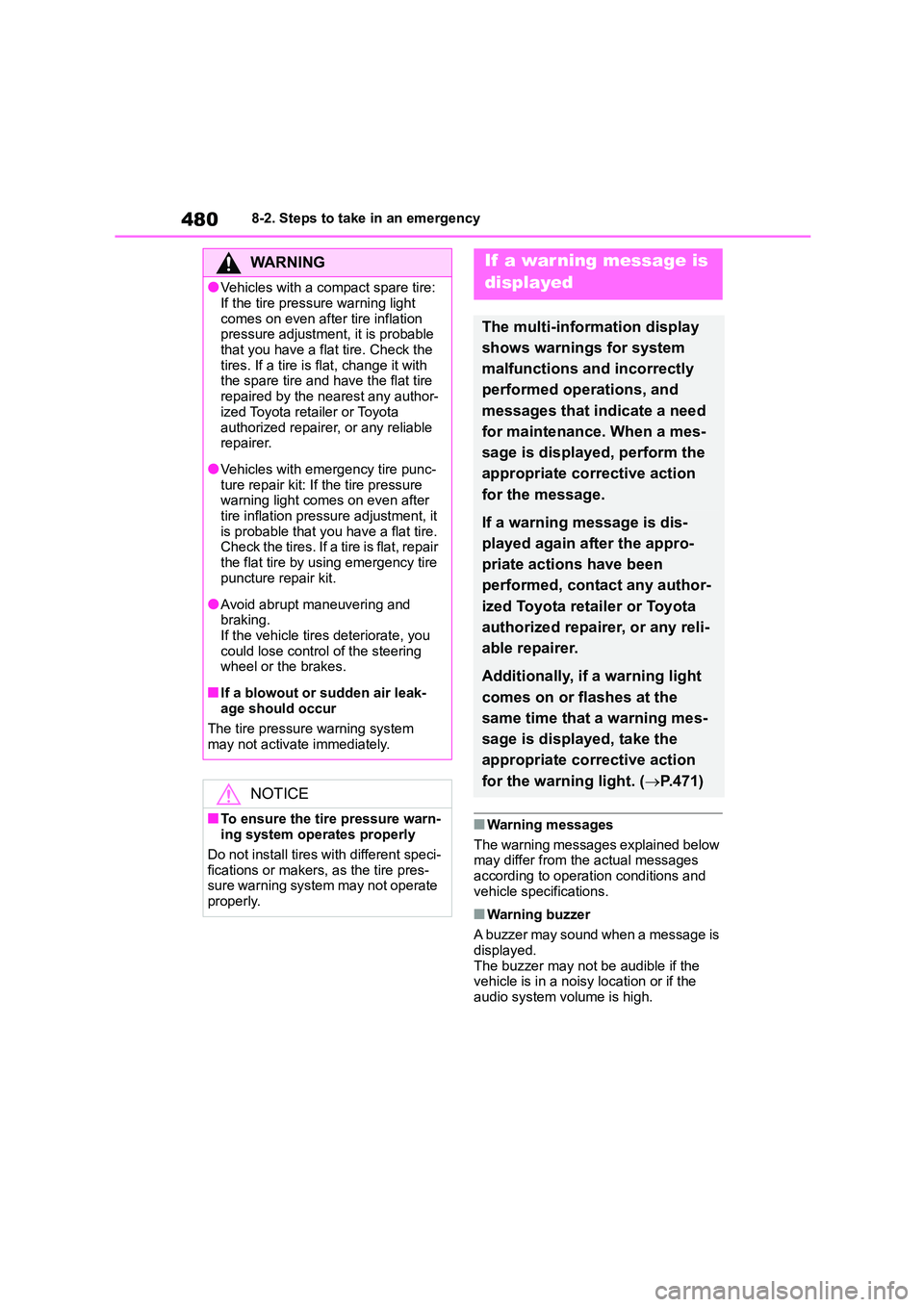
If a war ning message is
displayed
The multi-information display
shows warnings for system
malfunctions and incorrectly
performed operations, and
messages that indicate a need
for maintenance. When a mes-
sage is displayed, perform the
appropriate corrective action
for the message.
If a warning message is dis-
played again after the appro-
priate actions have been
performed, contact any author-
ized Toyota retailer or Toyota
authorized repairer, or any reli-
able repairer.
Additionally, if a warning light
comes on or flashes at the
same time that a warning mes-
sage is displayed, take the
appropriate corrective action
for the warning light. ( P.471)
Page 484 of 678
4828-2. Steps to take in an emergency
or any reliable repairer immediately.
●If any of the following messages are
displayed on the multi-information dis-
play, it may indicate a malfunction. Immediately stop the vehicle and con-
tact any authorized Toyota retailer or
Toyota authorized repairer, or any reli- able repairer.
• “Braking Power Low”
• “Charging System Malfunction” • “Oil Pressure Low”
NOTICE
■If “High Power Consumption Par-
tial Limit on AC/Heater Opera-
tion” is displayed frequently
There is a possible malfunction relat-
ing to the charging system or the bat-
tery may be deteriorating. Have the vehicle inspected by any authorized
Toyota retailer or Toyota authorized
repairer, or any reliable repairer immediately.
If you have a flat tire
(vehicles with an emer-
gency tire puncture
repair kit)
Your vehicle is not equipped
with a spare tire, but instead is
equipped with an emergency
tire puncture repair kit.
A puncture caused by a nail or
screw passing through the tire
tread can be repaired tempo-
rarily using the emergency tire
puncture repair kit. (The kit
contains a bottle of sealant.
The sealant can be used only
once to temporarily repair one
tire without removing the nail
or screw from the tire.)
Depending on the damage, this
kit cannot be used to repair the
tire. ( P.483)
After temporarily repairing the
tire with the kit, have the tire
repaired or replaced by any
authorized Toyota retailer or
Toyota authorized repairer, or
any reliable repairer. Repairs
conducted using the emer-
gency tire puncture repair kit
are only a temporary measure.
Have the tire repaired and
replaced as soon as possible.