2022 TOYOTA COROLLA CROSS light
[x] Cancel search: lightPage 40 of 612
401-1. For safe use
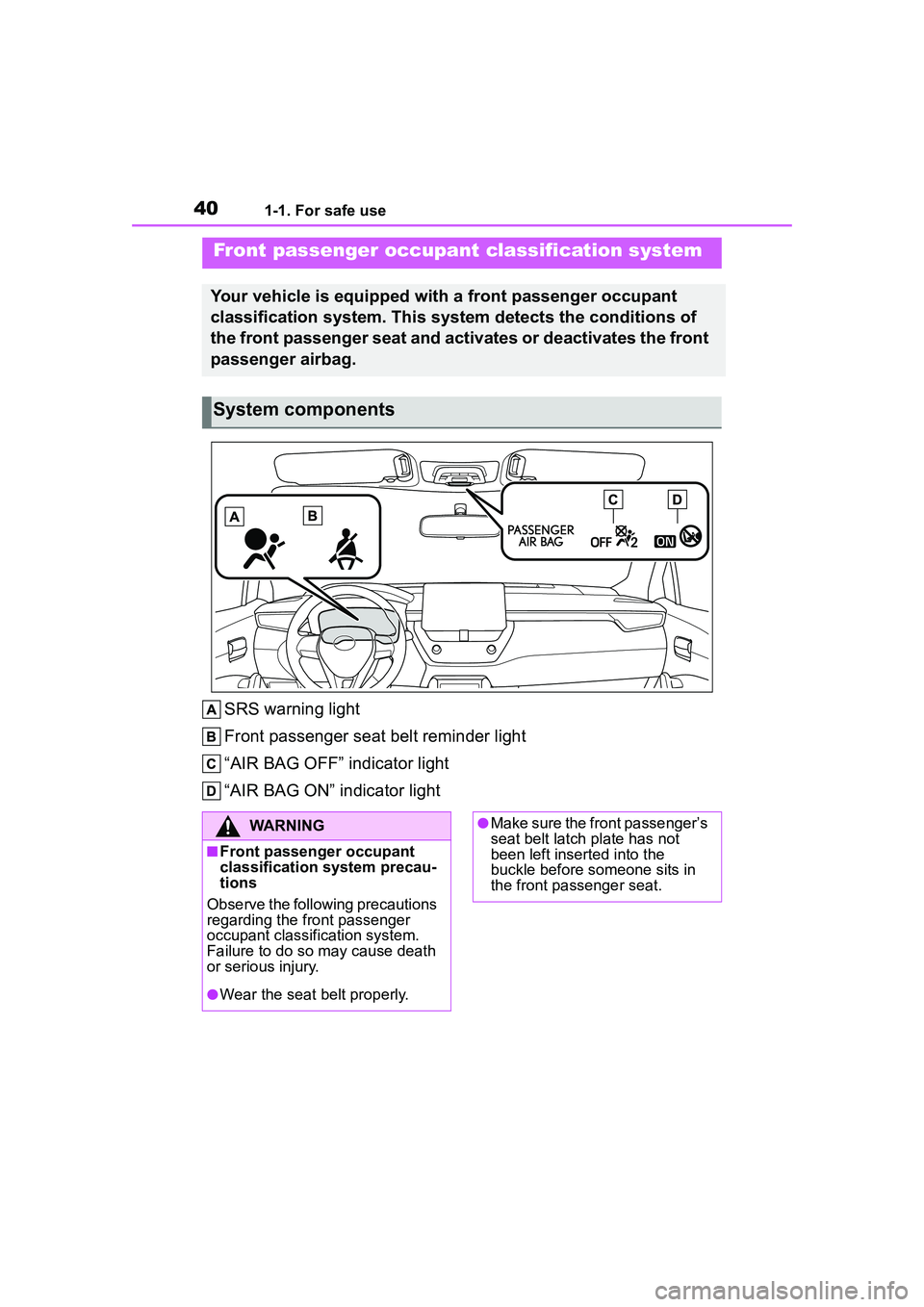
SRS warning light
Front passenger seat belt reminder light
“AIR BAG OFF” indicator light
“AIR BAG ON” indicator light
Front passenger occupant classification system
Your vehicle is equipped with a front passenger occupant
classification system. This system detects the conditions of
the front passenger seat and activates or deactivates the front
passenger airbag.
System components
WARNING
■Front passenger occupant
classification system precau-
tions
Observe the following precautions
regarding the front passenger
occupant classification system.
Failure to do so may cause death
or serious injury.
●Wear the seat belt properly.
●Make sure the front passenger’s
seat belt latch plate has not
been left inserted into the
buckle before someone sits in
the front passenger seat.
Page 41 of 612
411-1. For safe use
1
For safety and security
WARNING
●Make sure the “AIR BAG OFF”
indicator light is not illuminated
when using the seat belt
extender for the front passenger
seat. If the “AIR BAG OFF” indi-
cator light is illuminated, discon-
nect the extender tongue from
the seat belt buckle, and recon-
nect the seat belt. Reconnect
the seat belt extender after
making sure the “AIR BAG ON”
indicator light is illuminated. If
you use the seat belt extender
while the “AIR BAG OFF” indi-
cator light is illuminated, the
SRS airbags for the front pas-
senger will not activate, which
could cause death or serious
injury in the event of a collision.
●Do not apply a heavy load to the
front passenger seat or equip-
ment (e.g. seatback pocket).
●Do not put weight on the front
passenger seat by putting your
hands or feet on the front pas-
senger seat seatback from the
rear passenger seat.
●Do not let a rear passenger lift
the front passenger seat with
their feet or press on the seat-
back with their legs.
●Do not put objects under the
front passenger seat.
●Do not recline the front passen-
ger seatback so far that it
touches a rear seat. This may
cause the “AIR BAG OFF” indi-
cator light to be illuminated,
which indicates that the SRS
airbags for the front passenger
will not activate in the event of a
severe accident. If the seatback
touches the rear seat, return the
seatback to a position where it
does not touch the rear seat.
Keep the front passenger seat-
back as upright as possible
when the vehicle is moving.
Reclining the seatback exces-
sively may lessen the effective-
ness of the seat belt system.
●If an adult sits in the front pas-
senger seat, the “AIR BAG ON”
indicator light is illuminated. If
the “AIR BAG OFF” indicator is
illuminated, ask the passenger
to sit up straight, well back in
the seat, feet on the floor, and
with the seat belt worn correctly.
If the “AIR BAG OFF” indicator
still remains illuminated, either
ask the passenger to move to
the rear seat, or if that is not
possible, move the front pas-
senger seat fully rearward.
●When it is unavoidable to install
a forward-facing child restraint
system on the front passenger
seat, install the child restraint
system on the front passenger
seat in the proper order.
(
P. 4 8 )
●Do not modify or remove the
front seats.
●Do not kick the front passenger
seat or subject it to severe
impact. Otherwise, the SRS
warning light may come on to
indicate a malfunction of the
front passenger occupant clas-
sification system. In this case,
contact your Toyota dealer
immediately.
Page 42 of 612
421-1. For safe use
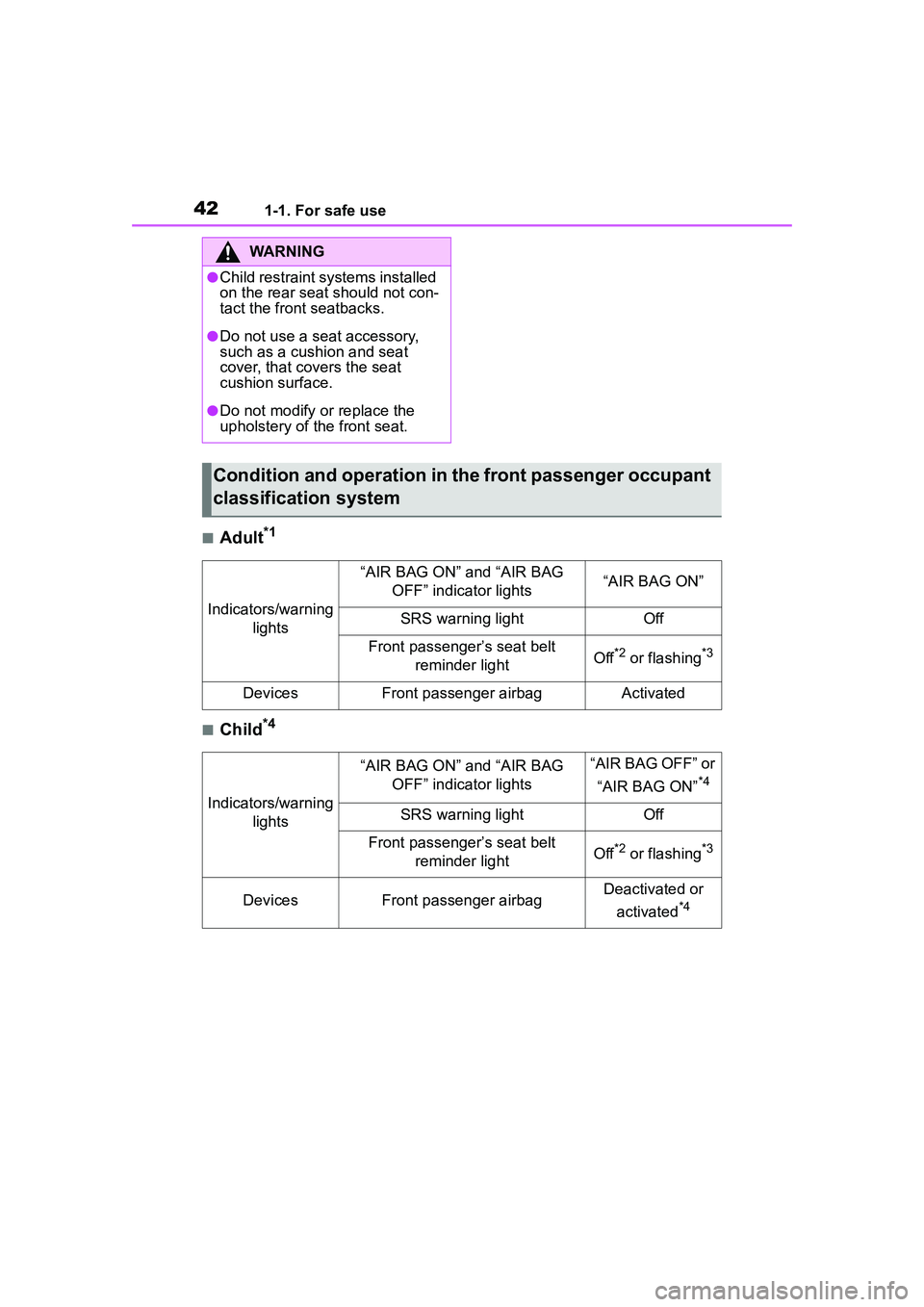
■Adult*1
■Child*4
WARNING
●Child restraint systems installed
on the rear seat should not con-
tact the front seatbacks.
●Do not use a seat accessory,
such as a cushion and seat
cover, that covers the seat
cushion surface.
●Do not modify or replace the
upholstery of the front seat.
Condition and operation in the front passenger occupant
classification system
Indicators/warning lights
“AIR BAG ON” and “AIR BAG OFF” indicator lights“AIR BAG ON”
SRS warning lightOff
Front passenger’s seat belt reminder lightOff*2 or flashing*3
DevicesFront passenger airbagActivated
Indicators/warning lights
“AIR BAG ON” and “AIR BAG OFF” indicator lights“AIR BAG OFF” or
“AIR BAG ON”
*4
SRS warning lightOff
Front passenger’s seat belt reminder lightOff*2 or flashing*3
DevicesFront passenger airbagDeactivated or
activated
*4
Page 43 of 612
431-1. For safe use
1
For safety and security
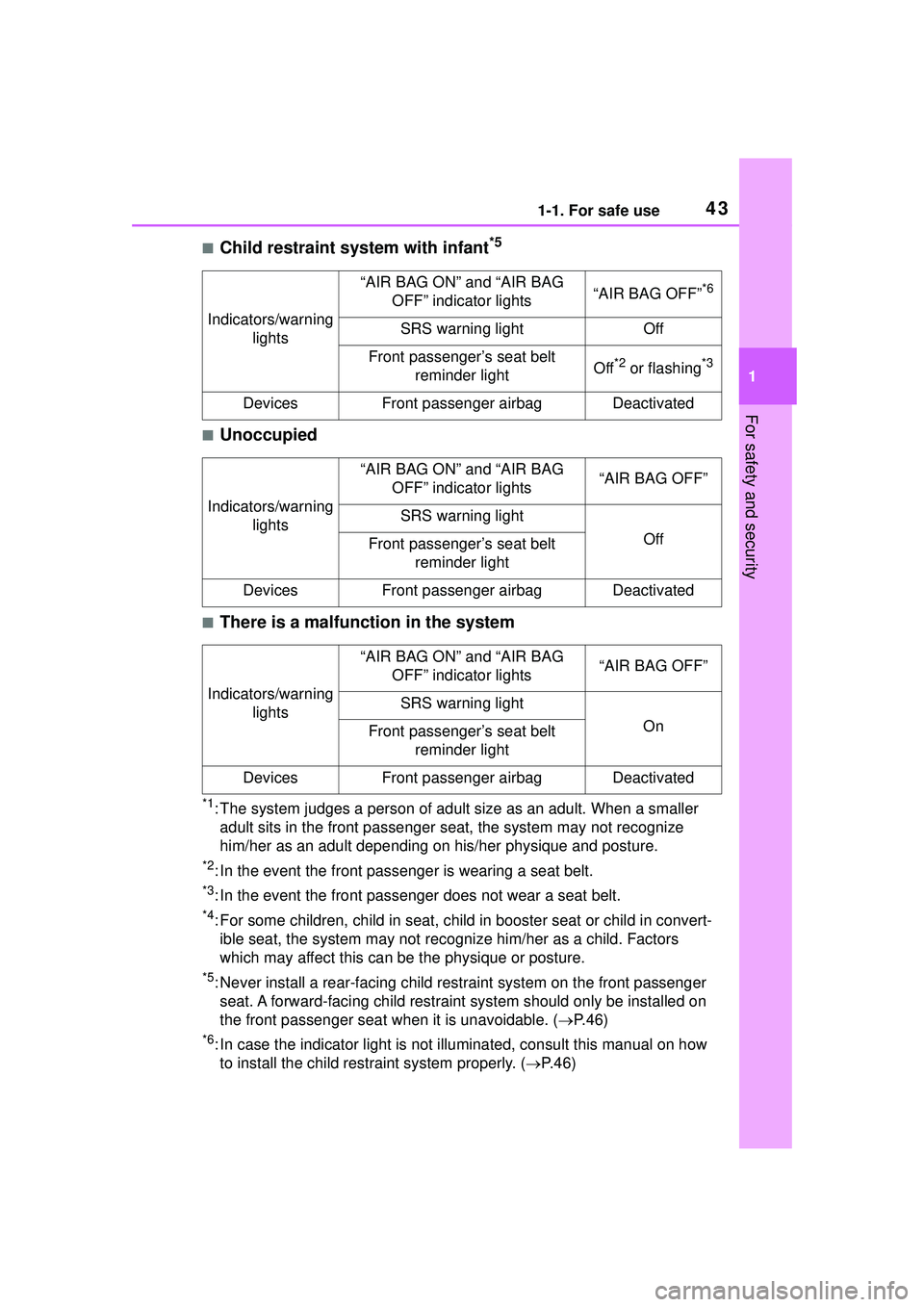
■Child restraint system with infant*5
■Unoccupied
■There is a malfunction in the system
*1: The system judges a person of adult size as an adult. When a smaller adult sits in the front passenger seat, the system may not recognize
him/her as an adult depending on his/her physique and posture.
*2: In the event the front passenger is wearing a seat belt.
*3: In the event the front passenger does not wear a seat belt.
*4: For some children, child in seat, child in booster seat or child in convert-
ible seat, the system may not rec ognize him/her as a child. Factors
which may affect this can be the physique or posture.
*5: Never install a rear-facing child rest raint system on the front passenger
seat. A forward-facing child restraint system should only be installed on
the front passenger seat w hen it is unavoidable. (P.46)
*6: In case the indicator light is not illu minated, consult this manual on how
to install the child restraint system properly. ( P. 4 6 )
Indicators/warning
lights
“AIR BAG ON” and “AIR BAG OFF” indicator lights“AIR BAG OFF”*6
SRS warning lightOff
Front passenger’s seat belt reminder lightOff*2 or flashing*3
DevicesFront passenger airbagDeactivated
Indicators/warning lights
“AIR BAG ON” and “AIR BAG OFF” indicator lights“AIR BAG OFF”
SRS warning light
OffFront passenger’s seat belt reminder light
DevicesFront passenger airbagDeactivated
Indicators/warning lights
“AIR BAG ON” and “AIR BAG OFF” indicator lights“AIR BAG OFF”
SRS warning light
OnFront passenger’s seat belt reminder light
DevicesFront passenger airbagDeactivated
Page 44 of 612

441-1. For safe use
Exhaust gas precau-
tions
Harmful substance to the
human body is included in
exhaust gases if inhaled.
WARNING
Exhaust gases include harmful
carbon monoxide (CO), which is
colorless and odorless. Observe
the following precautions.
Failure to do so may cause
exhaust gases enter the vehicle
and may lead to an accident
caused by light-headedness, or
may lead to death or a serious
health hazard.
■Important points while driving
●Keep the back door closed.
●If you smell exhaust gases in
the vehicle even when the back
door is closed, open the win-
dows and have the vehicle
inspected at your Toyota dealer
as soon as possible.
■When parking
●If the vehicle is in a poorly venti-
lated area or a closed area,
such as a garage, stop the
engine.
●Do not leave the vehicle with
the engine on for a long time.
If such a situation cannot be
avoided, park the vehicle in an
open space and ensure that
exhaust fumes do not enter the
vehicle interior.
●Do not leave the engine running
in an area with snow build-up,
or where it is snowing. If snow-
banks build up around the vehi-
cle while the engine is running,
exhaust gases may collect and
enter the vehicle.
■Exhaust pipe
The exhaust system needs to be
checked periodically. If there is a
hole or crack caused by corro-
sion, damage to a joint or abnor-
mal exhaust noise, be sure to
have the vehicle inspected and
repaired by your Toyota dealer.
Page 49 of 612
491-2. Child safety
1
For safety and security
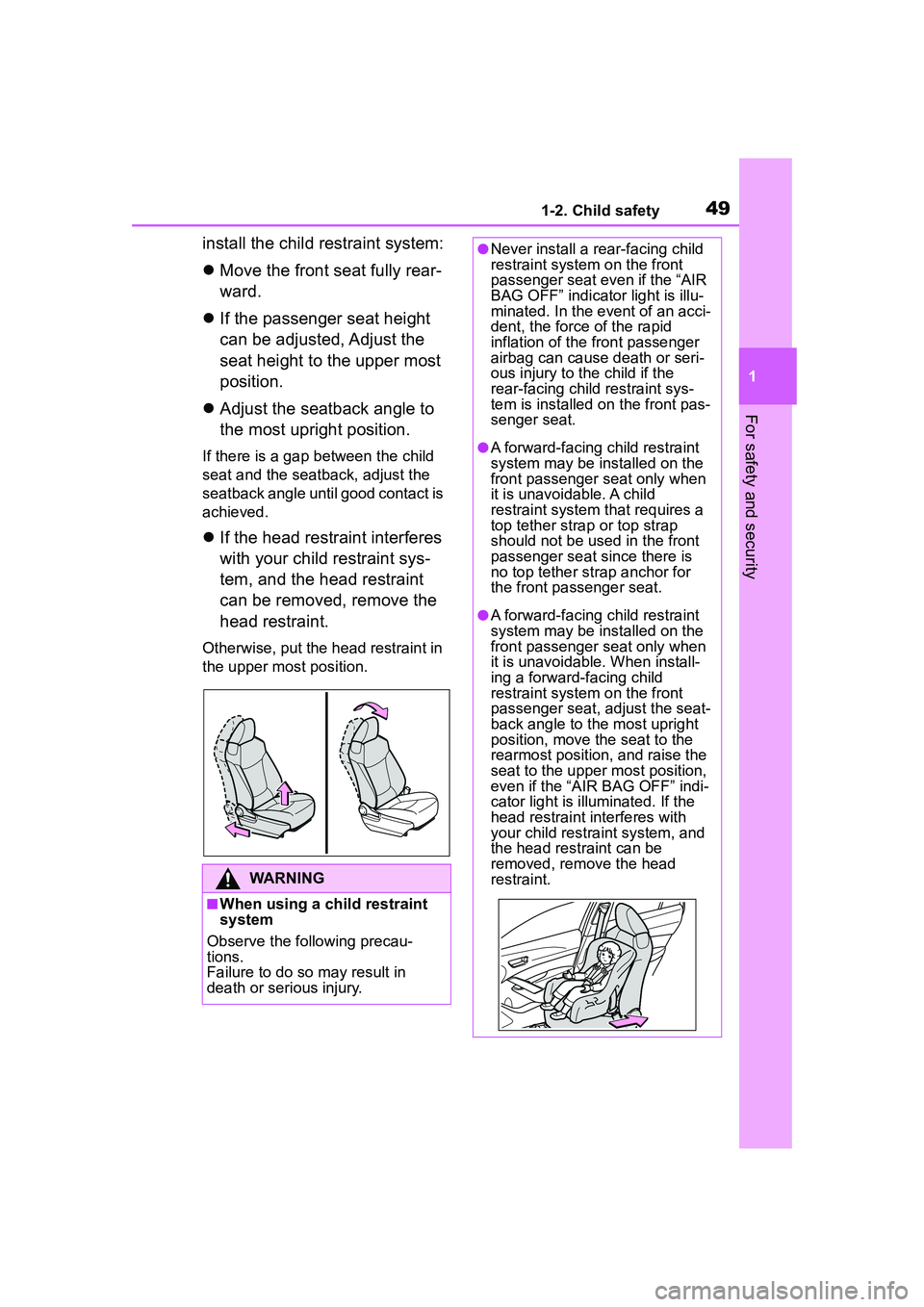
install the child restraint system:
Move the front seat fully rear-
ward.
If the passenger seat height
can be adjusted, Adjust the
seat height to the upper most
position.
Adjust the seatback angle to
the most upright position.
If there is a gap between the child
seat and the seatback, adjust the
seatback angle until good contact is
achieved.
If the head restraint interferes
with your child restraint sys-
tem, and the head restraint
can be removed, remove the
head restraint.
Otherwise, put the head restraint in
the upper most position.
WARNING
■When using a child restraint
system
Observe the following precau-
tions.
Failure to do so may result in
death or serious injury.
●Never install a re ar-facing child
restraint system on the front
passenger seat even if the “AIR
BAG OFF” indicator light is illu-
minated. In the event of an acci-
dent, the force of the rapid
inflation of the front passenger
airbag can cause death or seri-
ous injury to the child if the
rear-facing child restraint sys-
tem is installed on the front pas-
senger seat.
●A forward-facing child restraint
system may be installed on the
front passenger seat only when
it is unavoidable. A child
restraint system that requires a
top tether strap or top strap
should not be used in the front
passenger seat since there is
no top tether strap anchor for
the front passenger seat.
●A forward-facing child restraint
system may be installed on the
front passenger seat only when
it is unavoidable. When install-
ing a forward-facing child
restraint system on the front
passenger seat, adjust the seat-
back angle to the most upright
position, move the seat to the
rearmost position, and raise the
seat to the upper most position,
even if the “AIR BAG OFF” indi-
cator light is illuminated. If the
head restraint interferes with
your child restraint system, and
the head restraint can be
removed, remove the head
restraint.
Page 53 of 612
531-2. Child safety
1
For safety and security
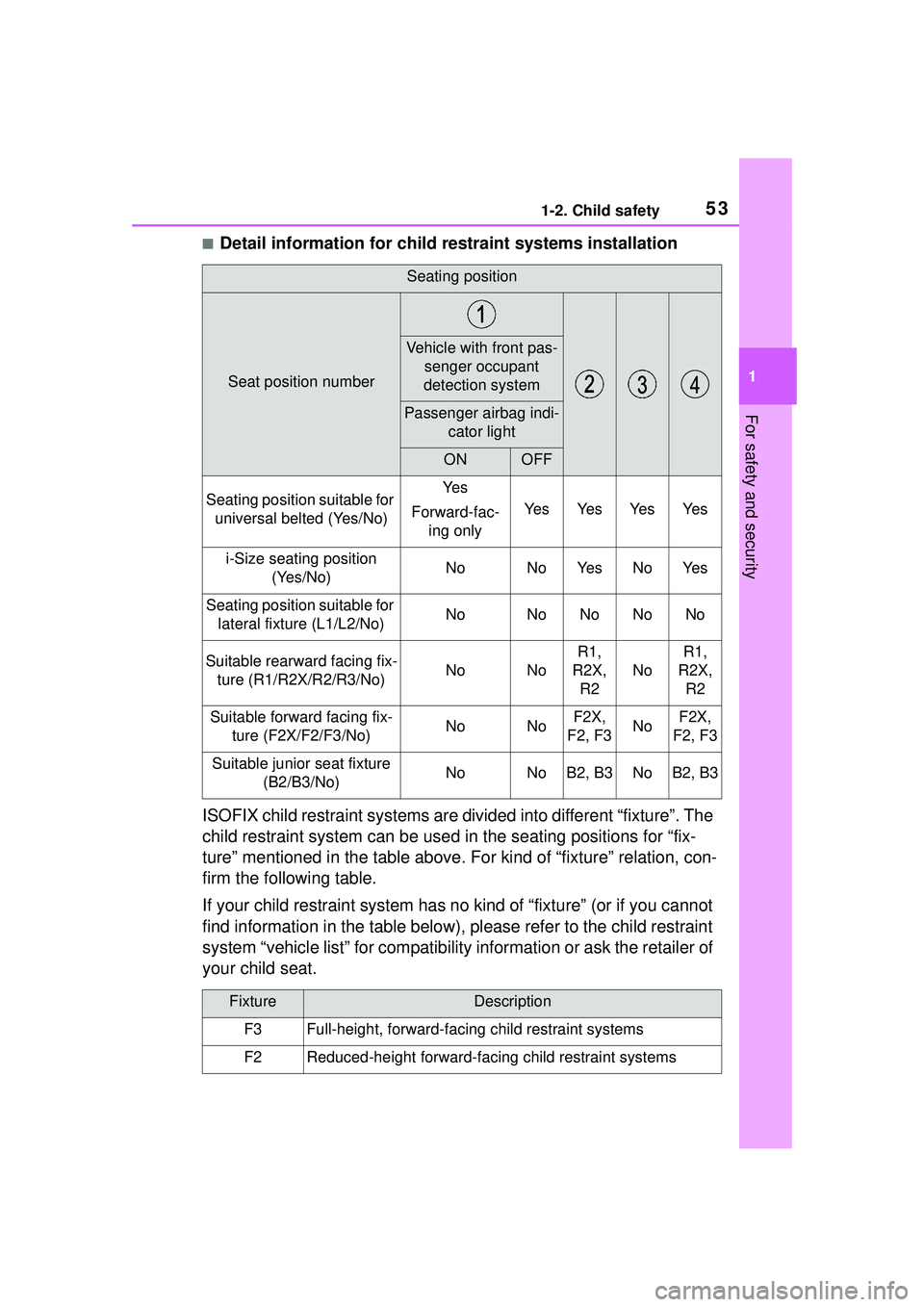
■Detail information for child restraint systems installation
ISOFIX child restraint systems are divided into different “fixture”. The
child restraint system can be used in the seating positions for “fix-
ture” mentioned in the table above. For kind of “fixture” relation, con-
firm the following table.
If your child restraint system has no kind of “fixture” (or if you cannot
find information in the table below), please refer to the child restraint
system “vehicle list” for compatibility information or ask the retailer of
your child seat.
Seating position
Seat position number
Vehicle with front pas- senger occupant
detection system
Passenger airbag indi- cator light
ONOFF
Seating position suitable for universal belted (Yes/No)Ye s
Forward-fac- ing only
Ye sYe sYe sYe s
i-Size seating position (Yes/No)NoNoYe sNoYe s
Seating position suitable for lateral fixture (L1/L2/No)NoNoNoNoNo
Suitable rearward facing fix-ture (R1/R2X/R2/R3/No)NoNo
R1,
R2X, R2
No
R1,
R2X, R2
Suitable forward facing fix- ture (F2X/F2/F3/No)NoNoF2X,
F2, F3NoF2X,
F2, F3
Suitable junior seat fixture (B2/B3/No)NoNoB2, B3NoB2, B3
FixtureDescription
F3Full-height, forward-facing child restraint systems
F2Reduced-height forward-facing child restraint systems
Page 54 of 612
541-2. Child safety
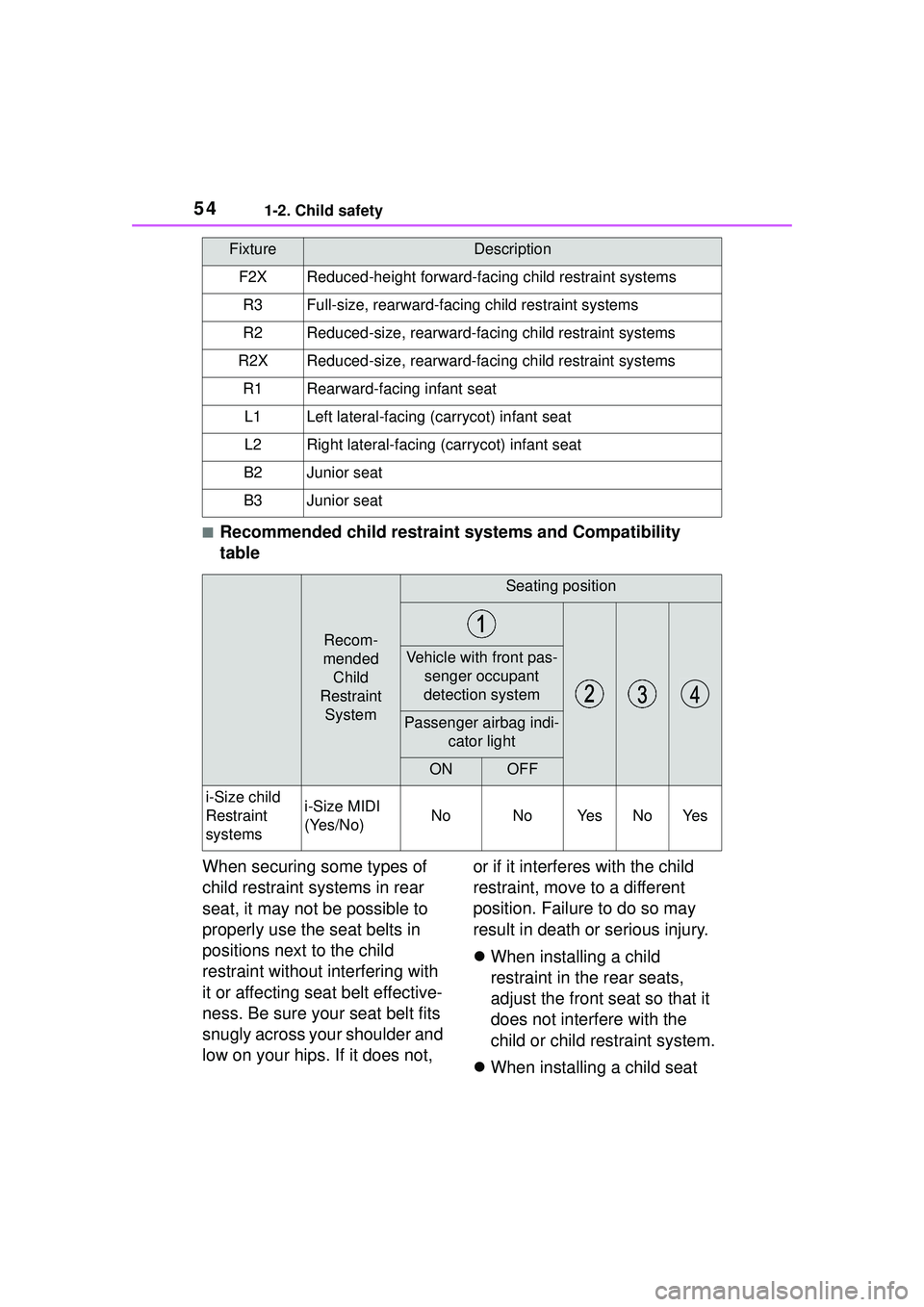
■Recommended child restraint systems and Compatibility
table
When securing some types of
child restraint systems in rear
seat, it may not be possible to
properly use the seat belts in
positions next to the child
restraint without interfering with
it or affecting seat belt effective-
ness. Be sure your seat belt fits
snugly across your shoulder and
low on your hips. If it does not, or if it interferes with the child
restraint, move to a different
position. Failure to do so may
result in death or serious injury.
When installing a child
restraint in the rear seats,
adjust the front seat so that it
does not interfere with the
child or child restraint system.
When installing a child seat
F2XReduced-height forward-facing child restraint systems
R3Full-size, rearward-facing child restraint systems
R2Reduced-size, rearward-fac ing child restraint systems
R2XReduced-size, rearward-facing child restraint systems
R1Rearward-facing infant seat
L1Left lateral-facing (carrycot) infant seat
L2Right lateral-facing (carrycot) infant seat
B2Junior seat
B3Junior seat
Recom-
mended Child
Restraint System
Seating position
Vehicle with front pas- senger occupant
detection system
Passenger airbag indi- cator light
ONOFF
i-Size child
Restraint
systemsi-Size MIDI
(Yes/No)NoNoYe sNoYe s
FixtureDescription