2022 SUZUKI JIMNY main
[x] Cancel search: mainPage 231 of 421
A WARNING
In addition to following the driving tips in this section, it is important to observe the following precautions for on-road and off-road driving. Driver and passengers should wear seat belts at all times. Do not let anyone else drive your vehicle unless they are also aware of the vehicle characteristics and handling differences described in this section. Avoid loaning your vehicle to any• one unless you accompany them. Make sure your tyres are in good condition and always maintain the specified tyre pressure. Refer to "Tyres" in the "INSPECTION AND MAINTENANCE" section for details. Do not use tyres other than those specified by SUZUKI. Never use dif• ferent sizes or types of tyres on the front and rear wheels. For informa• lion regarding the specified tyres, refer to the "SPECIFICATIONS" section. Never use oversized tyres or special shock absorbers and springs to raise uack up) your vehicle. This will raise the center of gravity of the vehicle and change its handling characteristics. (Continued)
A WARNING
(Continued) After driving through water, mud, or sandy ground, test the brakes while driving at a slow speed to see if they have maintained their nor• mal effectiveness. If the brakes are less effective than normal, dry them by repeatedly applying the brakes while driving slowly until the brakes have regained their nor• mal effectiveness. After extended operation in mud, sand, or water, have the brakes, bearings and joint parts etc. inspected by a SUZUKI dealer as soon as possible.
DRIVING TIPS
Running-in
NOTICE
The future performance and reliabil• ity of the engine depends on the care and restraint exercised during its early life. It is especially important to observe the following precautions during the first 960 km (600 miles) of vehicle operation. • After starting, do not race the engine. Warm ii up gradually. • Avoid prolonged vehicle operation at a constant speed. Moving parts will break in better if you vary your speed. Start off from a stop slowly. Avoid full throttle starts. Avoid hard braking, especially during the first 320 km (200 miles) of driving. Do not drive slowly with the !rans• mission in a high gear. Drive the vehicle at moderate engine speeds. Do not tow a trailer during the first 960 km (600 miles) of vehicle oper• ation.
4-8
Page 232 of 421

DRIVING TIPS
Catalytic converter
78RB04003
The purpose of the catalytic converter is to minimize the amount of harmful pollutants in your vehicle's exhaust. Use of lead".d fuel in vehicles equipped with catalytic converters is prohibited, because lead deactivates the pollutant-reducing components of the catalyst system.
The converter is designed to last the life of the vehicle under normal usage and when unleaded fuel is used. No special maintenance is required on the converter. However, it is very important to keep the engine properly tuned. Engine misfiring, which can result from an improperly tuned engine, may cause overheating of the catalytic converter. This may result in permanent
4-9
heat damage to the catalytic converter and other vehicle components.
NOTICE
To mm,m,ze the possibility of catalytic converter or other vehicle damage: • Maintain the engine in the proper operating condition. In the event of an engine malfunction, particularly one involving engine misfire or other apparent loss of performance, have the vehicle serviced promptly. • Do not turn off the engine or inter
rupt the ignition when the t(ans~i~sion is in gear and the vehicle 1s m motion. Do not try to start the engine by pushing or towing the vehicle, or coasting down a hill. Do not idle the engine with any spark plug wires disconnected or removed, such as during diagnostic testing. • Do not idle the vehicle for prolonged periods if idling seems rough or there are other malfunctions. Do not allow the fuel tank to get near the empty level.
A. WARNING
Be careful where you park and drive; the catalytic converter and other exhaust components can get very hot. As with any vehicle, do not park or operate this vehicle in areas where combustible materials such as dry grass or leaves can come in contact with a hot exhaust system.
Page 233 of 421
Improving fuel economy
The following instructions will help you improve fuel economy.
Avoid excessive idling If you park your vehicle for more than one minute, stop the engine and start it again later. When warming up a cold engine, do not allow the engine to idle or apply full throttle until the engine has reached operating temperature. Allow the engine to warm up by driving.
Avoid fast starts F~st starts away from lights or stop signs will consume fuel unnecessarily and shorten engine life. Start off slowly.
Avoid unnecessary stops Avoid unnecessary deceleration and stopping. Try to maintain a moderate, steady speed whenever possible. Slowing down and then accelerating again uses more fuel.
Keep a steady cruising speed Drive at a constant speed that road and traffic conditions will permit.
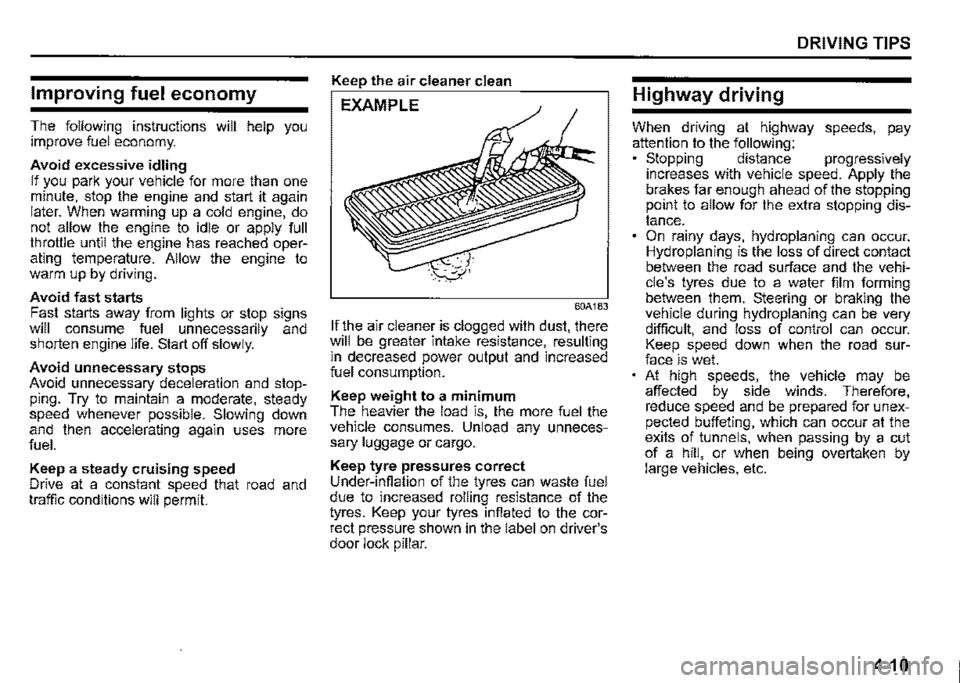
Keep the air cleaner clean
EXAMPLE
60A183
If the air cleaner is clogged with dust, there will be greater intake resistance, resulting m decreased power output and increased fuel consumption.
Keep weight to a minimum The heavier the load is, the more fuel the vehicle consumes. Unload any unnecessary luggage or cargo.
Keep tyre pressures correct Under-infiation of the tyres can waste fuel due to increased rolling resistance of the tyres. Keep your tyres infiated to the correct pressure shown in the label on driver's door lock pillar.
DRIVING TIPS
Highway driving
When driving at highway speeds, pay attention to the following: • Stopping distance progressively increases with vehicle speed. Apply the brakes far enough ahead of the stopping prnnt to allow for the extra stopping distance. On rainy days, hydroplaning can occur. Hydroplaning is the loss of direct contact between the road surface and the vehicle's tyres due to a water film forming between them. Steering or braking the vehicle during hydroplaning can be very difficult, and loss of control can occur. Keep speed down when the road surface is wet. At high speeds, the vehicle may be affected by side winds. Therefore, reduce speed and be prepared for unexpected buffeting, which can occur at the exits of tunnels, when passing by a cut of a hill, or when being overtaken by large vehicles, etc.
4-10
Page 240 of 421

OTHER CONTROLS AND EQUIPMENT
Interior light
Front
52RM50070
This light switch has three positions which function as described below:
ON (1) The light comes on and stays on regardless of whether the door is open or closed.
NOTE: The light will automatically be turned off to prevent the lead-acid battery from discharging when the following conditions are simultaneously met: The ignition switch is in "LOCK" position. The hazard warning lights, the position lights and the headlights are off.
5-5
• After 15 minutes from the light on.
DOOR (2) The light comes on when the door is opened. After closing all doors, the light will remain on for about 15 seconds and then fade out. If you insert the key to change the ignition mode to "ACC" or "ON" during this time, the light will start to fade out immediately. After removing the key from the ignition switch, the light will turn on for about 15 seconds and then fade out.
NOTE: The light will automatically be turned off to prevent the lead-acid battery from discharging when the following conditions are simultaneously met: • The ignition switch is in "LOCK" position. • After about 15 minutes of the light on.
OFF (3) The light remains off even when the door is opened.
Luggage compartment
(if equipped)
ON @l) o @i OFF
(1) (2)
78RB05010
This light switch has three positions which function as described below:
ON (1) The light comes on and stays on regardless of whether the tailgate is open or closed.
NOTE: The light will automatically be turned off to prevent the lead-acid battery from discharging when the following conditions are simultaneously met: The ignition switch is in "LOCK" position. The hazard warning lights, the position lights and the headlights are off. After 15 minutes from the light on.
Page 241 of 421

DOOR (2) The light comes on when the tailgate is opened. After closing the tailgate, the light will remain on for about 15 seconds and then fade out. If you insert the key to change the ignition mode to "ACC" or "ON" during this time, the light will start to fade out immediately. After removing the key from the ignition switch, the light will turn on for about 15 seconds and then fade out.
NOTE: The light will automatically be turned off to prevent the lead-acid battery from discharging when the following conditions are
simultaneously met: • The ignition switch is in "LOCK" position. • After about 15 minutes of the light on.
OFF (3) The light remains off even when the tailgate is opened.
NOTICE
Do not leave the tailgate open with the luggage · compartment light switch in ON position for a long time, or the lead-acid battery will discharge.
OTHER CONTROLS AND EQUIPMENT
NOTE: The light will automatically be turned off to prevent the lead-acid battery from discharging when after 15 minutes of the tail
gate open.
78RB05011
NOTE: The number of doors involved in the lighting operation of the interior light depends on the vehicle specification. If there is a switch (rubber protrusion) at the door opening as shown, the door is involved in the lighting operation. The tailgate is also involved in this operation even without the rubber protrusion.
Accessory socket
Luggage compartment (if equipped)
5-6
Page 242 of 421

OTHER CONTROLS AND EQUIPMENT
The accessory socket will work when the ignition switch is in "ACC" or "ON" position. This socket can be used to provide 12 volt/ 120 watt/1 O ampere power for electrical accessories. Check that the rubber cap remains on the socket when the socket is not in use.
5-7
NOTICE
To prevent the fuse from being blown, when using sockets at the same time, do not exceed the total combined power capacity of 12 volt/120 waW10 ampere. • Use of inappropriate electrical accessories can cause damage to your vehicle's electrical system. Check that any electrical accessories you use are designed to plug into this type of socket. • Check that the cap remains on the socket when the socket is not in use. When the ignition switch is in 11LOCK11 position during using the accessory socket, the following accidents may occur; -the audio or navigation system does not turn off. -the keyless entry system does not work, etc. If they occur, disconnect the item from the accessory socket and check whether the electrical equipments work properly. If the problem persists, ask a SUZUKI dealer to have the system inspected.
USB socket (if equipped)
78RB05014
Connect your portable digital music player, etc. to this socket to enjoy music through the vehicle's audio system. Refer to "Audio system (Type A I Type 8) (if equipped)" in this section.
NOTICE
Always close the cover when not in use, since entry of foreign material, dust, water, conductive liquids may damage the audio system or USS device.
Page 255 of 421

DEFROST (g)
78RB05034
Temperature-controlled air comes out of the windshield defroster outlets, the side defroster outlets and the side outlets.
OTHER CONTROLS AND EQUIPMENT
Air conditioning switch (5) To turn on the air conditioning system, set the blower speed selector to a position other than off and push in "NC" switch. With this "NC" switch operation, a indicator light will come on when the air conditioning system is working. To turn off the air conditioning system, push "NC" switch again.
During operation of the air conditioner, you may notice slight changes in engine speed. These changes are normal, the system is designed so that the compressor turns on or off to maintain the desired temperature.
Less operation of the compressor results in better fuel economy.
System operating instructions
Natural ventilation Select VENTILATION and FRESH AIR, the temperature selector to the desired temperature position, and the blower speed selector to off. Fresh air will flow through the vehicle during driving.
Forced ventilation The base settings are the same as for natural ventilation except you set the blower speed selector to a position other than off.
Normal heating (using outside air) Select HEAT and FRESH AIR, the temperature selector to the desired temperature position and the blower speed selector to the desired blower speed position. Setting the blower speed selector to a higher blower speed position increases heating
efficiency.
Quick heating (using recirculated air) The base settings are the same as for normal heating except you select RECIRCULATED AIR. If you use this heating method for an extended period of time, the air in the vehicle can become contaminated and the windows can become misty. Therefore, use this method only for quick heating and change to the normal heating method as soon as possible.
5-20
Page 257 of 421
Maintenance
If you do not use the air conditioner for a long period, such as during winter, it may not give the best performance when you start using it again. To help maintain optimum performance and durability of your air conditioner, it needs to be run periodically. Operate the air conditioner at least once a month for one minute with the engine idling. This circulates the refrigerant and oil and helps protect the internal components.
If your air conditioner is equipped with air filters, clean or replace them as specified . in "Maintenance schedule" in "INSPECTION AND MAINTENANCE" section.
(For models with air conditioner refrigerant R-1234yf) NOTE: Your vehicle uses the air conditioning refrigerant HFO-1234yf, commonly called R-1234yf. R-1234yf replaced R-134a for automotive applications. Other refrigerants are available, but only R-1234yf should be used in your vehicle. (For the country of Singapore) • For repair and parts replacement, have your vehicle repaired or replaced parts by an authorized SUZUKI dealer that has the mechanic qualified with SAE J2845 for air conditioner of R-1234yf.
OTHER CONTROLS AND EQUIPMENT
NOTICE
Using the wrong refrigerant may damage your air conditioning system. Use R-1234yf only. Do not mix or replace the R-1234yf with other refrigerants.
(For models with air conditioner refrigerant R-134a) NOTE: Your vehicle uses the air conditioning refrigerant HFC-134a, commonly called R-134a. R-134a replaced R-12 around 1993 for automotive applications. Other refrigerants are available, including recycled R-12, but only R-134a should be used in your
vehicle.
NOTICE
Using the wrong refrigerant may damage your air conditioning system. Use R-134a only. Do not mix or replace the R-134a with other refrigerants.
5-22