Page 356 of 421

INS.PECTION AND MAINTENANCE
4-tyre rotation
65D459
To avoid uneven wear of your tyres and to prolong their life, rotate the tyres as illustrated. Tyres should be rotated every 10000 km (6000 miles). After rotation, adjust front and rear tyre pressures to the specification listed on your vehicle's Tyre Information Label.
6-39
Changing Wheels
78RB07014
To change a wheel, use the following procedure:
1) Remove the jack, tools and spare wheel from the vehicle.
NOTE: How to remove the spare wheel:
78RB07052
1. Remove the center nut (1 ), then remove the spare wheel half cover (2) (if equipped). 2. Remove the wheel nuts of the spare wheel, then remove the spare wheel with both hands.
2) Loosen, but do not remove the wheel nuts. 3) Jack up the vehicle (follow the jacking instructions in the "EMERGENCY SERVICE" section in this manual) 4) Remove the wheel nuts and wheel. 5) Before installing the new wheel, clean any mud or dirt off from the surface of the wheel and hub with a clean cloth. Clean the hub carefully; it may be hot from driving.
Page 357 of 421

6) Install the new wheel and replace the wheel nuts with their cone shaped end facing the wheel. Tighten each nut snugly by hand until the wheel is securely seated on the hub.
78RB07017
Tightening torque for wheel nut: 100 Nm (10.0 kg-m, 72.3 lb-ft)
7) Lower the jack and fully tighten the nuts in a crisscross fashion with a wrench as shown in the illustration.
A WARNING
Use genuine wheel nuts and tighten them to the specified torque as soon as possible after changing wheels. Incorrect wheel nuts or improperly tightened wheel nuts may come loose or fall off, which can result in an accident. If you do not have a torque wrench, have the wheel nut torque checked by a SUZUKI dealer.
INSPECTION AND MAINTENANCE
NOTE: How to install the spare wheel:
(3)
78RB07053
When you install a 195/B0R 15 spare wheel to the vehicle, set the spare tyre bracket (3) (if equipped) with the mark of "195" on up position, and handle it in the reverse order of removal. For vehicles equipped with the spare wheel half cover; when you install the spare wheel half cover, check that the hollow (4) of the cover is positioned below the center of the spare wheel half cover.
6-40
Page 358 of 421

INSPECTION AND MAINTENANCE
Battery
A WARNING
• Batteries produce flammable hydrogen gas. Keep flames and sparks away from the battery or an explosion may occur. Never smoke when working near the battery. • When checking or servicing the battery, disconnect the negative cable. Be careful not to cause a short circuit by allowing metal objects to contact the battery posts and the vehicle at the same time. To avoid harm to yourself or damage to your vehicle or battery, follow the jump-starting instructions in "EMERGENCY SERVICE" section if it is necessary to jump-start your vehicle. • Diluted sulfuric acid spilled from battery can cause blindness or severe burns. Use proper eye protection and gloves. Flush eyes or bodi,: with ample water and get medical care immediately if suffered. Keep batteries out of reach of children.
6-41
~~,,_!s:./--(1)
~"1.L(2)
76MS006
For maintenance-free battery (cap-less type), you need not add water. For traditional type battery, which has water filler caps, the level of the battery fluid (acid) fluid (acid) must be kept between the upper level line (1) and lower level line (2) at all times. If the level is found to be below the lower level line (2), add distilled water to the upper level line (1 ). You should periodically check the battery, battery terminals, . and battery hold-down bracket for corrosion. Remove corrosion using a stiff brush and ammonia mixed with water or baking soda mixed with water. After removing corrosion, rinse with clean water.
If your vehicle is not going to be driven for a month or longer, disconnect the cable from the negative terminal of the battery to help prevent discharge.
Replacement of the battery
(2) (3)
(1)
78RB07019
To remove the battery: 1) Disconnect the negative cable (1). 2) Disconnect the positive cable (2). 3) Remove the retainer nuts (3) and remove the retainer (4).
To install the battery: 1) Install the battery in the reverse order of removal. 2) Tighten the bracket bolt and battery cables securely.
Page 359 of 421
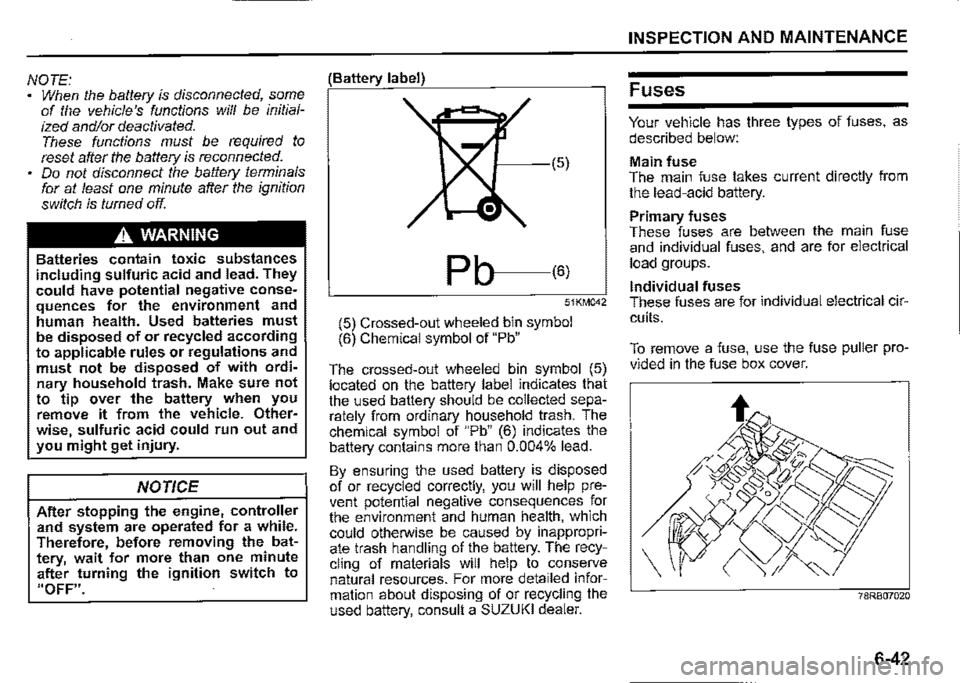
NOTE: (Battery label) When the battery is disconnected, some i::::-==-=="---------
of the vehicle's functions will be initialized and/or deactivated. These functions must be required to reset after the battery is reconnected. Do not disconnect the battery terminals for at least one minute after the ignition switch is turned off.
A WARNING
Batteries contain toxic substances including sulfuric acid and lead. They could have potential negative consequences for the environment and human health. Used batteries must be disposed of or recycled according to applicable rules or regulations and must not be disposed of with ordinary household trash. Make sure not to tip over the battery when you remove it from the vehicle. Otherwise, sulfuric acid could run out and you might get injury.
NOTICE
After stopping the engine, controller and system are operated for a while. Therefore, before removing the battery, wait for more than one minute after turning the ignition switch to 110FF".
Pb>----(5)
51KM042
(5) Crossed-out wheeled bin symbol (6) Chemical symbol of "Pb"
The crossed-out wheeled bin symbol (5) located on the battery label indicates that the used battery should be collected separately from ordinary household trash. The chemical symbol of "Pb" (6) indicates the battery contains more than 0.004% lead.
By ensuring the used battery is disposed of or recycled correctly, you will help prevent potential negative consequences for the environment and human health, which could otherwise be caused by inappropriate trash handling of the battery. The recycling of materials will help to conserve natural resources. For more detailed information about disposing of or recycling the used battery, consult a SUZUKI dealer.
INSPECTION AND MAINTENANCE
Fuses
Your vehicle has three types of fuses, as described below:
Main fuse The main fuse takes current directly from the lead-acid battery.
Primary fuses These fuses are between the main fuse and individual fuses, and are for electrical load groups.
Individual fuses These fuses are for individual electrical cir
cuits.
To remove a fuse, use the fuse puller provided in the fuse box cover.
78R807020
6-42
Page 360 of 421
INSPECTION AND MAINTENANCE
Fuses in engine compartment
(1) Main fuse box (2) Relay box
Main fuse box
~I'----,
6-43
§]
§]
§]
0
[N]
78RB07021
78RB07022
Relay box
00illJ[@[]~ [£C][@[]~(30) [@[]Dill]
0~'12217a ~ ~(31} ~[@[]Dill]
~[@[]~ !Jill] Dill]
~ ~ [@[] [illiJ 8 ;~ ~(32) cc
!ril @DB ~z v (33) :~ ~ ~ FRONT ~
78RB07023
MAIN FUSE / PRIMARY FUSE
(1) 120A FL 1
(2) 100A FL2
(3) BOA FL3
(4) 100A FL4
(5) 50A FL5
(6) 50A Ignition switch
(7) 40A ABS motor
(8) -Blank
(9) 30A Blower fan
(10) 30A Starter motor
(11) 30A Headlight cleaner
(12) 15A Headlight (Right)
(13) 15A Headlight (Left)
(14) 25A ABS/ESP® control mod-ule
(15) -Blank
(16) 15A Ignition coil
(17) 25A Headlight high
(18) 30A Back up
(19) -Blank
(20) 15A Fuel injection
Page 361 of 421

(21) 15A Transmission
(22) 50A Ignition sw2
(23) 10 A A/C compressor
(24) 10A 4WD
(25) 20A Front fog light
(26) -Blank
(27) 40A Power steering
(28) -Blank
(29) 40A Radiator fan
(30) -Blank
(31) 5A Starter motor
(32) 15A Headlight high (Left)
(33) 15A Headlight high (Right)
The main fuse, primary fuses and some of the individual fuses are located in the engine compartment. If the main fuse blows, no electrical component will function. If a primary fuse blows, no electrical component in the corresponding load group will function. When replacing the main fuse, a primary fuse or an individual fuse, use a genuine SUZUKI replacement parts or equivalent for individual fuses. To remove a fuse, use the fuse puller provided in the fuse box. The amperage of each fuse is shown in the back of the fuse box cover.
INSPECTION AND MAINTENANCE
IX! OK
BLOWN
60G111
A. WARNING
If the main fuse or a primary fuse blows, have your vehicle inspected by a SUZUKI dealer. Always use a genuine SUZUKI replacement. Never use a substitute such as a wire even for a temporary repair, or extensive electrical damage and a fire can result.
NOTE: Check that the fuse box always carries spare fuses.
6-44
Page 362 of 421
INSPECTION AND MAINTENANCE
Fuses under dashboard
6-45
78RB07024
1 2 3 4 5 6 7 8 9 10 11 12
71819202122232425
80P0185
PRIMARY FUSE
(1) 30A Power window
(2) 10A Meter
(3) 15A Engine Control Module
(4) 5A lgnition-1 signal 2
(5) 20A Blank
(6) -Blank
(7) -Blank
(8) 20A Door lock
(9) 15A Steering lock
(10) 10A Hazard
(11) -Blank
(12) 10A Rear fog lamp
(13) 5A ABS/Esp® control mod-ule
(14) 15A Seat heater
(15) 5A lgnition-1 signal 3
(16) 10A Dome light-2
(17) 5A Dome light
(18) 15A Radio
(19) 5A CONT
(20) 5A Key2
(21) 20A Power window timer
(22) 5A Key
(23) 15A Horn
(24) 5A Tail light (Left)
(25) 10A Tail light
(26) 10A Airbag
(27) 10A lgnition-1 signal
(28) 10A Back-up light
(29) 5A ACC-3
(30) 20A Rear defogger
(31) 10A Heated mirror
(32) 15A ACC-2
(33) 5A ACC
(34) 10A Rear wiper
(35) 5A lgnition-2 signal
(36) 15A Washer
(37) 25A Front wiper
(38) 10A Stop light
Page 363 of 421
OK BLOWN
81A283
A WARNING
Always replace a blown fuse with a fuse of the correct amperage. Never use a substitute such as aluminum foil or wire to replace a blown fuse. If you replace a fuse and the new one blows in a short period of time, you may have a major electrical problem. Have your vehicle inspected immediately by a SUZUKI dealer.
Headlight aiming
Since special procedures are required, ask a SUZUKI dealer for this job.
INSPECTION AND MAINTENANCE
Headlight Washer Fluid
78RB07046
Check that there is washer fluid in the tank. Refill it if necessary.
NOTICE
In winter season, be sure to remove snow or ice on the nozzle at the front bumper before operating headlight washer. To avoid the frozen damage to the nozzle of the headlight washer, be sure to use the specific washer fluid.
6-46
![SUZUKI JIMNY 2022 Owners Manual INSPECTION AND MAINTENANCE
Fuses in engine compartment
(1) Main fuse box (2) Relay box
Main fuse box
~I----,
6-43
§]
§]
§]
0
[N]
78RB07021
78RB07022
Relay box
00illJ[@[]~ [£C][@[]~(](/manual-img/20/43483/w960_43483-359.png "SUZUKI JIMNY 2022 Owners Manual INSPECTION AND MAINTENANCE
Fuses in engine compartment
(1) Main fuse box (2) Relay box
Main fuse box
~I----,
6-43
§]
§]
§]
0
[N]
78RB07021
78RB07022
Relay box
00illJ[@[]~ [£C][@[]~(")

