2022 SUZUKI IGNIS Engine power
[x] Cancel search: Engine powerPage 237 of 505
3-84
OPERATING YOUR VEHICLE
75RM4-01E
How grip control system works
When the grip control switch is on and one
side of the tires is slipping, the grip control
system assists you in smooth starting by
controlling the driving force and brake
force of all wheels.
• When the ESP
® system is off, the grip
control system cannot be activated.
NOTE:
While the grip control system is working,
the ESP
® warning light blinks.
Hill hold control sys tem (if equipped)The hill hold control system is designed to
assist you in starting to move up hills.
When you start to move up a hill, the sys-
tem helps to prevent the vehicle from roll-
ing downward (for approximately 2
seconds) while you move your foot from
the brake pedal to the accelerator pedal.
The hill hold control system activates for a
maximum of about 2 seconds if your foot is
moved from the brake pedal when the fol-
lowing conditions are all met.
1) The gearshift lever is in a forward gear or reverse gear.
2) The parking brake is released.
3) For manual transaxle models, the clutch pedal is depressed.
4) The vehicle is o n an upward incline.
CAUTION
To activate the grip control system,
push the grip control switch and
check that the indicator on the switch
turns on.
WA R N I N G
• Do not rely excessively on the hill
hold control system. The hill hold
control system may not prevent the
vehicle from rolling downward on a
hill under all load or road condi-
tions. Always be prepared to
depress the brake pedal to prevent
the vehicle from rolling downward.
Failure to pay attention and
depress the brake pedal to hold the
vehicle on a hill when necessary,
may result in loss of control or an
accident.
• The hill hold control system is not designed to stop the vehicle on a
hill. (Continued)
WA R N I N G
(Continued)
• After you release your foot from the
brake pedal, accelerate the vehicle
to move up immediately. If you
release your foot from the brake
pedal over 2 seconds, the hill hold
control system will be canceled. If
so, the vehicle may roll downward,
which can result in an accident
depending on the degree of slope.
And, the engine may stall and the
power assist for the steering and
brakes will not work so steering
and braking will be much harder
than usual which can result in an
accident or vehicle damage.
Page 251 of 505

4-4
DRIVING TIPS
75RM4-01E
CVT
75RM296
• When climbing steep hills, the vehiclemay begin to slow down and show a lack
of power. If this happens, you should
shift to a lower gear so that the engine
will again be operating in its normal
power range. Shift rapidly to prevent the
vehicle from losing momentum.
• When driving down a hill, the engine
should be used for braking by shifting to
the next lower gear.
Driving on slippery roads
60G089S
On wet roads, you shou ld drive at a lower
speed than you do on dry roads due to
possible slippage of tires during braking.
When driving on icy, snow-covered or
muddy roads, reduce your speed and
avoid sudden acceleration, abrupt braking,
or sharp steering movements.
4WD models
Your 4WD is designed to get better traction
on slippery roads than 2-wheel drive mod-
els. However, your 4WD will not have as
much traction in deep snow, mud or sand
as multipurpose 4WD vehicles. You should
not attempt to drive your 4WD in deep
snow, mud or sand. 4WD models are not
sport/utility vehicles, and are not designed
for off-road use.
WA R N I N G
Do not hold the brake pedal down too
long or too often while going down a
steep or long hill. This could cause
the brakes to overheat, resulting in
reduced braking efficiency. Failure to
take this precaution could result in
loss of vehicle control.
NOTICE
When descending a downhill, Never
turn the ignition key to “LOCK” posi-
tion or press the engine switch to
change the ignition mode to LOCK
(OFF). Emission control system and
CVT (if equipped) damage may result.
Page 260 of 505

5-5OTHER CONTROLS AND EQUIPMENT
75RM4-01E
Interior lightFront
62R0294
These light switches have three or four
positions which function as described
below:
ON (1)
• The light comes on and stays on regard-less of whether the door is open or
closed.
• To save the lead-acid battery, the light
will be automatically turned off when a
period of 15 minutes has elapsed after
the light comes on and other operations
are not done. DOOR (2)
• The light comes on while any of the
doors (including the tailgate) is opened.
For about 15 seconds after all doors are
closed, the light will remain on and then
fade out.
• If all doors are closed, the light comes on for about 15 seconds when the ignition
key is pulled out from the ignition switch
or the engine switch is pressed to
change the ignition mode from ON to
LOCK (OFF). After 15 seconds, the light
will fade out.
• To save the lead-acid battery, the light will be automatically turned off when a
period of 15 minutes has elapsed after
any of the doors (including the tailgate)
is opened and other operations are not
done.
If you perform any of the following proce-
dures before the light fading out, the light
will start to fade out immediately.
• Inserting the ignition key into the ignition switch or pressing the engine switch to
change the ignition mode to ACC or ON
• Locking all doors by operating the key, keyless entry transmitter, keyless push
start system remote controller, power
door locking switc h or request switch
OFF (3)
The light remains off even when the door is
opened.
Luggage compartment (if equipped)
75RM009
When you open the tailgate with the lug-
gage compartment light switch in ON posi-
tion (1), the light com es on and remains on
as long as you keep the tailgate open.
• To save the lead-acid battery, the light
will be automatically turned off when a
period of 15 minutes has elapsed after
the tailgate is opened and other opera-
tions are not done.
When the luggage compartment light
switch is in OFF position (2), the light
remains off regardless of whether the tail-
gate is open or close.
(1)
(2)
(3)
(2)
(1)
Page 372 of 505
7-23INSPECTION AND MAINTENANCE
75RM4-01E
Drive beltCheck that the drive belt tension is correct.
If the belt is too loose, insufficient battery
charging, engine overheating, poor power
steering, poor air conditioning, or exces-
sive belt wear can result. When you press
the belt with your thumb midway between
the pulleys, there should be a deflection
according to the following chart.
The belts should also be examined to
ensure that they are not damaged.
If you need to replace or adjust the belt
have it done by your SUZUKI dealer.K12C engine models
The drive belts tension is adjusted auto-
matically.
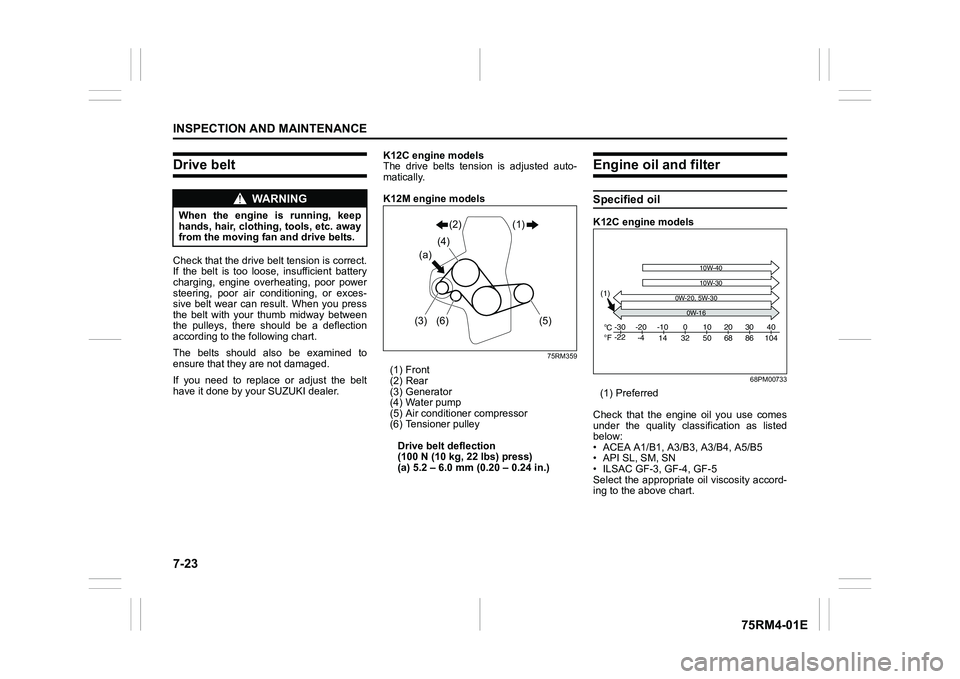
K12M engine models
75RM359
(1) Front
(2) Rear
(3) Generator
(4) Water pump
(5) Air conditioner compressor
(6) Tensioner pulley
Drive belt deflection
(100 N (10 kg, 22 lbs) press)
(a) 5.2 – 6.0 mm (0.20 – 0.24 in.)
Engine oil and filterSpecified oil K12C engine models
68PM00733
(1) Preferred
Check that the engine oil you use comes
under the quality classification as listed
below:
• ACEA A1/B1, A3/ B3, A3/B4, A5/B5
• API SL, SM, SN
• ILSAC GF-3, GF-4, GF-5
Select the appropriate oil viscosity accord-
ing to the above chart.
WA R N I N G
When the engine is running, keep
hands, hair, clothing, tools, etc. away
from the moving fan and drive belts.
(a) (4)(2) (1)
(3) (6) (5)
C Fo
o-30
-22
-20
10W-40
-4-10
14 32 50 68 86 104 010203040
10W-30
(1)
0W-20, 5W-30
0W-16
Page 378 of 505

7-29INSPECTION AND MAINTENANCE
75RM4-01E
81PN200
If the coolant level is below “LOW” mark,
more coolant should be added. Remove
the reservoir tank cap and add coolant until
the reservoir tank level reaches “FULL”
mark. Never fill the reservoir tank above
“FULL” mark.Coolant replacementSince special procedures are required, ask
your authorized SUZUKI dealer for this job.
Air cleanerIf the air cleaner is clogged with dust, there
will be greater intake resistance, resulting
in decreased power output and increased
fuel consumption.
(For K12C engine model)
81P60030
1) Remove the duct (1).
NOTICE
SUZUKI LLC: Super (Blue) coolant;
This coolant is already diluted to the
proper percentage. Do not dilute with
distilled water additionally. Doing so
may result in the possibility of freez-
ing and/or overheating coolant.
NOTICE
SUZUKI LLC: Standard (Green) cool-
ant;
• The mixture you use should con-tain 50% concentration of anti-
freeze.
• If the lowest ambient temperature in your area is expected to be –35°C
(–31°F) or below, use higher con-
centrations up to 60% following the
instructions on the antifreeze con-
tainer.
NOTICE
When putting the cap on the reser-
voir tank, line up the mark on the cap
and the mark on the tank. Failure to
follow this can result in coolant leak-
age.
FULL
LOW
(ΟΝ03/(
(1)
Page 394 of 505

7-45INSPECTION AND MAINTENANCE
75RM4-01E
Lithium-ion battery (if equipped)This battery is installed only in models
equipped with the ENG A-STOP system
and is located under the front passenger’s
seat.
• The lithium-ion battery is maintenance-free. However, in order to avoid a flat
battery, drive the vehicle once a month
for at least 30 minutes to recharge the
battery.
• When replacing or disposing of the lith- ium-ion battery, consult your authorized
SUZUKI dealer.
FusesYour vehicle has three types of fuses, as
described below:
Main fuse
The main fuse takes current directly from
the lead-acid battery.
Primary fuses
These fuses are between the main fuse
and individual fuses, and are for electrical
load groups.
Individual fuses
These fuses are for indi vidual electrical cir-
cuits.
To remove a fuse, use the fuse puller pro-
vided in the fuse box.
63J095
Fuses in engine compartment
74LHT0715
75RM065
WA R N I N G
Since mishandling the lithium-ion
battery may cause a fire or electric
shock or damage to the battery,
observe the following precautions.
• Do not remove or disassemble it.
• Do not allow it to get wet, for exam- ple, with water.
• Do not expose it to a strong impact.
• Do not lean or place any object on it.
• Do not remove battery terminals or power electrical accessories from
the terminals.
(5)
(3)
(4)
(2) (1)(5)
(4)
(3)
(2) (1)
(6)
(7)
(16)
(17)
(18)
(19)
(20)
(21)
(22)
(23)
(25)
(24)
(26)
(29)
(27)
(28)
(30)
(31)
(32)
(37)
(33)
(34)
(35)
(36) (8)
(9)
(10)
(11)
(12)
(13)
(14)
(15)FRONT
Page 395 of 505

7-46
INSPECTION AND MAINTENANCE
75RM4-01E
*1: Models with ENG A-STOP
*2: CVT models with ENG A-STOP
*3: Auto Gear Shift models
*4: Models with Auto-on headlight system
*5: Models with front fog light The main fuse, primary fuses and some of
the individual fuses are located in the
engine compartment. If the main fuse
blows, no electrical component will func-
tion. If a primary fuse blows, no electrical
component in the corresponding load
group will function. When replacing the
main fuse, a primary fuse or an individual
fuse, use a genuine S
UZUKI replacement.
To remove a fuse, use the fuse puller pro-
vided in the fuse box. The amperage of
each fuse is shown in the back of the fuse
box cover.
60G111
MAIN FUSE / PRIMARY FUSE
(1) 120 A FL1
(2) 100 A FL2
(3) 80 A FL3
(4) 100 A FL4
(5) 50 A FL5
(6) 150 A FL6
*1
(7) 40 A Power steering
(8) – Blank
(9) 10 A A/C compressor
(10) 25 A Headlight high
*4
(11) 15 A Headlight (Left)
(12) 15 A Headlight (Right)
(13) 30 A Starter motor
(14) 30 A Radiator fan
(15) 30 A Starter motor 2
*2
(16) 40 A Ignition switch 2
(17) – Blank
(18) 30 A T/M pump
*3
(19) 30 A Back-up
(20) – Blank
(21) 15 A Front fog light
*5
(22) 30 A Sub battery
*1
(23) 30 A Blower fan
(24) – Blank
(25) 5 A Starting signal
(26) – Blank
(27) 15 A Headlight high (Left)
*4
(28) 15 A Headlight high (Right)
*4
(29) 15 A T/M
*2
(30) 15 A T/M pump 2
*2
(31) 15 A FI
(32) 40 A ABS motor
(33) 25 A ABS solenoid
(34) – Blank
(35) 10 A T/M 2
*3
(36) 5 A T/M 3
*3
(37) 40 A Ignition switch
EXAMPLE
BLOWN OK
Page 417 of 505

8-8
EMERGENCY SERVICE
75RM4-01E
81PN248
5) Remove the plug from the filler hose (3)and insert the filler hose into the tire
valve (8).
63J349
6) Hold the bottle (2) with bottom upwardsand pump the bottle to fill the entire bot-
tle contents (sealant) into the tire.
Thereafter pull off the filler hose and
firmly screw the valve insert into the tire
valve again. If the valve insert is dirty or
lost, use the enclosed spare valve
insert.
81PN120
7) Screw the air hose (10) of the compres- sor (1) to the tire valve (8). Fit the
power plug (11) to the accessory
socket. For a manual transaxle or an
Auto Gear Shift vehicle, shift from “R”
(Reverse) into “N” (Neutral). Start the
engine. Switch on the compressor.
Inflate the tire to the required air pres-
sure. If the tire cannot be inflated to the required
air pressure within 5 minutes, move the
vehicle a few meters back and forth to
spread the sealant over the entire tire.
Then, inflate the tire again.
If the tire still cannot be inflated to the
required air pressure, the tire may be
severely damaged. In this case, the flat tire
repair kit cannot provide the necessary
seal. Consult a SUZUKI dealer or a road-
side assistance service.
NOTE:
If the tire is over-inflated, deflate air by
loosening the screw of the air hose.
(3)
(8)
(2)
(1)
(8) (11)
(10)
10 min. Max.required
air pressure
WA R N I N G
Do not stand by the tire, when inflat-
ing. It can burst.
NOTICE
Do not operate the compressor for
longer 10 minutes without cease. It
can cause overheating of the com-
pressor.