2022 SUBARU BRZ load capacity
[x] Cancel search: load capacityPage 408 of 432
Tire Information
402sures and make sure the wheel nuts
are correctly tightened. For informa-
tion about the tightening torque and
tightening sequence for the wheel
nuts, refer to
"Flat Tires"
P303.
■
Vehicle Load Limit – How to
Determine
The load capacity of your vehicle is
determined by weight, not by avail-
able cargo space. The load limit of
your vehicle is shown on the vehicle
placard attached to the driver’s side
B-pillar. Locate the statement “
The
combined weight of occupants and cargo
should never exceed XXX kg or XXX lbs
”
on your vehicle’s placard.
The vehicle placard also shows
seating capacity of your vehicle.
The total load capacity includes the
total weight of driver and all passen-
gers and their belongings, any
cargo, any optional equipment such
as a trailer hitch, roof rack or bike
carrier, etc., and the tongue load of
a trailer. Therefore cargo capacity
can be calculated by the following
method. Cargo capacity = Load limit
− (total
weight of occupants + total weight of
optional equipment)
For information about vehicle
loading, refer to
"Loading Your Vehicle"
P297.▼
Calculating total and load
capacities varying seating
configurations
Calculate the available load
capacity as shown in the following
examples:
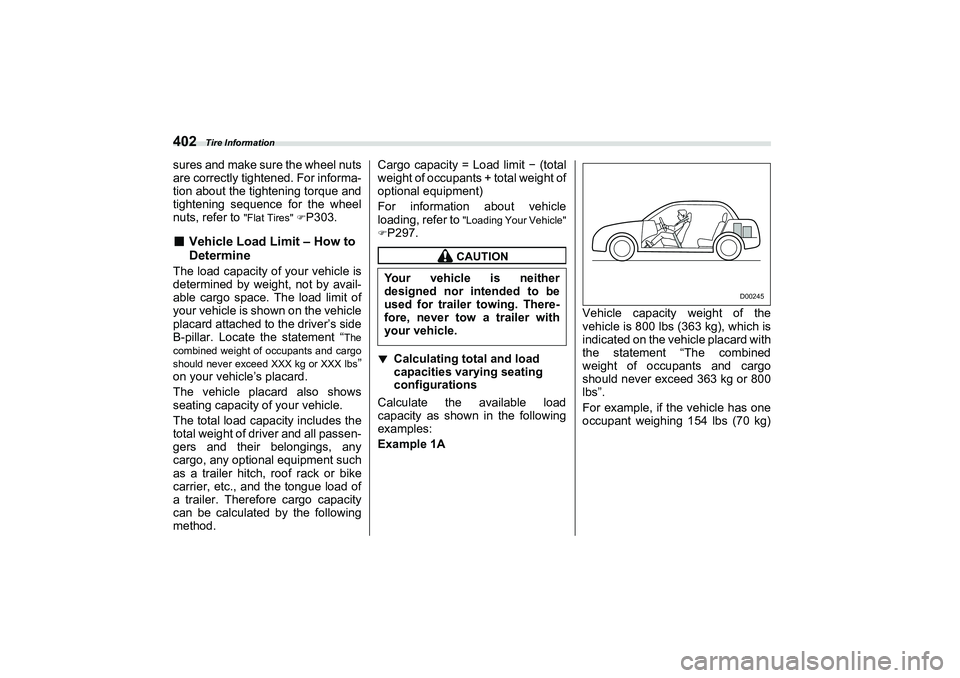
Example 1A Vehicle capacity weight of the
vehicle is 800 lbs (363 kg), which is
indicated on the vehicle placard with
the statement “The combined
weight of occupants and cargo
should never exceed 363 kg or 800
lbs”.
For example, if the vehicle has one
occupant weighing 154 lbs (70 kg)
CAUTION
Your vehicle is neither
designed nor intended to be
used for trailer towing. There-
fore, never tow a trailer with
your vehicle.
D00245
A4600BEscusenvhch13.fm 402 ページ 2021年7月>7日 5 曜日 午後>2時>1>7分
Page 409 of 432
Tire Information
403
Consumer Information and Reporting Safety Defects13
– CONTINUED –
plus cargo weighing 551 lbs (250
kg).
1. Calculate the total weight.
2. Calculate the available load
capacity by subtracting the total
weight from the vehicle capacity
weight of 800 lbs (363 kg).
3. The result of step 2 shows that a
further 95 lbs (43 kg) of cargo can
be carried.Example 1B
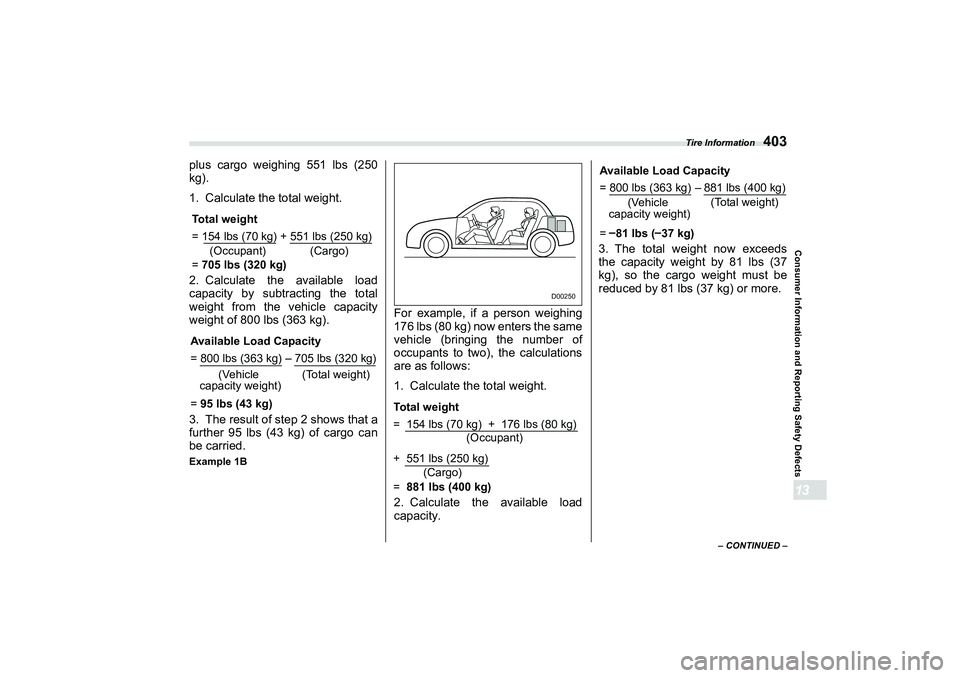
For example, if a person weighing
176 lbs (80 kg) now enters the same
vehicle (bringing the number of
occupants to two), the calculations
are as follows:
1. Calculate the total weight.
2. Calculate the available load
capacity.3. The total weight now exceeds
the capacity weight by 81 lbs (37
kg), so the cargo weight must be
reduced by 81 lbs (37 kg) or more.
Total weight
= 154 lbs (70 kg) + 551 lbs (250 kg)
= 705 lbs (320 kg)
(Occupant) (Cargo)
Available Load Capacity
= 800 lbs (363 kg) 705 lbs (320 kg)
= 95 lbs (43 kg)
(Vehicle
capacity weight) (Total weight)
D00250
Total weight
= 154 lbs (70 kg) + 176 lbs (80 kg)
+ 551 lbs (250 kg)
= 881 lbs (400 kg)
(Occupant)
(Cargo)
Available Load Capacity
= 800 lbs (363 kg) 881 lbs (400 kg)
= 81 lbs ( 37 kg)
(Vehicle
capacity weight) (Total weight)
A4600BEscusenvhch13.fm 403 ページ 2021年7月>7日 5 曜日 午後>2時>1>7分
Page 410 of 432
Tire Information
404Example 2AVehicle capacity weight of the
vehicle is 800 lbs (363 kg), which is
indicated on the vehicle placard with
the statement “The combined
weight of occupants and cargo
should never exceed 363 kg or 800
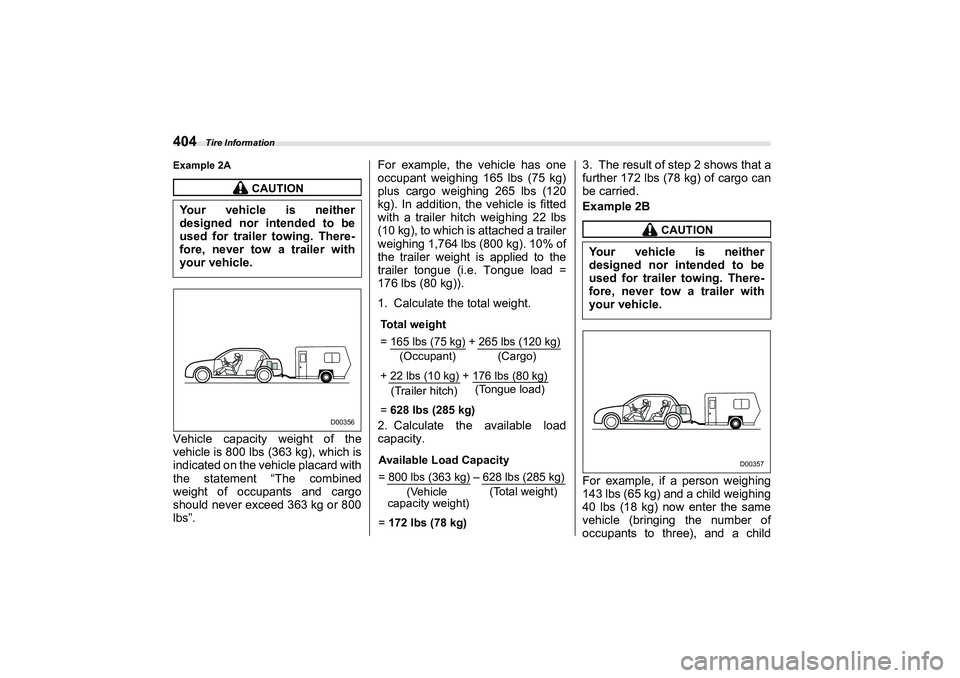
lbs”.For example, the vehicle has one
occupant weighing 165 lbs (75 kg)
plus cargo weighing 265 lbs (120
kg). In addition, the vehicle is fitted
with a trailer hitch weighing 22 lbs
(10 kg), to which is attached a trailer
weighing 1,764 lbs (800 kg). 10% of
the trailer weight
is applied to the
trailer tongue (i.e. Tongue load =
176 lbs (80 kg)).
1. Calculate the total weight.
2. Calculate the available load
capacity. 3. The result of step 2 shows that a
further 172 lbs (78 kg) of cargo can
be carried.
Example 2B
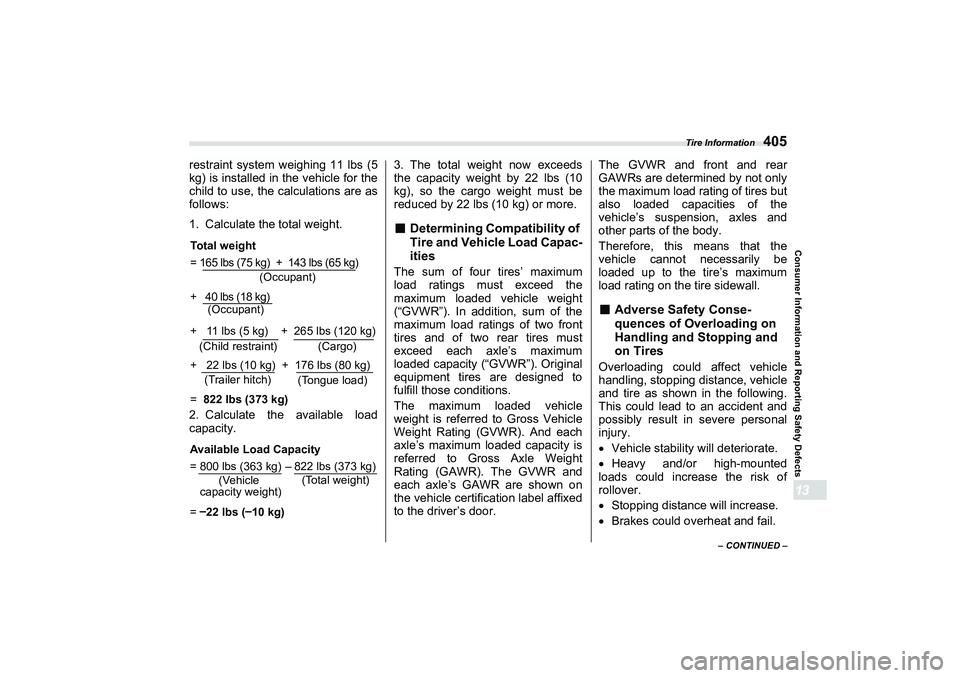
For example, if a person weighing
143 lbs (65 kg) and a child weighing
40 lbs (18 kg) now enter the same
vehicle (bringing the number of
occupants to three), and a child
CAUTION
Your vehicle is neither
designed nor intended to be
used for trailer towing. There-
fore, never tow a trailer with
your vehicle.
D00356
Total weight
= 165 lbs (75 kg) + 265 lbs (120 kg)
+ 22 lbs (10 kg) + 176 lbs (80 kg)
= 628 lbs (285 kg)
(Occupant) (Cargo)
(Trailer hitch) (Tongue load)
Available Load Capacity
= 800 lbs (363 kg) 628 lbs (285 kg)
= 172 lbs (78 kg)
(Vehicle
capacity weight) (Total weight)
CAUTION
Your vehicle is neither
designed nor intended to be
used for trailer towing. There-
fore, never tow a trailer with
your vehicle.
D00357
A4600BEscusenvhch13.fm 404 ページ 2021年7月>7日 5 曜日 午後>2時>1>7分
Page 411 of 432
Tire Information
405
Consumer Information and Reporting Safety Defects13
– CONTINUED –
restraint system weighing 11 lbs (5
kg) is installed in the vehicle for the
child to use, the calculations are as
follows:
1. Calculate the total weight.
2. Calculate the available load
capacity.3. The total weight now exceeds
the capacity weight by 22 lbs (10
kg), so the cargo weight must be
reduced by 22 lbs (10 kg) or more.
■
Determining Compatibility of
Tire and Vehicle Load Capac-
itiesThe sum of four tires’ maximum
load ratings must exceed the
maximum loaded vehicle weight
(“GVWR”). In addition, sum of the
maximum load ratings of two front
tires and of two rear tires must
exceed each axle’s maximum
loaded capacity (“GVWR”). Original
equipment tires are designed to
fulfill those conditions.
The maximum loaded vehicle
weight is referred to Gross Vehicle
Weight Rating (GVWR). And each
axle’s maximum loaded capacity is
referred to Gross Axle Weight
Rating (GAWR). The GVWR and
each axle’s GAWR are shown on
the vehicle certification label affixed
to the driver’s door. The GVWR and front and rear
GAWRs are determined by not only
the maximum load rating of tires but
also loaded capacities of the
vehicle’s suspension, axles and
other parts of the body.
Therefore, this means that the
vehicle cannot necessarily be
loaded up to the tire’s maximum
load rating on the tire sidewall.
■
Adverse Safety Conse-
quences of Overloading on
Handling and Stopping and
on TiresOverloading could affect vehicle
handling, stopping distance, vehicle
and tire as shown in the following.
This could lead to an accident and
possibly result in severe personal
injury.
Vehicle stability will deteriorate.
Heavy and/or high-mounted
loads could increase the risk of
rollover.
Stopping distance will increase.
Brakes could overheat and fail.
Total weight
= 165 lbs (75 kg) + 143 lbs (65 kg)
+ 40 lbs (18 kg)
+ 11 lbs (5 kg) + 265 lbs (120 kg)
+ 22 lbs (10 kg) + 176 lbs (80 kg)
= 822 lbs (373 kg) (Occupant)
(Cargo)
(Trailer hitch)
(Child restraint)
(Tongue load)
(Occupant)Available Load Capacity
= 800 lbs (363 kg) 822 lbs (373 kg)
=
22 lbs ( 10 kg)(Vehicle
capacity weight) (Total weight)
A4600BEscusenvhch13.fm 405 ページ 2021年7月9日 金曜日 午後4時39分
Page 412 of 432
Uniform Tire Quality Grading Standards
406Suspension, bearings, axles and
other parts of the body could break
or experience accelerated wear that
will shorten vehicle life.
Tires could fail.
Tread separation could occur.
Tire could separate from its rim.■ Steps for Determining
Correct Load Limit1. Locate the statement “The
combined weight of occupants and
cargo should never exceed XXX kg
or XXX lbs.” on your vehicle’s
placard.
2. Determine the combined weight
of the driver and passengers that
will be riding in your vehicle.
3. Subtract the combined weight of
the driver and passengers from
XXX kg or XXX lbs.
4. The resulting figure equals the
available amount of cargo and
luggage load capacity. For
example, if the “
XXX
” amount equals
1,400 lbs (635 kg) and there will be
five 150 lbs (68 kg) passengers in your vehicle, the amount of avail-
able cargo and luggage load
capacity is 650 lbs (1,400
− 750 (5 ×
150) = 650 lbs).
5. Determine the combined weight
of luggage and cargo being loaded
on the vehicle. That weight may not
safely exceed the available cargo
and luggage load capacity calcu-
lated in Step 4.
6. If your vehicle will be towing a
trailer, load from your trailer will be
transferred to your vehicle. Consult
this manual to determine how this
reduces the available cargo and
luggage load capacity of your
vehicle.
13-3. Uniform Tire Quality Grading StandardsThis information i ndicates the rela-
tive performance of passenger car
tires in the area of treadwear, trac-
tion, and temperature resistance.
This is to aid the consumer in
making an informed choice in the
purchase of tires.
Quality grades can be found where
applicable on the tire sidewall
between tread shoulder and
maximum section width. For
example:
TREADWEAR 200 TRACTION AA
TEMPERATURE A
The quality grades apply to new
pneumatic tires for use on
passenger cars. However, they do
not apply to deep tread, winter type
snow tires, space-saver or tempo-
rary use spare tires, tires with
nominal rim diameters of 12 inches
or less, or to some limited produc-
tion tires.
A4600BEscusenvhch13.fm 406 ページ 2021年7月9日 金曜日 午後4時39分