2022 RAM PROMASTER oil level
[x] Cancel search: oil levelPage 214 of 268

212SERVICING AND MAINTENANCE
AUTOMATIC TRANSMISSION
Selection Of Lubricant
It is important to use the proper transmission fluid
to ensure optimum transmission performance and
life. Use the manufacturer specified transmission
fluid Úpage 252. It is important to maintain the
transmission fluid at the correct level using the
recommended fluid.
NOTE:
No chemical flushes should be used in any trans -
mission; only the approved lubricant should be used.
Special Additives
The manufacturer strongly recommends against
using any special additives in the transmission.
Automatic Transmission Fluid (ATF) is an
engineered product and its performance may be
impaired by supplemental additives. Therefore,
do not add any fluid additives to the transmission. The only exception to this policy is the use of
special dyes for diagnosing fluid leaks in 9-speed
transmissions. Avoid using transmission sealers as
they may adversely affect seals.
Fluid Level Check
The fluid level is preset at the factory and does
not require adjustment under normal operating
conditions. Routine fluid level checks are not
required, therefore the transmission filler tube is
capped and no dipstick is provided. An authorized
dealer can check your transmission fluid level
using a special service dipstick. If you notice fluid
leakage or transmission malfunction, visit an
authorized dealer immediately to have the
transmission fluid level checked. Operating the
vehicle with an improper fluid level can cause
severe transmission damage.
WARNING!
Use only the manufacturer recommended
brake fluid Ú
page 251. Using the wrong
type of brake fluid can severely damage your
brake system and/or impair its performance.
The proper type of brake fluid for your vehicle
is also identified on the original factory
installed hydraulic master cylinder reservoir.
To avoid contamination from foreign matter or
moisture, use only new brake fluid or fluid that
has been in a tightly closed container. Keep
the master cylinder reservoir cap secured at
all times. Brake fluid in an open container
absorbs moisture from the air resulting in a
lower boiling point. This may cause it to boil
unexpectedly during hard or prolonged
braking, resulting in sudden brake failure.
This could result in a collision.
Overfilling the brake fluid reservoir can result
in spilling brake fluid on hot engine parts,
causing the brake fluid to catch fire. Brake
fluid can also damage painted and vinyl
surfaces, care should be taken to avoid its
contact with these surfaces.
Do not allow petroleum-based fluid to contami -
nate the brake fluid. Brake seal components could
be damaged, causing partial or complete brake
failure. This could result in a collision.
CAUTION!
Using a transmission fluid other than the
manufacturer recommended fluid may cause
deterioration in transmission shift quality and/or
torque converter shudder Ú page 252.
CAUTION!
Do not use chemical flushes in your
transmission as the chemicals can damage your
transmission components. Such damage is not
covered by the New Vehicle Limited Warranty.
22_VF_OM_EN_USC_t.book Page 212
Page 238 of 268

236SERVICING AND MAINTENANCE
NOTE:Wheel Valve Stem must be replaced as well when
installing new tires due to wear and tear in existing
tires.
Keep dismounted tires in a cool, dry place with as
little exposure to light as possible. Protect tires
from contact with oil, grease, and gasoline.
Replacement Tires
The tires on your new vehicle provide a balance of many
characteristics. They should be inspected regularly
for wear and correct cold tire inflation pressures.
The manufacturer strongly recommends that you use
tires equivalent to the originals in size, quality and
performance when replacement is needed. Refer to the
paragraph on “Tread Wear Indicators” in this section.
Refer to the Tire and Loading Information placard or the
Vehicle Certification Label for the size designation of
your tire. The Load Index and Speed Symbol for your tire
will be found on the original equipment tire sidewall.
See the Tire Sizing Chart example found in the Tire
Safety Information section of this manual for more
information relating to the Load Index and Speed
Symbol of a tire Úpage 226.
It is recommended to replace the two front tires or
two rear tires as a pair. Replacing just one tire can
seriously affect your vehicle’s handling. If you ever
replace a wheel, make sure that the wheel’s
specifications match those of the original wheels. It is recommended you contact an authorized tire
dealer or original equipment dealer with any
questions you may have on tire specifications or
capability. Failure to use equivalent replacement
tires may adversely affect the safety, handling, and
ride of your vehicle.
TIRE TYPES
All Season Tires — If Equipped
All Season tires provide traction for all seasons
(Spring, Summer, Autumn, and Winter). Traction
levels may vary between different all season tires.
All season tires can be identified by the M+S, M&S,
M/S or MS designation on the tire sidewall. Use all
season tires only in sets of four; failure to do so
may adversely affect the safety and handling of
your vehicle.
Summer Or Three Season Tires —
If Equipped
Summer tires provide traction in both wet and dry
conditions, and are not intended to be driven in snow or
on ice. If your vehicle is equipped with Summer tires, be
aware these tires are not designed for Winter or cold
driving conditions. Install Winter tires on your vehicle
when ambient temperatures are less than 40°F (5°C)
or if roads are covered with ice or snow. For more
information, contact an authorized dealer.
WARNING!
Do not use a tire, wheel size, load rating, or speed
rating other than that specified for your vehicle.
Some combinations of unapproved tires and
wheels may change suspension dimensions and
performance characteristics, resulting in changes
to steering, handling, and braking of your vehicle.
This can cause unpredictable handling and stress
to steering and suspension components. You
could lose control and have a collision resulting in
serious injury or death. Use only the tire and wheel
sizes with load ratings approved for your vehicle.
Never use a tire with a smaller load index or
capacity, other than what was originally equipped
on your vehicle. Using a tire with a smaller load
index could result in tire overloading and failure.
You could lose control and have a collision.
Failure to equip your vehicle with tires having
adequate speed capability can result in
sudden tire failure and loss of vehicle control.
CAUTION!
Replacing original tires with tires of a different
size may result in false speedometer and
odometer readings.
22_VF_OM_EN_USC_t.book Page 236
Page 260 of 268

258 C
Camera, Rear
...................................... 105, 106Capacities, Fluid............................................ 251Caps, Filler Fuel........................................................... 108Oil (Engine)................................................ 202Radiator (Coolant Pressure)...................... 210Car Washes................................................... 244Carbon Monoxide Warning............................ 175Cargo Area Cover............................................. 50Cargo Compartment........................................ 50Cargo Light...................................................... 35Cellular Phone............................................... 136Certification Label......................................... 109Change Oil Indicator........................................ 56Changing A Flat Tire....................................... 180Chart, Tire Sizing............................................ 226Check Engine Light (Malfunction
Indicator Light)................................................ 68Checking Your Vehicle For Safety.................. 172Checks, Safety............................................... 172Child Restraint............................................... 168Child RestraintsBooster Seats............................................ 170Child Seat Installation............................... 172Infant And Child Restraints....................... 169Older Children And Child Restraints..........169Clean Air Gasoline......................................... 249CleaningWheels...................................................... 239
Climate Control................................................ 39Manual........................................................ 39Rear............................................................. 42Cold Weather Operation.................................. 69Compact Spare Tire...................................... 237Contract, Service.......................................... 254Cooling Pressure Cap (Radiator Cap)............ 210Cooling System............................................. 209Adding Coolant (Antifreeze)...................... 210Coolant Level................................... 209, 211Cooling Capacity....................................... 251Disposal Of Used Coolant......................... 210Drain, Flush, And Refill............................. 209Inspection................................................. 211Points To Remember................................ 211Pressure Cap............................................ 210Radiator Cap............................................ 210Selection Of Coolant (Antifreeze)..... 209, 251Corrosion Protection..................................... 243Cruise Control (Speed Control)........................ 80Cruise Light...................................................... 66Cupholders................................................... 246Customer Assistance.................................... 253Customer Programmable Features............... 120Cybersecurity................................................ 119
D
Dealer Service.............................................. 204Defroster, Windshield................................... 173Diagnostic System, Onboard............................ 67
Dimmer Control Switch....................................36Dimmer SwitchHeadlight.....................................................33DipsticksAutomatic Transmission........................... 212Oil (Engine)............................................... 203Disable Vehicle Towing................................. 196DisposalAntifreeze (Engine Coolant)...................... 210Door Ajar..........................................................60Door Ajar Light.................................................60Door Locks.......................................................20Automatic....................................................22Doors...............................................................20Driver’s Seat Back Tilt......................................23DrivingThrough Flowing, Rising, Or Shallow Standing Water
.................................... 118
E
Electric Brake Control System....................... 138Electric Parking Brake......................................71Electric Remote Mirrors...................................31Electrical Power Outlets...................................45Electronic Speed Control (Cruise Control)........80Electronic Stability Control (ESC)................... 138Electronic Throttle Control Warning Light.........60
22_VF_OM_EN_USC_t.book Page 258
Page 261 of 268
259
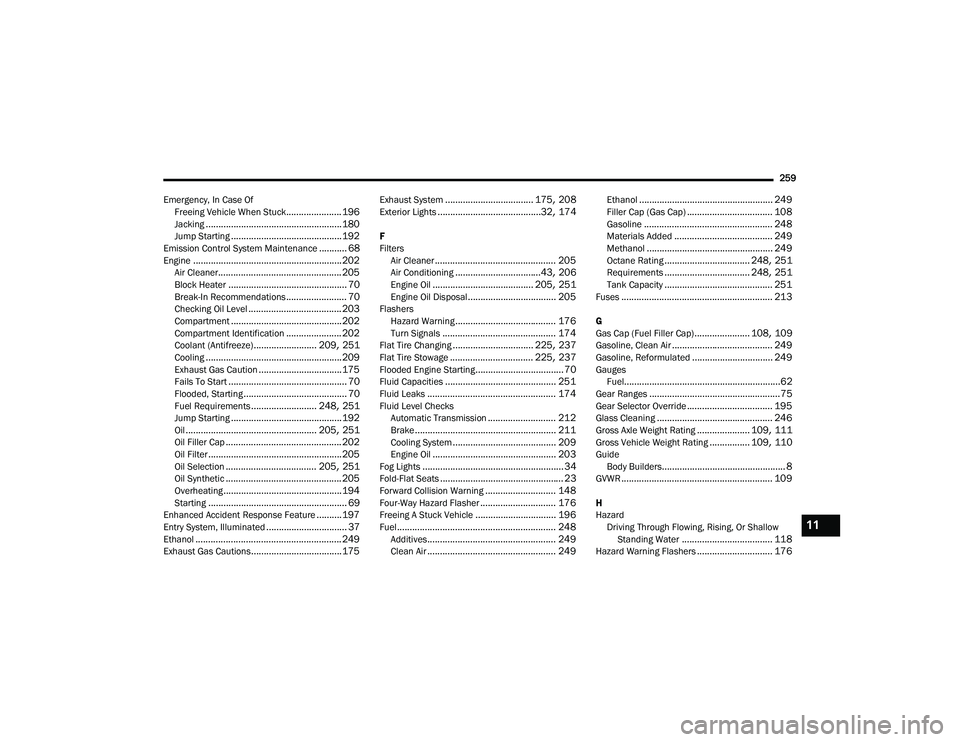
Emergency, In Case Of Freeing Vehicle When Stuck
...................... 196Jacking...................................................... 180Jump Starting............................................ 192Emission Control System Maintenance........... 68Engine........................................................... 202Air Cleaner................................................. 205Block Heater............................................... 70Break-In Recommendations........................ 70Checking Oil Level..................................... 203Compartment............................................ 202Compartment Identification...................... 202Coolant (Antifreeze)......................... 209, 251Cooling...................................................... 209Exhaust Gas Caution................................. 175Fails To Start............................................... 70Flooded, Starting......................................... 70Fuel Requirements.......................... 248, 251Jump Starting............................................ 192Oil.................................................... 205, 251Oil Filler Cap.............................................. 202Oil Filter..................................................... 205Oil Selection.................................... 205, 251Oil Synthetic.............................................. 205Overheating............................................... 194Starting....................................................... 69Enhanced Accident Response Feature..........197Entry System, Illuminated................................ 37Ethanol.......................................................... 249Exhaust Gas Cautions.................................... 175
Exhaust System................................... 175, 208Exterior Lights.........................................32, 174
F
FiltersAir Cleaner
................................................ 205Air Conditioning..................................43, 206Engine Oil........................................ 205, 251Engine Oil Disposal................................... 205FlashersHazard Warning........................................ 176Turn Signals............................................. 174Flat Tire Changing................................ 225, 237Flat Tire Stowage................................. 225, 237Flooded Engine Starting................................... 70Fluid Capacities............................................ 251Fluid Leaks................................................... 174Fluid Level ChecksAutomatic Transmission........................... 212Brake........................................................ 211Cooling System......................................... 209Engine Oil................................................. 203Fog Lights........................................................ 34Fold-Flat Seats................................................. 23Forward Collision Warning............................ 148Four-Way Hazard Flasher.............................. 176Freeing A Stuck Vehicle................................ 196Fuel............................................................... 248Additives................................................... 249Clean Air................................................... 249
Ethanol..................................................... 249Filler Cap (Gas Cap).................................. 108Gasoline................................................... 248Materials Added....................................... 249Methanol.................................................. 249Octane Rating.................................. 248, 251Requirements.................................. 248, 251Tank Capacity........................................... 251Fuses............................................................ 213
G
Gas Cap (Fuel Filler Cap)...................... 108, 109Gasoline, Clean Air........................................ 249Gasoline, Reformulated................................ 249GaugesFuel..............................................................62Gear Ranges....................................................75Gear Selector Override.................................. 195Glass Cleaning.............................................. 246Gross Axle Weight Rating..................... 109, 111Gross Vehicle Weight Rating................ 109, 110GuideBody Builders................................................. 8GVWR............................................................ 109
H
HazardDriving Through Flowing, Rising, Or Shallow Standing Water
.................................... 118Hazard Warning Flashers.............................. 176
11
22_VF_OM_EN_USC_t.book Page 259