2022 RAM PROMASTER brake fluid
[x] Cancel search: brake fluidPage 200 of 268
198
SERVICING AND MAINTENANCE
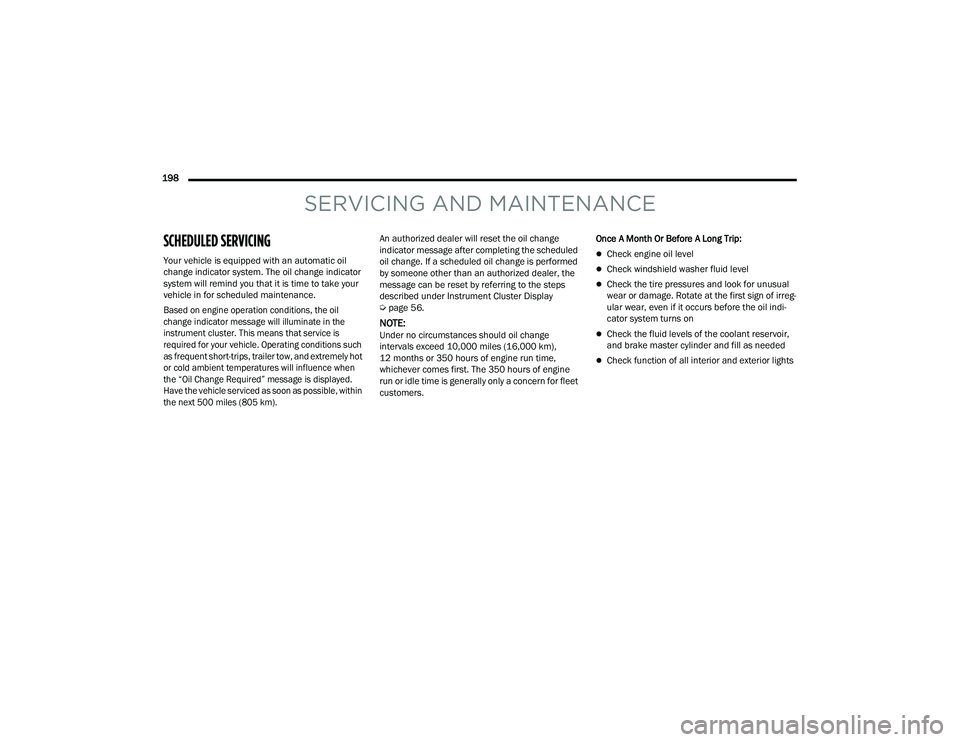
SCHEDULED SERVICING
Your vehicle is equipped with an automatic oil
change indicator system. The oil change indicator
system will remind you that it is time to take your
vehicle in for scheduled maintenance.
Based on engine operation conditions, the oil
change indicator message will illuminate in the
instrument cluster. This means that service is
required for your vehicle. Operating conditions such
as frequent short-trips, trailer tow, and extremely hot
or cold ambient temperatures will influence when
the “Oil Change Required” message is displayed.
Have the vehicle serviced as soon as possible, within
the next 500 miles (805 km).
An authorized dealer will reset the oil change
indicator message after completing the scheduled
oil change. If a scheduled oil change is performed
by someone other than an authorized dealer, the
message can be reset by referring to the steps
described under Instrument Cluster Display
Ú
page 56.
NOTE:Under no circumstances should oil change
intervals exceed 10,000 miles (16,000 km),
12 months or 350 hours of engine run time,
whichever comes first. The 350 hours of engine
run or idle time is generally only a concern for fleet
customers. Once A Month Or Before A Long Trip:
Check engine oil level
Check windshield washer fluid level
Check the tire pressures and look for unusual
wear or damage. Rotate at the first sign of irreg
-
ular wear, even if it occurs before the oil indi -
cator system turns on
Check the fluid levels of the coolant reservoir,
and brake master cylinder and fill as needed
Check function of all interior and exterior lights
22_VF_OM_EN_USC_t.book Page 198
Page 202 of 268

200SERVICING AND MAINTENANCE
Mileage or time passed (whichever comes first)
20,000
30,000
40,000
50,000
60,000
70,000
80,000
90,000
100,000
110,000
120,000
130,000
140,000
150,000
Or Years: 2 3 4 5 6 7 8 9 10 11 12 13 14 15
Or Kilometers:
32,000
48,000
64,000
80,000
96,000
112,000
128,000
144,000
160,000
176,000
192,000
208,000
224,000
240,000
Additional Inspections
Inspect the CV/Universal joints. X X X X X X X X X X X X X X
Inspect front suspension, tie rod ends, boot seals, and replace if necessary. X X X X X X X
Inspect the brake pads, replace as necessary. X X X X X X X
Inspect the rear door net block gap, adjust/replace as necessary. XXXXX
Additional Maintenance
Replace the engine air cleaner filter. XXXXX
Inspect the cabin air filter, replace as necessary. X X X X X X X
Replace the Brake Fluid every two years.
1X X X X X X X
Replace the spark plugs.
2X
22_VF_OM_EN_USC_t.book Page 200
Page 203 of 268

SERVICING AND MAINTENANCE201
Flush and replace the engine coolant at 10 years or 150,000 miles (240,000 km)
whichever comes first. X
X
Inspect and replace the PCV valve if necessary. X
1. The brake fluid change interval is time based only, mileage intervals do not apply.
2. The spark plug change interval is mileage based only, yearly intervals do not apply.
WARNING!
You can be badly injured working on or around a motor vehicle. Do only service work for which you have the knowledge and the right equipment. If you have
any doubt about your ability to perform a service job, take your vehicle to a competent mechanic.
Failure to properly inspect and maintain your vehicle could result in a component malfunction and affect vehicle handling and performance. This could cause an accident.
Mileage or time passed (whichever comes first)
20,000
30,000
40,000
50,000
60,000
70,000
80,000
90,000
100,000
110,000
120,000
130,000
140,000
150,000
Or Years: 2 3 4 5 6 7 8 9 10 11 12 13 14 15
Or Kilometers:
32,000
48,000
64,000
80,000
96,000
112,000
128,000
144,000
160,000
176,000
192,000
208,000
224,000
240,000
8
22_VF_OM_EN_USC_t.book Page 201
Page 204 of 268

202SERVICING AND MAINTENANCE
ENGINE COMPARTMENT
3.6L ENGINE
1 — Washer Fluid Reservoir Cap 5 — Engine Oil Dipstick
2 — Brake Fluid Reservoir Cap 6 — Coolant Reservoir Cap
3 — Engine Air Cleaner Filter 7 — Power Distribution Center (Fuses)
4 — Engine Oil Fill
22_VF_OM_EN_USC_t.book Page 202
Page 213 of 268

SERVICING AND MAINTENANCE211
Coolant Level
The coolant expansion bottle provides a quick
visual method for determining that the coolant
level is adequate. With engine off and cold, the
level of the engine coolant (antifreeze) in the bottle
should be between the “MIN” and “MAX” marks.
Cooling System Notes
NOTE:
When the vehicle is stopped after a few miles/kilo -
meters of operation, you may observe vapor coming
from the front of the engine compartment. This is
normally a result of moisture from rain, snow, or high
humidity accumulating on the radiator and being
vaporized when the thermostat opens, allowing hot
engine coolant (antifreeze) to enter the radiator.
If an examination of your engine compartment
shows no evidence of radiator or hose leaks, the
vehicle may be safely driven. The vapor will soon
dissipate.
Do not overfill the coolant expansion bottle.
Check the coolant freeze point in the radiator
and in the coolant expansion bottle. If engine
coolant needs to be added, the contents of the
coolant expansion bottle must also be protected
against freezing.
If frequent engine coolant additions are
required, the cooling system should be pressure
tested for leaks.
Maintain engine coolant concentration at a
minimum of 50% OAT coolant (conforming to
MS.90032) and distilled water for proper corro -
sion protection of your engine which contains
aluminum components.
Make sure that the coolant expansion bottle
overflow hoses are not kinked or obstructed.
Keep the front of the radiator clean. If your
vehicle is equipped with air conditioning, keep
the front of the condenser clean.
Do not change the thermostat for Summer or
Winter operation. If replacement is ever neces -
sary, install ONLY the correct type thermostat.
Other designs may result in unsatisfactory
engine cooling performance, poor gas mileage,
and increased emissions.
BRAKE SYSTEM
In order to ensure brake system performance, all
brake system components should be inspected
periodically Ú page 199.
Fluid Level Check — Brake Master Cylinder
The fluid level of the master cylinder should be
checked when performing under the hood service
or immediately if the Brake System Warning Light
indicates system failure. If necessary, add fluid to
bring level within the designated marks on the side
of the reservoir of the brake master cylinder. Be
sure to clean the top of the master cylinder area
before removing cap. With disc brakes the fluid
level can be expected to fall as the brake linings
wear. However, an unexpected drop in fluid level
may be caused by a leak and a system check
should be conducted Ú page 251.
WARNING!
Riding the brakes can lead to brake failure and
possibly a collision. Driving with your foot resting
or riding on the brake pedal can result in
abnormally high brake temperatures, excessive
lining wear, and possible brake damage. You
would not have your full braking capacity in an
emergency.
8
22_VF_OM_EN_USC_t.book Page 211
Page 214 of 268

212SERVICING AND MAINTENANCE
AUTOMATIC TRANSMISSION
Selection Of Lubricant
It is important to use the proper transmission fluid
to ensure optimum transmission performance and
life. Use the manufacturer specified transmission
fluid Úpage 252. It is important to maintain the
transmission fluid at the correct level using the
recommended fluid.
NOTE:
No chemical flushes should be used in any trans -
mission; only the approved lubricant should be used.
Special Additives
The manufacturer strongly recommends against
using any special additives in the transmission.
Automatic Transmission Fluid (ATF) is an
engineered product and its performance may be
impaired by supplemental additives. Therefore,
do not add any fluid additives to the transmission. The only exception to this policy is the use of
special dyes for diagnosing fluid leaks in 9-speed
transmissions. Avoid using transmission sealers as
they may adversely affect seals.
Fluid Level Check
The fluid level is preset at the factory and does
not require adjustment under normal operating
conditions. Routine fluid level checks are not
required, therefore the transmission filler tube is
capped and no dipstick is provided. An authorized
dealer can check your transmission fluid level
using a special service dipstick. If you notice fluid
leakage or transmission malfunction, visit an
authorized dealer immediately to have the
transmission fluid level checked. Operating the
vehicle with an improper fluid level can cause
severe transmission damage.
WARNING!
Use only the manufacturer recommended
brake fluid Ú
page 251. Using the wrong
type of brake fluid can severely damage your
brake system and/or impair its performance.
The proper type of brake fluid for your vehicle
is also identified on the original factory
installed hydraulic master cylinder reservoir.
To avoid contamination from foreign matter or
moisture, use only new brake fluid or fluid that
has been in a tightly closed container. Keep
the master cylinder reservoir cap secured at
all times. Brake fluid in an open container
absorbs moisture from the air resulting in a
lower boiling point. This may cause it to boil
unexpectedly during hard or prolonged
braking, resulting in sudden brake failure.
This could result in a collision.
Overfilling the brake fluid reservoir can result
in spilling brake fluid on hot engine parts,
causing the brake fluid to catch fire. Brake
fluid can also damage painted and vinyl
surfaces, care should be taken to avoid its
contact with these surfaces.
Do not allow petroleum-based fluid to contami -
nate the brake fluid. Brake seal components could
be damaged, causing partial or complete brake
failure. This could result in a collision.
CAUTION!
Using a transmission fluid other than the
manufacturer recommended fluid may cause
deterioration in transmission shift quality and/or
torque converter shudder Ú page 252.
CAUTION!
Do not use chemical flushes in your
transmission as the chemicals can damage your
transmission components. Such damage is not
covered by the New Vehicle Limited Warranty.
22_VF_OM_EN_USC_t.book Page 212
Page 254 of 268

252TECHNICAL SPECIFICATIONS
CHASSIS FLUIDS AND LUBRICANTS
CAUTION!
Mixing of engine coolant (antifreeze) other than specified Organic Additive Technology (OAT) engine coolant (antifreeze), may result in engine damage and
may decrease corrosion protection. Organic Additive Technology (OAT) engine coolant is different and should not be mixed with Hybrid Organic Additive Tech -
nology (HOAT) engine coolant (antifreeze) or any “globally compatible” coolant (antifreeze). If a non-OAT engine coolant (antifreeze) is introduced into the
cooling system in an emergency, the cooling system will need to be drained, flushed, and refilled with fresh OAT coolant (conforming to MS.90032), by an
authorized dealer as soon as possible.
Do not use water alone or alcohol-based engine coolant (antifreeze) products. Do not use additional rust inhibitors or antirust products, as they may not be
compatible with the radiator engine coolant and may plug the radiator.
This vehicle has not been designed for use with propylene glycol-based engine coolant (antifreeze). Use of propylene glycol-based engine coolant (antifreeze)
is not recommended.
Component Fluid, Lubricant, Or Genuine Part
Automatic TransmissionUse only Mopar® ZF 8 & 9 Speed ATF Automatic Transmission Fluid or equivalent. Failure to use the correct fluid may
affect the function or performance of your transmission.
Brake Master Cylinder We recommend using Mopar® DOT 4. DOT 4 brake fluid must be changed every two years regardless of mileage.
22_VF_OM_EN_USC_t.book Page 252
Page 259 of 268

257
INDEX
A
Active Driving Assist......................................... 92Active Speed Limiter........................................ 79Adaptive Cruise Control (ACC)
(Cruise Control)................................................ 80Adding Engine Coolant (Antifreeze)............... 210Adding Washing Fluid.................................... 203Additives, Fuel............................................... 249Air Bag........................................................... 162Air Bag Operation...................................... 162Air Bag Warning Light................................ 161Enhanced Accident Response...................197Event Data Recorder (EDR)....................... 197If Deployment Occurs................................ 165Maintaining Your Air Bag System.............. 167Maintenance............................................. 167Side Air Bags............................................. 163Transporting Pets...................................... 173Air Bag Light..................................59, 161, 173Air Cleaner, Engine
(Engine Air Cleaner Filter).............................. 205Air Conditioner Maintenance......................... 206Air Conditioner Refrigerant............................ 206Air Conditioner System.................................. 206Air Conditioning Filter............................. 43, 206Air Conditioning, Operating Tips................ 42, 43
Air Filter........................................................ 205Air PressureTires......................................................... 233AlarmSecurity Alarm...................................... 20, 61Alarm SystemSecurity Alarm............................................. 20Alterations/ModificationsVehicle........................................................... 8Antifreeze (Engine Coolant)................. 209, 251Disposal................................................... 210Anti-Lock Brake System (ABS)...................... 137Anti-Lock Warning Light................................... 61Assist, Hill Start............................................. 140Audio Systems (Radio).................................. 119Auto Down Power Windows............................. 48Auto Up Power Windows.................................. 48Automatic Door Locks...................................... 22Automatic Headlights....................................... 33Automatic High Beams.................................... 33Automatic Transmission.........................73, 213Adding Fluid..................................... 212, 213Fluid And Filter Change............................ 213Fluid Change............................................ 213Fluid Level Check..................................... 212
Fluid Type........................................ 212, 252Special Additives...................................... 212AUX Cord..........................................................44Auxiliary Driving Systems.............................. 142
B
Battery................................................... 60, 204Charging System Light.................................60Keyless Key Fob Replacement....................14Belts, Seat.................................................... 173Blind Spot Monitoring................................... 142Body Builders Guide........................................... 8Body Mechanism Lubrication........................ 207B-Pillar Location............................................ 230Brake Assist System..................................... 138Brake Control System, Electronic.................. 138Brake Fluid........................................... 211, 252Brake System....................................... 211, 247Anti-Lock (ABS)......................................... 137Fluid Check............................................... 211Master Cylinder........................................ 211Parking........................................................71Warning Light...............................................59Brake/Transmission Interlock..........................74Bulb Replacement........................................ 220Bulbs, Light.......................................... 174, 220
11
22_VF_OM_EN_USC_t.book Page 257