2022 NISSAN TITAN automatic
[x] Cancel search: automaticPage 18 of 635
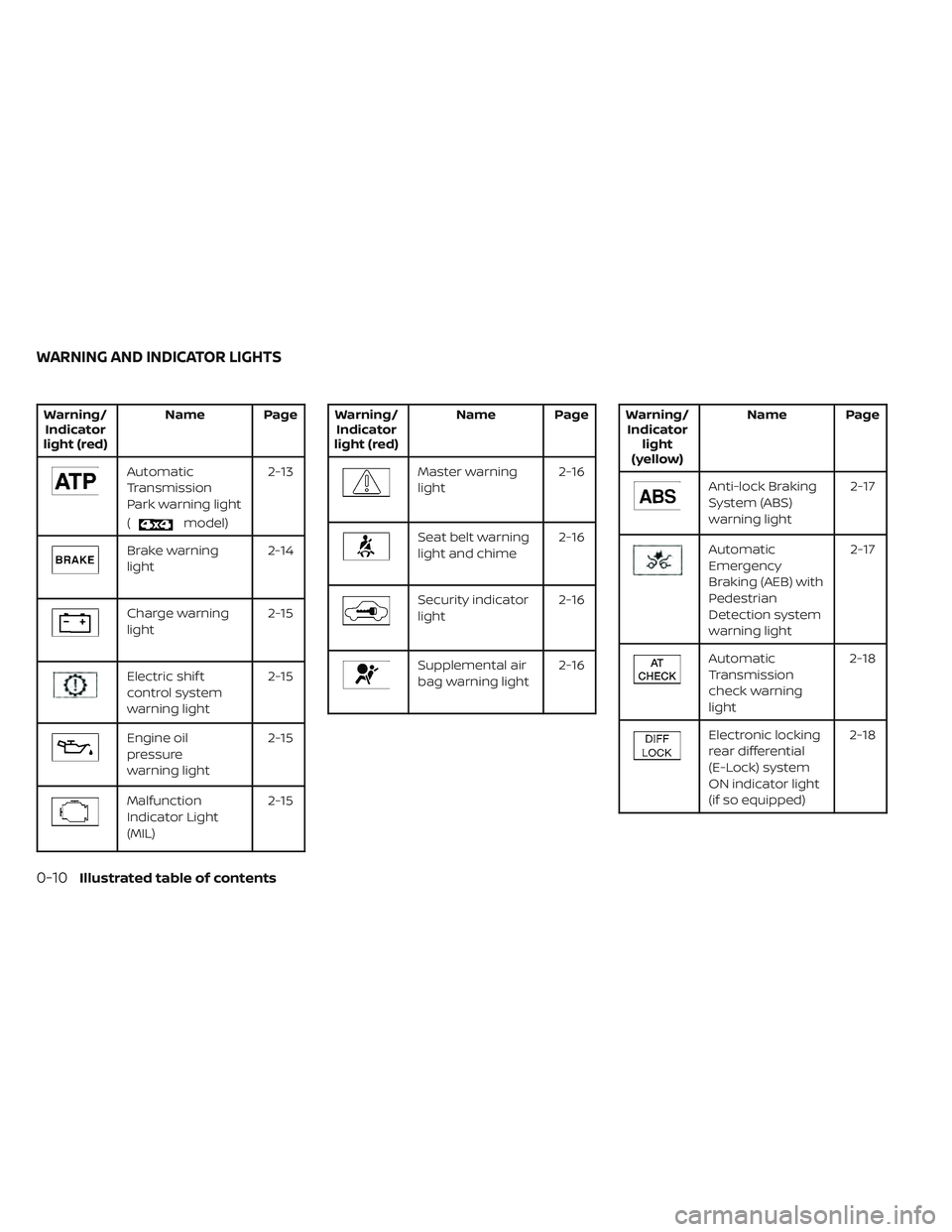
Warning/Indicator
light (red) Name Page
Automatic
Transmission
Park warning light
(
model)2-13
Brake warning
light
2-14
Charge warning
light 2-15
Electric shif t
control system
warning light2-15
Engine oil
pressure
warning light2-15
Malfunction
Indicator Light
(MIL)2-15
Warning/
Indicator
light (red) Name Page
Master warning
light
2-16
Seat belt warning
light and chime2-16
Security indicator
light2-16
Supplemental air
bag warning light2-16
Warning/
Indicator light
(yellow) Name Page
Anti-lock Braking
System (ABS)
warning light
2-17
Automatic
Emergency
Braking (AEB) with
Pedestrian
Detection system
warning light2-17
Automatic
Transmission
check warning
light
2-18
Electronic locking
rear differential
(E-Lock) system
ON indicator light
(if so equipped)2-18
WARNING AND INDICATOR LIGHTS
0-10Illustrated table of contents
Page 19 of 635
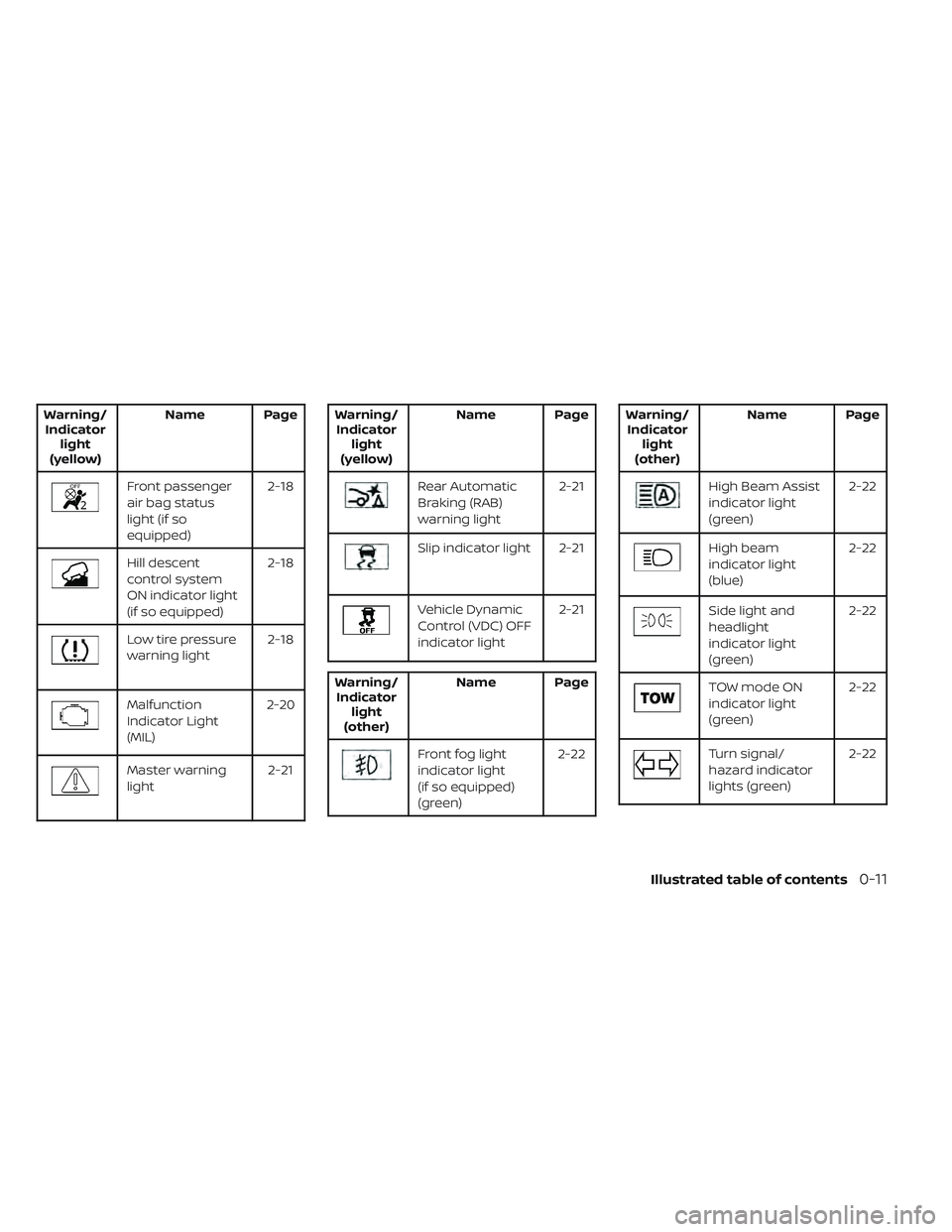
Warning/Indicator light
(yellow) Name Page
Front passenger
air bag status
light (if so
equipped) 2-18
Hill descent
control system
ON indicator light
(if so equipped)2-18
Low tire pressure
warning light
2-18
Malfunction
Indicator Light
(MIL)2-20
Master warning
light
2-21
Warning/
Indicator light
(yellow) Name Page
Rear Automatic
Braking (RAB)
warning light
2-21
Slip indicator light 2-21
Vehicle Dynamic
Control (VDC) OFF
indicator light2-21
Warning/
Indicator light
(other) Name Page
Front fog light
indicator light
(if so equipped)
(green) 2-22
Warning/
Indicator light
(other) Name Page
High Beam Assist
indicator light
(green)
2-22
High beam
indicator light
(blue)2-22
Side light and
headlight
indicator light
(green)2-22
TOW mode ON
indicator light
(green)
2-22
Turn signal/
hazard indicator
lights (green)2-22
Illustrated table of contents0-11
Page 40 of 635
•Do not allow children to play with the
seat belts. Most seating positions are
equipped with Automatic Locking
Retractor (ALR) mode seat belts. If
the seat belt becomes wrapped
around a child’s neck with the ALR
mode activated, the child can be se-
riously injured or killed if the seat belt
retracts and becomes tight. This can
occur even if the vehicle is parked.
Unbuckle the seat belt to release the
child. If the seat belt cannot be un-
buckled or is already unbuckled, re-
lease the child by cutting the seat
belt with a suitable tool (such as a
knife or scissors) to release the seat
belt.
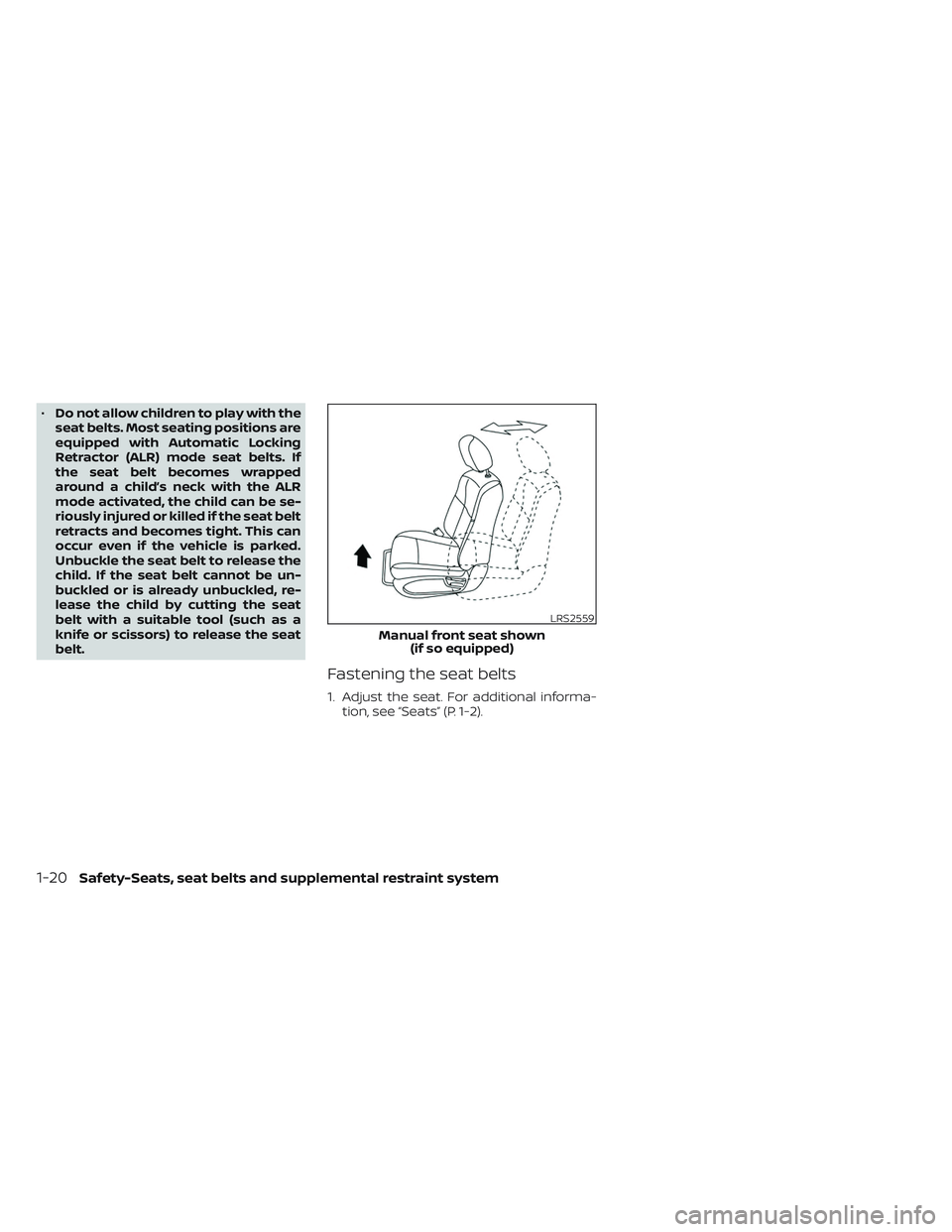
Fastening the seat belts
1. Adjust the seat. For additional informa- tion, see “Seats” (P. 1-2).
LRS2559
Manual front seat shown (if so equipped)
1-20Safety-Seats, seat belts and supplemental restraint system
Page 42 of 635
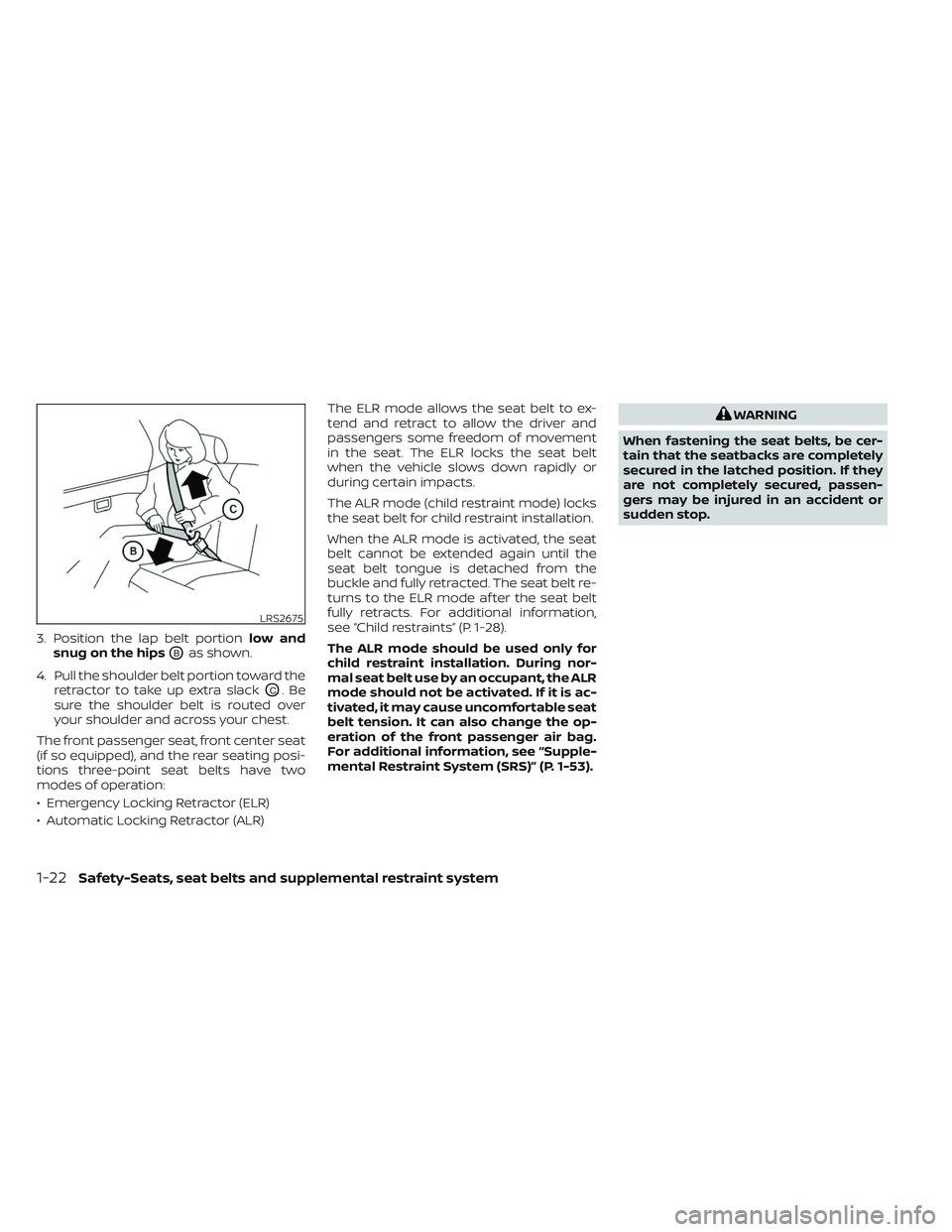
3. Position the lap belt portionlow and
snug on the hips
OBas shown.
4. Pull the shoulder belt portion toward the retractor to take up extra slack
OC.Be
sure the shoulder belt is routed over
your shoulder and across your chest.
The front passenger seat, front center seat
(if so equipped), and the rear seating posi-
tions three-point seat belts have two
modes of operation:
• Emergency Locking Retractor (ELR)
• Automatic Locking Retractor (ALR) The ELR mode allows the seat belt to ex-
tend and retract to allow the driver and
passengers some freedom of movement
in the seat. The ELR locks the seat belt
when the vehicle slows down rapidly or
during certain impacts.
The ALR mode (child restraint mode) locks
the seat belt for child restraint installation.
When the ALR mode is activated, the seat
belt cannot be extended again until the
seat belt tongue is detached from the
buckle and fully retracted. The seat belt re-
turns to the ELR mode af ter the seat belt
fully retracts. For additional information,
see “Child restraints” (P. 1-28).
The ALR mode should be used only for
child restraint installation. During nor-
mal seat belt use by an occupant, the ALR
mode should not be activated. If it is ac-
tivated, it may cause uncomfortable seat
belt tension. It can also change the op-
eration of the front passenger air bag.
For additional information, see “Supple-
mental Restraint System (SRS)” (P. 1-53).
WARNING
When fastening the seat belts, be cer-
tain that the seatbacks are completely
secured in the latched position. If they
are not completely secured, passen-
gers may be injured in an accident or
sudden stop.
LRS2675
1-22Safety-Seats, seat belts and supplemental restraint system
Page 45 of 635
•Periodically check to see that the seat
belt and the metal components, such
as buckles, tongues, retractors, flexible
wires and anchors, work properly. If loose
parts, deterioration, cuts or other dam-
age on the webbing is found, the entire
seat belt assembly should be replaced.WARNING
Do not allow children to play with the
seat belts. Most seating positions are
equipped with Automatic Locking Re-
tractor (ALR) mode seat belts. If the seat
belt becomes wrapped around a child’s
neck with the ALR mode activated, the
child can be seriously injured or killed if
the seat belt retracts and becomes
tight. This can occur even if the vehicle
is parked. Unbuckle the seat belt to re-
lease the child. If the seat belt cannot
be unbuckled or is already unbuckled,
release the child by cutting the seat
belt with a suitable tool (such as a knife
or scissors) to release the seat belt.
Children need adults to help protect
them. They need to be properly
restrained.
In addition to the general information in
this manual, child safety information is
available from many other sources, includ-
ing doctors, teachers, government traffic
safety offices, and community organiza-
tions. Every child is different, so be sure to
learn the best way to transport your child. There are three basic types of child re-
straint systems:
• Rear-facing child restraints
• Forward-facing child restraints
• Booster seats
The proper restraint depends on the child's
size. Generally, infants up to about 1 year
and less than 20 lbs. (9 kg) should be placed
in rear-facing child restraints. Forward-
facing child restraints are available for chil-
dren who outgrow rear-facing child re-
straints and are at least 1 year old. Booster
seats are used to help position a vehicle
lap/shoulder belt on a child who can no
longer use a forward-facing child restraint.
WARNING
Infants and children need special pro-
tection. The vehicle's seat belts may
not fit them properly. The shoulder belt
may come too close to the face or neck.
The lap belt may not fit over their small
hip bones. In an accident, an improp-
erly fitting seat belt could cause serious
or fatal injury. Always use appropriate
child restraints.
CHILD SAFETY
Safety-Seats, seat belts and supplemental restraint system1-25
Page 70 of 635
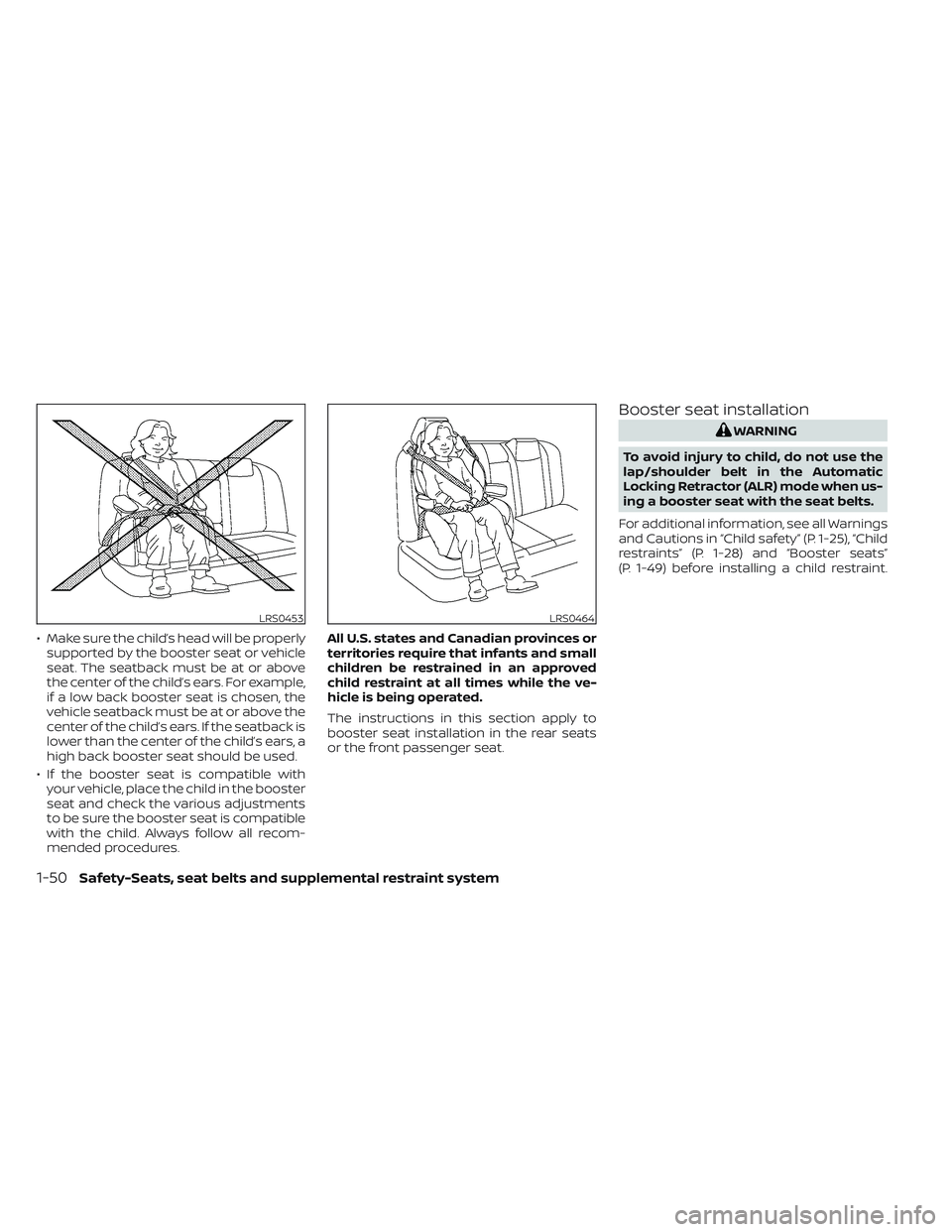
• Make sure the child’s head will be properlysupported by the booster seat or vehicle
seat. The seatback must be at or above
the center of the child’s ears. For example,
if a low back booster seat is chosen, the
vehicle seatback must be at or above the
center of the child’s ears. If the seatback is
lower than the center of the child’s ears, a
high back booster seat should be used.
• If the booster seat is compatible with your vehicle, place the child in the booster
seat and check the various adjustments
to be sure the booster seat is compatible
with the child. Always follow all recom-
mended procedures. All U.S. states and Canadian provinces or
territories require that infants and small
children be restrained in an approved
child restraint at all times while the ve-
hicle is being operated.
The instructions in this section apply to
booster seat installation in the rear seats
or the front passenger seat.
Booster seat installation
WARNING
To avoid injury to child, do not use the
lap/shoulder belt in the Automatic
Locking Retractor (ALR) mode when us-
ing a booster seat with the seat belts.
For additional information, see all Warnings
and Cautions in “Child safety” (P. 1-25), “Child
restraints” (P. 1-28) and “Booster seats”
(P. 1-49) before installing a child restraint.
LRS0453LRS0464
1-50Safety-Seats, seat belts and supplemental restraint system
Page 82 of 635

The NISSAN Advanced Air Bag System
monitors information from the crash zone
sensor and the Air bag Control Unit (ACU).
Inflator operation is based on the severity
of a collision and seat belt usage for the
driver. For the front passenger, the occu-
pant classification sensor is also moni-
tored. Based upon the information from
the sensor, only one front air bag may in-
flate in a crash, depending on the crash
severity. Additionally, the front passenger
air bag and front passenger supplemental
knee air bag may be automatically turned
off under some conditions, depending on
the weight detected on the front passen-
ger seat and how the seat belt is used. If the
front passenger air bag and front passen-
ger supplemental knee air bag are OFF, the
front passenger air bag status light will be
illuminated (if the seat is unoccupied, the
light will not be illuminated, but the air bag
will be off ). For additional information, see
“Front passenger air bag and status light”
(P. 1-63). One front air bag inflating does not
indicate improper performance of the
system.If you have any questions about your air
bag system, it is recommended that you
contact NISSAN or a NISSAN dealer. If you
are considering modification of your ve-
hicle due to a disability, you may also con-
tact NISSAN. Contact information is con-
tained in the front of this Owner's Manual.
When a front air bag inflates, a fairly loud
noise may be heard, followed by the re-
lease of smoke. This smoke is not harmful
and does not indicate a fire. Care should be
taken to not inhale it, as it may cause irrita-
tion and choking. Those with a history of a
breathing condition should get fresh air
promptly.
Front air bags, along with the use of seat
belts, help to cushion the impact force on
the face and chest of the front occupants.
They can help save lives and reduce seri-
ous injuries. However, an inflating front air
bag may cause facial abrasions or other
injuries. Front air bags, other than the driv-
er’s and front passenger’s supplemental
knee air bags, do not provide restraint to
the lower body.
Even with NISSAN Advanced Air Bags, seat
belts should be correctly worn and the
driver and front passenger seated upright
as far as practical away from the steering
wheel or instrument panel. The front air
bags inflate quickly in order to help protect
the front occupants. Because of this, the
force of the front air bag inflating can in-
crease the risk of injury if the occupant is
too close to, or is against, the front air bag
module during inflation.
The front air bags deflate quickly af ter a
collision.
The front air bags operate only when the
ignition switch is in the ON position.
Af ter placing the ignition switch in the
ON position, the supplemental air bag
warning light illuminates. The supple-
mental air bag warning light will turn off
af ter about 7 seconds if the system is
operational.
1-62Safety-Seats, seat belts and supplemental restraint system
Page 83 of 635

Front passenger air bag and status
light
WARNING
The front passenger air bag and front
passenger supplemental knee air bag
is designed to automatically turn OFF
under some conditions. Read this sec-
tion carefully to learn how it operates.
Proper use of the seat, seat belt and
child restraints is necessary for most
effective protection. Failure to follow all
instructions in this manual concerning
the use of seats, seat belts and child restraints can increase the risk or se-
verity of injury in an accident.
Status light
The front passenger seat is equipped with
an occupant classification sensor (weight
sensor) that turns the front passenger air
bag and front passenger supplemental
knee air bag on or off depending on the
weight applied to the front passenger seat.
The status of the front passenger air bag
and front passenger supplemental knee
air bag (ON or OFF) is indicated by the front
passenger air bag status light
which
is located on the instrument panel.
Af ter the ignition switch is placed in the
"ON" position, the front passenger air bag
status light on the instrument panel illumi-
nates for about 7 seconds and then turns
off or remains illuminated depending on
the front passenger seat occupied status.
The light operates as follows:
• Unoccupied front passenger’s seat: The
light is OFF and the front passenger
air bag is OFF and will not inflate in a
crash. • Front passenger seat occupied by a
small adult, child or child restraint as out-
lined in this section: The
light may or
may not illuminate, depending on the size
of the occupant or the type of child re-
straint being used. When the
light is
illuminated, the front passenger air bag is
OFF and will not inflate in a crash. For
additional information, see “Front pas-
senger air bag and status light” ( 1-63).
• Occupied front passenger seat and the passenger meets the conditions as out-
lined in this section: The
light is OFF
to indicate that the front passenger air
bag is operational.
In addition to the above, certain objects
placed on the front passenger seat may
also cause the light to operate as de-
scribed above depending on their weight.
For additional information, see “Normal op-
eration” (P. 1-65) and “Troubleshooting”
(P. 1-65).
Front passenger air bag
The front passenger air bag and front pas-
senger supplemental knee air bag are de-
signed to automatically turn OFF when the
vehicle is operated under some conditions
as described below in accordance with U.S.
regulations. If the front passenger air bag
WRS0475
Safety-Seats, seat belts and supplemental restraint system1-63