2022 NISSAN PATHFINDER coolant temperature
[x] Cancel search: coolant temperaturePage 520 of 647

CAUTION
• Always connect positive (+) to posi-
tive (+) and negative (−) to body
ground (for example, strut mounting
bolt, engine lif t bracket, etc.) — not to
the battery.
• Make sure the jumper cables do not
touch moving parts in the engine
compartment and that the cable
clamps do not contact any other
metal.
5. Start the engine of the booster vehicle and let it run for a few minutes.
6. Keep the engine speed of the booster vehicle at about 2,000 rpm and start the
engine of the vehicle being jump
started.
CAUTION
Do not keep the starter motor engaged
for more than 10 seconds. If the engine
does not start right away, place the ig-
nition switch in the OFF position and
wait 3 to 4 seconds before trying again.
7. Af ter starting the engine, carefully dis- connect the negative cable and then the
positive cable.
CAUTION
Automatic transmission models can-
not be push-started. Attempting to do
so may cause transmission damage.WARNING
• Do not continue to drive if your ve-
hicle overheats. Doing so could cause
engine damage or a vehicle fire.
• To avoid the danger of being scalded,
never remove the radiator or coolant
reservoir cap while the engine is still
hot. When the radiator or coolant res-
ervoir cap is removed, pressurized
hot water will spurt out, possibly
causing serious injury.
• Do not open the hood if steam is
coming out.
If your vehicle is overheating (indicated by
an extremely high temperature gauge
reading and the Low Oil Pressure: See
Owner’s Manual warning message ap-
pears in the vehicle information display), or
if you feel a lack of engine power, detect
abnormal noise, etc. take the following
steps:
1. Move the vehicle safely off the road, ap- ply the parking brake.
2. Push the park button to shif t to the P (Park) position.
Do not stop the engine.
PUSH STARTING IF YOUR VEHICLE OVERHEATS
In case of emergency6-13
Page 521 of 647

3. Turn off the air conditioner. Open all thewindows, move the heater or air condi-
tioner temperature control to maximum
hot and fan control to high speed.
4. Get out of the vehicle. Look and listen for steam or coolant escaping from the ra-
diator before opening the hood. If steam
or coolant is escaping, turn off the en-
gine. Do not open the hood further until
no steam or coolant can be seen.
5. Open the engine hood.
WARNING
If steam or water is coming from the
engine, stand clear to prevent getting
burned.
6. Visually check drive belts for damage or looseness. Also check if the cooling fan
is running. The radiator hoses and radia-
tor should not leak water. If coolant is
leaking, the water pump belt is missing
or loose, or the cooling fan does not run,
stop the engine.
WARNING
Be careful not to allow your hands, hair,
jewelry or clothing to come into con-
tact with, or get caught in, engine belts
or the engine cooling fan. The engine
cooling fan can start at any time.
7. Af ter the engine cools down, check the coolant level in the engine coolant reser-
voir tank with the engine running. Add
coolant to the engine coolant reservoir
tank if necessary. Have your vehicle re-
paired. It is recommended that you visit a
NISSAN dealer for this service. When towing your vehicle, all jurisdictional
and local regulations for towing must be
followed. Incorrect towing equipment
could damage your vehicle. Towing in-
structions are available from a NISSAN
dealer. Local service operators are gener-
ally familiar with the applicable laws and
procedures for towing. To assure proper
towing and to prevent accidental damage
to your vehicle, NISSAN recommends hav-
ing a service operator tow your vehicle. It is
advisable to have the service operator
carefully read the following precautions:
WARNING
• Never ride in a vehicle that is being
towed.
• Never get under your vehicle af ter it
has been lif ted by a tow truck.
CAUTION
• When towing, make sure that the
transmission, axles, steering system
and powertrain are in working condi-
tion. Use dollies or flatbed if any of
the listed systems are not working.
• Always attach safety chains before
towing.
TOWING YOUR VEHICLE
6-14In case of emergency
Page 627 of 647

• While going downhill, the weight of thetrailer pushing on the tow vehicle may
decrease overall stability. Therefore, to
maintain adequate control, reduce your
speed and shif t to a lower gear. Avoid
long or repeated use of the brakes when
descending a hill, as this reduces their
effectiveness and could cause overheat-
ing. Shif ting to a lower gear instead pro-
vides “engine braking” and reduces the
need to brake as frequently.
• If the engine coolant temperature rises to a high temperature, see “If your vehicle
overheats” (P. 6-13).
• Trailer towing requires more fuel than normal circumstances.
• Avoid towing a trailer for your vehicle's first 500 miles (805 km).
• For the first 500 miles (805 km) that you do tow, do not drive over 50 mph (80
km/h).
• Have your vehicle serviced more of ten than at intervals specified in the recom-
mended maintenance schedule in the
“Maintenance and schedules” section of
this manual. • When making a turn, your trailer wheels
will be closer to the inside of the turn than
your vehicle wheels. To compensate for
this, make a larger than normal turning
radius during the turn.
• Crosswinds and rough roads will ad- versely affect vehicle/trailer handling,
possibly causing vehicle sway. When be-
ing passed by larger vehicles, be pre-
pared for possible changes in crosswinds
that could affect vehicle handling.
Do the following if the trailer begins to
sway:
1. Take your foot off the accelerator pedal to allow the vehicle to coast and steer as
straight ahead as the road conditions
allow. This combination will help stabilize
the vehicle.
– Do not correct trailer sway by steering or applying the brakes.
2. When the trailer sway stops, gently apply the brakes and pull to the side of the
road in a safe area.
3. Try to rearrange the trailer load so it is balanced. For additional information,
see “Pre-towing tips” (P. 10-28). • Be careful when passing other vehicles.
Passing while towing a trailer requires
considerably more distance than normal
passing. Remember, the length of the
trailer must also pass the other vehicle
before you can safely change lanes.
• Downshif t the transmission to a lower gear for engine braking when driving
down steep or long hills. This will help
slow the vehicle without applying the
brakes.
• Avoid holding the brake pedal down too long or too frequently. This could cause
the brakes to overheat, resulting in re-
duced braking efficiency.
• Increase your following distance to allow for greater stopping distances while tow-
ing a trailer. Anticipate stops and brake
gradually.
• NISSAN recommends that the cruise control not be used while towing a trailer.
• Some states or provinces have specific regulations and speed limits for vehicles
that are towing trailers. Obey the local
speed limits.
• Check your hitch, trailer wiring harness connections, and trailer wheel lug nuts
af ter 50 miles (80 km) of travel and at
every break.
10-30Technical and consumer information
Page 637 of 647

Intelligent Trace Control (I-TC).....5-180Check tire pressure..........2-41, 2-66Child restraint with top tether strap. . . .1-41Child restraints.......1-32, 1-33, 1-34, 1-36LATCH (Lower Anchors and Tethers for
CHildren) System..............1-36Precautions on child
restraints............1-44, 1-51, 1-57Top tether strap anchor point
locations...................1-42Child safety rear door lock..........3-7Cleaning exterior and interior......7-2,7-4Climate-controlled seat switches.....2-85Cold weather driving............5-194Console box..................2-104Controls
Heater and air conditioner controls. .4-33CoolantCapacities and recommended
fuel/lubricants
...............10-2Changing engine coolant.........8-6Checking engine coolant level......8-6Engine coolant temperature gauge. . .2-9Corrosion protection..............7-7Cruise control................ .5-85Cup holders..................2-106
D
Daytime Running Light System......2-82Defroster switch
Rear window and outside mirror defroster
switch
.....................2-77
Dimensions and weights..........10-10Dimmer switch for instrument panel. . .2-83Door locks................... .3-5Drive belt....................8-16Driving
Cold weather driving...........5-194Driving with automatic
transmission................5-18Precautions when starting and
driving.................... .5-4Driving the vehicle...............5-18Dual panel moonroof............2-114
E
Economy - fuel................5-171Emergency call (SOS) button........2-93Emergency engine shutoff.......5-15,6-2Emission control information label. . . .10-12Emission control system warranty. . . .10-33Engine
Before starting the engine........5-16Capacities and recommended
fuel/lubricants...............10-2Changing engine coolant.........8-6Changing engine oil.............8-7Changing engine oil filter.........8-7Checking engine coolant level......8-6Checking engine oil level..........8-7Engine coolant temperature gauge. . .2-9Engine cooling system...........8-5Engine oil...................8-7
Engine oil and oil filter
recommendation.............10-7Engine oil pressure warning light. . . .2-15Engine oil viscosity.............10-7Engine serial number..........10-12Engine specifications...........10-9Starting the engine............5-16Engine Block Heater.............5-195Engine coolant temperature gauge. . . .2-9Event Data recorders........10-35, 10-36Exhaust gas (Carbon monoxide)......5-4Explanation of maintenance items.....9-2Explanation of scheduled maintenance
items...................... .9-5Extended storage switch..........2-100Eyeglass case.................2-105
F
F.M.V.S.S. certification label.........10-12Flashers (See hazard warning flasher
switch)......................6-2Flat tire...................6-3, 6-4Floor mat positioning aid...........7-6Fluid
Brake fluid..................8-12Capacities and recommended
fuel/lubricants...............10-2Engine coolant................8-5Engine oil...................8-7Windshield-washer fluid.........8-12Fog light switch................2-84
11-2
Page 638 of 647

Front air bag system (See supplemental
restraint system)...............1-68Front and rear sonar system.......5-183Front power seat adjustment........1-4Front seats....................1-2Front-door pocket..............2-101FuelCapacities and recommended
fuel/lubricants
...............10-2Fuel economy...............5-171Fuel gauge..................2-10Fuel octane rating.............10-6Fuel recommendation..........10-4Fuel efficient driving tips..........5-170Fuel gauge...................2-10Fuel-filler door.................3-29Fuses.......................8-21Fusible links..................8-22
G
Garage door opener, HomeLink® Universal
Transceiver.......2- 118, 2-119, 2-121, 2-122Gauge
Engine coolant temperature gauge. . .2-9Fuel gauge..................2-10Odometer................. .2-8Speedometer..............2-6, 2-7Tachometer.................2-8Trip odometer................2-8General maintenance.............9-2Glove box...................2-104Glove box lock................2-104
H
Hazard warning flasher switch........6-2Head restraints.................1-12Head Up Display (HUD)............2-90Headlight and turn signal switch.....2-78Headlight control switch...........2-78Headlights...................8-27Heated 2nd row seat switches.......2-87Heated seat switches............2-86Heated seats................. .2-85Heated steering wheel switch.......2-88Heater
Heater and air conditioner controls. .4-33Heater operation.............4-34Hill descent control switch.........2-89Hill descent control system........5-181Hill start assist system...........5-182HomeLink® Universal
Transceiver.......2- 118, 2-119, 2-121, 2-122Hood.......................3-21Hook
Luggage hook...............2-109Horn...................... .2-85
I
Idling Stop System..............5-189Ignition switch
Push-button ignition switch.......5-13Immobilizer system..........2-72,5-16Important vehicle information label. . .10-12
In-cabin microfilter..............8-18Increasing fuel economy..........5-171IndicatorNISSAN Intelligent Key® battery discharge
indicator
...................5-15Indicator lights and audible reminders
(See warning/indicator lights and audible
reminders)
...................2-12Inside automatic anti-glare mirror. . . .3-33Instrument brightness control.......2-83Instrument panel.............0-6, 2-4Instrument panel dimmer switch.....2-83Intelligent Around View Monitor......4-10Intelligent Blind Spot Intervention
(I-BSI)...................... .5-62Intelligent Cruise Control (ICC)
(for vehicles with ProPILOT Assist). . . .5-102Intelligent Driver Alertness (I-DA).....5-165Intelligent Forward Collision Warning
(I-FCW).....................5-149Intelligent Key system
Key operating range............3-8Key operation................3-9Mechanical key................3-3Remote keyless entry operation. . . .3-13Troubleshooting guide..........3-16Warning signals...............3-16Intelligent Lane Intervention (I-LI).....5-42Intelligent Trace Control (I-TC).......5-180Interior light..................2-116ISOFIX child restraints.............1-36
11-3
Page 641 of 647
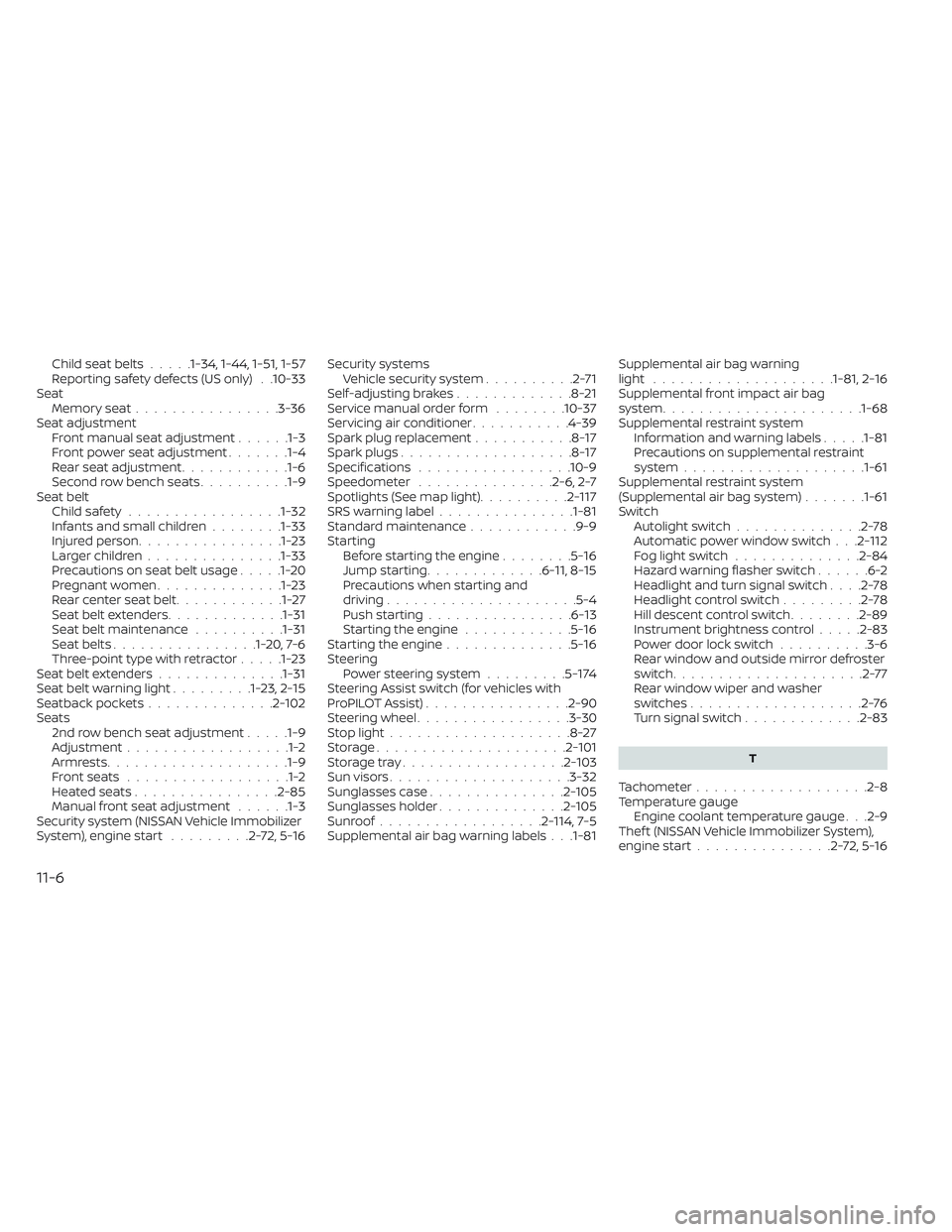
Child seat belts.....1-34, 1-44, 1-51, 1-57Reporting safety defects (US only). .10-33SeatMemory seat................3-36Seat adjustmentFront manual seat adjustment......1-3Front power seat adjustment.......1-4Rear seat adjustment............1-6Second row bench seats..........1-9Seat beltChild safety................ .1-32Infants and small children........1-33Injured person................1-23Larger children...............1-33Precautions on seat belt usage.....1-20Pregnant women..............1-23Rear center seat belt............1-27Seat belt extenders.............1-31Seat belt maintenance..........1-31Seat belts................1-20,7-6Three-point type with retractor.....1-23Seat belt extenders..............1-31Seat belt warning light.........1-23,2-15Seatback pockets..............2-102Seats
2nd row bench seat adjustment.....1-9Adjustment..................1-2Armrests................... .1-9Front seats..................1-2Heated seats................2-85Manual front seat adjustment......1-3Security system (NISSAN Vehicle Immobilizer
System), engine start.........2-72,5-16
Security systems
Vehicle security system..........2-71Self-adjusting brakes.............8-21Service manual order form........10-37Servicing air conditioner...........4-39Spark plug replacement...........8-17Spark plugs...................8-17Specifications................ .10-9Speedometer...............2-6, 2-7Spotlights (See map light)..........2-117SRS warning label...............1-81Standard maintenance............9-9Starting
Before starting the engine........5-16Jump starting.............6-11,8-15Precautions when starting and
driving.................... .5-4Push starting................6-13Starting the engine............5-16Starting the engine..............5-16Steering
Power steering system.........5-174Steering Assist switch (for vehicles with
ProPILOT Assist)................2-90Steering wheel................ .3-30Stop light....................8-27Storage.....................2-101Storage tray..................2-103Sun visors................... .3-32Sunglasses case...............2-105Sunglasses holder..............2-105Sunroof..................2-114, 7-5Supplemental air bag warning labels. . .1-81
Supplemental air bag warning
light................... .1-81, 2-16Supplemental front impact air bag
system..................... .1-68Supplemental restraint system
Information and warning labels.....1-81Precautions on supplemental restraint
system................... .1-61Supplemental restraint system
(Supplemental air bag system).......1-61Switch
Autolight switch..............2-78Automatic power window switch. . .2-112Fog light switch..............2-84Hazard warning flasher switch......6-2Headlight and turn signal switch. . . .2-78Headlight control switch.........2-78Hill descent control switch........2-89Instrument brightness control.....2-83Power door lock switch..........3-6Rear window and outside mirror defroster
switch.....................2-77Rear window wiper and washer
switches...................2-76Turn signal switch.............2-83
T
Tachometer.................. .2-8Temperature gauge
Engine coolant temperature gauge. . .2-9Thef t (NISSAN Vehicle Immobilizer System),
engine start...............2-72,5-16
11-6