2022 LEXUS RX350 battery
[x] Cancel search: batteryPage 426 of 508

4247-2. Steps to take in an emergency
Positive (+) battery terminal (second vehicle)
Negative (-) battery terminal (second vehicle)
Solid, stationary, unpainted metallic point away from the battery and any mov-
ing parts as shown in the illustration
4 Start the engine of the second vehi-
cle. Increase the engine speed
slightly and maintain at that level for
approximately 5 minutes to
recharge the battery of your vehi-
cle.
5 Open and close any of the doors of
your vehicle with the engine switch
off.
6 Maintain the engine speed of the
second vehicle and start the engine
of your vehicle by turning the
engine switch to IGNITION ON
mode.
7 Once the vehicle’s engine has
started, remove the jumper cables
in the exact reverse order from
which they were connected.
Once the engine starts, have the vehi-
cle inspected at your Lexus dealer as
soon as possible.
■Starting the engine when the battery is
discharged
The engine cannot be started by push-start-
ing.
■To prevent battery discharge
●Turn off the headlights and the audio sys-
tem while the engine is off.
●Turn off any unnecessary electrical com-
ponents when the vehicle is running at a
low speed for an extended period, such
as in heavy traffic.
■When removing the battery terminals
When the battery terminals are removed, the information stored in the ECU is
cleared. Before removi
ng the battery termi-
nals, contact your Lexus dealer.
■Charging the battery
The electricity stored in the battery will dis-
charge gradually even when the vehicle is
not in use, due to natural discharge and the
draining effects of certain electrical appli-
ances. If the vehicle is left for a long time,
the battery may discharge, and the engine
may be unable to start. (The battery
recharges automatically during driving.)
■When the battery is removed or dis-
charged
●In some cases, it may not be possible to
unlock the doors using the smart access
system with push-button start when the
battery is discharged. Use the wireless
remote control or the mechanical key to
lock or unlock the doors.
●The engine may not start on the first
attempt after the battery has recharged
but will start normally after the second
attempt. This is not a malfunction.
●The engine switch mode is memorized by
the vehicle. When the battery is recon-
nected, the system will return to the
mode it was in before the battery was dis-
charged. Before disconnecting the bat-
tery, turn the engine switch off.
If you are unsure wh at mode the engine
switch was in before the battery dis-
charged, be especially careful when
reconnecting the battery.
●The power back door must be initialized.
( P.107)
■Replacing the battery
●Use a battery with the same case size as
the previous battery and an equivalent
20 hour rate capacity (20HR) or greater.
• If the sizes differ, the battery cannot be
properly secured.
• If the 20 hour rate capacity is low, even if
B
C
D
Page 427 of 508
4257-2. Steps to take in an emergency
7
When trouble arises
the time period where the vehicle is not
used is a short time, the battery may dis-
charge and the engine may not be able to
start.
●For details, consult your Lexus dealer.
WARNING
■When removing the battery terminals
Always remove the negative (-) terminal
first. If the positive (+) terminal contacts
any metal in the surrounding area when
the positive (+) terminal is removed, a
spark may occur, leading to a fire in addi-
tion to electrical shocks and death or
serious injury.
■Avoiding battery fires or explosions
Observe the following precautions to
prevent accidentally igniting the flamma-
ble gas that may be emitted from the bat-
tery:
●Make sure each jumper cable is con-
nected to the correct terminal and that
it is not unintentionally in contact with
any other than the intended terminal.
●Do not allow the other end of the
jumper cable connected to the “+” ter-
minal to come into contact with any
other parts or metal surfaces in the
area, such as brackets or unpainted
metal.
●Do not allow the + and - clamps of the
jumper cables to come into contact
with each other.
●Do not smoke, use matches, cigarette
lighters or allow open flame near the
battery.
■Battery precautions
The battery contains poisonous and cor-
rosive acidic electrolyte, while related
parts contain lead and lead compounds.
Observe the following precautions when
handling the battery:
●When working with the battery, always
wear safety glasses and take care not
to allow any battery fluids (acid) to
come into contact with skin, clothing
or the vehicle body.
●Do not lean over the battery.
●In the event that battery fluid comes
into contact with the skin or eyes,
immediately wash the affected area
with water and seek medical attention.
Place a wet sponge or cloth over the
affected area until medical attention
can be received.
●Always wash your ha nds after handling
the battery support, terminals, and
other battery-related parts.
●Do not allow children near the battery.
■When replacing the battery
●When the vent plug and indicator are
close to the hold down clamp, the bat-
tery fluid (sulfuric acid) may leak.
●For information regarding battery
replacement, contact your Lexus
dealer.
NOTICE
■When handling jumper cables
When connecting the jumper cables,
ensure that they do not become entan-
gled in the cooling fans or engine drive
belt.
Page 436 of 508

4348-1. Specifications
*: The coolant capacity is a reference quantity.
If replacement is necessary, contact your Lexus dealer.
Cooling system
Capacity*
RX350 (Vehicles without towing package)
9.5 qt. (9.0 L, 7.9 Imp. qt.)
RX350 (Vehicles with towing package)
10.5 qt. (9.9 L, 8.7 Imp. qt.)
RX350L
13.1 qt. (12.4 L, 11 Imp. qt.)
Coolant type
Use either of the following:
“Toyota Super Long Life Coolant”
Similar high-quality ethylene glycol-based non-silicate,
non-amine, non-nitrite, and non-borate coolant with
long-life hybrid orga nic acid technology
Do not use plain water alone.
Ignition system (spark plug)
MakeDENSO FK20HBR8
Gap0.03 in. (0.8 mm)
NOTICE
■Iridium-tipped spark plugs
Use only iridium-tipped spark plugs. Do not adjust the spark plug gap.
Electrical system (battery)
Open voltage at 68°F (20°C):
12.6 V or higher: Fully charged
12.2 12.4 V: Half charged
12.0 V or lower: Discharged
(Turn the engine switch of f and turn on the head-
lights for 20 to 30 seconds.)
Charging rates5 A max.
Page 446 of 508

4448-1. Specifications
Glossary of tire terminology
Tire related termMeaning
Cold tire inflation pressure
Tire pressure when the vehicle has been parked for
three hours or more, or has not been driven more
than 1 mile or 1.5 km under that condition
Maximum inflation pressureThe maximum cold inflated pressure to which a tire
may be inflated, shown on the sidewall of the tire
Recommended inflation pressureCold tire inflation pressure recommended by a
manufacturer
Accessory weight
The combined weight (in excess of those standard
items which may be replaced) of automatic trans-
mission, power steering, power brakes, power win-
dows, power seats, radio and heater, to the extent
that these items are available as factory-installed
equipment (whether installed or not)
Curb weight
The weight of a motor vehicle with standard equip-
ment, including the maximum capacity of fuel, oil
and coolant, and if so equipped, air conditioning
and additional weight optional engine
Maximum loaded vehicle weight
The sum of:
(a) Curb weight
(b) Accessory weight
(c) Vehicle capacity weight
(d) Production options weight
Normal occupant weight
150 lb. (68 kg) times the number of occupants
specified in the second column of Table 1
* that fol-
lows
Occupant distributionDistribution of occupants in a vehicle as specified in
the third column of Table 1
* below
Production options weight
The combined weight of installed regular produc-
tion options weighing over 5 lb. (2.3 kg) in excess of
the standard items which they replace, not previ-
ously considered in curb weight or accessory
weight, including heavy duty brakes, ride levelers,
roof rack, heavy duty battery, and special trim
Page 451 of 508
4498-2. Customization
8
Vehicle specifications
8-2.Customization
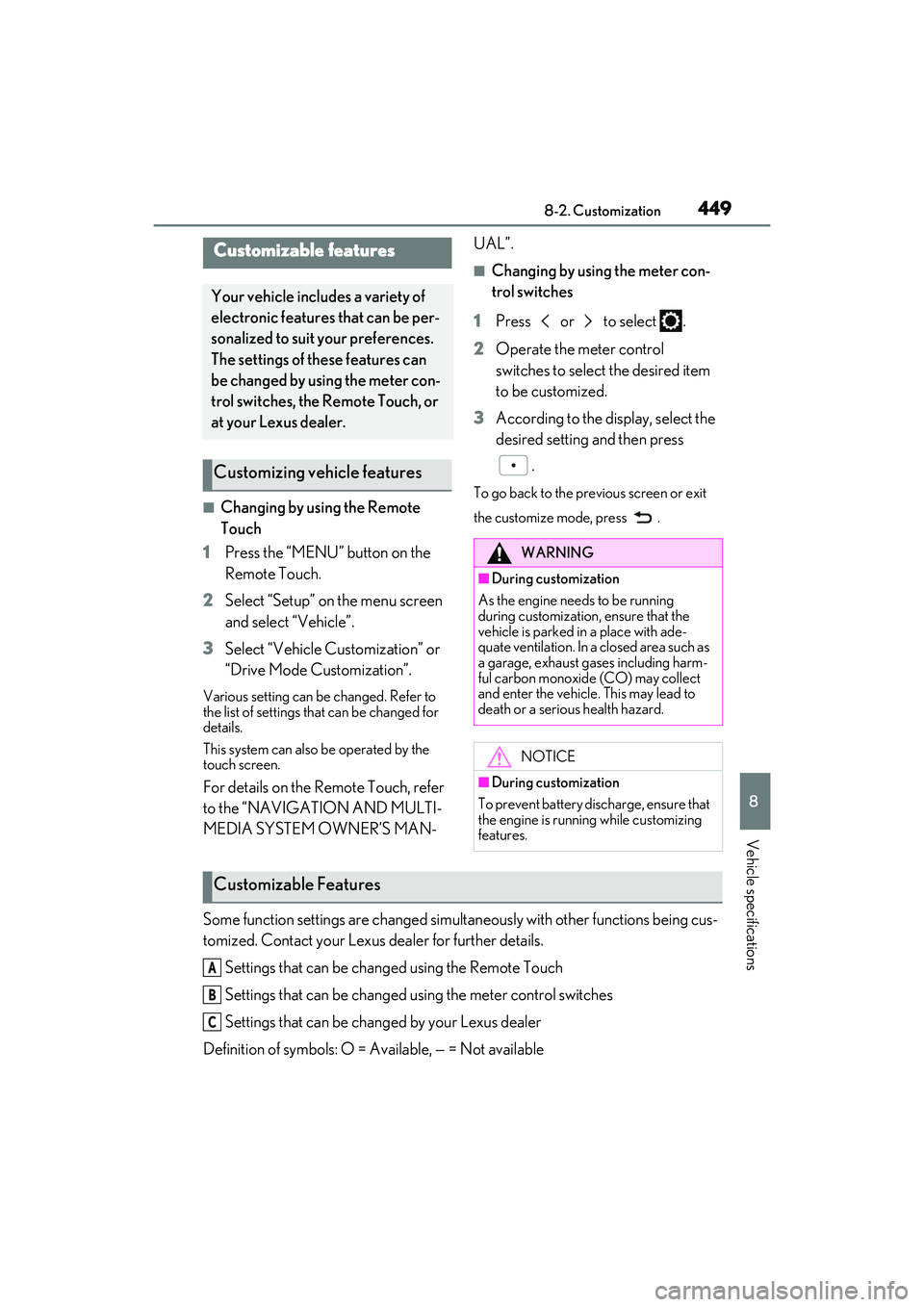
■Changing by using the Remote
Touch
1 Press the “MENU” button on the
Remote Touch.
2 Select “Setup” on the menu screen
and select “Vehicle”.
3 Select “Vehicle Customization” or
“Drive Mode Customization”.
Various setting can be changed. Refer to
the list of settings that can be changed for
details.
This system can also be operated by the
touch screen.
For details on the Remote Touch, refer
to the “NAVIGATION AND MULTI-
MEDIA SYSTEM OWNER’S MAN- UAL”.
■Changing by using the meter con-
trol switches
1 Press or to select .
2 Operate the meter control
switches to select the desired item
to be customized.
3 According to the display, select the
desired setting and then press
.
To go back to the previous screen or exit
the customize mode, press .
Some function settings are changed simultaneously with other functions being cus-
tomized. Contact your Lexus dealer for further details.
Settings that can be changed using the Remote Touch
Settings that can be changed using the meter control switches
Settings that can be changed by your Lexus dealer
Definition of symbols: O = Available, — = Not available
Customizable features
Your vehicle includes a variety of
electronic features that can be per-
sonalized to suit your preferences.
The settings of these features can
be changed by using the meter con-
trol switches, the Remote Touch, or
at your Lexus dealer.
Customizing vehicle features
WARNING
■During customization
As the engine needs to be running
during customization, ensure that the
vehicle is parked in a place with ade-
quate ventilation. In a closed area such as
a garage, exhaust gases including harm-
ful carbon monoxide (CO) may collect
and enter the vehicle. This may lead to
death or a serious health hazard.
NOTICE
■During customization
To prevent battery discharge, ensure that
the engine is running while customizing
features.
Customizable Features
A
B
C
Page 464 of 508
4628-3. Initialization
8-3.Initialization
*:If equipped
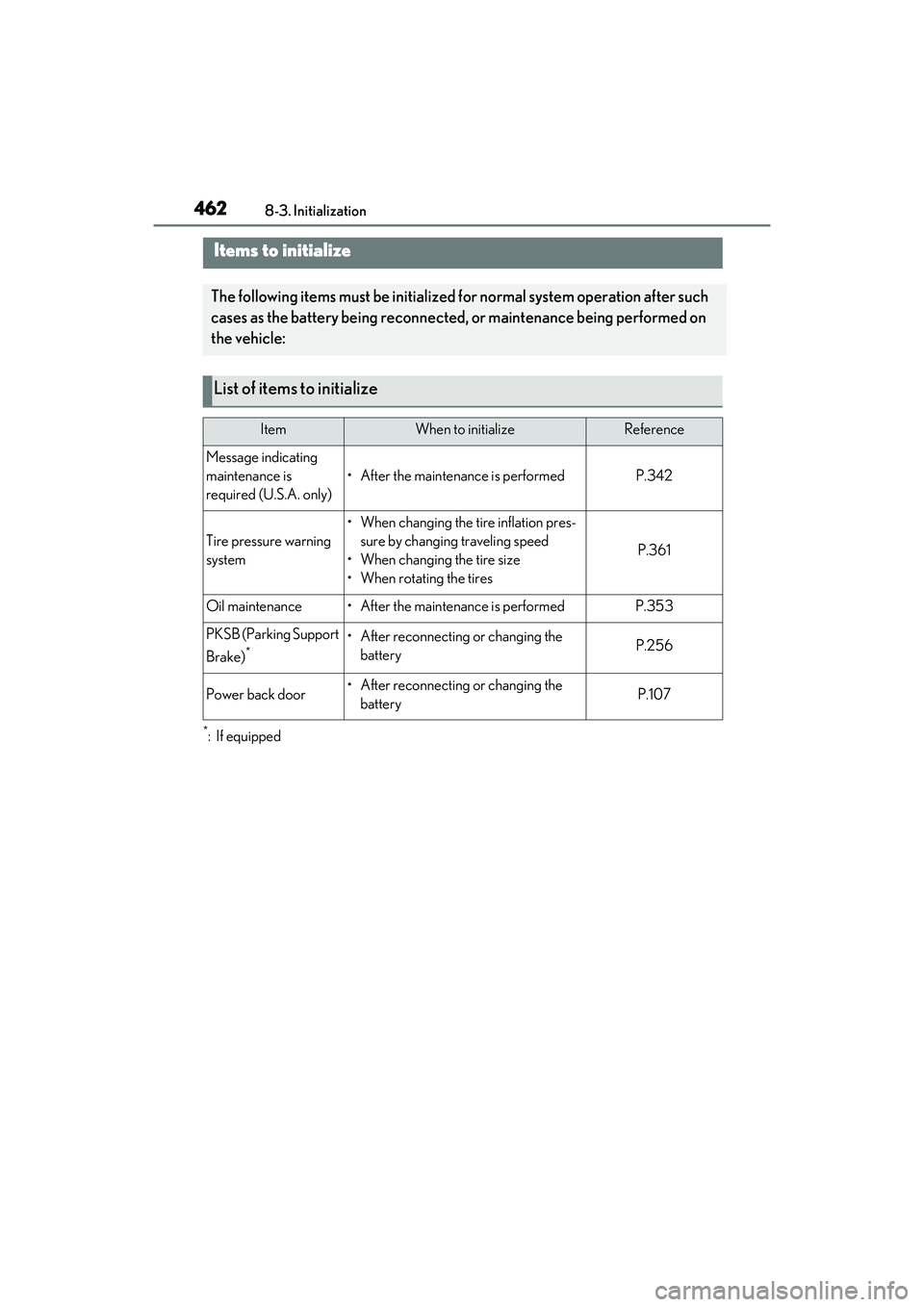
Items to initialize
The following items must be initialized for normal system operation after such
cases as the battery being reconnecte d, or maintenance being performed on
the vehicle:
List of items to initialize
ItemWhen to initializeReference
Message indicating
maintenance is
required (U.S.A. only)
• After the maintenance is performedP.342
Tire pressure warning
system
• When changing the tire inflation pres- sure by changing traveling speed
• When changing the tire size
• When rotating the tires
P.361
Oil maintenance• After the maintenance is performedP.353
PKSB (Parking Support
Brake)
*• After reconnecting or changing the
batteryP.256
Power back door• After reconnecting or changing the
batteryP.107
Page 480 of 508

478What to do if... (Troubleshooting)
1-1.What to do if... (Troubleshooting)What to do if... (Troubleshooting)
If you lose your mechanical keys,
new genuine mechanical keys can
be made by your Lexus dealer.
( P.419)
If you lose your electronic keys, the
risk of vehicle theft increases signifi-
cantly. Contact your Lexus dealer
immediately. ( P.419)
Is the electronic key battery weak or
depleted? ( P.369)
Is the engine switch in IGNITION
ON mode?
When locking the doors, turn the engine
switch off. ( P.173)
Is the electronic key left inside the
vehicle?
When locking the door s, make sure that
you have the electronic key on your per-
son.
The function may not operate prop-
erly due to the condition of the radio
wave. ( P.114)
Is the child-protector lock set?
The rear door cannot be opened from
inside the vehicle when the lock is set.
Open the rear door fr om outside and then
unlock the child-protector lock. ( P.100)
Did you press the engine switch
while firmly depressing the brake
pedal? ( P.170)
Is the shift lever in P? ( P.170)
Is the electronic key anywhere
detectable inside the vehicle?
( P.113)
Is the steering wheel unlocked?
( P.171)
Is the electronic key battery weak or
depleted?
In this case, the engine can be started in a
temporary way. ( P.422)
Is the battery discharged?
( P.423)
If you have a problem, check the
following before contacting your
Lexus dealer.
The doors cannot be locked,
unlocked, opened or closed
You lose your keys
The electronic key does not
operate properly
The doors cannot be locked or
unlocked
The rear door cannot be opened
If you think something is wrong
The engine does not start
The shift lever cannot be shifted
from P even if you depress the
brake pedal
Page 483 of 508

481Alphabetical Index
Alphabetical Index
A
A/CAir conditioning filter ............................... 366
Front automatic air conditioning system......................................................................... 284
Front seat concentr ated airflow mode
(S-FLOW)................................................. 292
Rear automatic air conditioning system ......................................................................... 294
ABS (Anti-lock Brake System).............. 265 Warning light ...............................................395
ACA (Active Cornering Assist) ........... 266
Active Cornering Assist (ACA) ........... 266
Adaptive Front-lighting System (AFS) 186
Adaptive Variable Suspension System266
AFS (Adaptive Front- lighting System) 186
AHB (Automatic High Beam) .................187
Air conditioning filter ................................. 366
Air conditioning system Air conditioning filter ............................... 366
Front automatic air conditioning system......................................................................... 284
Front seat concentr ated airflow mode
(S-FLOW)................................................. 292
Rear automatic air conditioning system ......................................................................... 294
Airbags Airbag operating conditions................... 33
Airbag precautions for your child ........ 36
Correct driving posture ............................ 25
Curtain shield airbag operating condi- tions .................................................................. 33
Curtain shield airbag precautions ....... 36
Front passenger occupa nt classification
system ............................................................. 39
General airbag precautions ................... 36
Locations of airbags.................................... 30
Modification and disp osal of airbags . 38
Side airbag operating conditions ......... 33
Side airbag precautions ............................ 36 Side and curtain shie
ld airbags operating
conditions ...................................................... 33
Side and curtain shield airbags precau- tions .................................................................. 36
SRS airbags......................................................30
SRS warning light.......................................394
Alarm ....................................................................67 Warning buzzer .........................................393
Anchor brackets ..................................... 46, 57
Antennas (smart acc ess system with
push-button start)........................................ 113
Anti-lock Brake System (ABS).............. 265 Warning light .............................................. 395
Approach warning...................................... 228
Armrest............................................................ 322
Assist grips ..................................................... 322
Audio system-linked display ...................... 83
Automatic headlight leveling system ... 185
Automatic High Beam ................................187
Automatic light control system............... 184
Automatic transmission .............................. 174 M mode ............................................................ 177
Paddle shift switches ........................176, 177
Auxiliary boxes .................................... 308, 311
Average fuel economy................................. 80
Average vehicle speed ................................ 80
AWD Control....................................................81
B
Back door .......................................................... 101
Back-up light Wattage .......................................................... 437
Back-up lights Replacing light bulbs..................... 375, 381
Battery Battery checking ....................................... 355
If the battery is discharged .................... 423
Preparing and checking before winter............................................................................ 271
Warning light ...............................................394
Blind Spot Monitor (BSM)....................... 232
Bottle holders ................................................ 307