2022 LEXUS ES350 flat tire
[x] Cancel search: flat tirePage 362 of 468

3607-2. Steps to take in an emergency
WARNING
As an added safety feature, your vehicle
has been equipped with a tire pressure
monitoring system (TPMS-tire pressure
warning system) that illuminates a low
tire pressure telltale (tire pressure warn-
ing light) when one or more of your tires
is significantly under-inflated. Accord-
ingly, when the low tire pressure telltale
(tire pressure warning light) illuminates,
you should stop and check your tires as
soon as possible, and inflate them to the
proper pressure. Driving on a signifi-
cantly under-inflated tire causes the tire
to overheat and can lead to tire failure.
Under-inflation also reduces fuel effi-
ciency and tire tread life, and may affect
the vehicle’s handling and stopping abil-
ity.
Please note that the TPMS (tire pressure
warning system) is not a substitute for
proper tire maintenance, and it is the
driver’s responsibility to maintain correct
tire pressure, even if under-inflation has
not reached the level to trigger illumina-
tion of the TPMS low tire pressure telltale
(tire pressure warning light).
Your vehicle has also been equipped
with a TPMS (tire pressure warning sys-
tem) malfunction indicator to indicate
when the system is not operating prop-
erly. The TPMS (tire pressure warning
system) malfunction indicator is com-
bined with the low tire pressure telltale
(tire pressure warnin g light). When the
system detects a malfunction, the telltale
will flash for approximately one minute
and then remain continuously illumi-
nated. This sequence will continue upon
subsequent vehicle start-ups as long as
the malfunction exists. When the mal-
function indicator is illuminated, the sys-
tem may not be able to detect or signal
low tire pressure as intended.
TPMS (tire pressure warning system)
malfunctions may occur for a variety of
reasons, including th e installation of
replacement or alternate tires or wheels
on the vehicle that prevent the TPMS
(tire pressure warning system) from
functioning properly. Always check the
TPMS (tire pressure warning system)
malfunction telltale after replacing one
or more tires or wheels on your vehicle
to ensure that the replacement or alter-
nate tires and wheels allow the TPMS
(tire pressure warning system) to con-
tinue to function properly.
NOTICE
■To ensure the tire pressure warning
system operates properly
Do not install tires wi th different specifi-
cations or makers, as the tire pressure
warning system may not operate prop-
erly.
Page 367 of 468

3657-2. Steps to take in an emergency
7
When trouble arises
vehicle inspected by your Lexus dealer
immediately.
• “Access System with Elec. Key Malfunc-
tion”
●If any of the following messages are
shown on the multi-information display, it
may indicate a malfunction. Immediately
stop the vehicle and contact your Lexus
dealer.
•“Braking Power Low”
• “Charging System Malfunction”
• “Oil Pressure Low”
Stop the vehicle in a safe place on a
hard, flat surface.
Set the parking brake.
Shift the shift lever to P.
Stop the engine.
Turn on the emergency flashers.
( P.344)
NOTICE
■If “High Power Co nsumption Power
to Climate Temporarily Limited” is
displayed frequently
There is a possible malfunction relating
to the charging system or the battery
may be deteriorating. Have the vehicle
inspected by your Lexus dealer.
If you have a flat tire
Your vehicle is equipped with a
spare tire. The flat tire can be
replaced with the spare tire.
For details about tires: P.320
WARNING
■If you have a flat tire
Do not continue driving with a flat tire.
Driving even a short distance with a flat
tire can damage the tire and the wheel
beyond repair, which could result in an
accident.
Before jacking up the vehicle
Page 369 of 468

3677-2. Steps to take in an emergency
7
When trouble arises
Type BJack handle
Wheel lock key
* (if equipped)
Jack
Spare tire
Wheel nut wrench
*: Documentation relating to the wheel lock key, such as the registration and I.D. card, is inside the glove box.
A
B
C
D
E
WARNING
■Using the tire jack
Observe the following precautions.
Improper use of the tire jack may cause
the vehicle to suddenly fall off the jack,
leading to death or serious injury.
●Do not use the tire jack for any pur-
pose other than replacing tires or
installing and removing tire chains.
●Only use the tire jack that comes with
this vehicle for replacing a flat tire.
Do not use it on other vehicles, and do
not use other tire jacks for replacing
tires on this vehicle.
●Put the jack properly in its jack point.
●Do not put any part of your body under
the vehicle while it is supported by the
jack.
●Do not start the engine or drive the
vehicle while the vehicle is supported
by the jack.
●Do not raise the vehicle while some-
one is inside.
●When raising the vehicle, do not put an
object on or under the jack.
Page 372 of 468
3707-2. Steps to take in an emergency
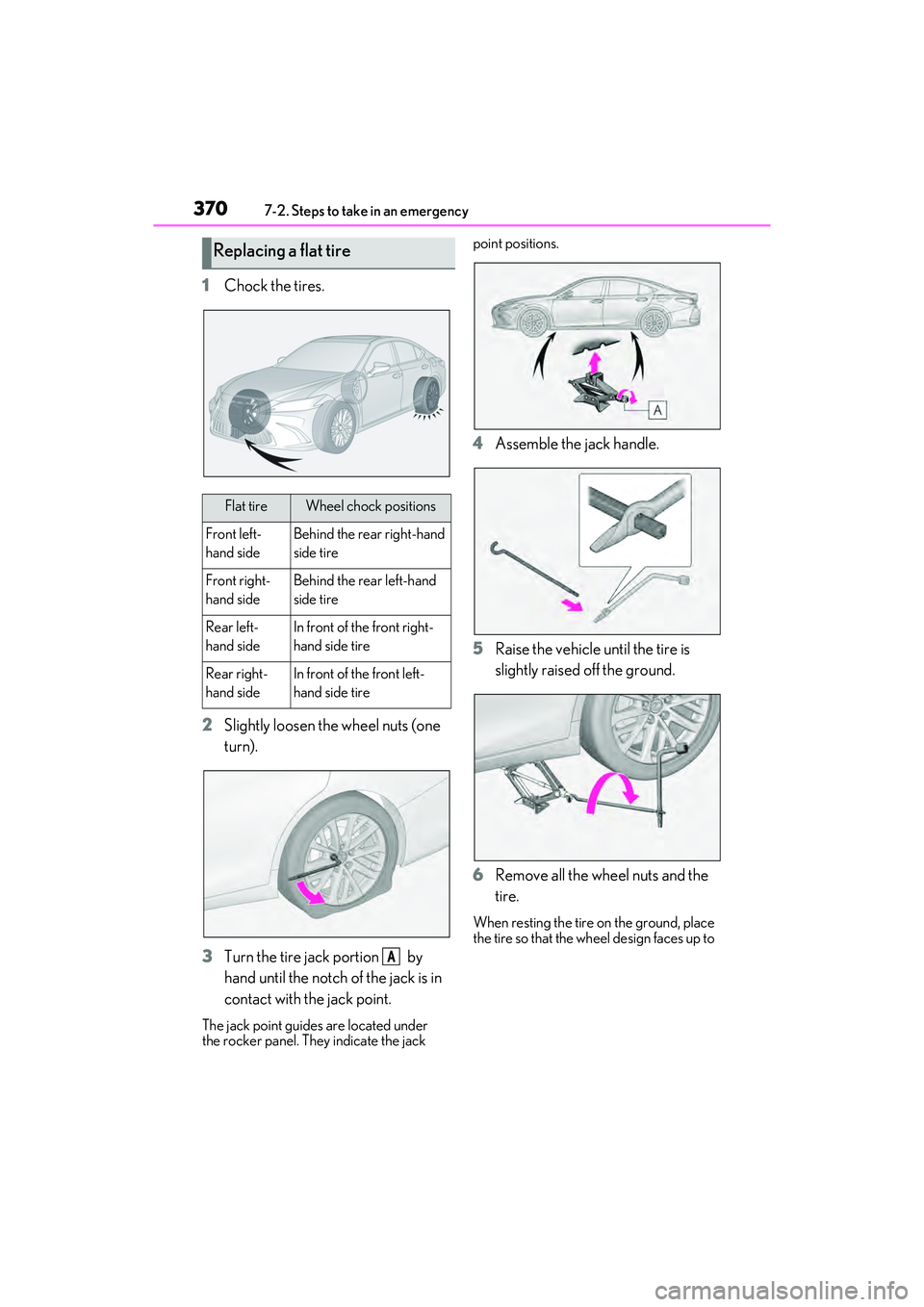
1Chock the tires.
2 Slightly loosen the wheel nuts (one
turn).
3 Turn the tire jack portion by
hand until the notch of the jack is in
contact with the jack point.
The jack point guides are located under
the rocker panel. They indicate the jack point positions.
4
Assemble the jack handle.
5 Raise the vehicle until the tire is
slightly raised off the ground.
6 Remove all the wheel nuts and the
tire.
When resting the tire on the ground, place
the tire so that the wheel design faces up to
Replacing a flat tire
Flat tireWheel chock positions
Front left-
hand sideBehind the rear right-hand
side tire
Front right-
hand sideBehind the rear left-hand
side tire
Rear left-
hand sideIn front of the front right-
hand side tire
Rear right-
hand sideIn front of the front left-
hand side tire
A
Page 373 of 468
3717-2. Steps to take in an emergency
7
When trouble arises
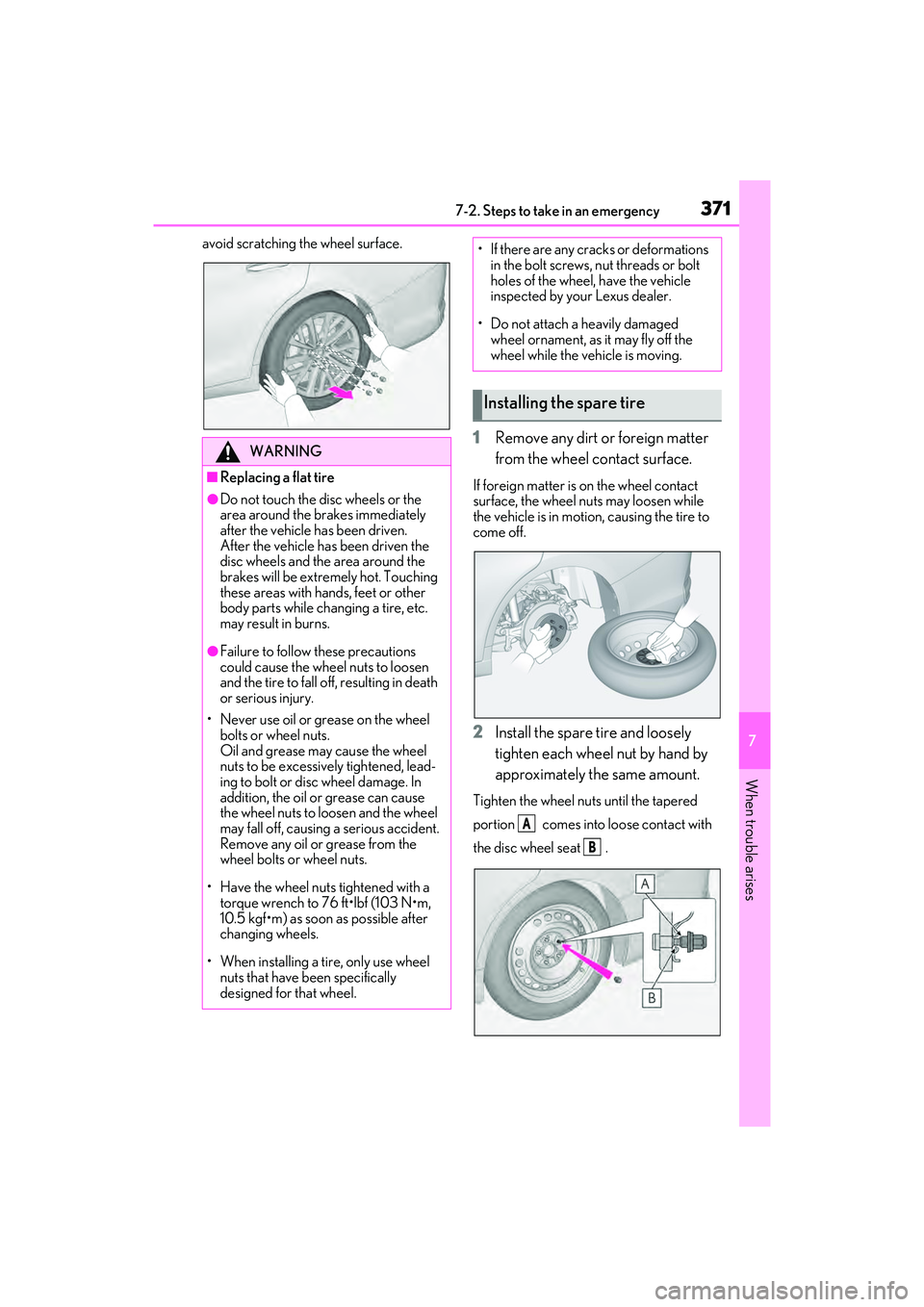
avoid scratching the wheel surface.
1Remove any dirt or foreign matter
from the wheel contact surface.
If foreign matter is on the wheel contact
surface, the wheel nuts may loosen while
the vehicle is in motion, causing the tire to
come off.
2Install the spare tire and loosely
tighten each wheel nut by hand by
approximately the same amount.
Tighten the wheel nuts until the tapered
portion comes into loose contact with
the disc wheel seat .
WARNING
■Replacing a flat tire
●Do not touch the disc wheels or the
area around the brakes immediately
after the vehicle has been driven.
After the vehicle has been driven the
disc wheels and the area around the
brakes will be extremely hot. Touching
these areas with hands, feet or other
body parts while changing a tire, etc.
may result in burns.
●Failure to follow these precautions
could cause the wheel nuts to loosen
and the tire to fall off, resulting in death
or serious injury.
• Never use oil or grease on the wheel bolts or wheel nuts.
Oil and grease may cause the wheel
nuts to be excessively tightened, lead-
ing to bolt or disc wheel damage. In
addition, the oil or grease can cause
the wheel nuts to loosen and the wheel
may fall off, causing a serious accident.
Remove any oil or grease from the
wheel bolts or wheel nuts.
• Have the wheel nuts tightened with a torque wrench to 76 ft•lbf (103 N•m,
10.5 kgf•m) as soon as possible after
changing wheels.
• When installing a tire, only use wheel nuts that have been specifically
designed for that wheel.
• If there are any cracks or deformations in the bolt screws, nut threads or bolt
holes of the wheel, have the vehicle
inspected by your Lexus dealer.
• Do not attach a heavily damaged wheel ornament, as it may fly off the
wheel while the vehicle is moving.
Installing the spare tire
A
B
Page 374 of 468

3727-2. Steps to take in an emergency
3Lower the vehicle.
4 Firmly tighten each wheel nut two
or three times in the order shown in
the illustration.
Tightening torque:
76 ft•lbf (103 N•m, 10.5 kgf•m)
5Stow the flat tire, tire jack and all
tools.
■The compact spare tire
●The compact spare tire is identified by
the label “TEMPORARY USE ONLY”
on the tire sidewall.
Use the compact spare tire temporarily,
and only in an emergency.
●Make sure to check the tire inflation
pressure of the compact spare tire.
( P.395)
■After completing the tire change
The tire pressure warning system must be
reset. ( P.324)
■When using the compact spare tire
As the compact spare tire is not equipped
with a tire pressure warning valve and
transmitter, low inflation pressure of the spare tire will not be indicated by the tire
pressure warning system. Also, if you
replace the compact spare tire after the tire
pressure warning light comes on, the light
remains on.
■When the compact spare tire is
attached
The vehicle becomes lower when driving
with the compact spare tire compared to
when driving with standard tires.
■If you have a flat front tire on a road cov-
ered with snow or ice (vehicles with 17-
inch tires)
Install the compact spare tire on one of the
rear wheels of the vehicle. Perform the fol-
lowing steps and fit tire chains to the front
tires:
1 Replace a rear tire with the compact
spare tire.
2 Replace the flat front tire with the tire
removed from the rear of the vehicle.
3 Fit tire chains to the front tires.
WARNING
■When using the compact spare tire
●Remember that the compact spare tire
provided is specifically designed for
use with your vehicle. Do not use your
compact spare tire on another vehicle.
●Do not use more than one compact
spare tire simultaneously.
●Replace the compact spare tire with a
standard tire as soon as possible.
●Avoid sudden acceleration, abrupt
steering, sudden braking and shifting
operations that cause sudden engine
braking.
■When the compact spare tire is
attached
The vehicle speed may not be correctly
detected, and the following systems may
not operate correctly:
• ABS & Brake assist
•VSC
Page 397 of 468
3958-1. Specifications
8
Vehicle specifications
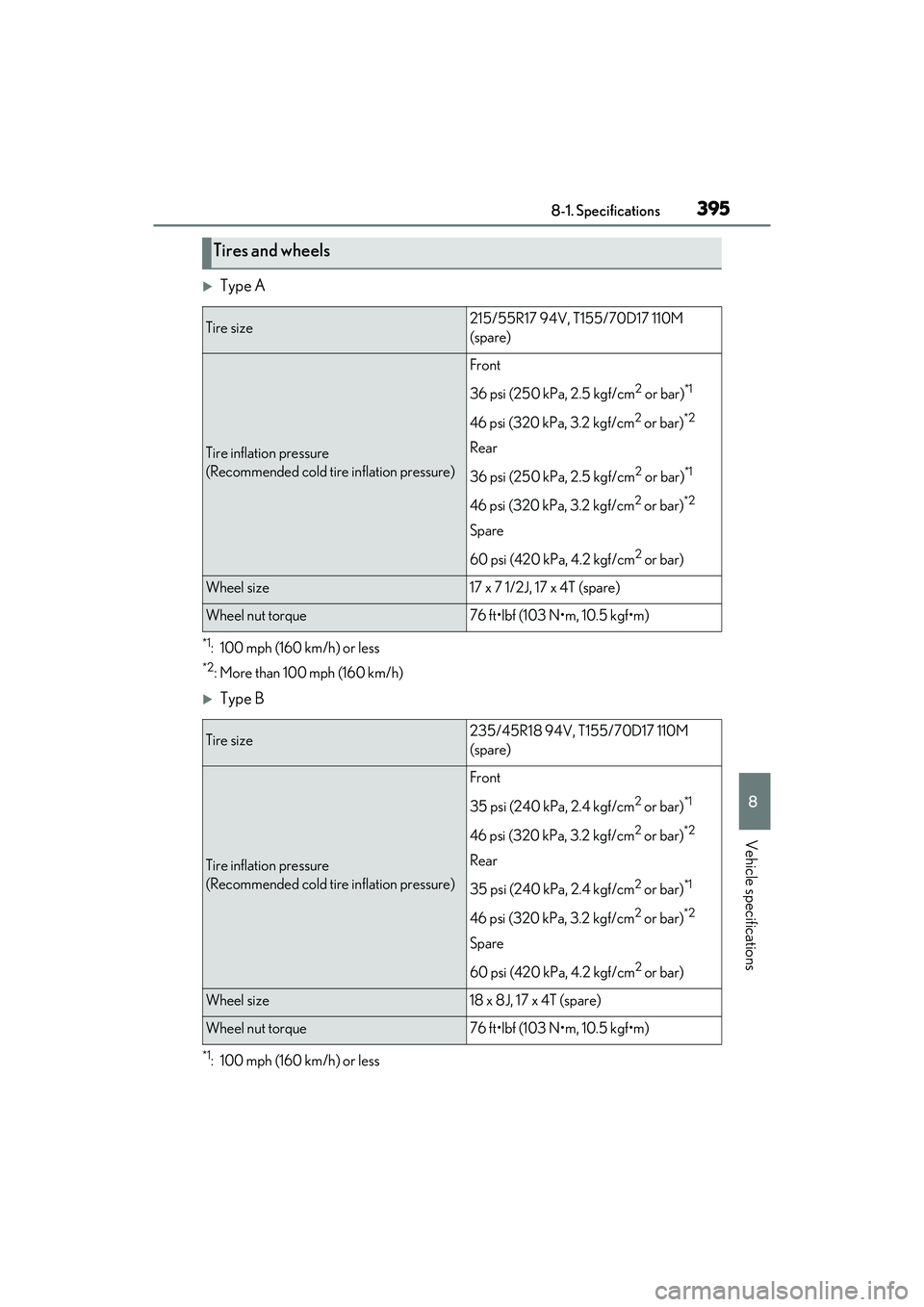
Type A
*1: 100 mph (160 km/h) or less
*2:More than 100 mph (160 km/h)
Type B
*1: 100 mph (160 km/h) or less
Tires and wheels
Tire size215/55R17 94V, T155/70D17 110M
(spare)
Tire inflation pressure
(Recommended cold tire inflation pressure)
Front
36 psi (250 kPa, 2.5 kgf/cm
2 or bar)*1
46 psi (320 kPa, 3.2 kgf/cm2 or bar)*2
Rear
36 psi (250 kPa, 2.5 kgf/cm
2 or bar)*1
46 psi (320 kPa, 3.2 kgf/cm2 or bar)*2
Spare
60 psi (420 kPa, 4.2 kgf/cm
2 or bar)
Wheel size17 x 7 1/2J, 17 x 4T (spare)
Wheel nut torque76 ft•lbf (103 N•m, 10.5 kgf•m)
Tire size235/45R18 94V, T155/70D17 110M
(spare)
Tire inflation pressure
(Recommended cold tire inflation pressure)
Front
35 psi (240 kPa, 2.4 kgf/cm
2 or bar)*1
46 psi (320 kPa, 3.2 kgf/cm2 or bar)*2
Rear
35 psi (240 kPa, 2.4 kgf/cm
2 or bar)*1
46 psi (320 kPa, 3.2 kgf/cm2 or bar)*2
Spare
60 psi (420 kPa, 4.2 kgf/cm
2 or bar)
Wheel size18 x 8J, 17 x 4T (spare)
Wheel nut torque76 ft•lbf (103 N•m, 10.5 kgf•m)
Page 398 of 468
3968-1. Specifications
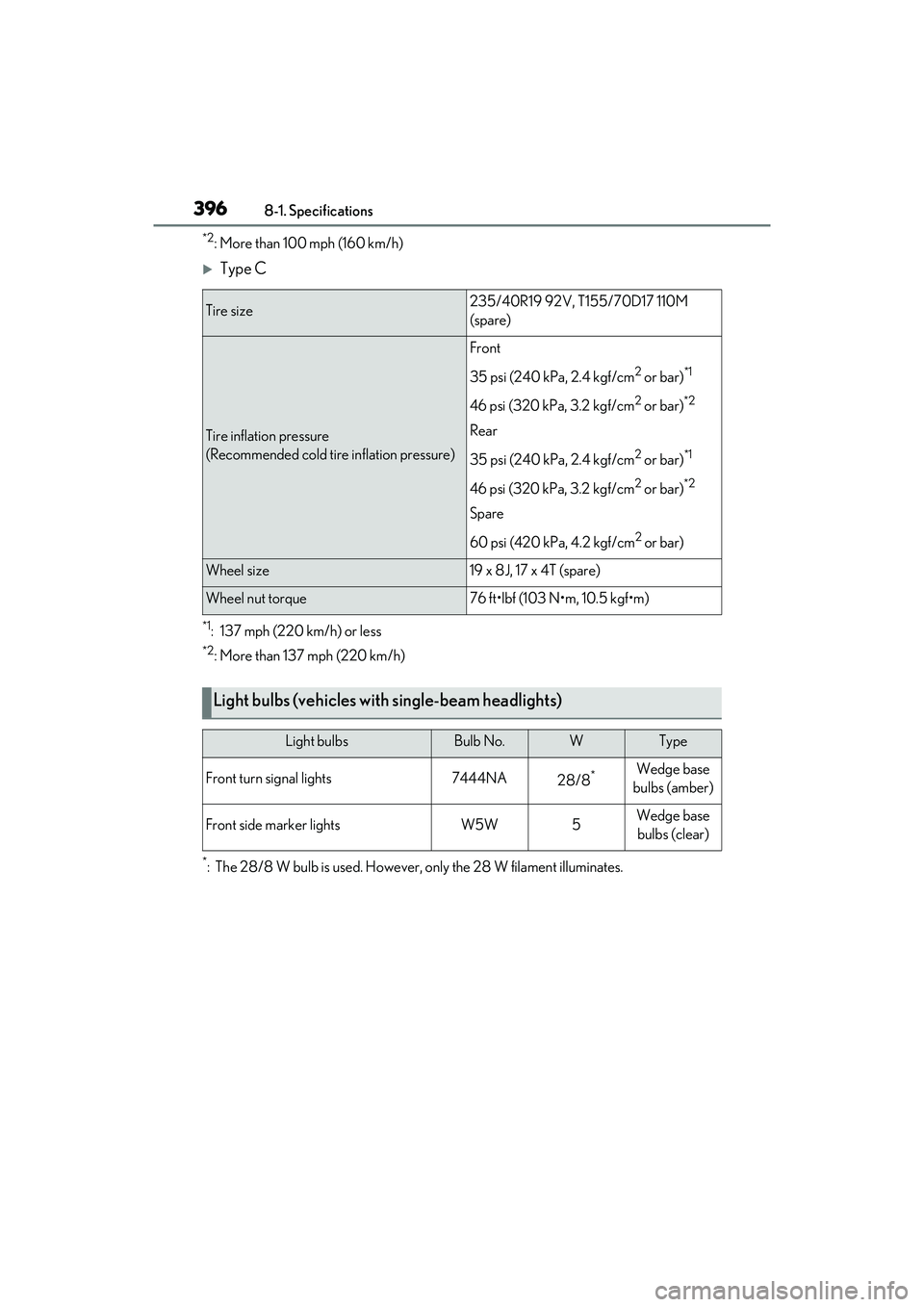
*2:More than 100 mph (160 km/h)
Type C
*1: 137 mph (220 km/h) or less
*2:More than 137 mph (220 km/h)
*: The 28/8 W bulb is used. However, only the 28 W filament illuminates.
Tire size235/40R19 92V, T155/70D17 110M
(spare)
Tire inflation pressure
(Recommended cold tire inflation pressure)
Front
35 psi (240 kPa, 2.4 kgf/cm
2 or bar)*1
46 psi (320 kPa, 3.2 kgf/cm2 or bar)*2
Rear
35 psi (240 kPa, 2.4 kgf/cm
2 or bar)*1
46 psi (320 kPa, 3.2 kgf/cm2 or bar)*2
Spare
60 psi (420 kPa, 4.2 kgf/cm
2 or bar)
Wheel size19 x 8J, 17 x 4T (spare)
Wheel nut torque76 ft•lbf (103 N•m, 10.5 kgf•m)
Light bulbs (vehicles with single-beam headlights)
Light bulbsBulb No.WType
Front turn signal lights7444NA28/8*Wedge base
bulbs (amber)
Front side marker lightsW5W5Wedge base bulbs (clear)