Page 310 of 468
3086-3. Do-it-yourself maintenance
6-3.Do-it-yo urself mainte nance
Do-it-yourself service pre-
cautions
If you perform maintenance by
yourself, be sure to follow the cor-
rect procedure as given in these
sections.
Maintenance
ItemsParts and tools
Battery condi-
tion (P.317)
•Grease
• Conventional wrench
(for terminal clamp
bolts)
Brake fluid
level
( P.317)
• FMVSS No.116 DOT 3
or SAE J1703 brake
fluid
FMVSS No.116 DOT 4
or SAE J1704 brake
fluid
•Rag or paper towel
• Funnel (used only for adding brake fluid)
Engine coolant
level
( P.316)
•“Toyota Super Long
Life Coolant” or a simi-
lar high quality eth-
ylene glycol-based
non-silicate, non-amine,
non-nitrite and non-
borate coolant with
long-life hybrid organic
acid technology
For the U.S.A.:
“Toyota Super Long
Life Coolant” is pre-
mixed with 50% cool-
ant and 50% deionized
water.
For Canada:
“Toyota Super Long
Life Coolant” is pre-
mixed with 55% cool-
ant and 45% deionized
water.
• Funnel (used only for adding coolant)
Engine oil level
( P.313)
•“Toyota Genuine
Motor Oil” or equiva-
lent
• Rag or paper towel
• Funnel (used only for adding engine oil)
Fuses
( P.335)• Fuse with same amper-
age rating as original
Headlight aim• Phillips-head screw-driver
Light bulbs
( P.338)
• Bulb with same number
and wattage rating as
original
• Flathead screwdriver
Radiator and
condenser
( P.316)
ItemsParts and tools
Page 311 of 468
3096-3. Do-it-yourself maintenance
6
Maintenance and care
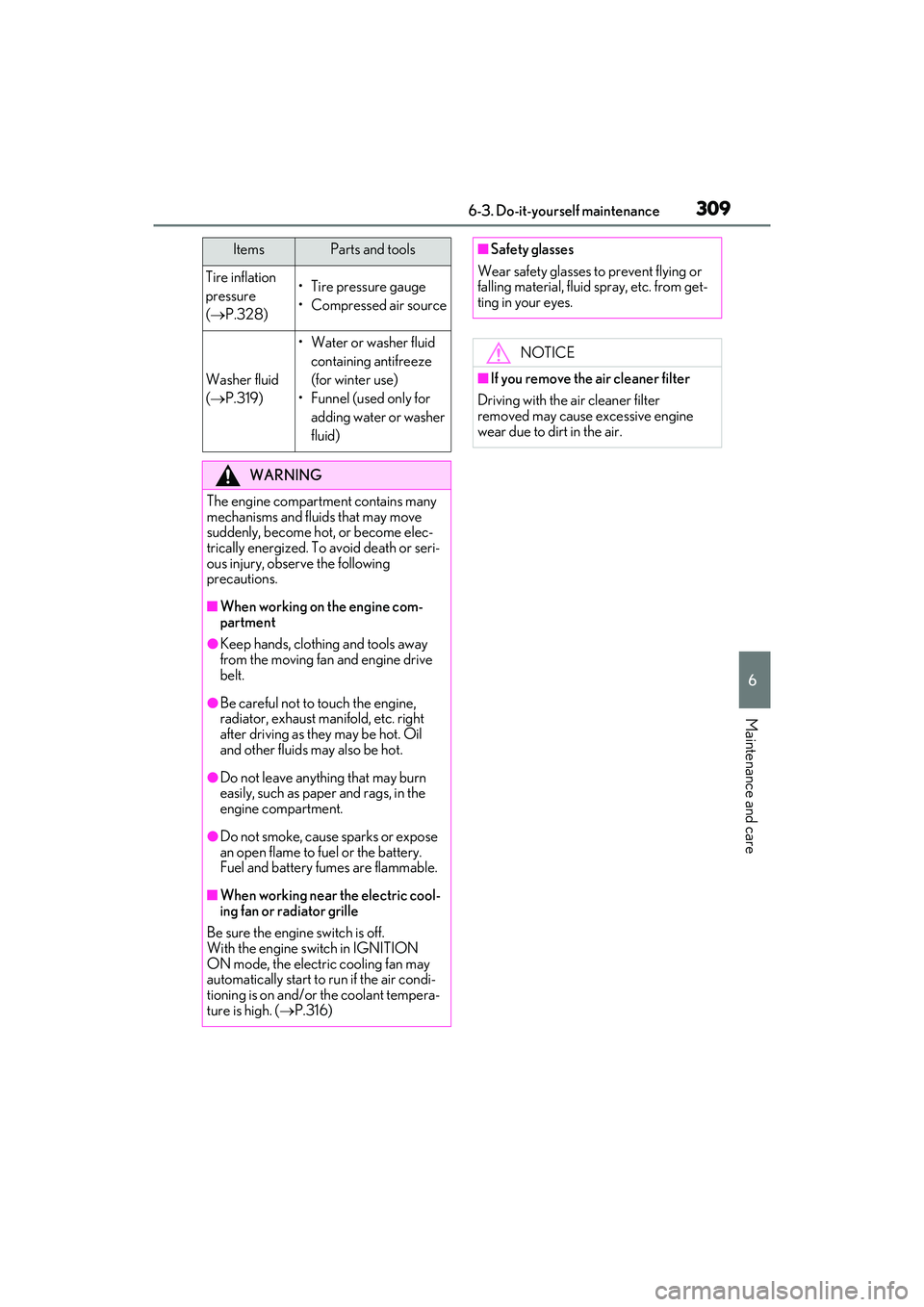
Tire inflation
pressure
( P.328)• Tire pressure gauge
• Compressed air source
Washer fluid
( P.319)
• Water or washer fluid
containing antifreeze
(for winter use)
• Funnel (used only for adding water or washer
fluid)
WARNING
The engine compartment contains many
mechanisms and fluids that may move
suddenly, become hot, or become elec-
trically energized. To avoid death or seri-
ous injury, observe the following
precautions.
■When working on the engine com-
partment
●Keep hands, clothing and tools away
from the moving fan and engine drive
belt.
●Be careful not to touch the engine,
radiator, exhaust manifold, etc. right
after driving as they may be hot. Oil
and other fluids may also be hot.
●Do not leave anything that may burn
easily, such as paper and rags, in the
engine compartment.
●Do not smoke, cause sparks or expose
an open flame to fuel or the battery.
Fuel and battery fumes are flammable.
■When working near the electric cool-
ing fan or radiator grille
Be sure the engine switch is off.
With the engine switch in IGNITION
ON mode, the electric cooling fan may
automatically start to run if the air condi-
tioning is on and/or the coolant tempera-
ture is high. ( P.316)
ItemsParts and tools■Safety glasses
Wear safety glasses to prevent flying or
falling material, fluid spray, etc. from get-
ting in your eyes.
NOTICE
■If you remove the air cleaner filter
Driving with the air cleaner filter
removed may cause excessive engine
wear due to dirt in the air.
Page 312 of 468
3106-3. Do-it-yourself maintenance
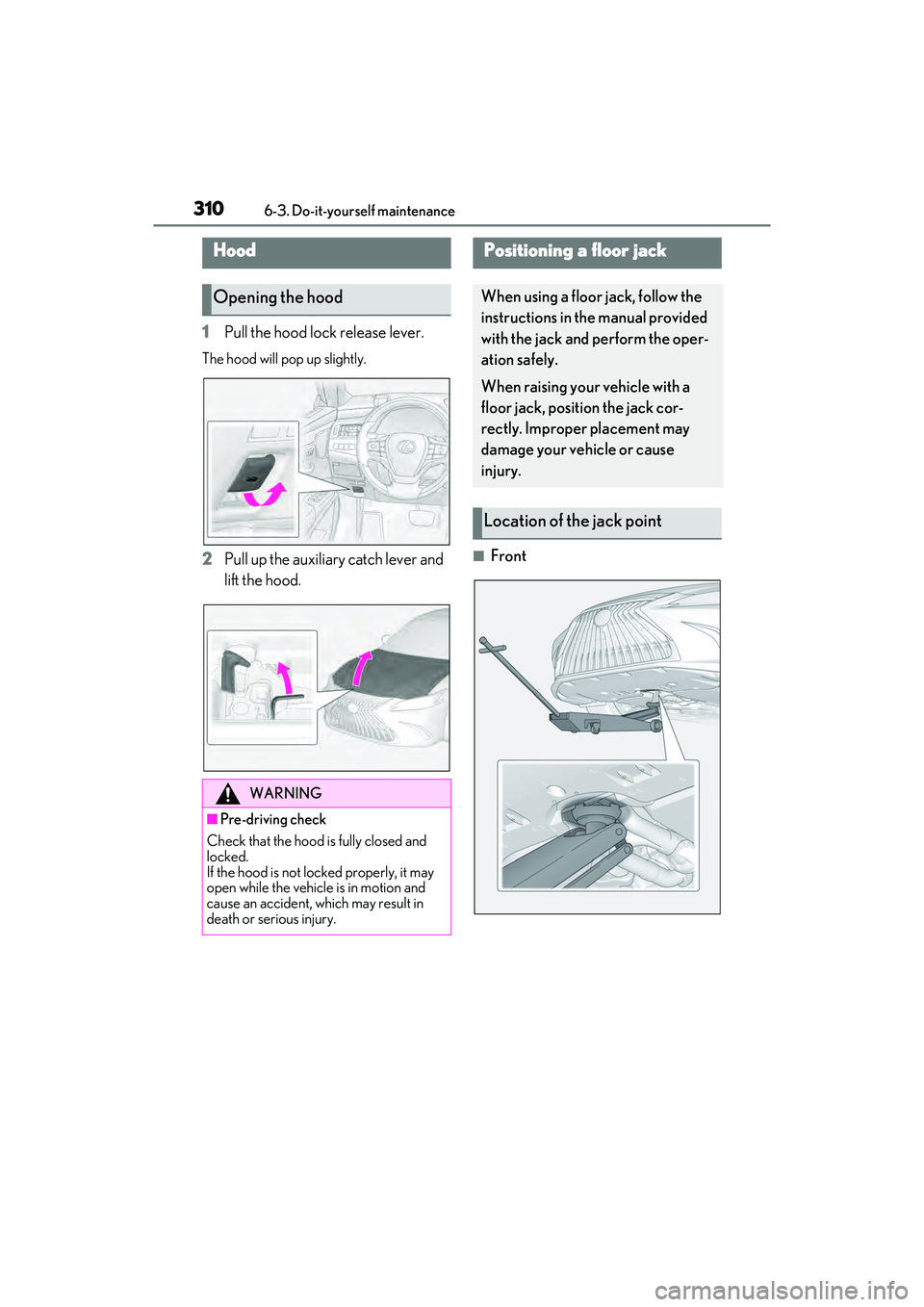
1Pull the hood lock release lever.
The hood will pop up slightly.
2Pull up the auxiliary catch lever and
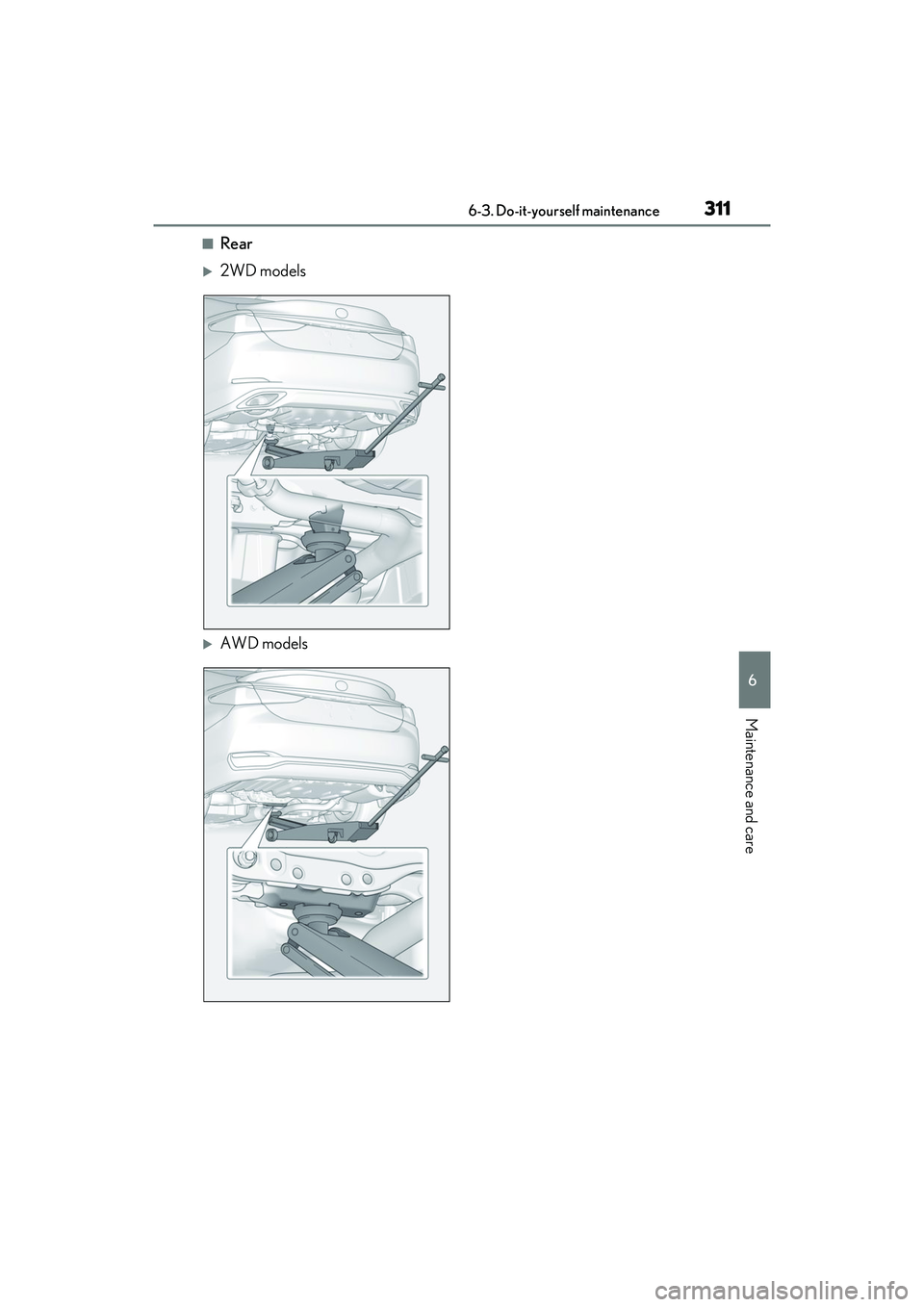
lift the hood.■Front
Hood
Opening the hood
WARNING
■Pre-driving check
Check that the hood is fully closed and
locked.
If the hood is not locked properly, it may
open while the vehicle is in motion and
cause an accident, which may result in
death or serious injury.
Positioning a floor jack
When using a floor jack, follow the
instructions in the manual provided
with the jack and perform the oper-
ation safely.
When raising your vehicle with a
floor jack, position the jack cor-
rectly. Improper placement may
damage your vehicle or cause
injury.
Location of the jack point
Page 313 of 468
3116-3. Do-it-yourself maintenance
6
Maintenance and care
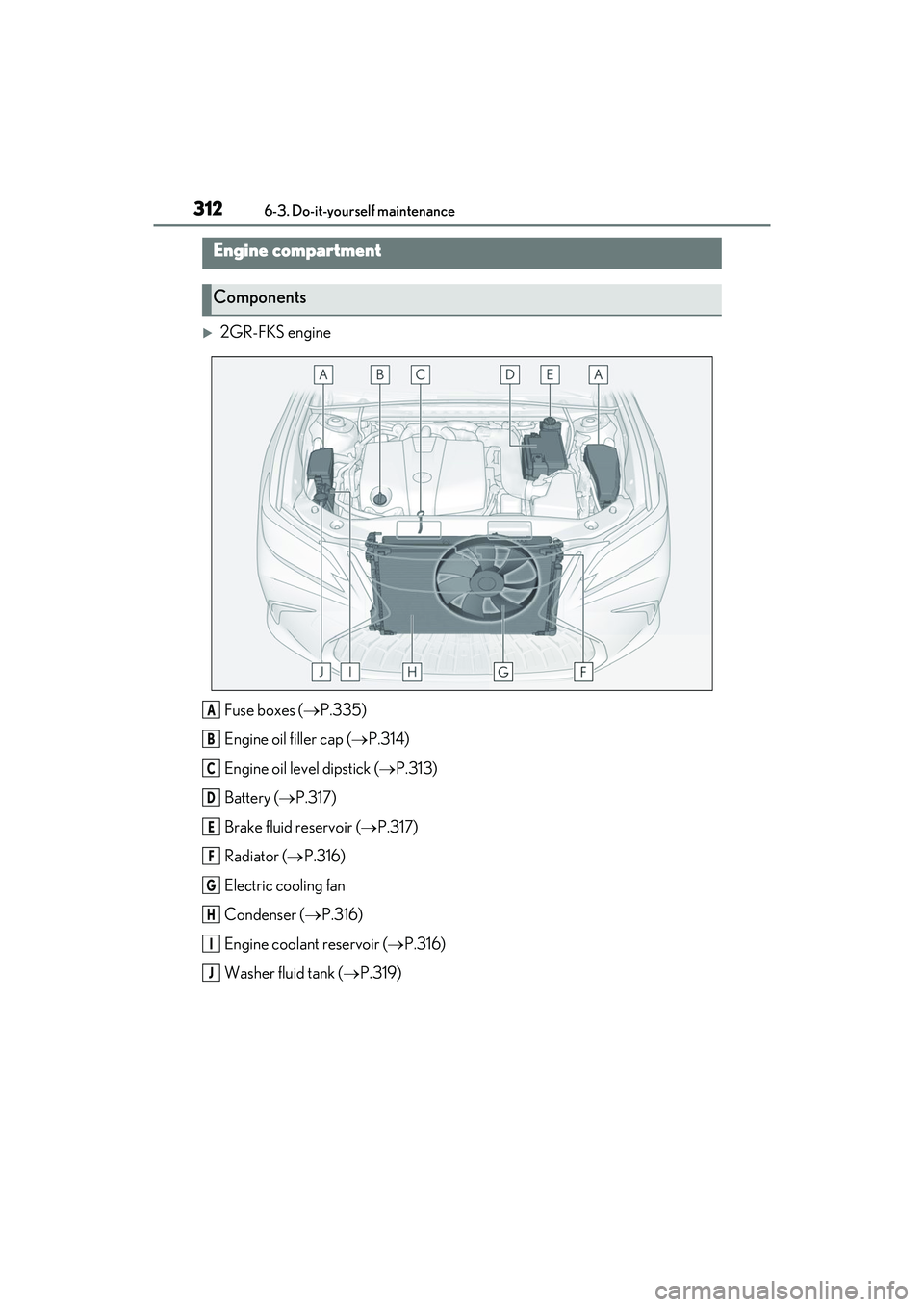
■Rear
2WD models
AWD models
Page 314 of 468
3126-3. Do-it-yourself maintenance
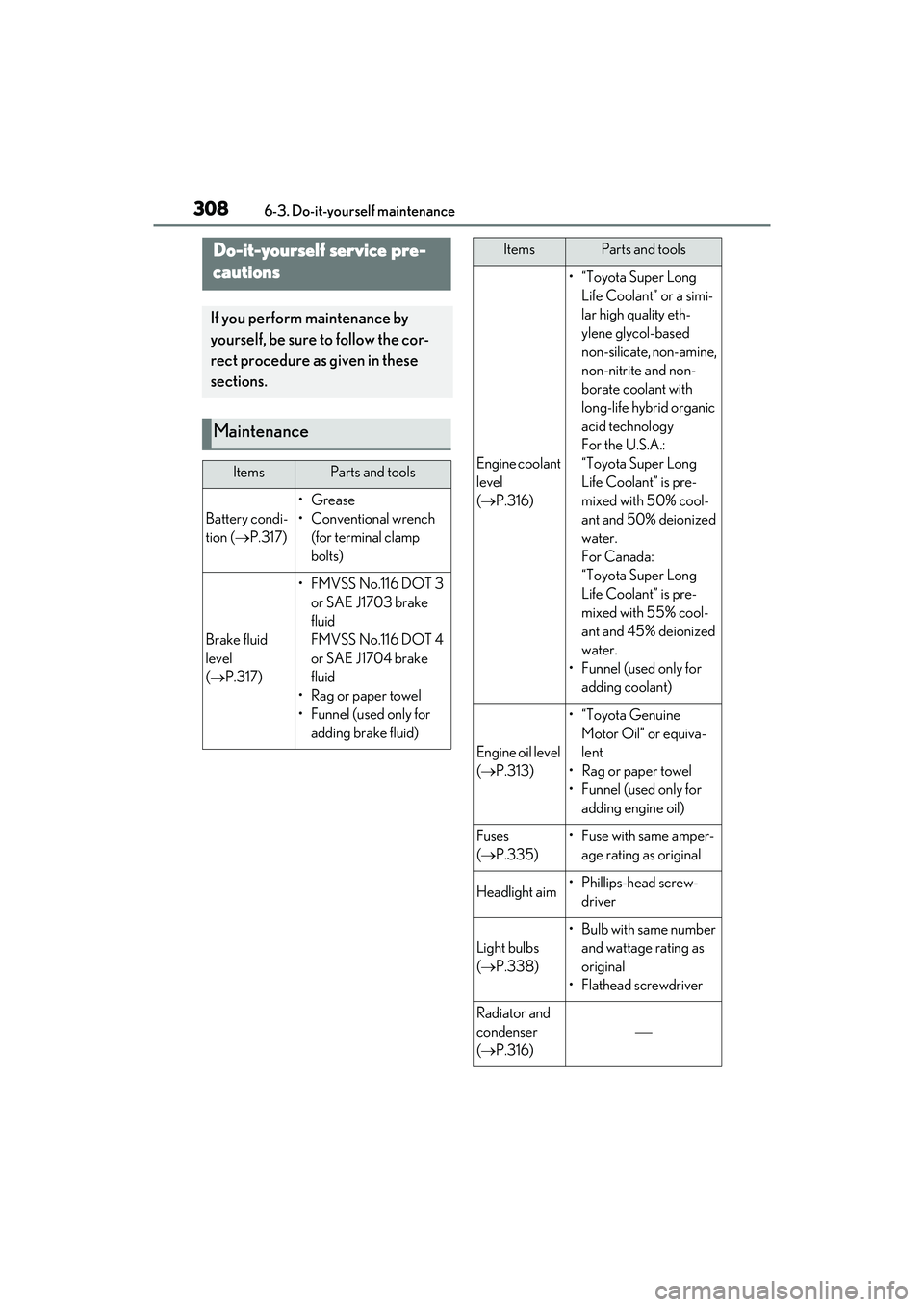
2GR-FKS engineFuse boxes ( P.335)
Engine oil filler cap ( P.314)
Engine oil level dipstick ( P.313)
Battery ( P.317)
Brake fluid reservoir ( P.317)
Radiator ( P.316)
Electric cooling fan
Condenser ( P.316)
Engine coolant reservoir ( P.316)
Washer fluid tank ( P.319)
Engine compartment
Components
A
B
C
D
E
F
G
H
I
J
Page 315 of 468
3136-3. Do-it-yourself maintenance
6
Maintenance and care
A25A-FKS engineFuse boxes ( P.335)
Engine oil filler cap ( P.314)
Engine oil level dipstick ( P.313)
Battery ( P.317)
Brake fluid reservoir ( P.317)
Radiator ( P.316)
Electric cooling fan
Condenser ( P.316)
Engine coolant reservoir ( P.316)
Washer fluid tank ( P.319)
With the engine at operating tempera-
ture and turned off, check the oil level
on the dipstick.
■Checking the engine oil
1 Park the vehicle on level ground.
After warming up the en gine and turning it
off, wait more than 5 minutes for the oil to
drain back into the bottom of the engine.
2 Holding a rag under the end, pull
the dipstick out.
A
B
C
D
E
F
G
H
I
J
Checking and adding the engine
oil
Page 316 of 468
3146-3. Do-it-yourself maintenance
2GR-FKS engine
A25A-FKS engine
3 Wipe the dipstick clean.
4 Reinsert the dipstick fully.
5 Holding a rag under the end, pull
the dipstick out and check the oil
level.
Low
Normal
Excessive
The shape of the dipstick may differ
depending on the type of vehicle or engine.
6
Wipe the dipstick and reinsert it
fully.
■Checking the oil type and prepar-
ing the items needed
Make sure to check the oil type and
prepare the items needed before add-
ing oil.
Engine oil selection
P.390
Oil quantity (Low Full)
2GR-FKS engine:
1.9 qt. (1.8 L, 1.6 Imp.qt.)
A25A-FKS engine:
1.6 qt. (1.5 L, 1.3 Imp. qt.)
Item
Clean funnel
■Adding engine oil
If the oil level is below or near the low
level mark, add engine oil of the same
type as that already in the engine.
2GR-FKS engine
A
B
C
Page 317 of 468

3156-3. Do-it-yourself maintenance
6
Maintenance and care
A25A-FKS engine
1 Remove the oil filler cap by turning
it counterclockwise.
2 Add engine oil slowly, checking the
dipstick.
3 Install the oil filler cap by turning it
clockwise.
■Engine oil consumption
A certain amount of engine oil will be con-
sumed while driving. In the following situa-
tions, oil consumption may increase, and
engine oil may need to be refilled in
between oil maintenance intervals.
●When the engine is new, for example
directly after purchasing the vehicle or
after replacing the engine
●If low quality oil or o il of an inappropriate
viscosity is used
●When driving at high engine speeds or
with a heavy load, or when driving while
accelerating or decelerating frequently
●When leaving the engine idling for a long
time, or when driving frequently through
heavy traffic
■After changing the engine oil
The engine oil maintenance data should be
reset. Perform the following procedures:
1 While the vehicle is stopped, press
of the meter control switches.
2 Press or of the meter control
switches, and select . 3
Press or of the meter control
switches, select “Veh icle Settings”, and
then press “OK”.
4 Press or of the meter control
switches, select “Oil Maintenance”, and
then press “OK”.
5 Select “Yes” and then press “OK”.
A message will be displayed on the multi-
information display when the reset proce-
dure has been completed.
WARNING
■Used engine oil
●Used engine oil contains potentially
harmful contaminants which may
cause skin disorders such as inflamma-
tion and skin cancer, so care should be
taken to avoid prolonged and
repeated contact. To remove used
engine oil from your skin, wash thor-
oughly with soap and water.
●Dispose of used oil an d filters only in a
safe and acceptable manner. Do not
dispose of used oil and filters in house-
hold trash, in sewers or onto the
ground.
Call your Lexus dealer, service station
or auto parts store for information
concerning recycling or disposal.
●Do not leave used engine oil within the
reach of children.
NOTICE
■To prevent serious engine damage
Check the oil level on a regular basis.
■When replacing the engine oil
●Be careful not to spill engine oil on the
vehicle components.
●Avoid overfilling, or the engine could
be damaged.
●Check the oil level on the dipstick
every time you refill the vehicle.