2022 KIA RIO oil change
[x] Cancel search: oil changePage 403 of 528

Maintenance
16
7
Vacuum crankcase ventilation
hoses
Inspect the surface of hoses for evi-
dence of heat and/or mechanical
damage. Hard and brittle rubber,
cracking, tears, cuts, abrasions, and
excessive swelling indicate deterio-
ration. Particular attention should be
paid to examine those hose surfaces
nearest to high heat sources, such
as the exhaust manifold.
Inspect the hose routing to assure
that the hoses do not come in con-
tact with any heat source, sharp
edges or moving component which
might cause heat damage or
mechanical wear. Inspect all hose
connections, such as clamps and
couplings, to make sure they are
secure, and that no leaks are pres-
ent. Hoses should be replaced
immediately if there is any evidence
of deterioration or damage.
Air cleaner filter
A Genuine Kia air cleaner filter is rec-
ommended when the filter is replaced.
Spark plugs
Make sure to install new spark plugs
of the correct heat range.
When assembling parts, be sure to
wipe the inside and outside of the
boot bottom of the ignition coil and
the insulator of the spark plug with a
soft cloth to prevent contamination of
the spark plug insulator.
Valve clearance (if equipped)
Inspect excessive valve noise and/or
engine vibration and adjust if neces-
sary. An authorized Kia dealer
should perform the operation.
Cooling system
Check the cooling system compo-
nents, such as the radiator, coolant
reservoir, hoses and connections for
leakage and damage. Replace any
damaged parts.
Coolant
The coolant should be changed at
the intervals specified in the mainte-
nance schedule.
Intelligent Variable
Transmission (IVT) fluid
The Intelligent Variable Transmission
(IVT) fluid should not be checked
under normal usage conditions.
But in severe conditions, the fluid
should be changed at an authorized
Kia dealer in accordance to the
scheduled maintenance at the begin-
ning of this chapter.
(Refer to “Maintenance Under Severe
Usage Conditions” this chapter.)
SC PE USA 7.qxp 9/9/2021 6:26 PM Page 16
Page 409 of 528
Maintenance
22
7
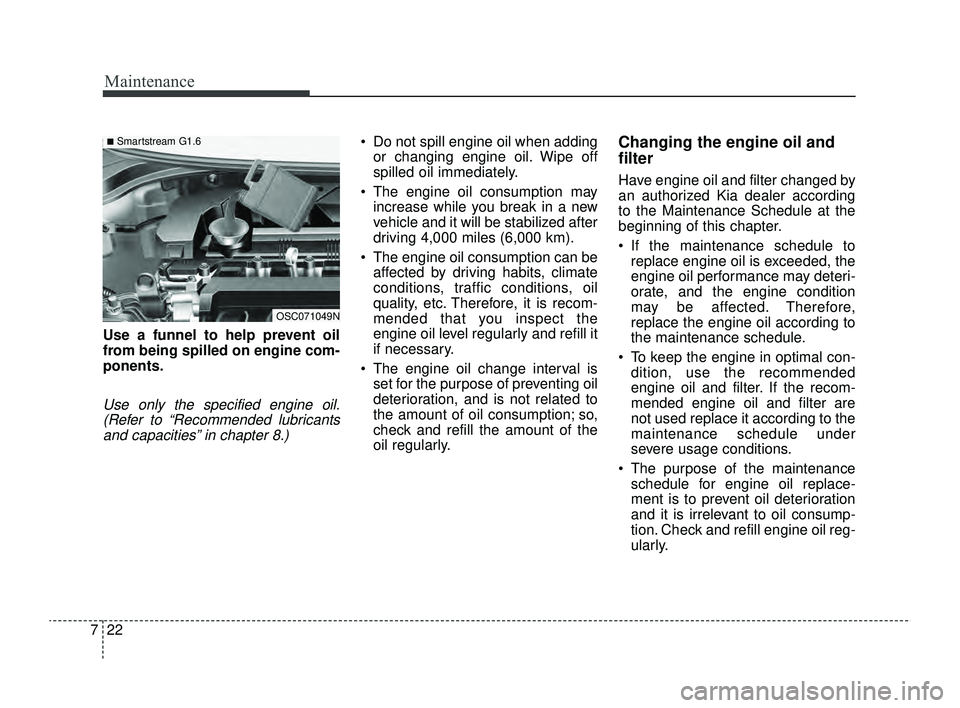
Use a funnel to help prevent oil
from being spilled on engine com-
ponents.
Use only the specified engine oil.
(Refer to “Recommended lubricantsand capacities” in chapter 8.)
Do not spill engine oil when adding or changing engine oil. Wipe off
spilled oil immediately.
The engine oil consumption may increase while you break in a new
vehicle and it will be stabilized after
driving 4,000 miles (6,000 km).
The engine oil consumption can be affected by driving habits, climate
conditions, traffic conditions, oil
quality, etc. Therefore, it is recom-
mended that you inspect the
engine oil level regularly and refill it
if necessary.
The engine oil change interval is set for the purpose of preventing oil
deterioration, and is not related to
the amount of oil consumption; so,
check and refill the amount of the
oil regularly.Changing the engine oil and
filter
Have engine oil and filter changed by
an authorized Kia dealer according
to the Maintenance Schedule at the
beginning of this chapter.
If the maintenance schedule toreplace engine oil is exceeded, the
engine oil performance may deteri-
orate, and the engine condition
may be affected. Therefore,
replace the engine oil according to
the maintenance schedule.
To keep the engine in optimal con- dition, use the recommended
engine oil and filter. If the recom-
mended engine oil and filter are
not used replace it according to the
maintenance schedule under
severe usage conditions.
The purpose of the maintenance schedule for engine oil replace-
ment is to prevent oil deterioration
and it is irrelevant to oil consump-
tion. Check and refill engine oil reg-
ularly.
OSC071049N
■Smartstream G1.6
SC PE USA 7.qxp 9/9/2021 6:26 PM Page 22
Page 509 of 528
Specifications, Consumer information, Reporting safety defects
88
Recommended SAE viscosity
number
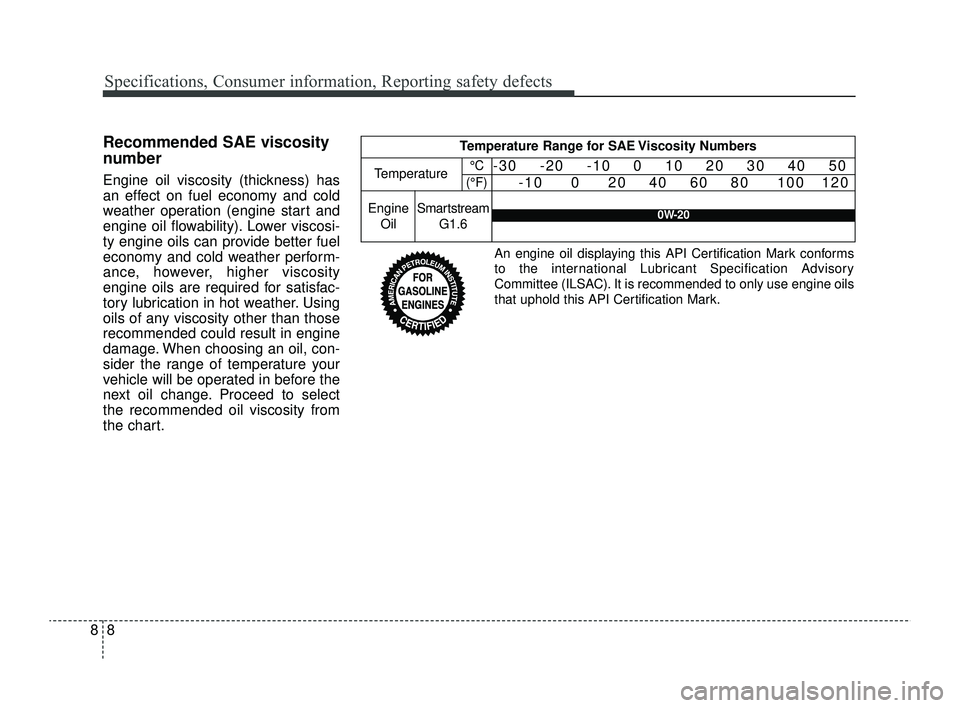
Engine oil viscosity (thickness) has
an effect on fuel economy and cold
weather operation (engine start and
engine oil flowability). Lower viscosi-
ty engine oils can provide better fuel
economy and cold weather perform-
ance, however, higher viscosity
engine oils are required for satisfac-
tory lubrication in hot weather. Using
oils of any viscosity other than those
recommended could result in engine
damage. When choosing an oil, con-
sider the range of temperature your
vehicle will be operated in before the
next oil change. Proceed to select
the recommended oil viscosity from
the chart.
Temperature Range for SAE Viscosity Numbers
Temperature°C
(°F)-30 -20 -10 0 10 20 30 40 50 -10 0 20 40 60 80 100 120
Smartstream
G1.60W-20EngineOil
An engine oil displaying this API Certification Mark conforms
to the international Lubricant Specification Advisory
Committee (ILSAC). It is recommended to only use engine oils
that uphold this API Certification Mark.
SC PE USA 8.qxp 8/23/2021 5:30 PM Page 8
Page 526 of 528

Index
10I
Wheel alignment and tire balance ............................7-45
Wheel replacement ....................................................7-47
Towing ........................................................................\
..6-29 Emergency towing ......................................................6-31
Removable towing hook (front)..................................6-30
Towing service ............................................................6-29
Trip computer ................................................................4-58 Service Mode (For type A cluster)..............................4-63
Trip information (Trip computer) ..............................4-58
Trunk (For 4 door) ........................................................4-24 Closing the trunk ........................................................4-24
Emergency trunk safety release ..................................4-25
Opening the trunk ......................................................4-24
Vehicle break-in process ..................................................1-5
Vehicle certification label ................................................8-9
Vehicle data collection and event data recorders ............1-6
Vehicle Identification Number (VIN)..............................8-9
Vehicle load limit ........................................................5-115 Certification label......................................................5-118
Tire and loading information label ..........................5-115
Vehicle modifications ......................................................1-5
Vehicle weight ............................................................5-120 Base curb weight ......................................................5\
-120
Cargo weight ............................................................5-120
GAW (Gross axle weight) ........................................5-120 GAWR (Gross axle weight rating) ..........................5-120
GVW (Gross vehicle weight) ..................................5-120
GVWR (Gross vehicle weight rating) ......................5-120
Vehicle curb weight ..................................................5-120
Warning and indicator lights..........................................4-78 Indicator Lights ..........................................................4-86
Warning lights ............................................................4-78
Washer fluid ..................................................................7-29 Checking the washer fluid level ..............................7-29
Weight/Volume ................................................................8-6
Windows ........................................................................\
4-33 Power windows ..........................................................4-34
Windshield defrosting and defogging..........................4-135 Automatic climate control system ............................4-136
Defogging logic ........................................................4-137
Manual climate control system ................................4-135
Winter driving ..............................................................5-110 Carry emergency equipment ....................................5-114
Change to "winter weight" oil if necessary ..............5-113
Check battery and cables ..........................................5-112
Check spark plugs and ignition system ....................5-113
Don't let ice and snow accumulate underneath ........5-113
Don't let your parking brake freeze ..........................5-113
Snowy or Icy conditions ..........................................5-110
To keep locks from freezing ....................................5-113
W
V
SC PE USA Index.qxp 8/23/2021 5:25 PM Page 10