763
Maintenance
3. Check the removed fuse; replace it
if it is blown. To remove or insert
the fuse, use the fuse puller in the
engine compartment fuse panel.
4. Push in a new fuse of the same
rating, and make sure it fits tightly
in the clips. If it fits loosely, consult
an authorized Kia dealer.Multi fuse
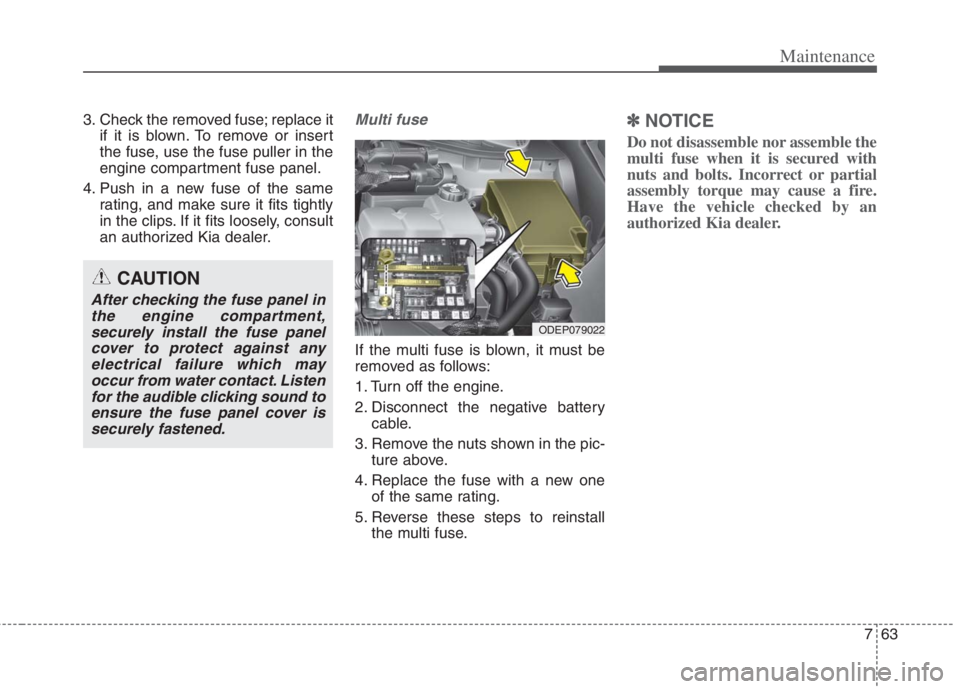
If the multi fuse is blown, it must be
removed as follows:
1. Turn off the engine.
2. Disconnect the negative battery
cable.
3. Remove the nuts shown in the pic-
ture above.
4. Replace the fuse with a new one
of the same rating.
5. Reverse these steps to reinstall
the multi fuse.
✽ ✽
NOTICE
Do not disassemble nor assemble the
multi fuse when it is secured with
nuts and bolts. Incorrect or partial
assembly torque may cause a fire.
Have the vehicle checked by an
authorized Kia dealer.
ODEP079022
CAUTION
After checking the fuse panel in
the engine compartment,
securely install the fuse panel
cover to protect against any
electrical failure which may
occur from water contact. Listen
for the audible clicking sound to
ensure the fuse panel cover is
securely fastened.
85
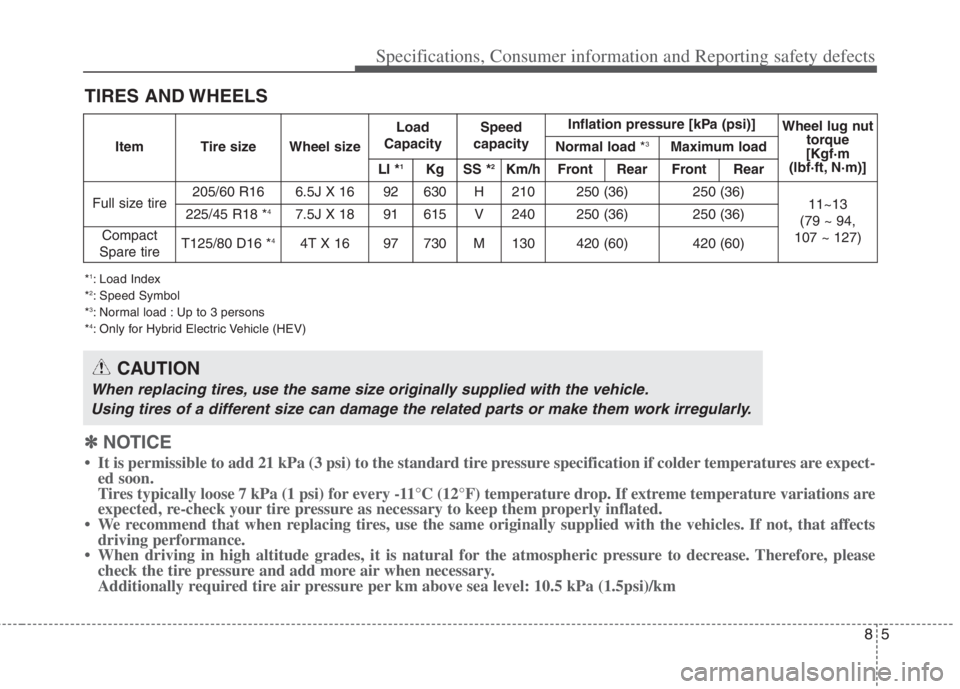
TIRES AND WHEELS
*1: Load Index
*2: Speed Symbol
*3: Normal load : Up to 3 persons
*4: Only for Hybrid Electric Vehicle (HEV)
CAUTION
When replacing tires, use the same size originally supplied with the vehicle.
Using tires of a different size can damage the related parts or make them work irregularly.
ItemTire sizeWheel size
Load
CapacitySpeed
capacityInflation pressure [kPa (psi)]Wheel lug nut
torque
[Kgf·m
(lbf·ft, N·m)]
Normal load *3Maximum load
LI *1KgSS *2Km/hFront RearFront Rear
Full size tire205/60 R16 6.5J X 1692630H210250 (36)250 (36)11~13
(79 ~ 94,
107 ~ 127)225/45 R18 *47.5J X 1891615V240250 (36)250 (36)
Compact
Spare tireT125/80 D16 *44T X 1697730M130420 (60)420 (60)
Specifications, Consumer information and Reporting safety defects
✽ ✽
NOTICE
• It is permissible to add 21 kPa (3 psi) to the standard tire pressure specification if colder temperatures are expect-
ed soon.
Tires typically loose 7 kPa (1 psi) for every -11°C (12°F) temperature drop. If extreme temperature variations are
expected, re-check your tire pressure as necessary to keep them properly inflated.
• We recommend that when replacing tires, use the same originally supplied with the vehicles. If not, that affects
driving performance.
• When driving in high altitude grades, it is natural for the atmospheric pressure to decrease. Therefore, please
check the tire pressure and add more air when necessary.
Additionally required tire air pressure per km above sea level: 10.5 kPa (1.5psi)/km