2022 HYUNDAI KONA format
[x] Cancel search: formatPage 25 of 579
Vehicle Information, Consumer Information and Reporting Safety Defects
2-12
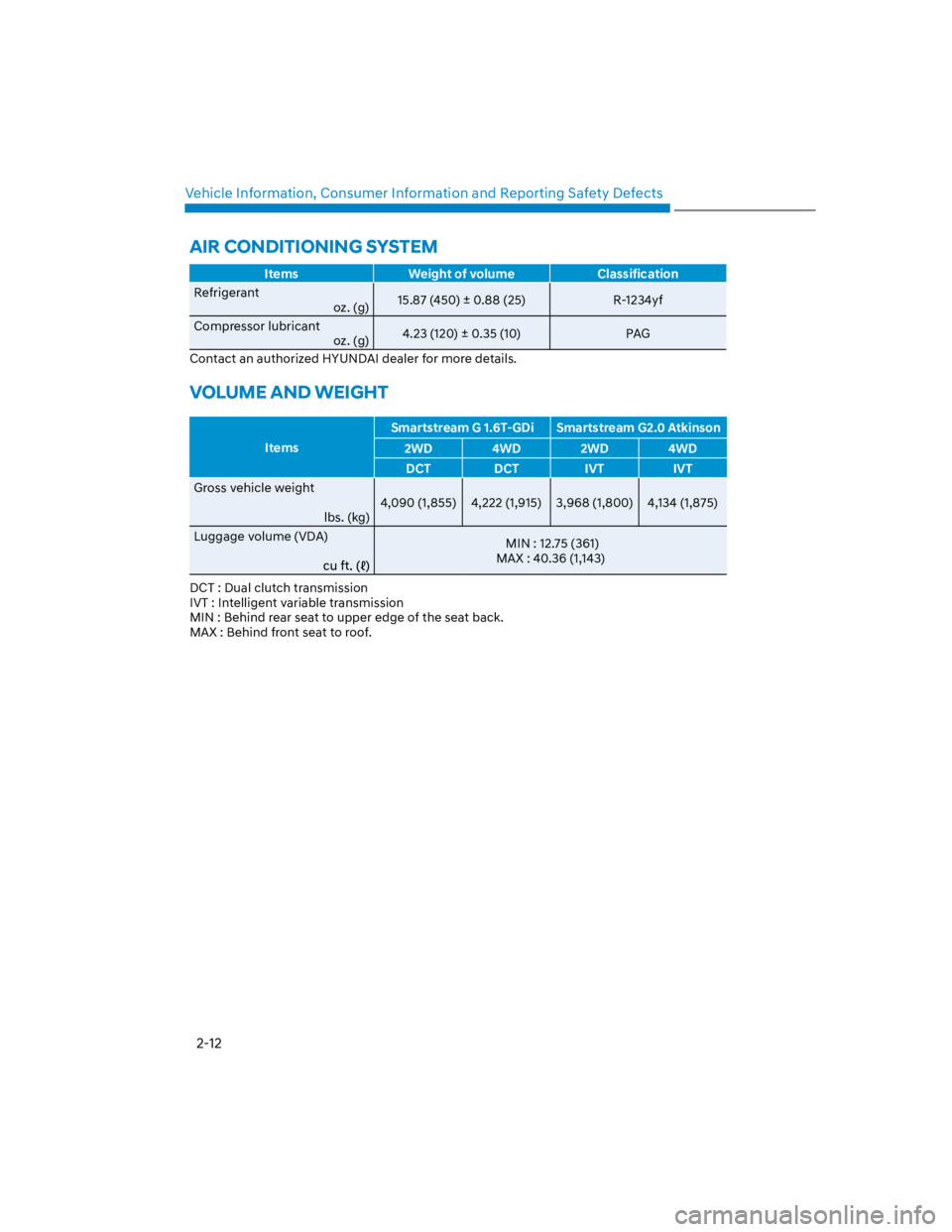
Items Weight of volume Classification
Refrigerant
oz. (g)15.87 (450) ± 0.88 (25) R-1234yf
Compressor lubricant
oz. (g)4.23 (120) ± 0.35 (10) PAG
Contact an authorized HYUNDAI dealer for more details.
VOLUME AND WEIGHT
Items
Smartstream G 1.6T-GDi Smartstream G2.0 Atkinson
2WD 4WD 2WD 4WD
DCT DCT IVT IVT
Gross vehicle weight
lbs. (kg)
4,090 (1,855) 4,222 (1,915) 3,968 (1,800) 4,134 (1,875)
Luggage volume (VDA) MIN : 12.75 (361)
MAX : 40.36 (1,143)
DCT : Dual clutch transmission
IVT : Intelligent variable transmission
MIN : Behind rear seat to upper edge of the seat back.
MAX : Behind front seat to roof.
AIR CONDITIONING SYSTEM
Page 27 of 579
Vehicle Information, Consumer Information and Reporting Safety Defects
2-14
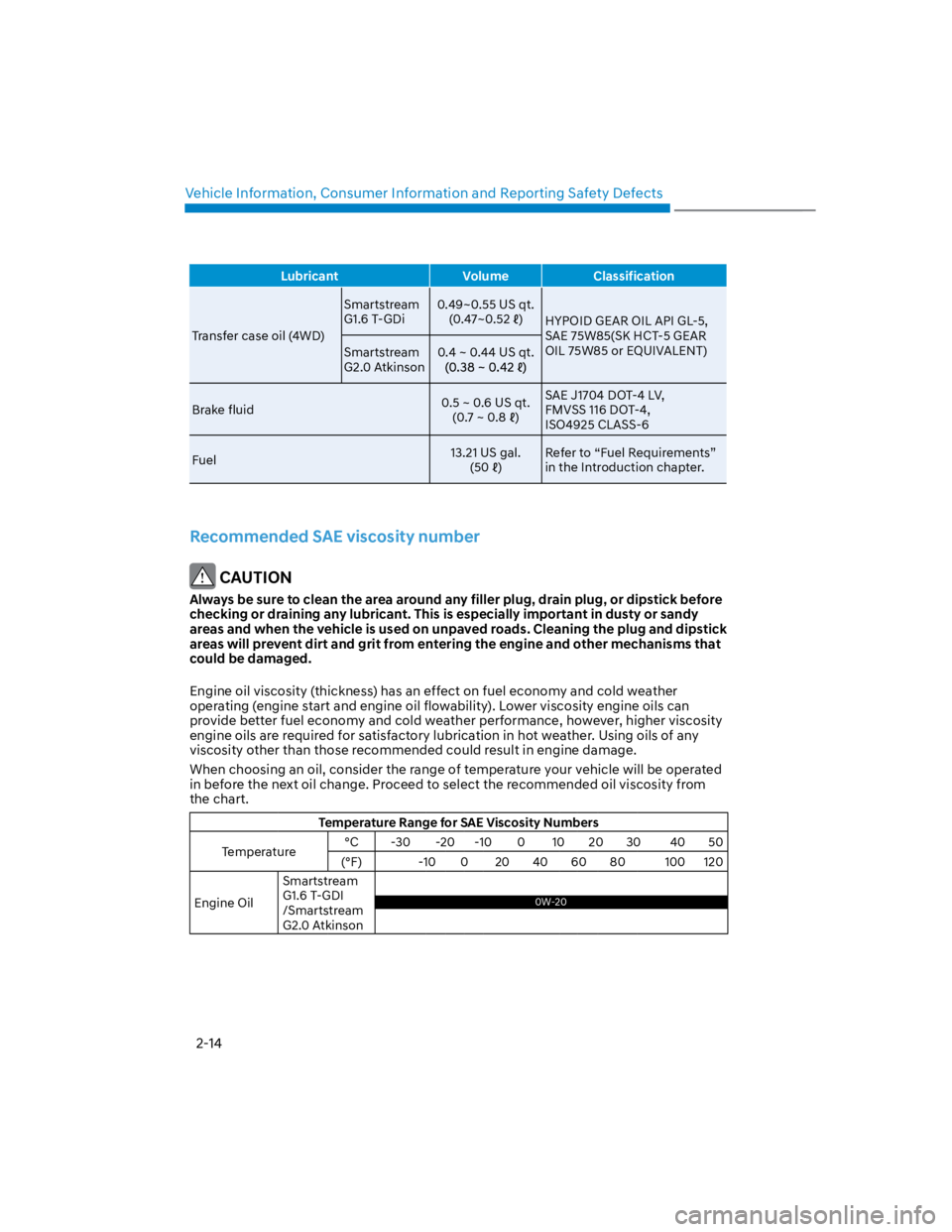
Lubricant Volume Classification
Transfer case oil (4WD)
Smartstream
G1.6 T-GDi
0.49~0.55 US qt.
(0.47~0.52 )HYPOID GEAR OIL API GL-5,
SAE 75W85(SK HCT-5 GEAR
OIL 75W85 or EQUIVALENT)Smartstream
G2.0 Atkinson
0.4 ~ 0.44 US qt.
Brake fluid0.5 ~ 0.6 US qt.
(0.7 ~ 0.8 )
SAE J1704 DOT-4 LV,
FMVSS 116 DOT-4,
ISO4925 CLASS-6
Fuel13.21 US gal.
(50 )
Refer to “Fuel Requirements”
in the Introduction chapter.
Recommended SAE viscosity number
CAUTION
Always be sure to clean the area around any filler plug, drain plug, or dipstick before
checking or draining any lubricant. This is especially important in dusty or sandy
areas and when the vehicle is used on unpaved roads. Cleaning the plug and dipstick
areas will prevent dirt and grit from entering the engine and other mechanisms that
could be damaged.
Engine oil viscosity (thickness) has an effect on fuel economy and cold weather
operating (engine start and engine oil flowability). Lower viscosity engine oils can
provide better fuel economy and cold weather performance, however, higher viscosity
engine oils are required for satisfactory lubrication in hot weather. Using oils of any
viscosity other than those recommended could result in engine damage.
When choosing an oil, consider the range of temperature your vehicle will be operated
in before the next oil change. Proceed to select the recommended oil viscosity from
the chart.
Temperature Range for SAE Viscosity Numbers
Temperature°C -30 -20 -10 0 10 20 30 40 50
(°F) -10 0 20 40 60 80 100 120
Engine Oil
Smartstream
G1.6 T-GDI
/Smartstream
G2.0 Atkinson
0W-200W-20
Page 29 of 579
Vehicle Information, Consumer Information and Reporting Safety Defects
2-16
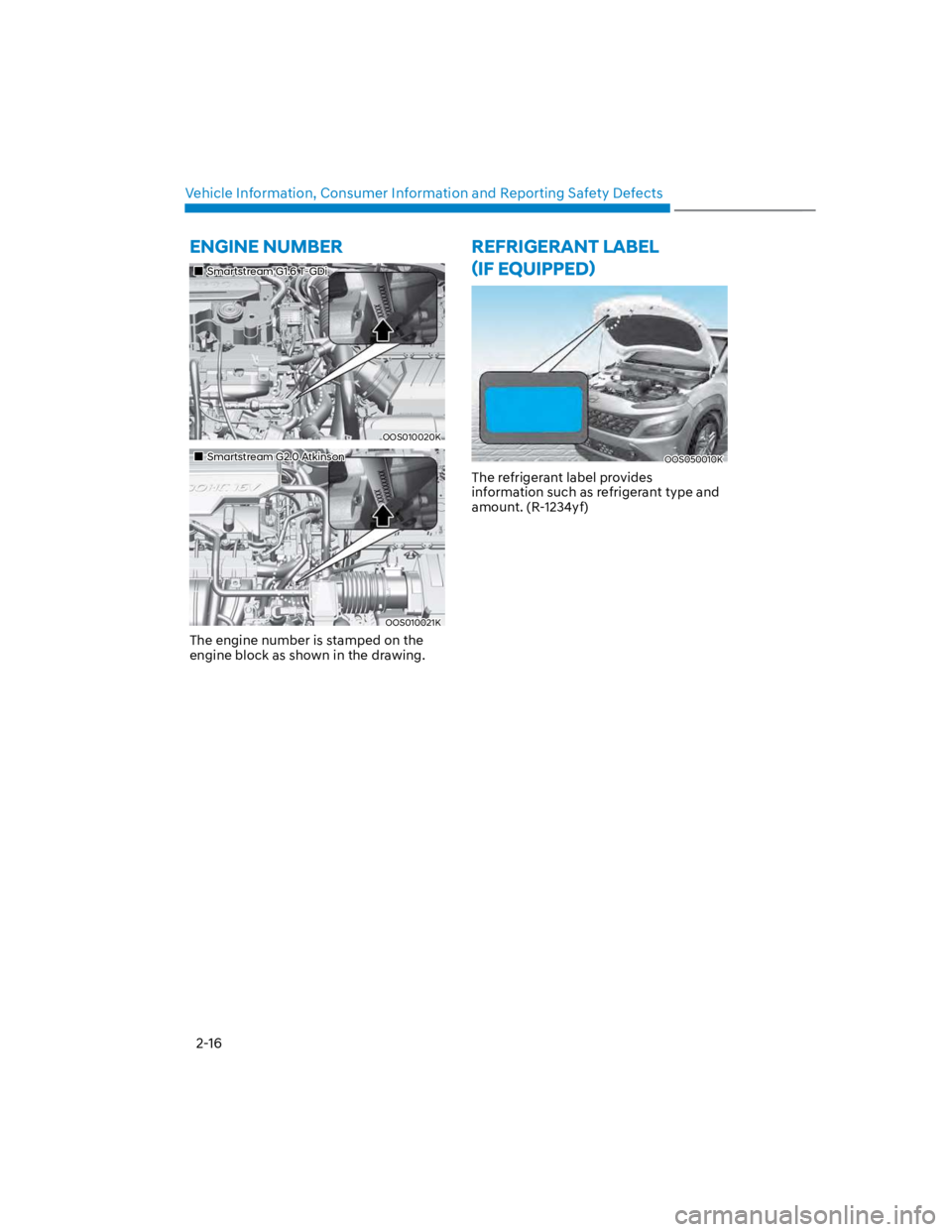
ENGINE NUMBER
Smartstream G1.6 T-GDi
OOS010020K
Smartstream G2.0 Atkinson
OOS010021K
The engine number is stamped on the
engine block as shown in the drawing.
REFRIGERANT LABEL
OOS050010K
The refrigerant label provides
information such as refrigerant type and
amount. (R-1234yf)
Page 30 of 579

02
2-17
This consumer information has been prepared in accordance with regulations issued
by the National Highway Traffic Safety Administration of the U.S. Department of
Transportation.Your HYUNDAI dealer will help answer any questions you may have as
you read this information.
HYUNDAI motor vehicles are designed and manufactured to meet or exceed all
applicable safety standards.
For your safety, however, we strongly urge you to read and follow all directions in
this Owner’s Manual, particularly the information under the headings “NOTICE”,
“CAUTION” and “WARNING”.
If, after reading this manual, you have any questions regarding the operation of your
vehicle, please contact the Hyundai Customer Care Center.
Hyundai Customer Care
P.O. Box 20850
Fountain Valley, CA 92728
800-633-5151
[email protected]
Hyundai’s Customer Care representatives are available Monday through Friday,
between the hours of 6:00 AM and 5:00 PM PST
and Saturday between 6:30 AM and 3:00 PM PST (English).
For Customer Care assistance in Spanish or Korean, representatives are available
Monday through Friday between 6:30 AM and 3:00 PM PST.
CONSUMER INFORMATION
Page 31 of 579

Vehicle Information, Consumer Information and Reporting Safety Defects
2-18
If you believe that your vehicle has a defect which could cause a crash or
could cause injury or death, you should immediately inform the National
Highway Traffic Safety Administration (NHTSA) in addition to notifying
HYUNDAI MOTOR AMERICA.
To contact NHTSA, you may call the Vehicle Safety Hotline toll-free at 1-888-
327-4236 (TTY: 1-800-424-9153);
go to http://www.safercar.gov;
download the SaferCar mobile application;
or write to: Administrator, NHTSA
1200 New Jersey Ave, SE,
West Building Washington, D.C. 20590.
You can also obtain other information about motor vehicle safety from
http://www.safercar.gov.
If NHTSA receives similar complaints, it may open an investigation, and if it
finds that a safety defect exists in a group of vehicles, it may order a recall and
remedy campaign. However, NHTSA cannot become involved in individual
problems between you, your dealer, or HYUNDAI MOTOR AMERICA.
REPORTING SAFETY DEFECTS
Page 32 of 579
3
3. Seats & Safety System
Important safety precautions ...........................................................................3-2
Always wear your seat belt .......................................................................................... 3-2
Restrain all children ...................................................................................................... 3-2
Air bag hazards ............................................................................................................. 3-2
Driver distraction .......................................................................................................... 3-2
Control your speed ....................................................................................................... 3-2
Keep your vehicle in safe condition ............................................................................ 3-2
Seats .................................................................................................................. 3-3
Safety precautions .......................................................................................................3-4
Front seats ....................................................................................................................3-5
Rear Seats ................................................................................................................... 3-10
Head Restraints ...........................................................................................................3-13
Seat Warmers and Air Ventilation Seats ....................................................................3-17
Seat belts ......................................................................................................... 3-20
Seat belt safety precautions ......................................................................................3-20
Seat belt warning light ................................................................................................3-21
Seat belt restraint system .......................................................................................... 3-22
Additional seat belt safety precautions .................................................................... 3-27
Care of seat belts........................................................................................................ 3-29
Child Restraint System (CRS) ......................................................................... 3-30
Children Always in the Rear .......................................................................................3-30
Selecting a Child Restraint System (CRS) ..................................................................3-31
Installing a Child Restraint System (CRS) ................................................................. 3-33
Air bag - supplemental restraint system ........................................................ 3-41
Where are the air bags? .............................................................................................3-43
How does the air bags system operate? .................................................................. 3-46
What to expect after an air bag inflates .................................................................. 3-49
Occupant Classification System (OCS) .................................................................... 3-50
Why didn’t my air bag go off in a collision? ..............................................................3-56
SRS care ...................................................................................................................... 3-61
Additional safety precautions....................................................................................3-62
Air bag warning labels................................................................................................3-62
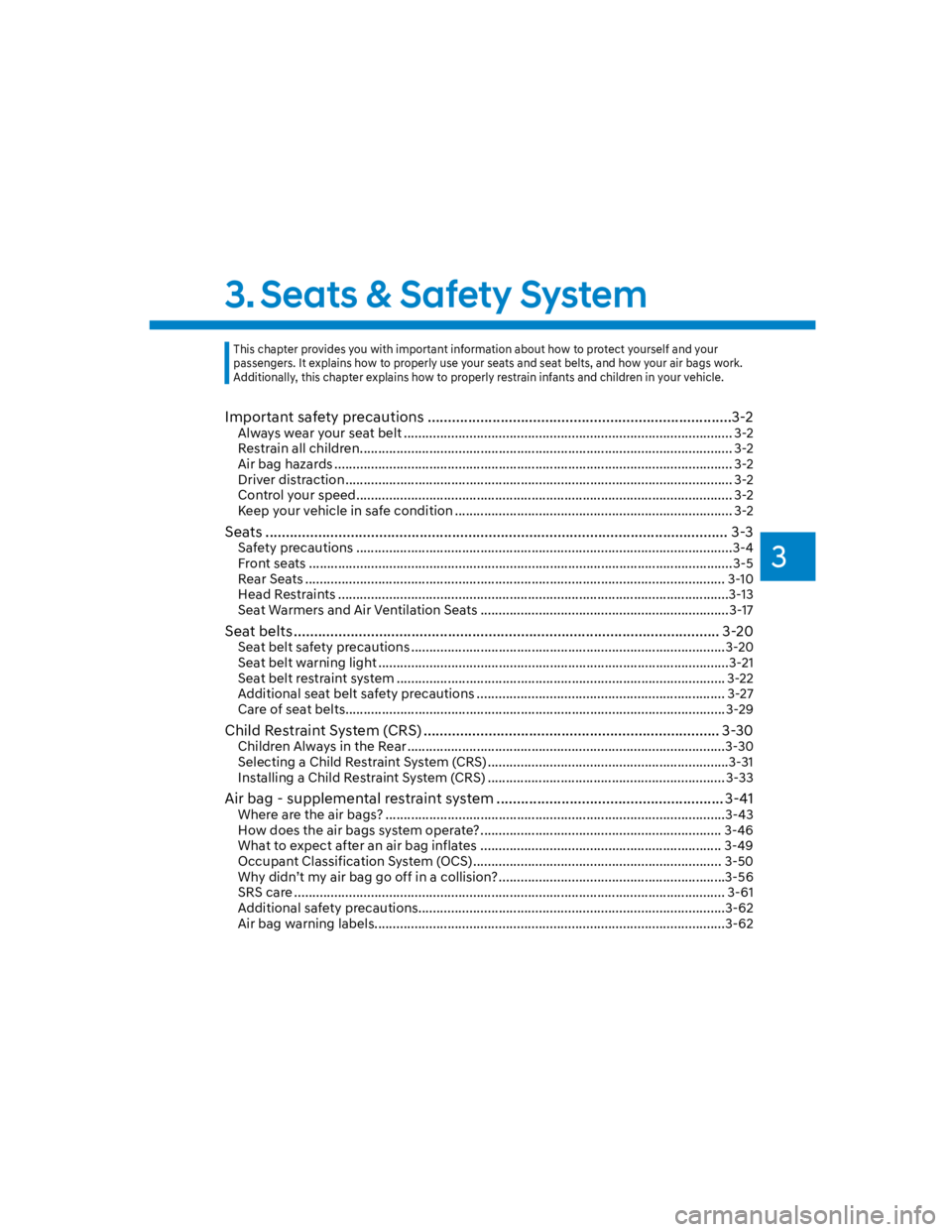
This chapter provides you with important information about how to protect yourself and your
passengers. It explains how to properly use your seats and seat belts, and how your air bags work.
Additionally, this chapter explains how to properly restrain infants and children in your vehicle.
Page 34 of 579
3-3
03
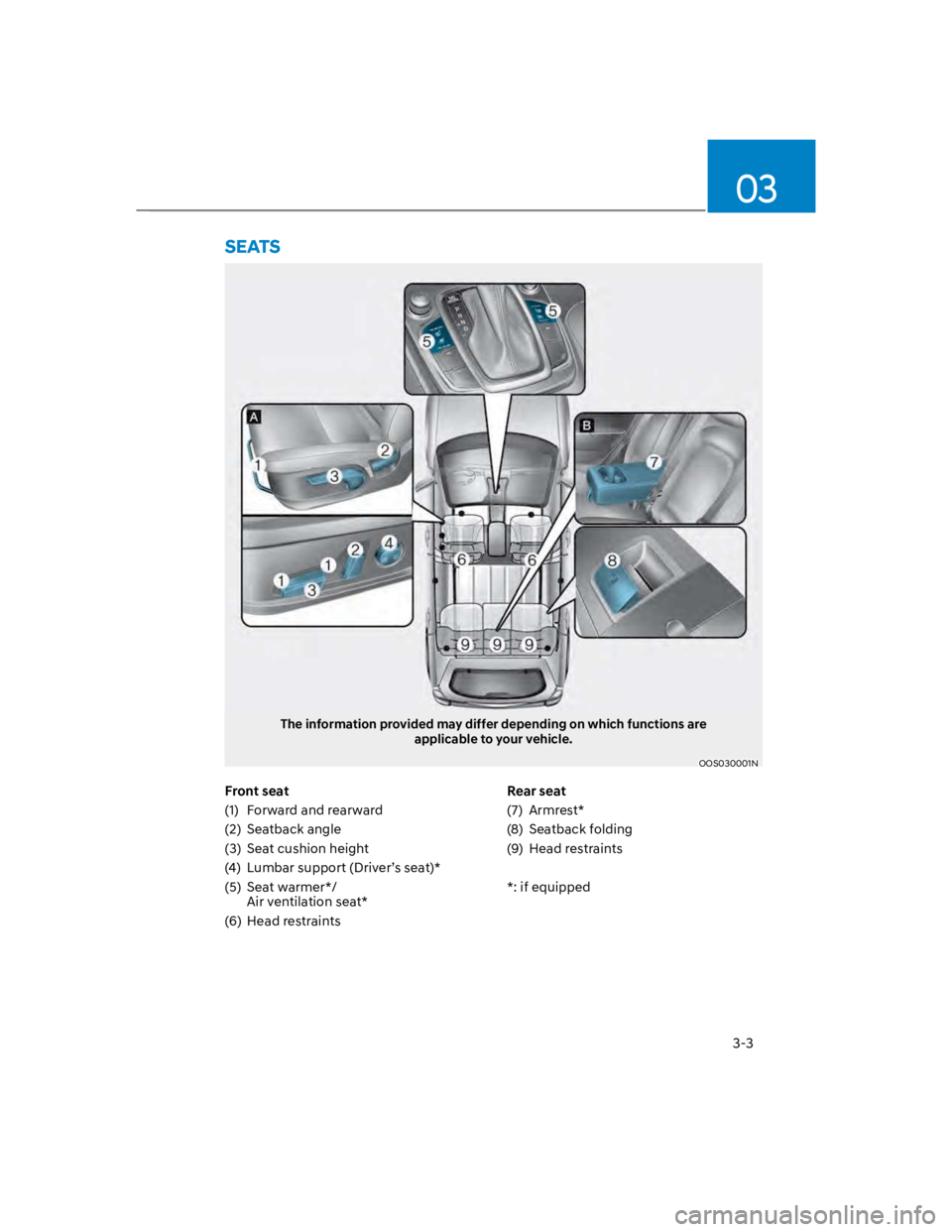
Front seat
(1) Forward and rearward
(2) Seatback angle
(3) Seat cushion height
(4) Lumbar support (Driver’s seat)*
(5) Seat warmer*/
Air ventilation seat*
(6) Head restraints
Rear seat
(7) Armrest*
(8) Seatback folding
(9) Head restraints
*: if equipped
SEATS
The information provided may differ depending on which functions are
applicable to your vehicle.
OOS030001N
Page 49 of 579
Seats & Safety System
3-18
Information
With the seat warmer switch in the ON
position, the heating system in the seat
turns off or on automatically depending on
the seat temperature.
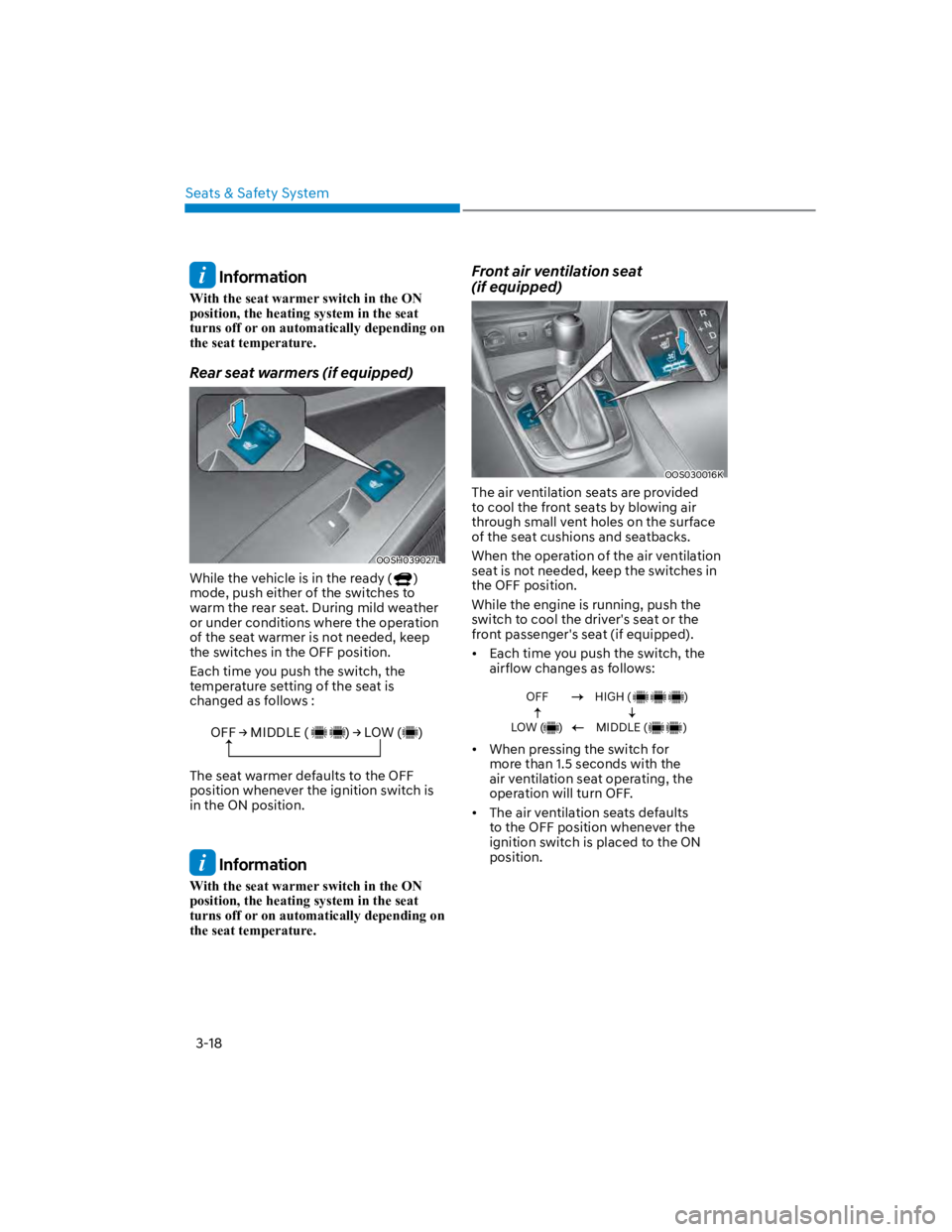
Rear seat warmers (if equipped)
OOSH039027L
While the vehicle is in the ready ()
mode, push either of the switches to
warm the rear seat. During mild weather
or under conditions where the operation
of the seat warmer is not needed, keep
the switches in the OFF position.
Each time you push the switch, the
temperature setting of the seat is
changed as follows :
OFF MIDDLE ( ) LOW ( )
The seat warmer defaults to the OFF
position whenever the ignition switch is
in the ON position.
Information
With the seat warmer switch in the ON
position, the heating system in the seat
turns off or on automatically depending on
the seat temperature.
Front air ventilation seat
(if equipped)
OOS030016K
The air ventilation seats are provided
to cool the front seats by blowing air
through small vent holes on the surface
of the seat cushions and seatbacks.
When the operation of the air ventilation
seat is not needed, keep the switches in
the OFF position.
While the engine is running, push the
switch to cool the driver's seat or the
front passenger's seat (if equipped).
Each time you push the switch, the
airflow changes as follows:
OFF
LOW ( )
HIGH ( )
MIDDLE ( )
When pressing the switch for
more than 1.5 seconds with the
air ventilation seat operating, the
operation will turn OFF.
The air ventilation seats defaults
to the OFF position whenever the
ignition switch is placed to the ON
position.