Page 480 of 579
Emergency situations
8-30
OIGH067043
OOS080015N
11.
After driving approximately 4~6 miles
(7~10 km or about 10 minutes), stop at
a safe location.
12.
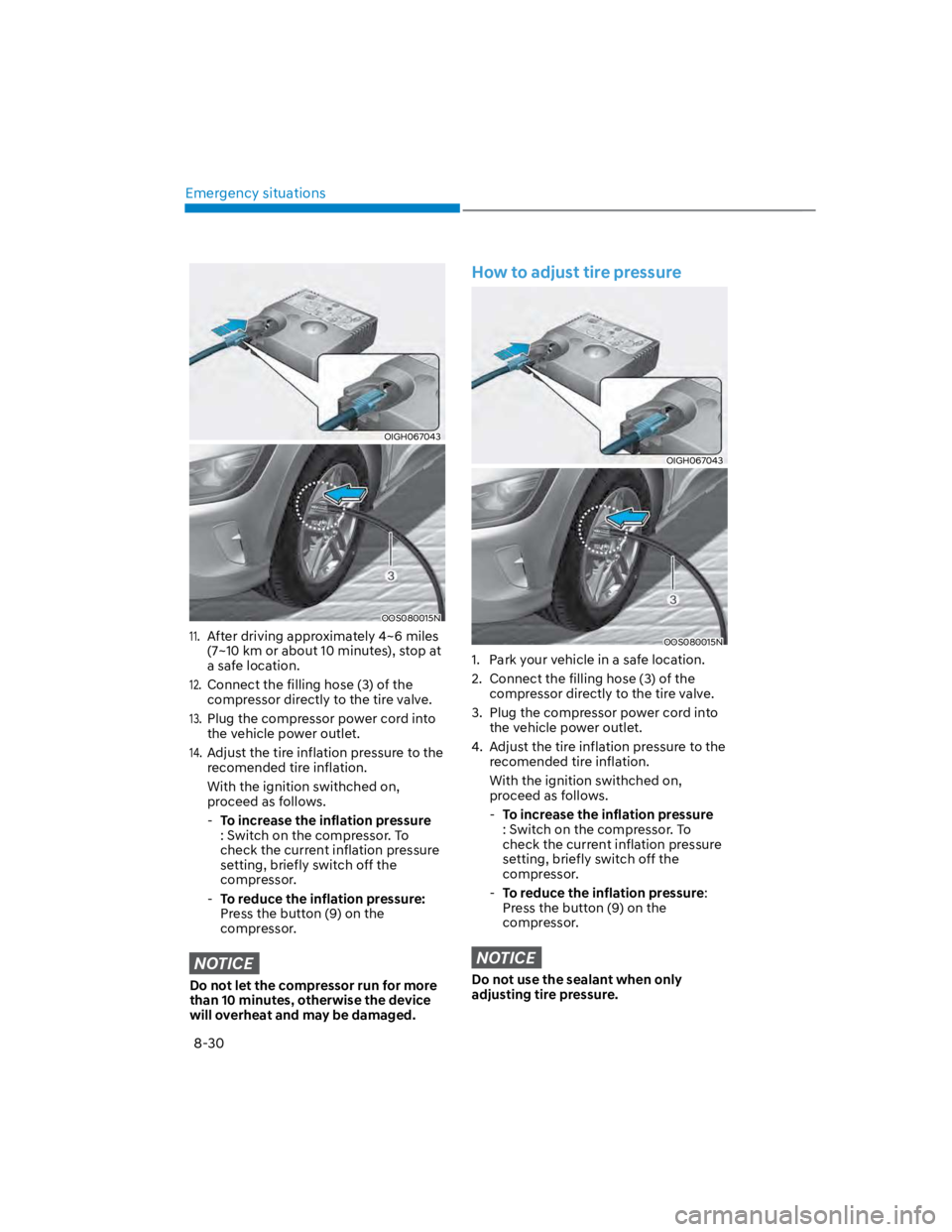
Connect the filling hose (3) of the
compressor directly to the tire valve.
13.
Plug the compressor power cord into
the vehicle power outlet.
14.
Adjust the tire inflation pressure to the
recomended tire inflation.
With the ignition swithched on,
proceed as follows.
-To increase the inflation pressure
: Switch on the compressor. To
check the current inflation pressure
setting, briefly switch off the
compressor.
-To reduce the inflation pressure:
Press the button (9) on the
compressor.
NOTICE
Do not let the compressor run for more
than 10 minutes, otherwise the device
will overheat and may be damaged.
How to adjust tire pressure
OIGH067043
OOS080015N
1. Park your vehicle in a safe location.
2. Connect the filling hose (3) of the
compressor directly to the tire valve.
3. Plug the compressor power cord into
the vehicle power outlet.
4. Adjust the tire inflation pressure to the
recomended tire inflation.
With the ignition swithched on,
proceed as follows.
-To increase the inflation pressure
: Switch on the compressor. To
check the current inflation pressure
setting, briefly switch off the
compressor.
-To reduce the inflation pressure:
Press the button (9) on the
compressor.
NOTICE
Do not use the sealant when only
adjusting tire pressure.
Page 494 of 579
Maintenance
9-8
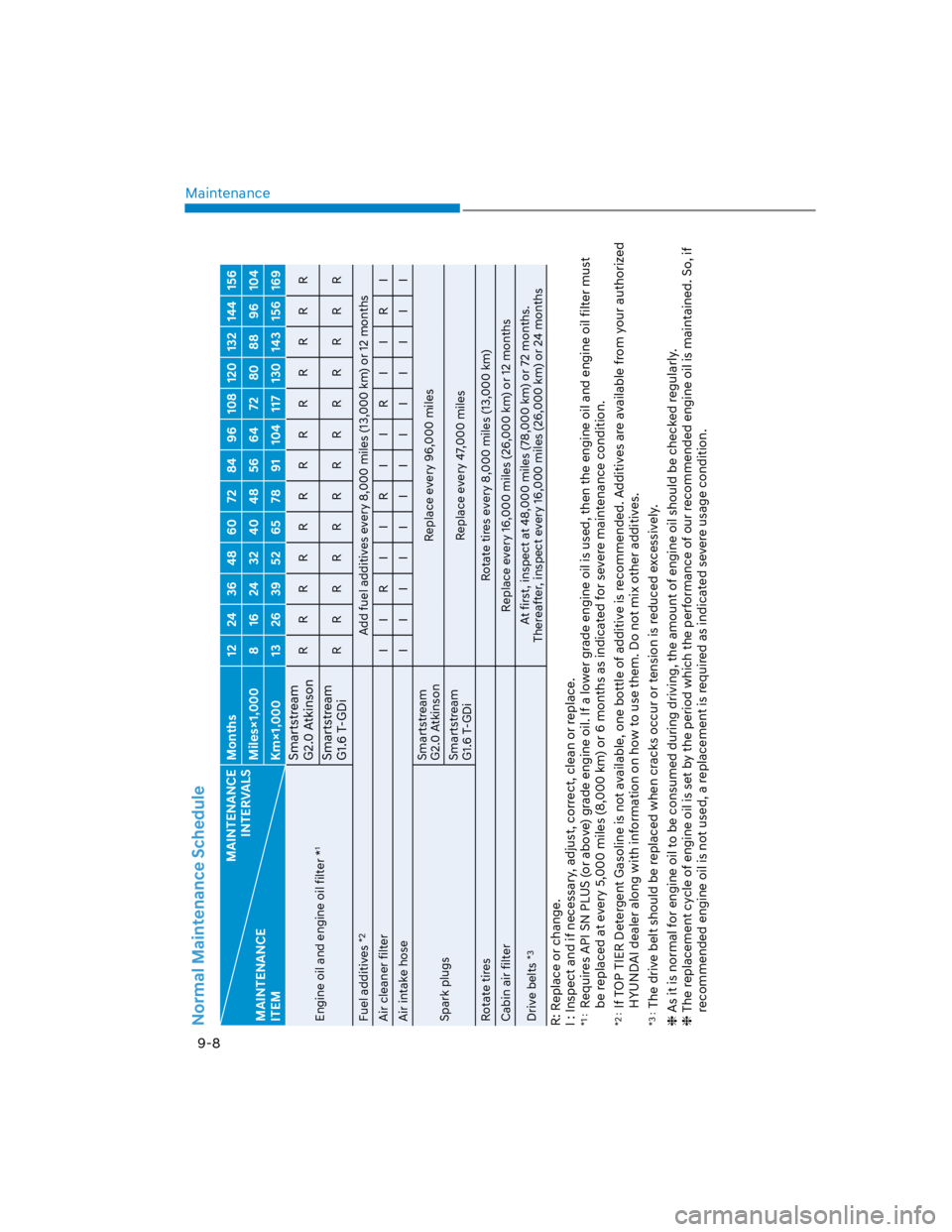
Normal Maintenance Schedule
MAINTENANCE
INTERVALS
MAINTENANCE
ITEM
Months 12 24 36 48 60 72 84 96 108 120 132 144 156
Miles×1,000 8 16 24 32 40 48 56 64 72 80 88 96 104
Km×1,000 13 26 39 52 65 78 91 104 117 130 143 156 169
Engine oil and engine oil filter *
1
Smartstream
G2.0 Atkinson
R R R R R R R R R R R R R
Smartstream
G1.6 T-GDi
R R R R R R R R R R R R R
Fuel additives
*2
Add fuel additives every 8,000 miles (13,000 km) or 12 months
Air cleaner filter I I R I I R I I R I I R I
Air intake hose I I I I I I I I I I I I I
Spark plugs
Smartstream
G2.0 Atkinson
Replace every 96,000 miles
Smartstream
G1.6 T-GDi
Replace every 47,000 miles
Rotate tires Rotate tires every 8,000 miles (13,000 km)
Cabin air filter Replace every 16,000 miles (26,000 km) or 12 months
Drive belts
*3
At first, inspect at 48,000 miles (78,000 km) or 72 months.
Thereafter, inspect every 16,000 miles (26,000 km) or 24 months
R: Replace or change.
I : Inspect and if necessary, adjust, correct, clean or replace.
*1 :
Requires API SN PLUS (or above) grade engine oil. If a lower grade engine oil is used, then the engine oil and engine oil filter must
be replaced at every 5,000 miles (8,000 km) or 6 months as indicated for severe maintenance condition.
*2 :
If TOP TIER Detergent Gasoline is not available, one bottle of additive is recommended. Additives are available from your authorized
HYUNDAI dealer along with information on how to use them. Do not mix other additives.
*3 :
The drive belt should be replaced when cracks occur or tension is reduced excessively.
As it is normal for engine oil to be consumed during driving, the amount of engine oil should be checked regularly.
The replacement cycle of engine oil is set by the period which the performance of our recommended engine oil is maintained. So, if
recommended engine oil is not used, a replacement is required as indicated severe usage condition.
Page 497 of 579
09
9-11
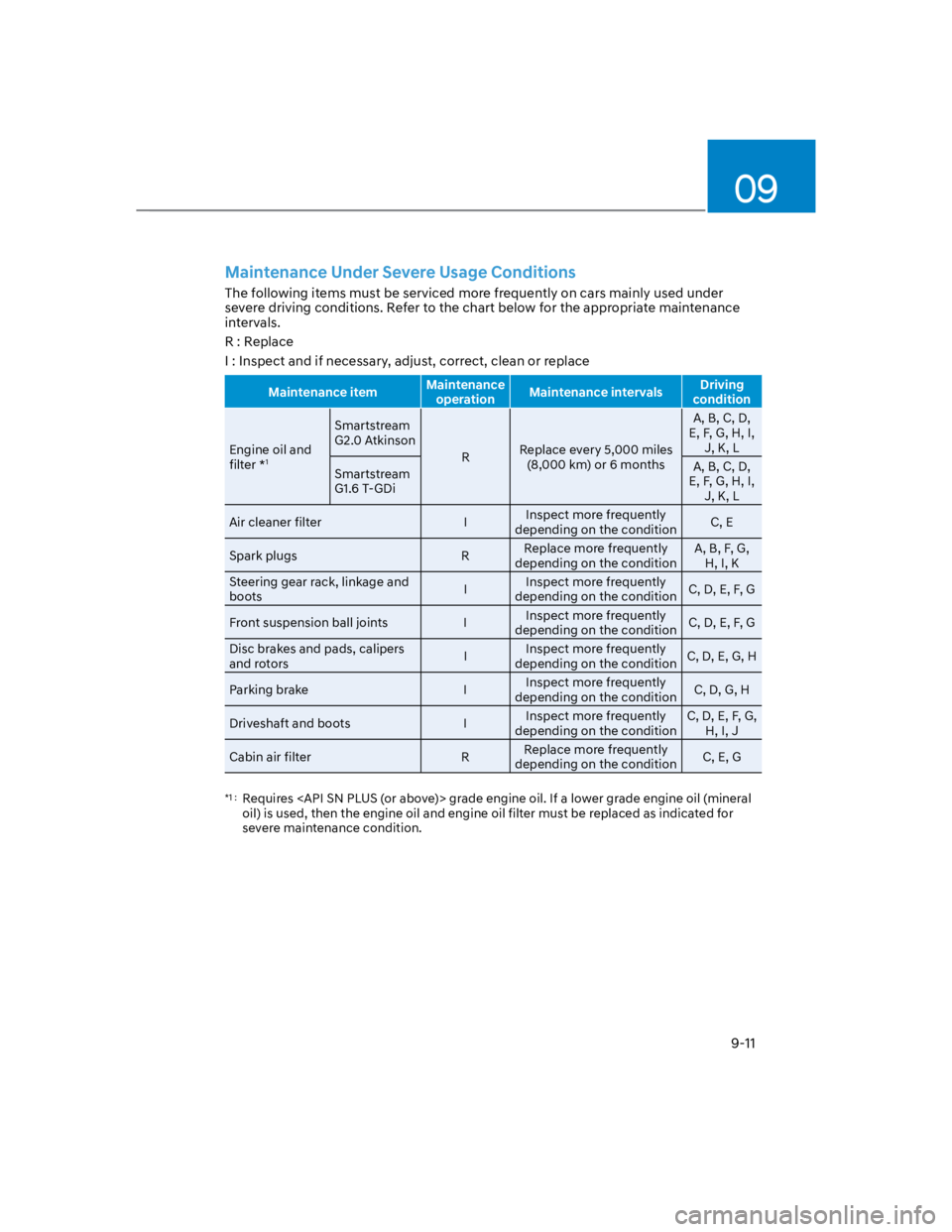
Maintenance Under Severe Usage Conditions
The following items must be serviced more frequently on cars mainly used under
severe driving conditions. Refer to the chart below for the appropriate maintenance
intervals.
R : Replace
I : Inspect and if necessary, adjust, correct, clean or replace
Maintenance itemMaintenance
operationMaintenance intervalsDriving
condition
Engine oil and
filter *1
Smartstream
G2.0 Atkinson
RReplace every 5,000 miles
(8,000 km) or 6 months
A, B, C, D,
E, F, G, H, I,
J, K, L
Smartstream
G1.6 T-GDi
A, B, C, D,
E, F, G, H, I,
J, K, L
Air cleaner filter IInspect more frequently
depending on the conditionC, E
Spark plugs RReplace more frequently
depending on the condition
A, B, F, G,
H, I, K
Steering gear rack, linkage and
bootsIInspect more frequently
depending on the conditionC, D, E, F, G
Front suspension ball joints IInspect more frequently
depending on the conditionC, D, E, F, G
Disc brakes and pads, calipers
and rotorsIInspect more frequently
depending on the conditionC, D, E, G, H
Parking brake IInspect more frequently
depending on the conditionC, D, G, H
Driveshaft and boots IInspect more frequently
depending on the condition
C, D, E, F, G,
H, I, J
Cabin air filter RReplace more frequently
depending on the conditionC, E, G
*1 : Requires grade engine oil. If a lower grade engine oil (mineral
oil) is used, then the engine oil and engine oil filter must be replaced as indicated for
severe maintenance condition.
Page 499 of 579
09
9-13
Engine oil and filter
The engine oil and filter should be
changed at the intervals specified in the
maintenance schedule. If the vehicle
is being driven in severe conditions,
more frequent oil and filter changes are
required.
Drive belts
Inspect all drive belts for evidence
of cuts, cracks, excessive wear or oil
saturation and replace if necessary.
Drive belts should be checked
periodically for proper tension and
adjusted as necessary.
Information
Fuel lines, fuel hoses and
connections
Check the fuel lines, fuel hoses and
connections for leakage and damage.
We recommend an authorized HYUNDAI
dealer replace any damaged or leaking
parts immediately.
Fuel filter (for gasoline engine)
The fuel filter is considered to be
maintenance free but periodic inspection
is recommended for this maintenance
depends on fuel quality. If there are
some important matters like fuel flow
restriction, surging, loss of power, hard
starting problem etc., replace the fuel
filter immediately. Consult an authorized
HYUNDAI dealer for details.
Vapor hose and fuel filler cap
The vapor hose and fuel filler cap should
be inspected at those intervals specified
in the maintenance schedule. Make sure
a new vapor hose or fuel filler cap is
correctly replaced.
Vacuum crankcase ventilation
hoses (if equipped)
Inspect the surface of hoses for evidence
of heat and/or mechanical damage.
Hard and brittle rubber, cracking,
tears, cuts, abrasions, and excessive
swelling indicate deterioration. Particular
attention should be paid to examine
those hose surfaces nearest to high heat
sources, such as the exhaust manifold.
Inspect the hose routing to ensure that
the hoses do not come in contact with
any heat source, sharp edges or moving
component which might cause heat
damage or mechanical wear. Inspect
all hose connections, such as clamps
and couplings, to make sure they are
secure, and that no leaks are present.
Hoses should be replaced immediately if
there is any evidence of deterioration or
damage.
Air cleaner filter
We recommend that the air cleaner filter
be replaced by an authorized HYUNDAI
dealer.
Spark plugs
Make sure to install new spark plugs of
the correct heat range.
When assembling parts, be sure to
wipe the inside and outside of the boot
bottom of the ignition coil and the
insulator of the spark plug with a soft
cloth to prevent contamination of the
spark plug insulator.
EXPLANATION OF SCHEDULED MAINTENANCE ITEMS
Page 504 of 579
Maintenance
9-18
The high-pressure cooling system has a
reservoir filled with year-round antifreeze
coolant. The reservoir is filled at the
factory.
Check the antifreeze protection and
coolant level at least once a year, at
the beginning of the winter season and
before traveling to a colder climate.
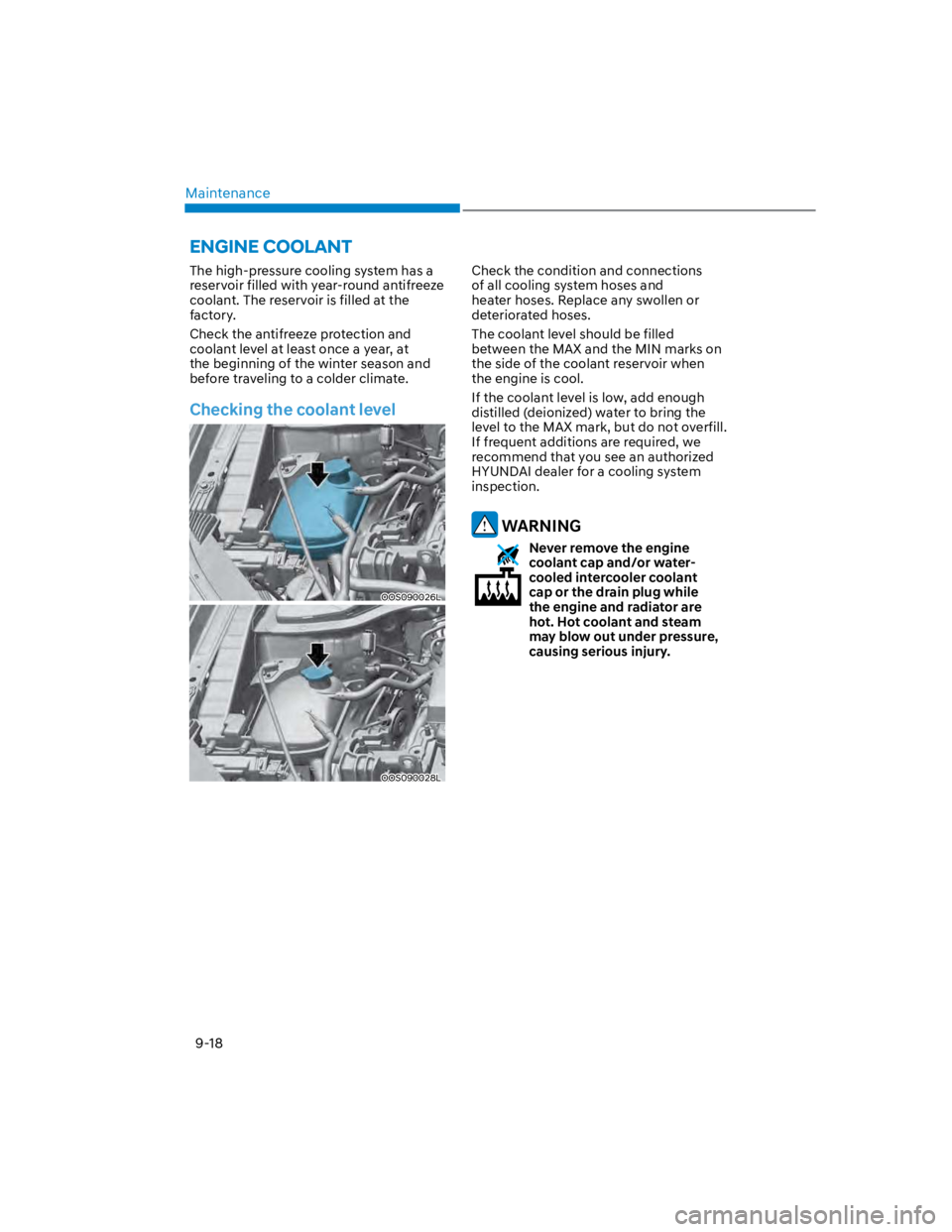
Checking the coolant level
OOS090026L
OOS090028L
Check the condition and connections
of all cooling system hoses and
heater hoses. Replace any swollen or
deteriorated hoses.
The coolant level should be filled
between the MAX and the MIN marks on
the side of the coolant reservoir when
the engine is cool.
If the coolant level is low, add enough
distilled (deionized) water to bring the
level to the MAX mark, but do not overfill.
If frequent additions are required, we
recommend that you see an authorized
HYUNDAI dealer for a cooling system
inspection.
WARNING
Never remove the engine
coolant cap and/or water-
cooled intercooler coolant
cap or the drain plug while
the engine and radiator are
hot. Hot coolant and steam
may blow out under pressure,
causing serious injury.
ENGINE COOLANT