2022 HYUNDAI I30 Lte
[x] Cancel search: LtePage 327 of 659
5-23
Driving your vehicle
5
To reduce the risk of SERIOUS
INJURY or DEATH:
ALWAYS wear your seatbelt.
In a collision, an unbelted
occupant is significantly more
likely to be seriously injured
or killed than a properly belt-
ed occupant.
Avoid high speeds when cor-
nering or turning.
Do not make quick steering
wheel movements, such as
sharp lane changes or fast,
sharp turns.
The risk of rollover is greatly
increased if you lose control
of your vehicle at highway
speeds.
Loss of control often occurs if
two or more wheels drop off
the roadway and the driver
over steers to reenter the
roadway.(Continued)
WARNING (Continued)
In the event your vehicle
leaves the roadway, do not
steer sharply. Instead, slow
down before pulling back into
the travel lanes.
HYUNDAI recommends you
follow all posted speed limits.
Page 334 of 659
5-30
Driving your vehicle
Information - Kickdown
Mechanism (if equipped)
Use the kickdown mechanism for
maximum acceleration. Depress the
accelerator pedal beyond the pressure
point. The automatic transmission will
shift to a lower gear depending on the
engine speed.i
(Continued)
In the event your vehicle
leaves the roadway, do not
steer sharply. Instead, slow
down before pulling back into
the travel lanes.
HYUNDAI recommends you
follow all posted speed limits.
To reduce the risk of SERIOUS
INJURY or DEATH:
ALWAYS wear your seatbelt.
In a collision, an unbelted
occupant is significantly more
likely to be seriously injured
or killed than a properly belt-
ed occupant.
Avoid high speeds when cor-
nering or turning.
Do not make quick steering
wheel movements, such as
sharp lane changes or fast,
sharp turns.
The risk of rollover is greatly
increased if you lose control
of your vehicle at highway
speeds.
Loss of control often occurs if
two or more wheels drop off
the roadway and the driver
over steers to reenter the
roadway. (Continued)
WARNING
Page 344 of 659
5-40
Driving your vehicle
Information - Kickdown
Mechanism (if equipped)
Use the kickdown mechanism for
maximum acceleration. Depress the
accelerator pedal beyond the pressure
point. The automatic transmission will
shift to a lower gear depending on the
engine speed.i
To reduce the risk of SERIOUS
INJURY or DEATH:
ALWAYS wear your seatbelt.
In a collision, an unbelted
occupant is significantly more
likely to be seriously injured
or killed than a properly belt-
ed occupant.
Avoid high speeds when cor-
nering or turning.
Do not make quick steering
wheel movements, such as
sharp lane changes or fast,
sharp turns.
The risk of rollover is greatly
increased if you lose control
of your vehicle at highway
speeds.
Loss of control often occurs if
two or more wheels drop off
the roadway and the driver
over steers to reenter the
roadway. (Continued)
(Continued)
In the event your vehicle
leaves the roadway, do not
steer sharply. Instead, slow
down before pulling back into
the travel lanes.
HYUNDAI recommends you
follow all posted speed limits.
WARNING
Page 454 of 659
5-150
Driving your vehicle
Reducing the risk of a rollover
Your multi-purpose passenger vehi-
cle is defined as a Sports Utility
Vehicle (SUV). SUV’s have higher
ground clearance and a narrower
track to make them capable of per-
forming in a wide variety of off-road
applications. The specific design
characteristics give them a higher
center of gravity than ordinary vehi-
cles making them more likely to roll
over if you make abrupt turns. Utility
vehicles have a significantly higher
rollover rate than other types of vehi-
cles. Due to this risk, driver and pas-
sengers are strongly recommended
to buckle their seat belts. In a rollover
crash, an unbelted person is signifi-
cantly more likely to die than a per-
son wearing a seat belt.
There are steps that a driver can
make to reduce the risk of a rollover.
If at all possible, avoid sharp turns or
abrupt maneuvers, do not load your
vehicle with heavy cargo on the roof,
and never modify your vehicle in any
way.Utility vehicles have a signifi-
cantly higher rollover rate than
other types of vehicles. To pre-
vent rollovers or loss of control:
Take corners at slower speeds
than you would with a passen-
ger vehicle.
Avoid sharp turns and abrupt
maneuvers.
Do not modify your vehicle in
any way that you would raise
the center of gravity.
Keep tires properly inflated.
Do not carry heavy cargo on
the roof.
WARNING
In a rollover crash, an unbelted
person is significantly more
likely to die than a person wear-
ing a seat belt. Make sure all
passengers are wearing their
seat belts.
WARNING
Page 480 of 659
6-10
What to do in an emergency
Your vehicle has also been equipped
with a TPMS malfunction indicator to
indicate when the system is not
operating properly. The TPMS mal-
function indicator is combined with
the low tire pressure telltale. When
the system detects a malfunction,
the telltale will flash for approximate-
ly one minute and then remain con-
tinuously illuminated. This sequence
will continue upon subsequent vehi-
cle start-ups as long as the malfunc-
tion exists. When the malfunction
indicator is illuminated, the system
may not be able to detect or signal
low tire pressure as intended.
TPMS malfunctions may occur for a
variety of reasons, including the
installation of replacement or alter-
nate tires or wheels on the vehicle
that prevent the TPMS from function-
ing properly. Always check the TPMS
malfunction telltale after replacing
one or more tires or wheels on your
vehicle to ensure that the replace-
ment or alternate tires and wheels
allow the TPMS to continue to func-
tion properly. If any of the below happens, we
recommend that the system be
checked by an authorized HYUNDAI
dealer.
1. The low tire pressure telltale/
TPMS malfunction indicator
does not illuminate for 3 sec-
onds when Engine Start/Stop
button is turned to the ON or
engine is running.
2. The TPMS malfunction indicator remains illuminated after blink-
ing for approximately 1 minute.
3. The Low tire pressure position telltale remains illuminated.
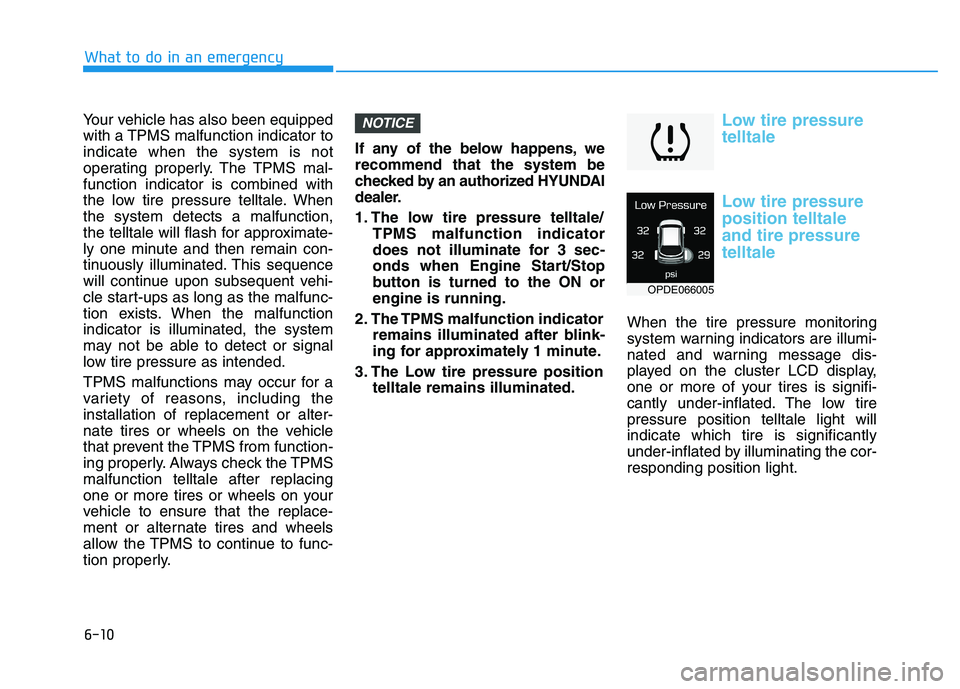
Low tire pressure
telltale
Low tire pressure
position telltale
and tire pressure
telltale
When the tire pressure monitoring
system warning indicators are illumi-
nated and warning message dis-
played on the cluster LCD display,
one or more of your tires is signifi-
cantly under-inflated. The low tire
pressure position telltale light will
indicate which tire is significantly
under-inflated by illuminating the cor-
responding position light.
NOTICE
OPDE066005
Page 514 of 659
7
Maintenance
7
Maintenance
Engine compartment .............................................7-3
Maintenance services ...........................................7-6
Owner's responsibility ......................................................7-6
Owner maintenance precautions ..................................7-6
Owner maintenance ...............................................7-7
Owner maintenance schedule ........................................7-8
Scheduled maintenance services ......................7-10
Normal Maintenance Schedule
(Gasoline Engine, for Europe)......................................7-11
Maintenance Under Severe Usage and
Low Mileage Conditions
(Gasoline Engine, for Europe)......................................7-14
Normal Maintenance Schedule
(Gasoline Engine, except Europe) ...............................7-16
Maintenance Under Severe Usage and
Low Mileage Conditions
(Gasoline Engine, except Europe) ...............................7-20
Normal Maintenance Schedule
(Diesel Engine, for Europe) ..........................................7-22
Maintenance Under Severe Usage and
Low Mileage Conditions
(Diesel Engine, for Europe) ..........................................7-25
Normal Maintenance Schedule
(Diesel Engine, except Europe)....................................7-27
Maintenance Under Severe Usage and
Low Mileage Conditions
(Diesel Engine, except Europe)....................................7-30
Explanation of scheduled maintenance items .7-32
Engine oil ..............................................................7-35
Checking the engine oil level .......................................7-35
Checking the engine oil and filter ..............................7-36
Engine coolant......................................................7-37
Checking the engine coolant level..............................7-37
Changing the engine coolant .......................................7-39
Brake/clutch fluid ................................................7-40
Checking the brake/clutch fluid level ........................7-40
Washer fluid .........................................................7-41
Checking the washer fluid level ..................................7-41
Parking brake .......................................................7-41
Checking the parking brake .........................................7-41
Fuel Filter (For Diesel)........................................7-42
Draining water from fuel filter ....................................7-42
Fuel filter cartridge replacement ................................7-42
Air cleaner ............................................................7-42
Filter replacement ...........................................................7-42
Climate control air filter .....................................7-44
Filter inspection ...............................................................7-44
Filter replacement ...........................................................7-44
Wiper blades .........................................................7-45
Blade inspection ..............................................................7-45
Blade replacement ..........................................................7-46
7
Page 524 of 659

7-11
7
Maintenance
I : Inspect and if necessary, adjust, correct, clean or replace.
R : Replace or change.
** : The engine oil level should be checked regularly and maintained properly. Operating with an insufficient amount of oil can dam-
age the engine, and such damage is not covered by warranty.
*
1: Inspect drive belt tensioner, idler and alternator pulley and if necessary correct or replace.
*2: Check the engine oil level and leak every 500 km (350 miles) or before starting a long trip.
*3: If good quality gasolines meet Europe Fuel standards (EN228) or equivalents including fuel additives is not available, one bot -
tle of additive is recommended. Additives are available from your authorized HYUNDAI dealer along with information on how to
use them. Do not mix other additives.
*
4: For your convenience, it can be replaced prior to it's interval when you do maintenance of other items.
Normal Maintenance Schedule (Gasoline Engine, for Europe)
Months24487296120144168192
Miles x 1,00020406080100120140160
Km x 1,000306090120150180210240
Drive belts *1At first, inspect at 90,000 km (60,000 miles) or 72 months, after that, every 30,000 km (20,000 miles) or 24 months
Engine oil and
engine oil filter ** *2
1.0 T-GDI Replace every 15,000 km (10,000 miles) or 12 months
1.4 T-GDI Replace every 15,000 km (10,000 miles) or 12 months
MPI Replace every 30,000 km (20,000 miles) or 12 months
Fuel additives *3Add every 15,000 km (10,000 miles) or 12 months
Intercooler, in/out hose,
air intake hose T-GDIInspect every 15,000 km (10,000 miles)
Air cleaner filterIRIRIRIR
Spark plugsT-GDIReplace every 75,000 km (50,000 miles) *4or 60 months
MPIReplace every 160,000 km (100,000 miles) *4or 120 months
MAINTENANCE INTERVALS
MAINTENANCE
ITEM
Page 525 of 659
Maintenance
7-12
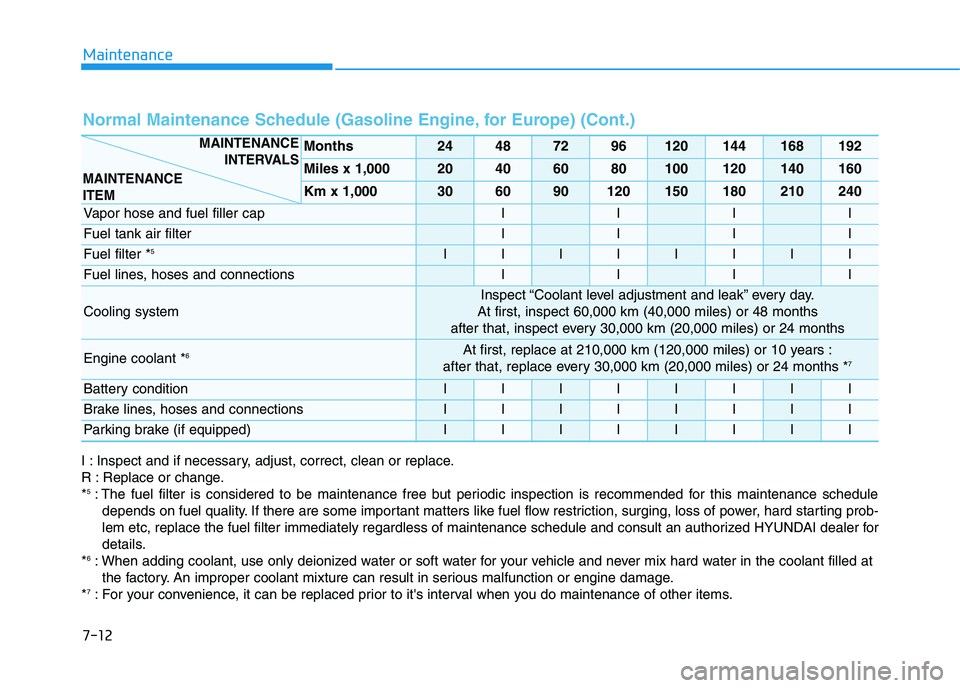
Normal Maintenance Schedule (Gasoline Engine, for Europe) (Cont.)
Months24487296120144168192
Miles x 1,00020406080100120140160
Km x 1,000306090120150180210240
Vapor hose and fuel filler capIIII
Fuel tank air filterIIII
Fuel filter *5IIIIIIII
Fuel lines, hoses and connectionsIIII
Cooling system
Inspect “Coolant level adjustment and leak” every day.
At first, inspect 60,000 km (40,000 miles) or 48 months
after that, inspect every 30,000 km (20,000 miles) or 24 months
Engine coolant *6At first, replace at 210,000 km (120,000 miles) or 10 years :
after that, replace every 30,000 km (20,000 miles) or 24 months *7
Battery conditionIIIIIIII
Brake lines, hoses and connectionsIIIIIIII
Parking brake (if equipped)IIIIIIII
MAINTENANCE INTERVALS
MAINTENANCE
ITEM
I : Inspect and if necessary, adjust, correct, clean or replace.
R : Replace or change.
*
5: The fuel filter is considered to be maintenance free but periodic inspection is recommended for this maintenance schedule depends on fuel quality. If there are some important matters like fuel flow restriction, surging, loss of power, hard starting p rob-
lem etc, replace the fuel filter immediately regardless of maintenance schedule and consult an authorized HYUNDAI dealer for
details.
*
6: When adding coolant, use only deionized water or soft water for your vehicle and never mix hard water in the coolant filled at the factory. An improper coolant mixture can result in serious malfunction or engine damage.
*
7: For your convenience, it can be replaced prior to it's interval when you do maintenance of other items.