2022 GMC YUKON engine overheat
[x] Cancel search: engine overheatPage 270 of 422

GMC Yukon/Yukon XL/Denali Owner Manual (GMNA-Localizing-U.S./
Canada/Mexico-15555988) - 2022 - CRC - 12/3/21
Driving and Operating 269
beyond the passed vehicle before returning
to the lane. Pass on level roadways. Avoid
passing on hills if possible.
Backing Up
Hold the bottom of the steering wheel with
one hand. To move the trailer to the left,
move that hand to the left. To move the
trailer to the right, move that hand to the
right. Always back up slowly and, if possible,
have someone guide you.
Making TurnsCaution
Turn more slowly and make wider arcs
when towing a trailer to prevent damage
to your vehicle. Making very sharp turns
could cause the trailer to contact the
vehicle.
Make wider turns than normal when towing,
so trailer will not go over soft shoulders,
over curbs, or strike road signs, trees,
or other objects. Always signal turns well in
advance. Do not steer or brake suddenly.
Driving on Grades
Reduce speed and shift to a lower gear
before starting down a long or steep
downhill grade. If the transmission is not
shifted down, the brakes may overheat and
result in reduced braking efficiency.
The vehicle can tow in D (Drive). Shift the
transmission to a lower gear if the
transmission shifts too often under heavy
loads and/or hilly conditions.
When towing at higher altitudes, engine
coolant will boil at a lower temperature
than at lower altitudes. If the engine is
turned off immediately after towing at high
altitude on steep uphill grades, the vehicle
could show signs similar to engine
overheating. To avoid this, let the engine
run, preferably on level ground, with the
transmission in P (Park) for a few minutes
before turning the engine off. If the
overheat warning comes on, see Engine
Overheating 0309.
Parking on Hills
{Warning
To prevent serious injury or death,
always park your vehicle and trailer on a
level surface when possible.
When parking your vehicle and your trailer
on a hill: 1. Press the brake pedal, but do not shift into P (Park) yet. Turn the wheels into
the curb if facing downhill or into traffic
if facing uphill.
2. Have someone place chocks under the trailer wheels.
3. When the wheel chocks are in place, gradually release the brake pedal to
allow the chocks to absorb the load of
the trailer.
4. Reapply the brake pedal. Then apply the parking brake and shift into P (Park).
5. Release the brake pedal.
Leaving After Parking on a Hill
1. Apply and hold the brake pedal.
.Start the engine.
.Shift into a gear.
.Release the parking brake.
Page 272 of 422

GMC Yukon/Yukon XL/Denali Owner Manual (GMNA-Localizing-U.S./
Canada/Mexico-15555988) - 2022 - CRC - 12/3/21
Driving and Operating 271
Caution
If the vehicle tires begin to spin and the
vehicle begins to slide toward the water,
remove your foot from the accelerator
pedal and apply the brake pedal. Seek
help to have the vehicle towed up
the ramp.
Maintenance when Trailer Towing
The vehicle needs service more often when
used to tow trailers. SeeMaintenance
Schedule 0374. It is especially important to
check the engine oil, axle lubricant, belts,
cooling system, and brake system before
and during each trip.
Check periodically that all nuts and bolts on
the trailer hitch are tight.
Engine Cooling when Trailer Towing
The cooling system may temporarily
overheat during severe operating conditions.
See Engine Overheating 0309.
Trailer Towing
If equipped with a diesel engine, see the
Duramax diesel supplement.
Caution
Towing a trailer improperly can damage
the vehicle and result in costly repairs
not covered by the vehicle warranty. To
tow a trailer correctly, follow the
directions in this section and see your
dealer for important information about
towing a trailer with the vehicle.
Trailering is different than just driving the
vehicle by itself. Trailering means changes in
handling, acceleration, braking, durability,
and fuel economy. Successful, safe trailering
takes correct equipment, and it has to be
used properly.
The following information has many
time-tested, important trailering tips and
safety rules. Many of these are important
for your safety and that of your passengers.
Read this section carefully before pulling a
trailer.
Trailer Weight
{Warning
Never exceed the towing capacity for
your vehicle. Safe trailering requires monitoring the
weight, speed, altitude, road grades, outside
temperature, and how frequently the vehicle
is used to tow a trailer.
Trailer Weight Ratings
When towing a trailer, the combined weight
of the vehicle, vehicle contents, trailer, and
trailer contents must be below all of the
maximum weight ratings for the vehicle,
including:
.GCWR: Gross Combined Weight Rating
.GVWR: Gross Vehicle Weight Rating
.Maximum Trailer Weight Rating
.GAWR-RR: Gross Axle Weight Rating-Rear
.Maximum Trailer Tongue Weight Rating
See “Weight-Distributing Hitch and
Adjustment” underTowing Equipment 0274
to determine if equalizer bars are required
to obtain the maximum trailer weight
rating.
See “Trailer Brakes” underTowing
Equipment 0274 to determine if brakes are
required based on your trailer's weight.
Page 296 of 422

GMC Yukon/Yukon XL/Denali Owner Manual (GMNA-Localizing-U.S./
Canada/Mexico-15555988) - 2022 - CRC - 12/3/21
Vehicle Care 295
Vehicle Care
General Information
General Information . . . . . . . . . . . . . . . . . . . 296
California Perchlorate MaterialsRequirements . . . . . . . . . . . . . . . . . . . . . . . 296
Accessories and Modifications . . . . . . . . . 296
Vehicle Checks
Doing Your Own Service Work . . . . . . . . 297
Hood . . . . . . . . . . . . . . . . . . . . . . . . . . . . . . . . . . 297
Engine Compartment Overview . . . . . . . 299
Engine Oil . . . . . . . . . . . . . . . . . . . . . . . . . . . . . 302
Engine Oil Life System . . . . . . . . . . . . . . . . 304
Automatic Transmission Fluid . . . . . . . . . 305
Engine Air Filter Life System . . . . . . . . . . 305
Engine Air Cleaner/Filter . . . . . . . . . . . . . . 305
Cooling System . . . . . . . . . . . . . . . . . . . . . . . 306
Engine Overheating . . . . . . . . . . . . . . . . . . . 309
Engine Fan . . . . . . . . . . . . . . . . . . . . . . . . . . . . . 311
Washer Fluid . . . . . . . . . . . . . . . . . . . . . . . . . . . 311
Brakes . . . . . . . . . . . . . . . . . . . . . . . . . . . . . . . . . 311
Brake Pad Life System . . . . . . . . . . . . . . . . . 312
Brake Fluid . . . . . . . . . . . . . . . . . . . . . . . . . . . . . 313
Battery - North America . . . . . . . . . . . . . . . 314
Four-Wheel Drive . . . . . . . . . . . . . . . . . . . . . . 314
Front Axle . . . . . . . . . . . . . . . . . . . . . . . . . . . . . 315
Rear Axle . . . . . . . . . . . . . . . . . . . . . . . . . . . . . . 315
Park Brake and P (Park) Mechanism Check . . . . . . . . . . . . . . . . . . . . . . . . . . . . . . . . 315 Wiper Blade Replacement . . . . . . . . . . . . . 316
Glass Replacement . . . . . . . . . . . . . . . . . . . . . 317
Windshield Replacement . . . . . . . . . . . . . . . 317
Gas Strut(s) . . . . . . . . . . . . . . . . . . . . . . . . . . . . 317
Headlamp Aiming
Front Headlamp Aiming . . . . . . . . . . . . . . . 318
Bulb Replacement
LED Lighting . . . . . . . . . . . . . . . . . . . . . . . . . . . 318
Electrical System
Electrical System Overload . . . . . . . . . . . . . 318
Fuses and Circuit Breakers . . . . . . . . . . . . . 320
Engine Compartment Fuse Block . . . . . . 320
Instrument Panel Fuse Block . . . . . . . . . . . 324
Rear Compartment Fuse Block . . . . . . . . . 326
Wheels and Tires
Tires . . . . . . . . . . . . . . . . . . . . . . . . . . . . . . . . . . . 328
All-Season Tires . . . . . . . . . . . . . . . . . . . . . . . 329
Winter Tires . . . . . . . . . . . . . . . . . . . . . . . . . . . 329
Low-Profile Tires . . . . . . . . . . . . . . . . . . . . . . . 329
All-Terrain Tires . . . . . . . . . . . . . . . . . . . . . . . 329
Tire Sidewall Labeling . . . . . . . . . . . . . . . . . 330
Tire Designations . . . . . . . . . . . . . . . . . . . . . . 331
Tire Terminology and Definitions . . . . . . 331
Tire Pressure . . . . . . . . . . . . . . . . . . . . . . . . . . 333
Tire Pressure for High-Speed
Operation . . . . . . . . . . . . . . . . . . . . . . . . . . . . 335
Tire Pressure Monitor System . . . . . . . . . 336
Tire Pressure Monitor Operation . . . . . . . 337 Tire Inspection . . . . . . . . . . . . . . . . . . . . . . . . 339
Tire Rotation . . . . . . . . . . . . . . . . . . . . . . . . . . 339
When It Is Time for New Tires . . . . . . . . 340
Buying New Tires . . . . . . . . . . . . . . . . . . . . . . 341
Different Size Tires and Wheels . . . . . . . 342
Uniform Tire Quality Grading . . . . . . . . . 343
Wheel Alignment and Tire Balance . . . . 344
Wheel Replacement . . . . . . . . . . . . . . . . . . . 344
Tire Chains . . . . . . . . . . . . . . . . . . . . . . . . . . . . 345
If a Tire Goes Flat . . . . . . . . . . . . . . . . . . . . . 345
Tire Changing . . . . . . . . . . . . . . . . . . . . . . . . . 346
Full-Size Spare Tire . . . . . . . . . . . . . . . . . . . . 356
Jump Starting
Jump Starting - North America . . . . . . . . 357
Towing the Vehicle
Towing the Vehicle . . . . . . . . . . . . . . . . . . . 360
Recreational Vehicle Towing . . . . . . . . . . . 361
Appearance Care
Exterior Care . . . . . . . . . . . . . . . . . . . . . . . . . . 364
Interior Care . . . . . . . . . . . . . . . . . . . . . . . . . . 368
Floor Mats . . . . . . . . . . . . . . . . . . . . . . . . . . . . . 371
Page 308 of 422
GMC Yukon/Yukon XL/Denali Owner Manual (GMNA-Localizing-U.S./
Canada/Mexico-15555988) - 2022 - CRC - 12/3/21
Vehicle Care 307
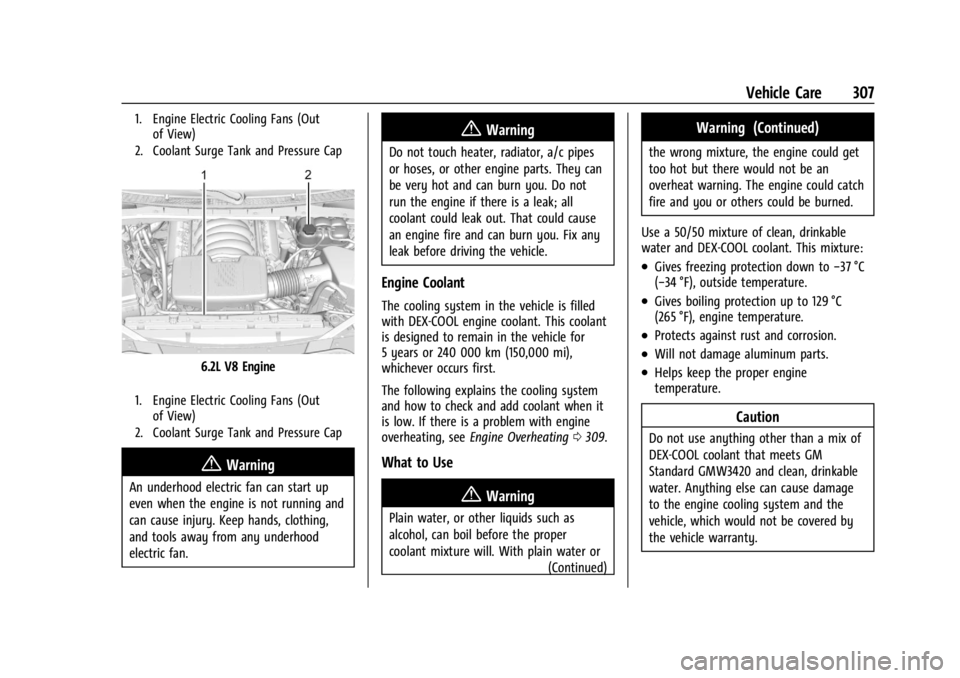
1. Engine Electric Cooling Fans (Outof View)
2. Coolant Surge Tank and Pressure Cap
6.2L V8 Engine
1. Engine Electric Cooling Fans (Out of View)
2. Coolant Surge Tank and Pressure Cap
{Warning
An underhood electric fan can start up
even when the engine is not running and
can cause injury. Keep hands, clothing,
and tools away from any underhood
electric fan.
{Warning
Do not touch heater, radiator, a/c pipes
or hoses, or other engine parts. They can
be very hot and can burn you. Do not
run the engine if there is a leak; all
coolant could leak out. That could cause
an engine fire and can burn you. Fix any
leak before driving the vehicle.
Engine Coolant
The cooling system in the vehicle is filled
with DEX-COOL engine coolant. This coolant
is designed to remain in the vehicle for
5 years or 240 000 km (150,000 mi),
whichever occurs first.
The following explains the cooling system
and how to check and add coolant when it
is low. If there is a problem with engine
overheating, see Engine Overheating 0309.
What to Use
{Warning
Plain water, or other liquids such as
alcohol, can boil before the proper
coolant mixture will. With plain water or
(Continued)
Warning (Continued)
the wrong mixture, the engine could get
too hot but there would not be an
overheat warning. The engine could catch
fire and you or others could be burned.
Use a 50/50 mixture of clean, drinkable
water and DEX-COOL coolant. This mixture:
.Gives freezing protection down to −37 °C
(−34 °F), outside temperature.
.Gives boiling protection up to 129 °C
(265 °F), engine temperature.
.Protects against rust and corrosion.
.Will not damage aluminum parts.
.Helps keep the proper engine
temperature.
Caution
Do not use anything other than a mix of
DEX-COOL coolant that meets GM
Standard GMW3420 and clean, drinkable
water. Anything else can cause damage
to the engine cooling system and the
vehicle, which would not be covered by
the vehicle warranty.
Page 309 of 422

GMC Yukon/Yukon XL/Denali Owner Manual (GMNA-Localizing-U.S./
Canada/Mexico-15555988) - 2022 - CRC - 12/3/21
308 Vehicle Care
Never dispose of engine coolant by putting
it in the trash, or by pouring it on the
ground, or into sewers, streams, or bodies of
water. Have the coolant changed by an
authorized service center, familiar with legal
requirements regarding used coolant
disposal. This will help protect the
environment and your health.
Checking Coolant
The coolant surge tank is in the engine
compartment on the driver side of the
vehicle. SeeEngine Compartment Overview
0 299.
The vehicle must be on a level surface when
checking the coolant level.
5.3L V8 Engine Shown, 6.2L V8 Engine Similar Check to see if coolant is visible in the
coolant surge tank. If the coolant inside the
coolant surge tank is boiling, wait until it
cools down. The coolant level should be at
or above the indicated mark. If it is not,
there may be a leak in the cooling system.
If coolant is visible but the coolant level is
not at or above the indicated mark, see the
following sections on how to add coolant to
the coolant surge tank following.
How to Add Coolant to the Coolant
Surge Tank
If the vehicle has a diesel engine, see
“Cooling System”
in the Duramax diesel
supplement for the proper coolant fill
procedure.
{Warning
Spilling coolant on hot engine parts can
burn you. Coolant contains ethylene
glycol and it will burn if the engine parts
are hot enough.
{Warning
Plain water, or other liquids such as
alcohol, can boil before the proper
coolant mixture will. With plain water or
the wrong mixture, the engine could get
too hot but there would not be an
overheat warning. The engine could catch
fire and you or others could be burned.
{Warning
Steam and scalding liquids from a hot
cooling system are under pressure.
Turning the pressure cap, even a little,
can cause them to come out at high
speed and you could be burned. Never
turn the cap when the cooling system,
including the pressure cap, is hot. Wait
for the cooling system and pressure cap
to cool.
Page 310 of 422

GMC Yukon/Yukon XL/Denali Owner Manual (GMNA-Localizing-U.S./
Canada/Mexico-15555988) - 2022 - CRC - 12/3/21
Vehicle Care 309
Caution
Failure to follow the specific coolant fill
procedure could cause the engine to
overheat and could cause system
damage. If coolant is not visible in the
surge tank, contact your dealer.
If no coolant is visible in the surge tank, add
coolant.
1. Remove the coolant surge tank pressure cap when the cooling system, including
the coolant surge tank pressure cap and
upper radiator hose, is no longer hot.
Turn the pressure cap slowly
counterclockwise about one full turn. If a
hiss is heard, wait for that to stop.
A hiss means there is still some
pressure left. 2. Keep turning the pressure cap slowly,
and remove it.
3. Fill the coolant surge tank with the proper mixture to the full cold mark.
4. With the coolant surge tank pressure cap off, start the engine and let it run until
the engine coolant temperature gauge
indicates approximately 90 °C (195 °F).
By this time, the coolant level inside the
coolant surge tank may be lower. If the
level is lower, add more of the proper
mixture to the coolant surge tank until
the level reaches the indicated mark.
5. Replace the pressure cap tightly.
6. Verify coolant level after the engine is shut off and the coolant is cold.
If necessary, repeat coolant fill procedure
Steps 1–6.
Caution
If the pressure cap is not tightly installed,
coolant loss and engine damage may
occur. Be sure the cap is properly and
tightly secured.
Engine Overheating
Caution
Do not run the engine if there is a leak
in the engine cooling system. This can
cause a loss of all coolant and can
damage the system and vehicle. Have
any leaks fixed right away.
The vehicle has several indicators to warn of
engine overheating.
There is a coolant temperature gauge and a
engine coolant temperature warning light in
the vehicle's instrument cluster. See Engine
Coolant Temperature Gauge 0110 and
Engine Coolant Temperature Warning Light
0 119.
In addition, there are ENGINE OVERHEATED
STOP ENGINE, ENGINE OVERHEATED IDLE
ENGINE, and ENGINE POWER IS REDUCED
messages in the Driver Information
Center (DIC).
If the decision is made not to lift the hood
when this warning appears, get service help
right away. See Roadside Assistance Program
0 393.
Page 311 of 422

GMC Yukon/Yukon XL/Denali Owner Manual (GMNA-Localizing-U.S./
Canada/Mexico-15555988) - 2022 - CRC - 12/3/21
310 Vehicle Care
If the decision is made to lift the hood,
make sure the vehicle is parked on a level
surface.
Check to see if the engine cooling fan(s) are
running. If the engine is overheating, the
fans should be running. If they are not, do
not continue to run the engine. Have the
vehicle serviced.
If Steam is Coming from the Engine
Compartment
{Warning
Steam and scalding liquids from a hot
cooling system are under pressure.
Turning the pressure cap, even a little,
can cause them to come out at high
speed and you could be burned. Never
turn the cap when the cooling system,
including the pressure cap, is hot. Wait
for the cooling system and pressure cap
to cool.
If No Steam is Coming from the Engine
Compartment
The ENGINE OVERHEATED STOP ENGINE or
the ENGINE OVERHEATED IDLE ENGINE
message, along with a low coolant
condition, can indicate a serious problem.
If there is an engine overheat warning, but
no steam is seen or heard, the problem may
not be too serious. Sometimes the engine
can get a little too hot when the vehicle:
.Climbs a long hill on a hot day.
.Stops after high-speed driving.
.Idles for long periods in traffic.
.Tows a trailer; seeTrailer Towing0271.
If the ENGINE OVERHEATED STOP ENGINE or
the ENGINE OVERHEATED IDLE ENGINE
message appears with no sign of steam, try
this for a minute or so: 1. Turn the air conditioning off.
2. Turn the heater on to the highest temperature and to the highest fan
speed. Open the windows as necessary.
3. When it is safe to do so, pull off the road, shift to P (Park) or N (Neutral), and
let the engine idle. If the engine coolant temperature gauge is
no longer in the overheat zone or an
overheat warning no longer displays, the
vehicle can be driven. Continue to drive the
vehicle slowly for about 10 minutes. Keep a
safe vehicle distance from the vehicle in
front. If the warning does not come back on,
continue to drive normally and have the
cooling system checked for proper fill and
function.
If the warning continues, pull over, stop, and
park the vehicle right away.
If there is still no sign of steam and the
vehicle is equipped with an engine driven
cooling fan, push down the accelerator until
the engine speed is about twice as fast as
normal idle speed for at least five minutes
while the vehicle is parked. If the warning is
still there, turn off the engine and get
everyone out of the vehicle until it
cools down.
If there is no sign of steam, idle the engine
for five minutes while parked. If the warning
is still displayed, turn off the engine until it
cools down.
Page 413 of 422

GMC Yukon/Yukon XL/Denali Owner Manual (GMNA-Localizing-U.S./Cana-
da/Mexico-15555988) - 2022 - RegulatoryCompliance - 12/3/21
412 Index
DrivingAssistance Systems . . . . . . . . . . . . . . . . . . . . 254
Better Fuel Economy . . . . . . . . . . . . . . . . . . . . 191
Characteristics and Towing Tips . . . . . . . . 267
Defensive . . . . . . . . . . . . . . . . . . . . . . . . . . . . . . 192
Hill and Mountain Roads . . . . . . . . . . . . . . 198
If the Vehicle is Stuck . . . . . . . . . . . . . . . . . 200
Impaired . . . . . . . . . . . . . . . . . . . . . . . . . . . . . . . 192
Loss of Control . . . . . . . . . . . . . . . . . . . . . . . . 194
Off-Road . . . . . . . . . . . . . . . . . . . . . . . . . . . . . . . 194
Off-Road Recovery . . . . . . . . . . . . . . . . . . . . . 193
Vehicle Load Limits . . . . . . . . . . . . . . . . . . . . 201
Wet Roads . . . . . . . . . . . . . . . . . . . . . . . . . . . . . 198
Winter . . . . . . . . . . . . . . . . . . . . . . . . . . . . . . . . . 199
Dual Automatic Climate Control System . . . . . . . . . . . . . . . . . . . . . . . . . . . . . . . . .182
Dynamic Fuel Management . . . . . . . . . . . . . . 210
E
Electric Brake Boost . . . . . . . . . . . . . . . . . . . . . . 219
Electric Parking Brake . . . . . . . . . . . . . . . . . . . . 219
Electric Parking Brake Light . . . . . . . . . . . . . . . 116
Electrical Equipment, Add-On . . . . . . . . . . . . 294
Electrical System Engine Compartment Fuse Block . . . . . . . 320
Fuses and Circuit Breakers . . . . . . . . . . . . . 320
Instrument Panel Fuse Block . . . . . . . . . . . 324
Overload . . . . . . . . . . . . . . . . . . . . . . . . . . . . . . . 318 Electrical System (cont'd)
Rear Compartment Fuse Block . . . . . . . . . 326
Emergency OnStar . . . . . . . . . . . . . . . . . . . . . . . . . . . . . . . . . 402
Engine Air Cleaner/Filter . . . . . . . . . . . . . . . . . . . . . . 305
Check Light (Malfunction Indicator) . . . . . 114
Compartment Overview . . . . . . . . . . . . . . . . 299
Coolant Temperature Gauge . . . . . . . . . . . 110
Coolant Temperature Warning Light . . . . 119
Cooling System . . . . . . . . . . . . . . . . . . . . . . . . 306
Drive Belt Routing . . . . . . . . . . . . . . . . . . . . . 389
Exhaust . . . . . . . . . . . . . . . . . . . . . . . . . . . . . . . . . 211
Fan . . . . . . . . . . . . . . . . . . . . . . . . . . . . . . . . . . . . . 311
Oil Life System . . . . . . . . . . . . . . . . . . . . . . . . 304
Oil Pressure Gauge . . . . . . . . . . . . . . . . . . . . 109
Oil Pressure Light . . . . . . . . . . . . . . . . . . . . . . . 121
Overheating . . . . . . . . . . . . . . . . . . . . . . . . . . . 309
Power Messages . . . . . . . . . . . . . . . . . . . . . . . 130
Running While Parked . . . . . . . . . . . . . . . . . . 211
Starting . . . . . . . . . . . . . . . . . . . . . . . . . . . . . . . . 207
Engine Air Filter Life System . . . . . . . . . . . . . 305
Entry Lighting . . . . . . . . . . . . . . . . . . . . . . . . . . . 144
Equipment, Towing . . . . . . . . . . . . . . . . . . . . . . 274
Event Data Recorders . . . . . . . . . . . . . . . . . . . .400
Exit Lighting . . . . . . . . . . . . . . . . . . . . . . . . . . . . . 144
Extended Parking . . . . . . . . . . . . . . . . . . . . . . . . 210
Extender, Seat Belt . . . . . . . . . . . . . . . . . . . . . . . 59 Exterior Lamp Controls . . . . . . . . . . . . . . . . . . . .138
Exterior Lamps Off Reminder . . . . . . . . . . . . 140
Exterior Lighting Battery Saver . . . . . . . . . . .145
F
Fan
Engine . . . . . . . . . . . . . . . . . . . . . . . . . . . . . . . . . . 311
Filter, Engine Air Cleaner . . . . . . . . . . . . . . . . . . . . . 305
Flash-to-Pass . . . . . . . . . . . . . . . . . . . . . . . . . . . . . 140
Flashers, Hazard Warning . . . . . . . . . . . . . . . . . 141
Flat Tire . . . . . . . . . . . . . . . . . . . . . . . . . . . . . . . . . 345 Changing . . . . . . . . . . . . . . . . . . . . . . . . . . . . . . 346
Floor Console Storage . . . . . . . . . . . . . . . . . . . . . 93
Floor Mats . . . . . . . . . . . . . . . . . . . . . . . . . . . . . . . . 371
Fluid Automatic Transmission . . . . . . . . . . . . . . . 305
Brakes . . . . . . . . . . . . . . . . . . . . . . . . . . . . . . . . . 313
Washer . . . . . . . . . . . . . . . . . . . . . . . . . . . . . . . . . 311
Fog Lamps . . . . . . . . . . . . . . . . . . . . . . . . . . . . . . . .142
Folding Mirrors . . . . . . . . . . . . . . . . . . . . . . . . . . . 28
Forward Collision Alert (FCA) System . . . . 254
Four Corner Air Suspension Light . . . . . . . . 120
Four Corner Air Suspension System . . . . . . 227
Four-Wheel Drive . . . . . . . . . . . . . . . . . . . . . . . . . . . . . . . . . . 314
Drive Light . . . . . . . . . . . . . . . . . . . . . . . . . . . . . . 117
Drive System . . . . . . . . . . . . . . . . . . . . . . . . . . 215