2022 FORD BRONCO lock
[x] Cancel search: lockPage 179 of 562

Note:You can only move the gearshift leverto crawler (C) by raising the collar belowthe gearshift knob up before shifting tocrawler. This is a lockout feature whichprotects the transmission from accidentallyengaging crawler (C) when intending toselect second (2).
If crawler (C) is not fully engaged press theclutch pedal down, return the gearshift tothe neutral position, then release the clutchpedal. Re-apply the clutch pedal, then liftthe gearshift collar and shift into crawler(C) again.
The crawler gear enables an easier start inunusual conditions or terrain. You shouldchange up to first (1) when possible andrefrain from using crawler (C) at highengine speeds as transmission damagecould result. See Manual TransmissionPrecautions (page 174).
In normal use, ensure your vehicle isstationary before selecting crawler (C) asit is primarily a starting gear. If you changedown to crawler (C) from first (1) while thevehicle is moving, ensure an engine speedis below 1500 rpm, and that the clutchpedal is fully pressed for a smoothtransition to crawler gear.
RECOMMENDED SHIFT
SPEEDS
Recommended Shift Speeds
For best fuel efficiency when driving yourvehicle, shift to the next gear by 3000RPM.
Shifting at a higher RPM such as3000-6000 RPM can increase theperformance capabilities of the vehicle.However, higher engine and transmissionspeeds can increase wear and reduce fueleconomy.
When downshifting your vehicle, alwaysshift at the lowest engine RPM possible tomatch your driving conditions. This isusually under 2000 RPM for all forwardgears, except for downshifting into thecrawler (C) gear which you should dobelow 1500 RPM. See ManualTransmission Precautions (page 174).
Note:Always fully depress the clutch pedalbetween gear shifts.
175
2022 Bronco (TG1) Canada/United States of America, enUSA, Edition date: 202109, First-PrintingManual TransmissionE99067
Page 184 of 562
BRAKE SHIFT INTERLOCK
WHAT IS BRAKE SHIFTINTERLOCK
Brake shift interlock prevents you fromshifting out of park (P) when you haveswitched the ignition on and not pressedthe brake pedal.
BRAKE SHIFT INTERLOCKPRECAUTIONS
WARNING: Do not drive yourvehicle until you verify that thestoplamps are working.
WARNING: When doing thisprocedure, you need to take thetransmission out of park (P) whichmeans your vehicle can roll freely. Toavoid unwanted vehicle movement,apply the parking brake prior to doingthis procedure. Use wheel chocks ifappropriate.
WARNING: If the parking brake isfully released, but the brake warninglamp remains illuminated, the brakesmay not be working properly. Have yourvehicle checked as soon as possible.
USING BRAKE SHIFT INTERLOCK
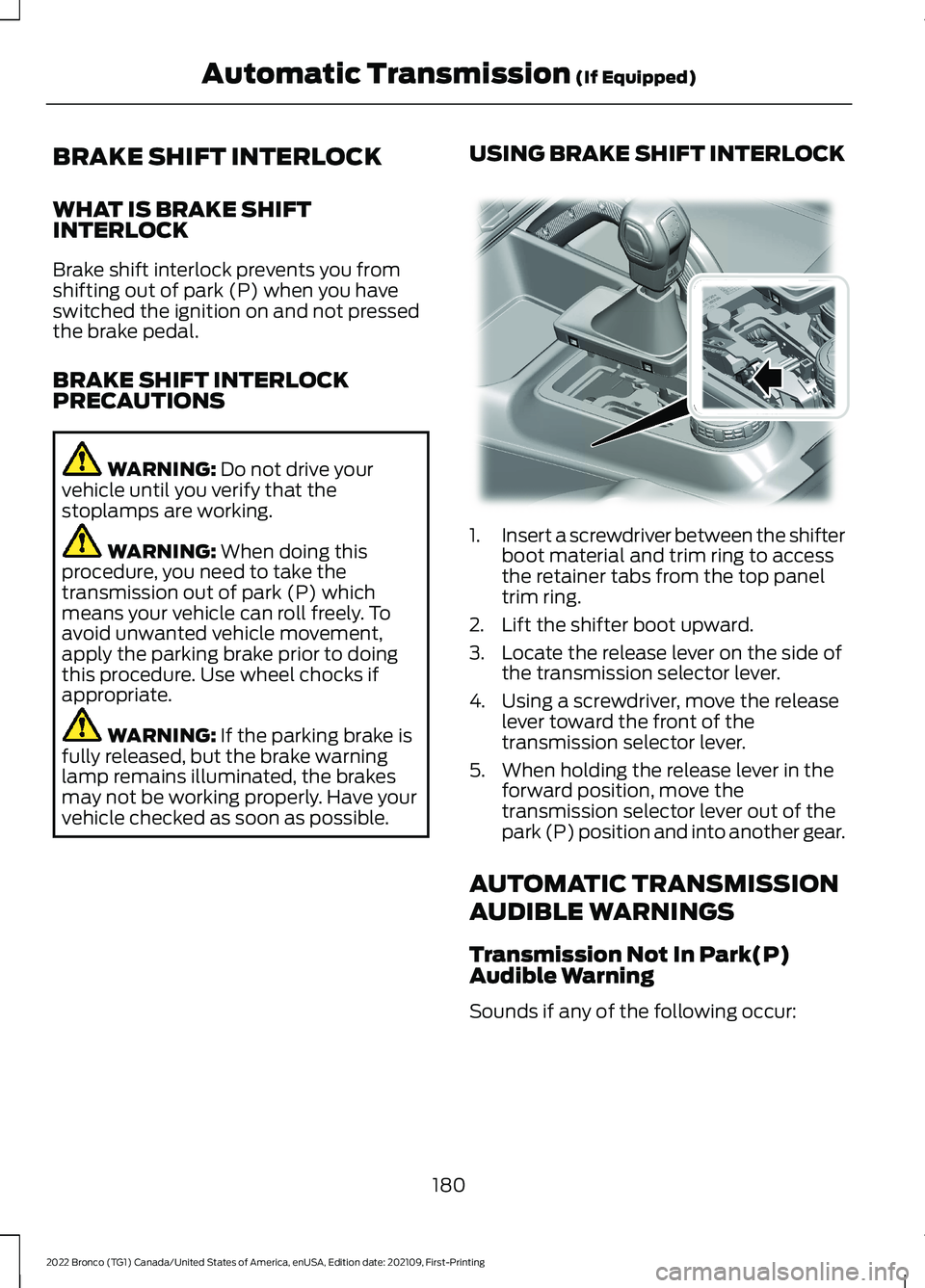
1.Insert a screwdriver between the shifterboot material and trim ring to accessthe retainer tabs from the top paneltrim ring.
2.Lift the shifter boot upward.
3.Locate the release lever on the side ofthe transmission selector lever.
4.Using a screwdriver, move the releaselever toward the front of thetransmission selector lever.
5.When holding the release lever in theforward position, move thetransmission selector lever out of thepark (P) position and into another gear.
AUTOMATIC TRANSMISSION
AUDIBLE WARNINGS
Transmission Not In Park(P)Audible Warning
Sounds if any of the following occur:
180
2022 Bronco (TG1) Canada/United States of America, enUSA, Edition date: 202109, First-PrintingAutomatic Transmission (If Equipped)E346836
Page 186 of 562

HOW DOES FOUR-WHEEL
DRIVE WORK - 4X4 WITH PART
TIME ENGAGEMENT
4x4 With Part Time Engagement (If
Equipped)
This system offers the driver two-wheeldrive high, four-wheel drive high, andfour-wheel drive low as available modesof operation. When you select eitherfour-wheel drive high or four-wheel drivelow, the system provides mechanicallylocked four-wheel drive power to both thefront and rear wheels for use in off-road orslippery conditions such as deep snow,sand or mud. Selecting four-wheel drivelow also provides additional gearing forincreased torque multiplication forconditions like deep sand, steep slopes, orpulling heavy objects.
Additionally, the system is capable ofrecreational flat towing by putting thetransfer case into neutral (N). SeeRecreationally Towing Your Vehicle(page 309).
HOW DOES FOUR-WHEEL
DRIVE WORK - ADVANCED 4X4
WITH 4A MODE
Advanced 4x4 With Automatic OnDemand Engagement (If Equipped)
This system monitors various vehiclesensory inputs to provide an increasedlevel of performance. This system offersthe driver two-wheel drive high, four-wheeldrive auto, four-wheel drive high, andfour-wheel drive low as available modesof operation. When you select four-wheeldrive auto, the system continuously variespower to the front wheels for optimumperformance for all on-road conditions.When you select either four-wheel drive
high or four-wheel drive low, the systemprovides electronically locked power to thefront and rear wheels for use in off-road orslippery conditions such as deep snow,sand or mud. Selecting four-wheel drivelow also provides additional gearing forincreased torque multiplication forconditions like deep sand, steep slopes, orpulling heavy objects.
Additionally, the system is capable ofrecreational flat towing by putting thetransfer case into neutral (N). SeeRecreationally Towing Your Vehicle(page 309).
FOUR-WHEEL DRIVE
PRECAUTIONS
WARNING: Do not becomeoverconfident in the ability of four-wheeldrive vehicles. Although a four-wheeldrive vehicle may accelerate better thana two-wheel drive vehicle in low tractionsituations, it won't stop any faster thantwo-wheel drive vehicles. Always driveat a safe speed.
WARNING: Vehicles with a highercenter of gravity (utility and four-wheeldrive vehicles) handle differently thanvehicles with a lower center of gravity(passenger cars). Avoid sharp turns,excessive speed and abrupt steering inthese vehicles. Failure to drive cautiouslyincreases the risk of losing control of yourvehicle, vehicle rollover, personal injuryand death.
182
2022 Bronco (TG1) Canada/United States of America, enUSA, Edition date: 202109, First-PrintingFour-Wheel Drive
Page 187 of 562

FOUR-WHEEL DRIVE
LIMITATIONS
Do not use four-wheel drive high orfour-wheel drive low mode on dry, hardsurfaced roads. Doing so can produceexcessive noise, increase tire wear and candamage driveline components. Four-wheeldrive high or four-wheel drive low mode isonly for use on consistently slippery orloose surfaces. Use of four-wheel drive lowmode on these surfaces could producesome noise, such as occasional clunks, butshould not damage driveline components.
For vehicles with an electronicshift-on-the-fly transfer case, the drivelinecould become mechanically blocked whenattempting to shift out of a four-wheeldrive mode on dry, hard surfaced roads.
Note:When your vehicle comes with the4x4 part-time selectable engagementtransfer case and you are transitioning fromconsistently loose or slippery surfaces, besure the four-wheel drive system is notmechanically blocked once you are on dry,hard surfaced roads in two-wheel drive high.
Note: In certain scenarios, where thefour-wheel drive system has difficultyengaging, a To Engage 4x4 Slow to 3 MPHor To Engage 4x4 Slow to 5 km/hmessage could appear in the instrumentcluster. You can also see this messagewhen engaging the four-wheel drive systemin extreme cold climates at the beginningof the drive cycle. Once the driveline warmsup, shifting to four-wheel drive can resumeas normal.
Operating Four-Wheel Drive witha Spare or Mismatched Tires
On four-wheel drive vehicles, the size ofthe spare tire can affect the four-wheeldrive system.
If there is a significant difference betweenthe size of the spare tire and the remainingtires, you could have limited four-wheeldrive functionality, added noise, discomfortand driveline damage.
Due to normal tire wear, your spare tire isnot necessarily the same size as youron-road tires, which makes your spare tirea dissimilar size. Use the spare tire on alimited basis only.
When driving with a dissimilar wheel andtire assembly do not:
•Exceed 50 mph (80 km/h) whenoperating in a four-wheel drive mode.
•Select a four-wheel drive mode unlessthe vehicle is stationary.
•Use a four-wheel drive mode on drypavement.
You could have limited four-wheel drivefunctionality when driving with a dissimilarwheel and tire assembly, especially whendriving in a mechanically locked four-wheeldrive mode. You can experience thefollowing:
•Additional noise from the transfer caseor other drive components.
•Difficulty shifting in and out of amechanically locked four-wheel drivemode.
•Driveline component damage.
Mechanical Shift Blocking
On vehicles with an electronicshift-on-the-fly transfer case, the transfercase distributes torque to the front wheelsby mechanically interlocking the front andrear driveshafts together. Various externalfactors can affect shifting performance ofthis type of system including, but notlimited to:
•Vehicle acceleration.
•Dissimilar tire sizes.
•High steering input.
183
2022 Bronco (TG1) Canada/United States of America, enUSA, Edition date: 202109, First-PrintingFour-Wheel Drive
Page 188 of 562

For vehicles with an electronicshift-on-the-fly transfer case, whenshifting into two-wheel drive high on dry,hard surfaced roads, we recommend thatyou follow the following procedure toreduce the likelihood of a mechanical shiftblock:
1.When driving straight, come to acomplete stop on a flat, horizontalsurface.
2.For vehicles with an automatictransmission, shift into park (P). Forvehicles with a manual transmission,press the clutch.
3.Select 2H and wait for the 2H LED tobecome solid.
4.For vehicles with an automatictransmission, shift into reverse (R). Forvehicles with a manual transmission,select reverse (R) and release theclutch. Let the vehicle roll backward upto 3 ft (1 m) and press the brake.
5.For vehicles with an automatictransmission, shift into drive (D). Forvehicles with a manual transmission,press the clutch in again, select aforward gear and release the clutch.Let the vehicle roll forward up to 3 ft(1 m).
If the system is mechanically blocked, oneor more of the following actions can relievethe mechanical shift block:
•Momentary acceleration.
•Momentary braking.
•Bringing the vehicle to a stop.
•Shifting the transmission to neutral andback to drive.
•Shifting the transmission to reverseand back to drive.
•Driving the vehicle around a tight turnat a slow speed.
SWITCHING FOUR-WHEEL
DRIVE ON AND OFF
A vehicle that comes with four-wheel drive,when selected, has the ability to use allfour wheels to power itself. This increasestraction, which may enable you to safelydrive over terrain and road conditions thata conventional two-wheel drive vehiclecannot.
On some four-wheel drive models, theinitial shift from two-wheel drive tofour-wheel drive while the vehicle ismoving can cause a momentary clunk andratcheting sound. These sounds are normalas the front drivetrain comes up to speedand are not cause for concern.
SELECTING A FOUR-WHEEL
DRIVE MODE - 4X4 WITH PART
TIME ENGAGEMENT
To select a four-wheel drive mode, pushthe button.
184
2022 Bronco (TG1) Canada/United States of America, enUSA, Edition date: 202109, First-PrintingFour-Wheel DriveE345849
Page 190 of 562
1.Bring your vehicle to a speed of 0 mph(0 km/h).
2.For vehicles with an automaticTransmission, place in neutral (N). Forvehicles with a manual transmission,fully depress the clutch pedal.
3.Push the 4L on the four-wheel drivemode selector.
Note: A 4x4 Shift in Progress messageappears in the information display indicatingthe shift is in progress. If any of the previousshift conditions are not met, the shift shouldnot occur and the information display canguide the driver through the proper shiftingprocedures.
Note:If Shift Delayed Drive Forwarddisplays in the information display, placethe transmission in a forward gear, moveyour vehicle forward approximately 5 ft(1.5 m), and shift the transmission back toneutral (N) to allow the transfer case tocomplete the range shift.
Note:When the light is solid, the systemhas achieved the desired four-wheel drivemode. When a selected four-wheel drivemode LED is blinking, the system isattempting to shift to that specificfour-wheel drive mode.
Note:When all lights are blinking have yourvehicle serviced as soon as possible.
Note:When you achieve recreationaltowing, all lights are off and the instrumentcluster displays Neutral Tow Enabled LeaveTransmission in Neutral.
FOUR-WHEEL DRIVE MODES
TWO-WHEEL DRIVE HIGH
Two-wheel drive high is for generalon-road driving. Power is sent to the rearwheels only.
Note:Two-wheel drive high can turn on oroff based on Drive Mode selection SeeG.O.A.T. Mode Control (page 242).
FOUR-WHEEL DRIVE AUTO (If
Equipped)
Four-wheel drive auto provideselectronically controlled four-wheel drivepower to both the front and rear wheels,as required, for increased traction in varyingon-road conditions. The four-wheel driveauto tuning varies based on selected DriveMode. See Selecting a Four-Wheel DriveMode (page 184).
Note:Four-wheel drive auto can turn on oroff automatically based on Drive Modeselection. See Selecting a Four-WheelDrive Mode (page 184).
FOUR-WHEEL DRIVE HIGH
Four-wheel drive high provideselectronically or mechanically lockedfour-wheel drive power to both the frontand rear wheels for use in off-road orwinter conditions such as deep snow, sandor mud. This mode is not for use on drypavement.
Note:Four-wheel drive high can turn on oroff automatically based on Drive Modeselection.
FOUR-WHEEL DRIVE LOW
Four-wheel drive low provideselectronically or mechanically lockedfour-wheel drive power to both the frontand rear wheels for use on low tractionsurfaces, but does so with additionalgearing for increased torque multiplication.This mode is only for off-road conditionssuch as deep sand, steep slopes, or pullingheavy objects.
186
2022 Bronco (TG1) Canada/United States of America, enUSA, Edition date: 202109, First-PrintingFour-Wheel Drive
Page 192 of 562

DetailsMessage
Displays when the driver attempts to shift out of four-wheel drive low without the transmission in neutral(N).
To Exit 4L Shift to N
Displays when the driver attempts to shift out of four-wheel drive low without the clutch pedal pressed.To exit 4L Press Clutch
Displays when the four-wheel drive system is shiftinginto and out of two-wheel drive high or between highand low ranges.
4x4 Shift in Progress
Displays when the four-wheel drive system detects adriving condition which temporarily requires greaterfour-wheel drive performance. The system resumesnormal function after the system no longer detectsthese driving conditions.
4X4 Temporarily Locked
Displays when the four-wheel system detects elevatedsystem temperature and temporarily stops providingpower to the front wheels. The system resumes normalfunction when the system temperature returns tonormal.
4x4 Temporarily Disabled
Displays when the four-wheel drive system resumesnormal function.4x4 Restored
Displays when the transfer case is not able to completea shift and requires forward motion to complete theshift.
Shift Delayed Drive Forward
Displays when the system has become disabled dueto mismatched tires or an external fault.4x4 OFF
Displays when neutral tow mode has been successfullyengaged.Neutral Tow Enabled LeaveTransmission in Neutral
Displays when neutral tow mode has been successfullydisengaged.Neutral Tow Disabled
Displays when the driver selects a four-wheel drivemode that is disallowed in the currently selected drivemode.
Selected 4x4 Mode Not Avail-able in Current Drive Mode
Displays when the system is unable to engage four-wheel drive high and requires the driver to slow downbefore attempting to engage.
To Engage 4x4 Slow to 3 MPH
188
2022 Bronco (TG1) Canada/United States of America, enUSA, Edition date: 202109, First-PrintingFour-Wheel Drive
Page 194 of 562

WHAT IS THE ELECTRONIC
LOCKING DIFFERENTIAL
The electronic locking differential is adevice housed in the front or rear axle and,when activated allows both wheels on thataxle to turn at the same speed. Theelectronic locking differential can provideadditional traction should your vehiclebecome stuck. You can activate thedifferential electronically and shift it on thefly within the operating speed range. Theelectronic differential automaticallydisengages when the vehicle speedexceeds a set value and it automaticallyreengages when the vehicle speed goesbelow a set value. See Switching theElectronic Locking Differential On andOff (page 190). It also automaticallyengages based on certain selected G.O.A.Tmodes. See G.O.A.T. Mode Control(page 242). The electronic lockingdifferential is for use in mud, rocks, sand,or any off-road condition where you needmaximum traction. It is not for use on drypavement.
Note:The electronic locking differentialsare for off-road use only and not for use ondry pavement. Using the electronic lockingdifferentials on dry pavement results inincreased tire wear, noise and vibration ordriveline damage.
Note:The front electronic lockingdifferential is only available in four-wheeldrive low (4L).
Note:Locking the front differential reducesyour ability to make tight turning maneuversand creates additional resistance to steeringinputs.
Note:Switching the electronic lockingdifferentials off while turning results indisengagement difficulties. If the electroniclocking differential has difficultydisengaging, release the accelerator pedaland turn the steering wheel back and forthin small increments while maintainingcontrol and following a straight line.
SWITCHING THE ELECTRONIC
LOCKING DIFFERENTIAL ON
AND OFF
Activating the Electronic LockingDifferential
Front locking differential switchA
Rear locking differential switchB
You can activate the front or rear lockingdifferential by pressing the switch on thecenter switch pack.
Front Electronic Locking Differential Engagement Speed and Availability
Automatic Re-Engagement SpeedAutomatic Disen-gagement SpeedMaximum Engage-ment SpeedFour-Wheel DriveMode
20 mph (32 km/h)25 mph (41 km/h)20 mph (32 km/h)4L
190
2022 Bronco (TG1) Canada/United States of America, enUSA, Edition date: 202109, First-PrintingElectronic Locking Differential (If Equipped)E333068