2022 DODGE DURANGO transmission oil
[x] Cancel search: transmission oilPage 105 of 332

STARTING AND OPERATING103
(Continued)
NOTE:A new engine may consume some oil during its first
few thousand miles (kilometers) of operation. This
should be considered a normal part of the break-in
and not interpreted as a problem. Please check
your oil level with the engine oil indicator often
during the break-in period. Add oil as required.
PARKING BRAKE
Before leaving the vehicle, make sure that the
parking brake is fully applied and place the gear
selector in the PARK (P) position.
The foot operated parking brake is located below
the lower left corner of the instrument panel. To
apply the parking brake, firmly push the parking
brake pedal fully. To release the parking brake,
press the parking brake pedal a second time and
let your foot up as you feel the brake disengage.
Parking Brake
When the parking brake is applied with the ignition
switch in the ON/RUN position, the Brake Warning
Light in the instrument cluster will illuminate.
NOTE:
When the parking brake is applied and the
transmission is placed in gear, the Brake
Warning Light will flash. If vehicle speed is
detected, a chime will sound to alert the driver.
Fully release the parking brake before
attempting to move the vehicle.
This light only shows that the parking brake is
applied. It does not show the degree of brake
application.
When parking on a hill, it is important to turn the
front wheels toward the curb on a downhill grade
and away from the curb on an uphill grade. Apply
the parking brake before placing the gear selector
in PARK, otherwise the load on the transmission
locking mechanism may make it difficult to move
the gear selector out of PARK.
WARNING!
Never use the PARK position as a substitute
for the parking brake. Always apply the
parking brake fully when parked to guard
against vehicle movement and possible injury
or damage.
When leaving the vehicle, always remove the
key fob from the ignition and lock your vehicle.
Never leave children alone in a vehicle, or with
access to an unlocked vehicle. Allowing chil -
dren to be in a vehicle unattended is
dangerous for a number of reasons. A child or
others could be seriously or fatally injured.
Children should be warned not to touch the
parking brake, brake pedal or the gear
selector.
When leaving the vehicle, always make sure
the keyless ignition node is in the OFF posi -
tion, remove the key fob from the vehicle and
lock the vehicle.
Do not leave the key fob in or near the vehicle
or in a location accessible to children, and do
not leave the ignition of a vehicle equipped
with Keyless Enter ‘n Go™ in the ACC or ON/
RUN position. A child could operate power
windows, other controls, or move the vehicle.
Be sure the parking brake is fully disengaged
before driving; failure to do so can lead to
brake failure and a collision.
Always fully apply the parking brake when
leaving your vehicle, or it may roll and cause
damage or injury. Also be certain to leave the
transmission in PARK. Failure to do so may
allow the vehicle to roll and cause damage or
injury.
WARNING!
4
22_WD_OM_EN_USC_t.book Page 103
Page 156 of 332

154STARTING AND OPERATING
Flowing Water
If the water is swift flowing and rising (as in storm
run-off), avoid crossing until the water level
recedes and/or the flow rate is reduced. If you
must cross flowing water avoid depths in excess of
9 inches (23 cm). The flowing water can erode the
streambed, causing your vehicle to sink into
deeper water. Determine exit point(s) that are
downstream of your entry point to allow for drifting.
Standing Water
Avoid driving in standing water deeper than
20 inches (51 cm), and reduce speed
appropriately to minimize wave effects. Maximum
speed in 20 inches (51 cm) of water is less than
5 mph (8 km/h).
Maintenance
After driving through deep water, inspect your
vehicle fluids and lubricants (engine oil,
transmission oil, axle, transfer case) to ensure the
fluids have not been contaminated. Contaminated
fluid (milky, foamy in appearance) should be
flushed/changed as soon as possible to prevent
component damage.
Driving In Snow, Mud And Sand
In heavy snow, when pulling a load, or for
additional control at slower speeds, shift the
transmission to a low gear and shift the transfer
case to AWD Low if necessary Ú page 109. Only
shift into a lower gear to maintain forward motion.
Over-revving the engine can spin the wheels and
traction will be lost.
Avoid abrupt downshifts on icy or slippery roads,
because engine braking may cause skidding and
loss of control.
Hill Climbing
NOTE:Before attempting to climb a hill, determine the
conditions at the crest and/or on the other side.
Before climbing a steep hill, shift the transmission
to a lower gear and shift the transfer case to AWD
Low. Use FIRST gear and AWD Low for very steep
hills.
If you stall or begin to lose forward motion while
climbing a steep hill, allow your vehicle to come to
a stop and immediately apply the brakes. Restart
the engine, and shift into REVERSE. Back slowly
down the hill, allowing the compression braking of
the engine to help regulate the speed. If the brakes
are required to control vehicle speed, apply them
lightly and avoid locking or skidding the tires. Remember, never drive diagonally across a hill;
always drive straight up or down.
If the wheels start to slip as you approach the crest
of a hill, ease off the accelerator and maintain
forward motion by turning the front wheels slowly.
This may provide a fresh “bite” into the surface and
will usually provide traction to complete the climb.
Traction Downhill
Shift the transmission into a low gear, and the
transfer case into AWD Low. Let the vehicle go
slowly down the hill with all four wheels turning
against engine compression drag. This will permit
you to control the vehicle speed and direction.
When descending mountains or hills, repeated
braking can cause brake fade with loss of braking
control. Avoid repeated heavy braking by
downshifting the transmission whenever possible.
WARNING!
If the engine stalls, you lose forward motion, or
cannot make it to the top of a steep hill or grade,
never attempt to turn around. To do so may
result in tipping and rolling the vehicle. Always
back carefully straight down a hill in REVERSE
gear. Never back down a hill in NEUTRAL using
only the brake.
22_WD_OM_EN_USC_t.book Page 154
Page 277 of 332

SERVICING AND MAINTENANCE275
AUTOMATIC TRANSMISSION
Special Additives
The manufacturer strongly recommends against
using any special additives in the transmission.
Automatic Transmission Fluid (ATF) is an
engineered product and its performance may be
impaired by supplemental additives. Therefore, do
not add any fluid additives to the transmission.
Avoid using transmission sealers as they may
adversely affect seals.
Fluid Level Check
The fluid level is preset at the factory and does not
require adjustment under normal operating
conditions. Routine fluid level checks are not
required; therefore the transmission has no
dipstick. An authorized dealer can check your
transmission fluid level using special service tools. If you notice fluid leakage or transmission
malfunction, visit an authorized dealer
immediately to have the transmission fluid level
checked. Operating the vehicle with an improper
fluid level can cause severe transmission damage.
Fluid And Filter Changes
Under normal operating conditions, the fluid
installed at the factory will provide satisfactory
lubrication for the life of the vehicle.
Routine fluid and filter changes are not required.
However, change the fluid and filter if the fluid
becomes contaminated (with water, etc.), or if the
transmission is disassembled for any reason.
To avoid contamination from foreign matter or
moisture, use only new brake fluid or fluid that
has been in a tightly closed container. Keep
the master cylinder reservoir cap secured at
all times. Brake fluid in an open container
absorbs moisture from the air resulting in a
lower boiling point. This may cause it to boil
unexpectedly during hard or prolonged
braking, resulting in sudden brake failure.
This could result in a collision.
Overfilling the brake fluid reservoir can result
in spilling brake fluid on hot engine parts,
causing the brake fluid to catch fire. Brake
fluid can also damage painted and vinyl
surfaces, care should be taken to avoid its
contact with these surfaces.
Do not allow petroleum based fluid to contam
-
inate the brake fluid. Brake seal components
could be damaged, causing partial or
complete brake failure. This could result in
a collision.
WARNING!
CAUTION!
Do not use chemical flushes in your
transmission as the chemicals can damage your
transmission components. Such damage is not
covered by the New Vehicle Limited Warranty.
CAUTION!
If a transmission fluid leak occurs, visit an
authorized dealer immediately. Severe
transmission damage may occur. An authorized
dealer has the proper tools to adjust the fluid
level accurately.
8
22_WD_OM_EN_USC_t.book Page 275
Page 278 of 332
276SERVICING AND MAINTENANCE
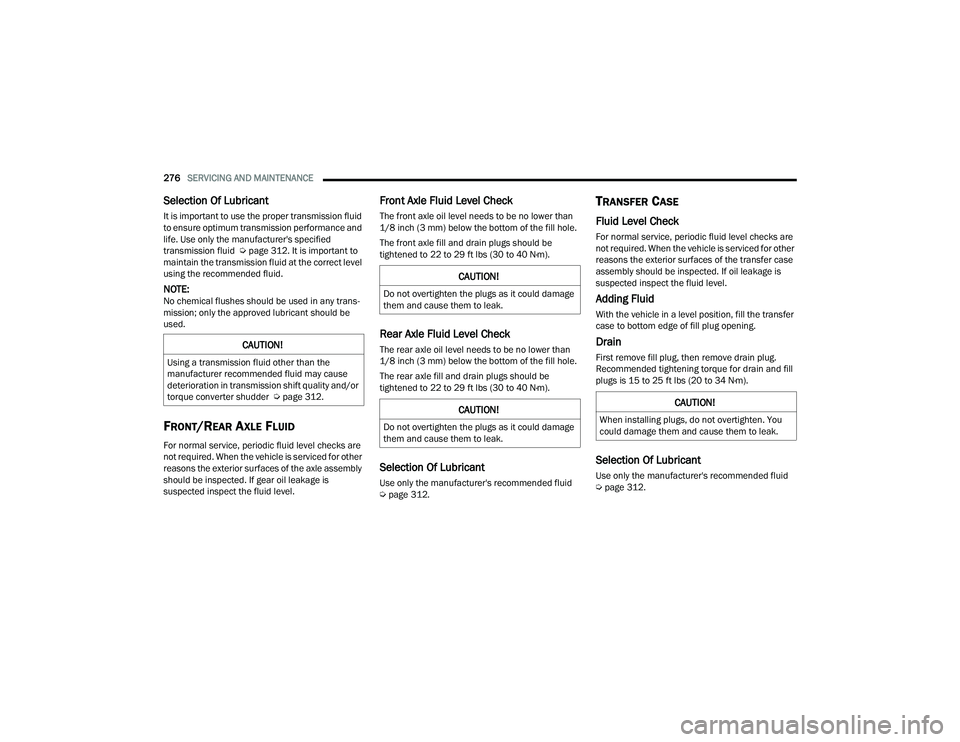
Selection Of Lubricant
It is important to use the proper transmission fluid
to ensure optimum transmission performance and
life. Use only the manufacturer's specified
transmission fluid Úpage 312. It is important to
maintain the transmission fluid at the correct level
using the recommended fluid.
NOTE:No chemical flushes should be used in any trans -
mission; only the approved lubricant should be
used.
FRONT/REAR AXLE FLUID
For normal service, periodic fluid level checks are
not required. When the vehicle is serviced for other
reasons the exterior surfaces of the axle assembly
should be inspected. If gear oil leakage is
suspected inspect the fluid level.
Front Axle Fluid Level Check
The front axle oil level needs to be no lower than
1/8 inch (3 mm) below the bottom of the fill hole.
The front axle fill and drain plugs should be
tightened to 22 to 29 ft lbs (30 to 40 N·m).
Rear Axle Fluid Level Check
The rear axle oil level needs to be no lower than
1/8 inch (3 mm) below the bottom of the fill hole.
The rear axle fill and drain plugs should be
tightened to 22 to 29 ft lbs (30 to 40 N·m).
Selection Of Lubricant
Use only the manufacturer's recommended fluid
Ú page 312.
TRANSFER CASE
Fluid Level Check
For normal service, periodic fluid level checks are
not required. When the vehicle is serviced for other
reasons the exterior surfaces of the transfer case
assembly should be inspected. If oil leakage is
suspected inspect the fluid level.
Adding Fluid
With the vehicle in a level position, fill the transfer
case to bottom edge of fill plug opening.
Drain
First remove fill plug, then remove drain plug.
Recommended tightening torque for drain and fill
plugs is 15 to 25 ft lbs (20 to 34 N·m).
Selection Of Lubricant
Use only the manufacturer's recommended fluid
Úpage 312.
CAUTION!
Using a transmission fluid other than the
manufacturer recommended fluid may cause
deterioration in transmission shift quality and/or
torque converter shudder Ú page 312.
CAUTION!
Do not overtighten the plugs as it could damage
them and cause them to leak.
CAUTION!
Do not overtighten the plugs as it could damage
them and cause them to leak.
CAUTION!
When installing plugs, do not overtighten. You
could damage them and cause them to leak.
22_WD_OM_EN_USC_t.book Page 276
Page 314 of 332
312TECHNICAL SPECIFICATIONS
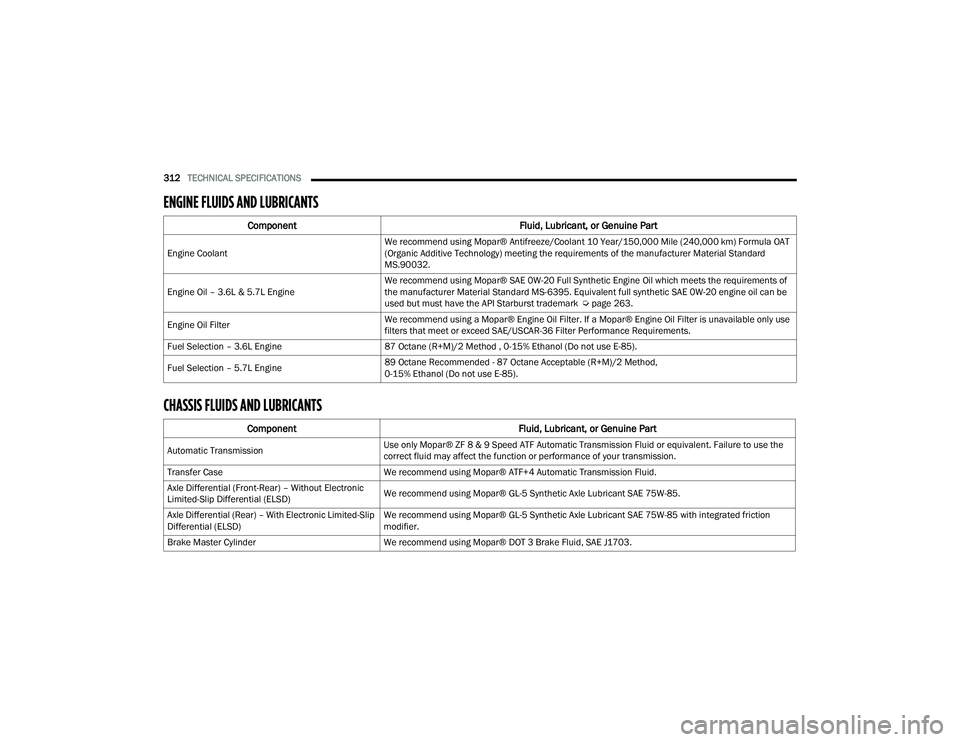
ENGINE FLUIDS AND LUBRICANTS
CHASSIS FLUIDS AND LUBRICANTS
Component Fluid, Lubricant, or Genuine Part
Engine CoolantWe recommend using Mopar® Antifreeze/Coolant 10 Year/150,000 Mile (240,000 km) Formula OAT
(Organic Additive Technology) meeting the requirements of the manufacturer Material Standard
MS.90032.
Engine Oil – 3.6L & 5.7L Engine We recommend using Mopar® SAE 0W-20 Full Synthetic Engine Oil which meets the requirements of
the manufacturer Material Standard MS-6395. Equivalent full synthetic SAE 0W-20 engine oil can be
used but must have the API Starburst trademark Ú
page 263.
Engine Oil Filter We recommend using a Mopar® Engine Oil Filter. If a Mopar® Engine Oil Filter is unavailable only use
filters that meet or exceed SAE/USCAR-36 Filter Performance Requirements.
Fuel Selection – 3.6L Engine 87 Octane (R+M)/2 Method , 0-15% Ethanol (Do not use E-85).
Fuel Selection – 5.7L Engine 89 Octane Recommended - 87 Octane Acceptable (R+M)/2 Method,
0-15% Ethanol (Do not use E-85).
Component
Fluid, Lubricant, or Genuine Part
Automatic TransmissionUse only Mopar® ZF 8 & 9 Speed ATF Automatic Transmission Fluid or equivalent. Failure to use the
correct fluid may affect the function or performance of your transmission.
Transfer Case We recommend using Mopar® ATF+4 Automatic Transmission Fluid.
Axle Differential (Front-Rear) – Without Electronic
Limited-Slip Differential (ELSD) We recommend using Mopar® GL-5 Synthetic Axle Lubricant SAE 75W-85.
Axle Differential (Rear) – With Electronic Limited-Slip
Differential (ELSD) We recommend using Mopar® GL-5 Synthetic Axle Lubricant SAE 75W-85 with integrated friction
modifier.
Brake Master Cylinder We recommend using Mopar® DOT 3 Brake Fluid, SAE J1703.
22_WD_OM_EN_USC_t.book Page 312
Page 320 of 332

318 B
Battery
.................................................... 90, 261Charging System Light................................. 90Keyless Key Fob Replacement.................... 15Battery Saver Feature...................................... 50Belts, Seat..................................................... 232Blind Spot Monitoring.................................... 188Body Mechanism Lubrication........................ 267B-Pillar Location............................................. 290Brake Assist System...................................... 183Brake Control System, Electronic.................. 183Brake Fluid.......................................... 274, 312Brake System...................................... 274, 307Anti-Lock (ABS).......................................... 307Fluid Check............................................... 274Master Cylinder......................................... 274Parking...................................................... 103Warning Light.............................................. 90Brake/Transmission Interlock....................... 105Bulb Replacement............................... 284, 285Bulbs, Light.................................................... 234
C
Camera, Rear................................................ 136Capacities, Fluid............................................ 311Caps, Filler Oil (Engine)................................................ 259Radiator (Coolant Pressure)...................... 273Car Washes................................................... 304Carbon Monoxide Warning............................ 234
Cargo Area Cover...................................... 74, 75Cargo Compartment........................................ 74Light............................................................ 74Luggage Carrier........................................... 76Cargo Light....................................................... 74Cargo Tie-Downs.............................................. 75Cellular Phone.............................................. 181Center High Mounted Stop Light................... 286Certification Label......................................... 138Chains, Tire................................................... 300Chart, Tire Sizing........................................... 287Check Engine Light
(Malfunction Indicator Light)............................ 98Checking Your Vehicle For Safety................. 231Checks, Safety.............................................. 231Child Restraint.............................................. 216Child RestraintsBooster Seats........................................... 219Child Seat Installation.............................. 229How To Stow An unused ALR Seat Belt.... 227Infant And Child Restraints....................... 218Locating The LATCH Anchorages.............. 223Lower Anchors And TethersFor Children......................................... 220Older Children And Child Restraints......... 218Seating Positions...................................... 220Child Safety Locks........................................... 25Clean Air Gasoline......................................... 309CleaningWheels..................................................... 299
Climate Control................................................54Automatic....................................................54Cold Weather Operation................................ 102Compact Spare Tire...................................... 297Contract, Service........................................... 314Cooling Pressure Cap (Radiator Cap)............ 273Cooling System............................................. 272Adding Coolant (Antifreeze)...................... 273Cooling Capacity....................................... 311Disposal Of Used Coolant......................... 273Drain, Flush, And Refill............................. 272Inspection................................................. 272Points To Remember................................ 274Pressure Cap............................................ 273Radiator Cap............................................. 273Selection Of Coolant(Antifreeze)......................... 272, 311, 312Corrosion Protection..................................... 304Cruise Control (Speed Control)............. 116, 118Cruise Light......................................................96Customer Assistance.................................... 313Cybersecurity................................................ 156
D
Daytime Running Lights...................................48Defroster, Windshield................................... 232De-Icer, Remote Start......................................20Diagnostic System, Onboard............................97DipsticksOil (Engine)............................................... 261
22_WD_OM_EN_USC_t.book Page 318
Page 323 of 332
321
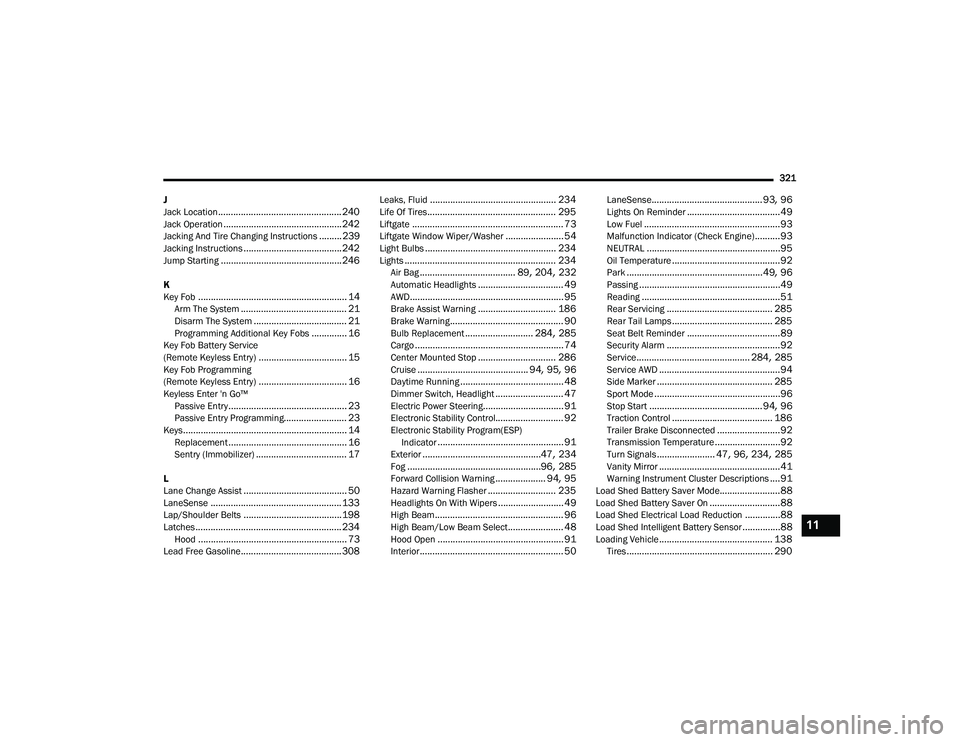
J
Jack Location
................................................. 240Jack Operation............................................... 242Jacking And Tire Changing Instructions......... 239Jacking Instructions....................................... 242Jump Starting................................................ 246
K
Key Fob........................................................... 14Arm The System.......................................... 21Disarm The System..................................... 21Programming Additional Key Fobs.............. 16Key Fob Battery Service
(Remote Keyless Entry)................................... 15Key Fob Programming
(Remote Keyless Entry)................................... 16Keyless Enter 'n Go™ Passive Entry............................................... 23Passive Entry Programming......................... 23Keys................................................................. 14Replacement............................................... 16Sentry (Immobilizer).................................... 17
L
Lane Change Assist......................................... 50LaneSense.................................................... 133Lap/Shoulder Belts....................................... 198Latches.......................................................... 234Hood........................................................... 73Lead Free Gasoline........................................ 308
Leaks, Fluid.................................................. 234Life Of Tires................................................... 295Liftgate............................................................ 73Liftgate Window Wiper/Washer....................... 54Light Bulbs.................................................... 234Lights............................................................ 234Air Bag...................................... 89, 204, 232Automatic Headlights.................................. 49AWD............................................................. 95Brake Assist Warning............................... 186Brake Warning............................................. 90Bulb Replacement........................... 284, 285Cargo........................................................... 74Center Mounted Stop............................... 286Cruise............................................ 94, 95, 96Daytime Running......................................... 48Dimmer Switch, Headlight........................... 47Electric Power Steering................................ 91Electronic Stability Control........................... 92Electronic Stability Program(ESP)Indicator.................................................. 91Exterior...............................................47, 234Fog.....................................................96, 285Forward Collision Warning.................... 94, 95Hazard Warning Flasher........................... 235Headlights On With Wipers.......................... 49High Beam................................................... 96High Beam/Low Beam Select...................... 48Hood Open.................................................. 91Interior......................................................... 50
LaneSense............................................ 93, 96Lights On Reminder.....................................49Low Fuel......................................................93Malfunction Indicator (Check Engine)..........93NEUTRAL.....................................................95Oil Temperature...........................................92Park......................................................49, 96Passing........................................................49Reading.......................................................51Rear Servicing.......................................... 285Rear Tail Lamps........................................ 285Seat Belt Reminder.....................................89Security Alarm.............................................92Service............................................. 284, 285Service AWD................................................94Side Marker.............................................. 285Sport Mode..................................................96Stop Start.............................................94, 96Traction Control........................................ 186Trailer Brake Disconnected.........................92Transmission Temperature..........................92Turn Signals....................... 47, 96, 234, 285Vanity Mirror................................................41Warning Instrument Cluster Descriptions....91Load Shed Battery Saver Mode........................88Load Shed Battery Saver On............................88Load Shed Electrical Load Reduction..............88Load Shed Intelligent Battery Sensor...............88Loading Vehicle............................................. 138Tires.......................................................... 290
11
22_WD_OM_EN_USC_t.book Page 321
Page 326 of 332

324 Vented
......................................................... 37Ventilated.................................................... 37Security AlarmArm The System.......................................... 21Disarm The System..................................... 21Security System........................................ 21, 92Sentry Key (Immobilizer).................................. 17Sentry Key Replacement................................. 16Service Assistance......................................... 313Service Contract............................................ 314Service Manuals............................................ 315Shifting.......................................................... 104Automatic Transmission.................. 104, 105Shoulder Belts............................................... 198Signals, Turn..................................96, 234, 285Snow Chains (Tire Chains)............................. 300Snow Tires..................................................... 297Spare Tires................................. 240, 297, 298Speed ControlAccel/Decel............................................... 117Accel/Decel (ACC Only)............................. 122Cancel....................................................... 118Resume..................................................... 118Set............................................................. 117Speed Control (Cruise Control)... 116, 117, 118Starting............................................................ 99Button......................................................... 17Cold Weather............................................ 102Engine Fails To Start................................. 102Remote....................................................... 18
Starting And Operating..................................... 99Starting Procedures......................................... 99Steering........................................................... 26Power....................................................... 114Tilt Column.................................................. 26Wheel, Heated............................................. 27Wheel, Tilt.................................................... 26Steering Wheel Audio Controls..................... 181Steering Wheel Mounted Sound
System Controls............................................ 181Storage............................................................ 62Storage, Vehicle......................................61, 304Storing Your Vehicle...................................... 304Sun Roof................................................... 71, 72Sun Visor......................................................... 41Sunglasses Storage......................................... 63Sunshade Operation........................................ 72Sway Control, Trailer..................................... 187Symbol Glossary.............................................. 10Synthetic Engine Oil...................................... 263SystemVehicle Security........................................... 21System, Remote Starting................................. 18
T
Telescoping Steering Column.......................... 26Temperature Control, Automatic (ATC)............. 60Tie Down Hooks, Cargo.................................... 75Tilt Steering Column........................................ 26Tire And Loading Information Placard........... 290
Tire Markings................................................ 286Tire Safety Information.................................. 286Tires.................................. 233, 293, 297, 303Aging (Life Of Tires)................................... 295Air Pressure.............................................. 293Chains...................................................... 300Changing.................................................. 239Compact Spare......................................... 297General Information........................ 293, 297High Speed............................................... 294Inflation Pressure..................................... 293Life Of Tires.............................................. 295Load Capacity........................................... 290Pressure Monitoring System(TPMS)........................................... 94, 193Quality Grading......................................... 303Radial....................................................... 294Replacement............................................ 296Rotation.................................................... 302Safety.............................................. 286, 293Sizes......................................................... 287Snow Tires................................................ 297Spare Tires.............................240, 297, 298Spinning................................................... 295Trailer Towing........................................... 145Tread Wear Indicators.............................. 295Wheel Nut Torque..................................... 307To Open Hood..................................................73Tongue Weight/Trailer Weight...................... 143Tow N Go....................................................... 112
22_WD_OM_EN_USC_t.book Page 324