2022 CITROEN C4 CACTUS lock
[x] Cancel search: lockPage 139 of 256

137
Fuel tank
Tank capacity:
- Pe trol: approximately 50 litres.
-
D
iesel: approximately 45 or 50 litres
(depending on version).
If you have put in the wrong fuel for
your vehicle, you must have the tank
drained and refilled with the correct
fuel before you star t the engine.
Low fuel level
When the low fuel level is reached,
this warning lamp in the instrument
panel comes on, accompanied by
an audible warning, a message and
the last bar of the fuel gauge flashes
in red.
When it first comes on, about 5 litres of fuel
remain in the tank.
Until sufficient fuel has been added, this
warning lamp appears every time the ignition
is switched on, accompanied by an audible
signal and a message. This audible warning
and message are repeated with increasing
frequency as the fuel level drops towards " 0".
You must refuel as soon as possible to avoid
running out. For more information on Running out of
fuel (Diesel)
, refer to the corresponding
section.
Refilling
A label on the inside of the fuel filler flap
reminds you of the type of fuel to use,
depending on your engine type.
Additions of fuel must be of at least 5 litres, in
order to be registered by the fuel gauge.
Opening the filler cap may create a noise
caused by an inrush of air. This is entirely
normal and results from the sealing of the fuel
system.
To refuel in complete safety:
F
Y
ou must switch off the engine. F
W
ith the vehicle unlocked, press the rear-
central part of the filler flap.
F
T
ake care to select the pump that delivers
the correct type of fuel for your vehicle.
F
I
nsert the key in the cap then turn it to
the left, or turn the cap by hand to the left
(depending on version).
Once you have finished refuelling:
F
R
efit the filler cap.
F
T
urn the key to the right then remove it from
the cap, or turn the cap manually to the right
(depending on version).
F
P
ush the fuel flap to close it.
F
R
emove the cap and place it on its support
(on the filler flap).
F
I
nsert the filler nozzle as far as possible
before starting the filling (risk of splashing).
F
F
ill up the tank, but do not continue after
the 3
rd cut-off of the nozzle; this could
cause malfunctions.
7
Practical information
Page 153 of 256

151
Important: in the event of a top-up after
a breakdown because of a lack of
AdBlue, you must wait around 5 minutes
before switching on the ignition, without
opening the driver's door, locking
the vehicle, introducing the key into
the ignition switch, or introducing
the key of the
K
eyless Entr y and
Star ting system into the passenger
compartment .
Switch on the ignition, then wait for 10
seconds before starting the engine.
Access to the AdBlue® tank
via the boot
Filling the AdBlue® tank is an operation
included in every routine ser vice on your
vehicle by a CITROËN dealer or a qualified
workshop.
Nevertheless, given the capacity of the tank, it
may be necessary to top up the fluid between
ser vices, as soon as an alert (warning lamps
and a message) indicates it.
You are recommended to go to a CITROËN
dealer or a qualified workshop.
If you intend to do the topping-up yourself,
read the following procedure carefully.
The supply in a non-drip bottle simplifies the
topping-up. F
S
witch off the ignition and remove the key.
Or
F
W
ith
K
eyless Entry and Starting, press the
" START/STOP " button to switch off the
engine.
F
F
rom the boot, lift the carpet and then,
depending on the equipment, lift out the
spare wheel and/or the storage box.
F
W
ithout pressing, turn the black cap a
quarter turn anti-clockwise and lift it off.
F
T
urn the blue cap anti-clockwise.
Access to the AdBlue® tank
via the fuel filler flap
A blue cap under the fuel filler flap indicates
access to the AdBlue® tank.
Read the following procedure carefully to
be able to top up properly.
F
S
witch off the ignition and remove the key.
Or
F
W
ith
K
eyless Entry and Starting, press the
" START/STOP " button to switch off the
engine.
F
T
ake non-drip bottles of AdBlue
®. After first
checking the use-by date, read carefully
the instructions on use on the label before
pouring the contents of the bottle into your
vehicle's AdBlue
® tank.
F
A
fter filling, per form the same operations in
reverse order.
7
Practical information
Page 154 of 256

152
F Obtain a container of AdBlue®. After first
checking the use-by date, read carefully
the instructions on use on the label before
pouring the contents of the container into
your vehicle's AdBlue
® tank.
Or
F
I
nsert the AdBlue
® pump nozzle and fill the
tank until the nozzle stops automatically.
Important:
To prevent the AdBlue
® tank from
ov
er flowing, it is recommended:
F
T
o top up between 10 and 13 litres
using AdBlue
® containers.
Or
F
I
f filling in a ser vice station, stop after
the third automatic shut-off of the
nozzle.
F
A
fter refilling, carry out these same
operations in reverse order.
F
W
ith the vehicle unlocked and the fuel filler
flap open, turn the AdBlue
® blue filler cap
anti-clockwise.Advice on care and
maintenance
Recommendations on the care and
maintenance of your vehicle are given in the
Maintenance and Warranty Guide.
Leather
Leather is a natural product. Appropriate
regular care and cleaning is essential for its
durability.
Refer to your vehicle's Maintenance and
Warranty Guide for information on all the
special precautions to observe.
Care of the stickers
These styling stickers are treated to give good
resistance to ageing and tearing.
They have been designed to allow you to
customise your vehicle's bodywork.
When using a high pressure jet wash, keep the
end of the lance at least 30 centimetres from
the stickers. For the care of the stickers in the rear door
windows, we recommend the following:
-
U
se a wide jet at a temperature of
between 25°C and 40°C.
-
W
here possible, direct the jet at right
angles to the stickers.
Practical information
Page 161 of 256

159
Removing a wheel
Parking the vehicle
Park the vehicle where it does not block
traffic: the ground must be level, stable
and non-slippery.
With a manual gearbox, engage first
gear then switch off the ignition to block
the wheels.
With an automatic gearbox , place the
gear selector at position P then switch off
the ignition to block the wheels.
With an electronic gearbox , place the
gear selector at position D then switch off
the ignition to block the wheels.
Apply the parking brake and check that
the warning lamp is on in the instrument
panel.
The passengers must get out of the
vehicle and wait in safety.
Make sure that the jack is correctly
positioned at one of the vehicle's jacking
points.
Incorrect use of the jack could cause the
vehicle to drop.
Never go underneath a vehicle raised
using a jack; use an axle stand. Wheel with hub cap
When refitting the wheel
, after tightening
the wheel bolts, refit the hub cap, starting
by placing its aperture in line with the
valve and then pushing it into place all
round its edge with the palm of your hand.
List of operations
F If your vehicle has steel wheels, remove the hub cap.
F
I
f your vehicle has alloy wheels, remove the
bolt cover(s) using tool 3 .
F
I
f your vehicle has security wheel bolts, fit
security bolt socket 5 to wheelbrace 1 to
slacken the security bolt.
F
L
oosen the other bolts using wheelbrace 1
o n l y. Ensure that the jack is stable. If the
ground is slippery or loose, the jack may
slip or collapse – Risk of injury!
Ensure that the jack is positioned strictly
at one of jacking points, A or B
, under the
vehicle, making sure that the vehicle's
contact sur face is centred on the head of
the jack. Otherwise, the vehicle could be
damaged and/or the jack could collapse –
Risk of injury!
F P lace the base plate of the jack 2 on the
ground and ensure that it is directly below
the front A or rear B jacking point provided
on the chassis, whichever is closest to the
wheel to be changed.
8
In the event of a breakdown
Page 165 of 256
163
To refit, carry out these operations in reverse
o r d e r.
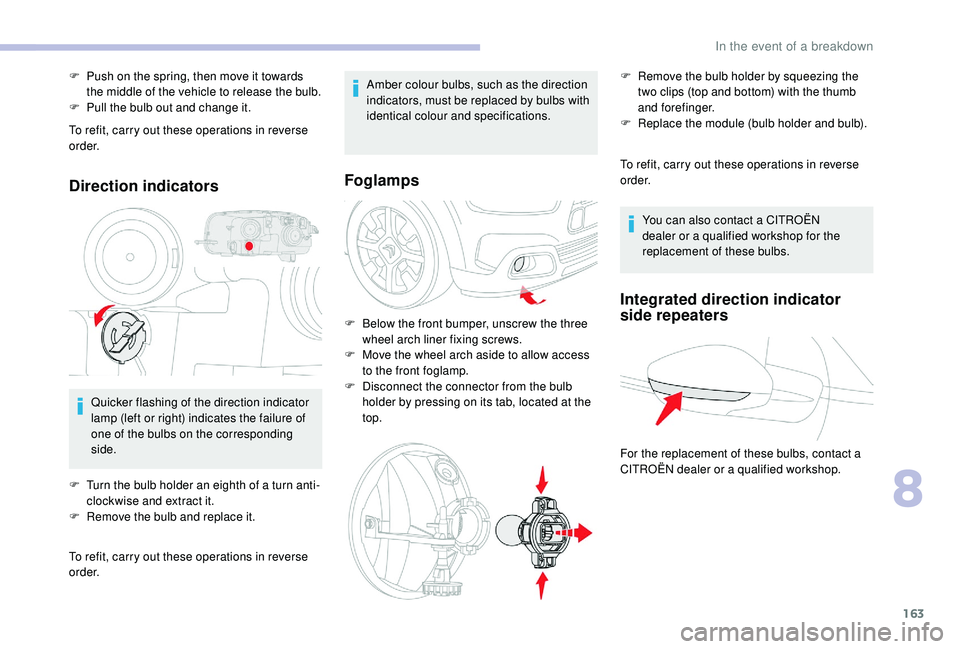
Direction indicators
Quicker flashing of the direction indicator
lamp (left or right) indicates the failure of
one of the bulbs on the corresponding
side.
F
T
urn the bulb holder an eighth of a turn anti-
clockwise and extract it.
F
R
emove the bulb and replace it.
To refit, carry out these operations in reverse
o r d e r. Amber colour bulbs, such as the direction
indicators, must be replaced by bulbs with
identical colour and specifications.
Foglamps
F Below the front bumper, unscrew the three
wheel arch liner fixing screws.
F
M
ove the wheel arch aside to allow access
to the front foglamp.
F
D
isconnect the connector from the bulb
holder by pressing on its tab, located at the
top. To refit, carry out these operations in reverse
o r d e r.
F
P
ush on the spring, then move it towards
the middle of the vehicle to release the bulb.
F
P
ull the bulb out and change it.
You can also contact a CITROËN
dealer or a qualified workshop for the
replacement of these bulbs.
Integrated direction indicator
side repeaters
For the replacement of these bulbs, contact a
CITROËN dealer or a qualified workshop. F
R
emove the bulb holder by squeezing the
two clips (top and bottom) with the thumb
and forefinger.
F
R
eplace the module (bulb holder and bulb).
8
In the event of a breakdown
Page 167 of 256

165
To refit, carry out these operations in reverse
o r d e r.
Make sure the reversing lamp is connected
properly before refitting the bulb holder.
Take care to engage the lamp in its guides
while remaining within the vehicle's centreline.
Tighten sufficiently to ensure sealing, but
without damaging the lamp.
Sidelamps (LED) and foglamps
(LED)
For the replacement of LEDs, contact a
CITROËN dealer or a qualified workshop.
Third brake lamp (LED)
For the replacement of LEDs, contact a
CITROËN dealer or a qualified workshop.
Number plate lamps (W5W)
Interior lighting
Courtesy lamp with bulbs (W5W)
F Using a thin, flap tip screwdriver, unclip the entire console surrounding the courtesy
lamp.
F
P
ull the faulty bulb out and change it.
F
P
ut in place the console around the
courtesy lamp and clip it correctly.
Courtesy lamp with LED
For the replacement of LEDs, contact a
CITROËN dealer or a qualified workshop.
-
f
or the other lamps, press gently from the
top and turn the corresponding bulb a
quarter turn anti-clockwise.
F
I
nsert a thin screwdriver into one of the cut-
outs in the lens. F
P
ush it outwards to unclip it.
F
R
emove the lens.
F
C
hange the faulty bulb.
To refit, press on the lens to clip it in place.
8
In the event of a breakdown
Page 170 of 256

168
FuseNo. Rating
(A) Functions
F1 10Door mirrors (electric adjustment).
F4 15Horn.
F6 20Front and rear screenwash.
F8 20Rear wiper.
F10 30Locks.
F27 5Alarm (pre-equipment).
F29 20Touch screen.
F31 15Radio.
F32 1512 volt socket.
F35 5Headlamp height adjustment, Grip control.
F36 5Courtesy lamp, map reading lamps.
In the event of a breakdown
Page 175 of 256

173
Never try to charge a frozen battery – risk
of explosion!
If the battery has frozen, have it checked
by a CITROËN dealer or by a qualified
workshop who will check that the internal
components have not been damaged and
that the container has not cracked, which
would mean a risk of toxic and corrosive
acid leaking.
Disconnecting the battery
In order to maintain an adequate state
of charge for starting the engine, it is
recommended that the battery be disconnected
if the vehicle is taken out of ser vice for a long
period.
Quick-release terminal clamp
Reconnecting the (+) terminalDo not force the lever as locking will not
be possible if the clamp is not positioned
correctly; start the procedure again.
After reconnecting the battery
After reconnecting the battery, turn on the
ignition and wait 1 minute before starting
the engine, in order to enable the electronic
systems to initialise.
F
O
nce the battery is charged, switch off the
charger B before disconnecting the cables
from the battery A .
If this label is present, it is essential to
use only a 12 V charger to avoid causing
irreversible damage to the electrical
components related to the Stop & Start
system. Before disconnecting the battery:
F
c
lose all openings (doors, tailgate, windows,
sunroof),
F
s
witch off all electrical consumers (audio
system, wipers, lighting, etc.),
F
s
witch off the ignition and wait for four
minutes.
At the battery, it is only necessary to
disconnect the (+) terminal.
Disconnecting the (+) terminal
F
Ra
ise the lever A
fully to release the clamp B .
F
R
emove the clamp B by lifting it off. F
Ra
ise the lever A fully.
F
R
efit the open clamp B on the (+)
terminal.
F
P
ush the clamp B fully down.
F
L
ower the lever A to lock the clamp B
.
If minor problems nevertheless persist
following this operation, contact a CITROËN
dealer or a qualified workshop.
8
In the event of a breakdown