2022 CITROEN C-ELYSÉE change
[x] Cancel search: changePage 56 of 260

54
Headlamp adjustment
To avoid causing a nuisance to other road
users, the height of the headlamp beams
should be adjusted according to the load in the
vehicle.
Depending on the version, this adjustment can
be carried out using the control located:
-
U
nder the bonnet.
-
T
o the left of the steering wheel
Under the bonnet
To the left of the steering wheel
01 or 2 people in the front seats.
- 5
people.
1 5
people + maximum authorised load in
the boot.
- Driver on his own + maximum authorised
load in the boot.
The higher number positions can be used,
but may limit the area illuminated by the
headlamps.
The initial setting is position " 0".
Wiper control stalk
Windscreen wipers
Fast wiping (heavy rain).
Normal wiping (moderate rain).
Intermittent wiping (proportional to
the speed of the vehicle).
Of f.
Single wipe (press down and
release).
F
R
aise the bonnet to access the control (one
per headlamp).
F
T
urn the control to adjust the height of the
headlamp beam. Raise or lower the control to the desired
position to change the wiping speed.
Lighting and visibility
Page 62 of 260

60
If you purchased your vehicle outside the
Brand network, we invite you to check
the configuration of these ser vices and,
if desired, have a dealer change it to suit
your wishes. In a multilingual country,
configuration is possible in the official
national language of your choice.
For technical reasons and, in particular,
to improve the quality of the "telematic
services" services for customers, the
manufacturer reser ves the right to carry
out updates to the vehicle's on-board
communication system.Electronic stability control
(ESC)
A set of the following Electronic Stability
systems:
-
a
nti-lock braking system (ABS) and
electronic brake force distribution (EBFD),
-
em
ergency braking assistance (EBA),
-
w
heel anti-slip regulation (ASR) or traction
control,
-
d
ynamic stability control (DSC).
Definitions
Anti-lock braking system (ABS)
and electronic brake force
distribution (EBFD)
These systems improve the stability and
manoeuvrability of your vehicle when braking
and contribute towards improved control in
corners, in particular on poor or slippery road
surfaces.
The ABS prevents wheel lock in the event of
emergency braking.
The electronic brake force distribution system
manages the braking pressure wheel by wheel.
Emergency braking assistance
(EBA)
In an emergency, this system enables you to
reach the optimum braking pressure more
quickly and therefore reduce the stopping
distance.
Anti-slip regulation (ASR)
This system optimises traction in order to
avoid wheel slip by acting on the brakes of
the driving wheels and on the engine. It also
improves the directional stability of the vehicle
on acceleration.
Dynamic stability control (DSC)
If there is a difference between the path
followed by the vehicle and that required by the
driver, this system monitors each wheel and
automatically acts on the brake of one or more
wheels and on the engine to return the vehicle
to the required path, within the limits of the laws
of physics. It is triggered in relation to the speed at which
the brake pedal is pressed. This is felt by a
reduction in the resistance of the pedal and an
increase in braking efficiency.
Safety
Page 63 of 260
61
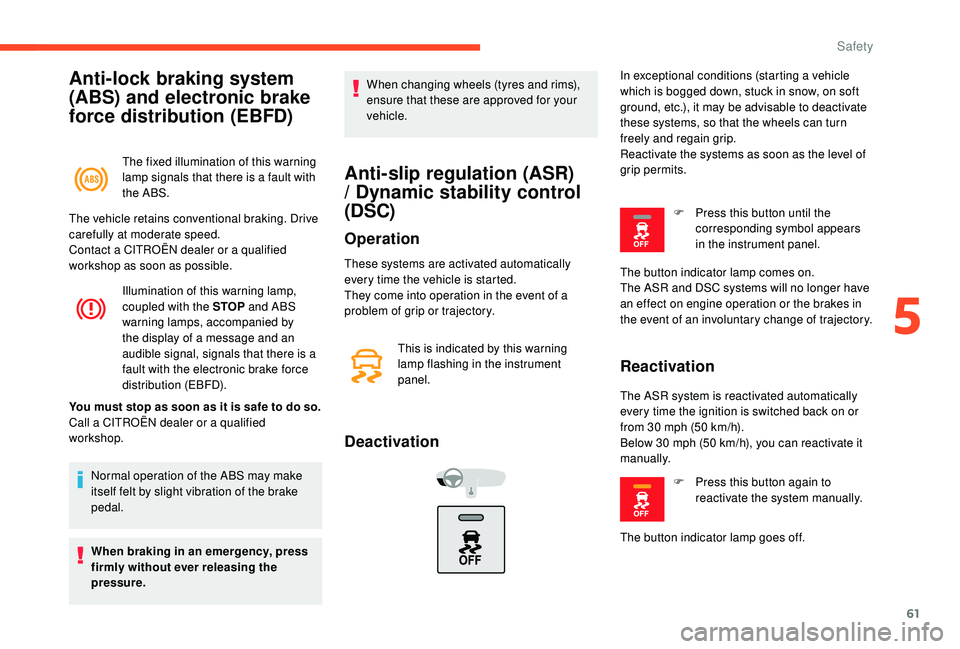
Anti-lock braking system
(ABS) and electronic brake
force distribution (EBFD)
The fixed illumination of this warning
lamp signals that there is a fault with
the ABS.
Illumination of this warning lamp,
coupled with the STOP and ABS
warning lamps, accompanied by
the display of a message and an
audible signal, signals that there is a
fault with the electronic brake force
distribution (EBFD).
Normal operation of the ABS may make
itself felt by slight vibration of the brake
pedal.
When braking in an emergency, press
firmly without ever releasing the
pressure. When changing wheels (tyres and rims),
ensure that these are approved for your
vehicle.Anti-slip regulation (ASR)
/ Dynamic stability control
(DSC)
Operation
These systems are activated automatically
every time the vehicle is started.
They come into operation in the event of a
problem of grip or trajectory.
Deactivation
In exceptional conditions (starting a vehicle
which is bogged down, stuck in snow, on soft
ground, etc.), it may be advisable to deactivate
these systems, so that the wheels can turn
freely and regain grip.
Reactivate the systems as soon as the level of
grip permits.
The vehicle retains conventional braking. Drive
carefully at moderate speed.
Contact a CITROËN dealer or a qualified
workshop as soon as possible.
You must stop as soon as it is safe to do so.
Call a CITROËN dealer or a qualified
workshop. This is indicated by this warning
lamp flashing in the instrument
panel.F
P
ress this button until the
corresponding symbol appears
in the instrument panel.
The button indicator lamp comes on.
The ASR and DSC systems will no longer have
an effect on engine operation or the brakes in
the event of an involuntary change of trajectory.
Reactivation
The ASR system is reactivated automatically
every time the ignition is switched back on or
from 30
mph (50 km/h).
Below 30
mph (50 km/h), you can reactivate it
manually.
F
P
ress this button again to
reactivate the system manually.
The button indicator lamp goes off.
5
Safety
Page 66 of 260

64
Advice
The driver must ensure that passengers use
the seat belts correctly and that they are all
restrained securely before setting off.
Wherever you are seated in the vehicle,
always fasten your seat belt, even for short
journeys.
Do not interchange the seat belt buckles as
they will not completely fulfil their role.
The seat belts are equipped with an inertia
reel which allows the strap length to
automatically adjust to your shape. The seat
belt returns to its storage automatically when
it is not in use.
Before and after use, ensure that the seat belt
is reeled in correctly.
The lower part of the strap must be positioned
as low as possible on the pelvis.
The upper part must be positioned in the
hollow of the shoulder.
The inertia reels are fitted with a device which
automatically locks the strap in the event
of a collision or emergency braking or if the
vehicle rolls over. You can release the device
by pulling the strap firmly and then releasing it
so that it reels in slightly.In order to be effective, a seat belt:
-
M ust be tightened as close to the body as
possible,
-
M
ust be pulled in front of you with a
smooth movement, ensuring that it is not
twisted,
-
M
ust only be used to secure one person,
-
M
ust not show signs of tear or fraying.
-
M
ust not be changed or modified, in order
to avoid affecting its performance. Instructions for children
Use a suitable child seat, if the passenger is
less than 12
years old or shorter than one and
a half metres.
Never use the same seat belt to secure more
than one person.
Never allow a child to travel on your lap.
For more information on Child seats , refer to
the corresponding section.
In accordance with current safety regulations,
for all repairs on your vehicle's seat belts, go
to a qualified workshop with the skills and
equipment needed, which a CITROËN dealer
is able to provide.
Have your seat belts checked regularly by the
a CITROËN dealer or a qualified workshop,
particularly if the straps show signs of
damage.
Clean the seat belt straps with soapy water or
a textile cleaning product, sold by CITROËN
dealers.
After folding or moving a seat or a rear bench
seat, ensure that the seat belt is positioned
and reeled in correctly. In the event of an impact
Depending on the nature and seriousness
of the impacts
, the pyrotechnic pretensioner
device may trigger before and independently
of airbag deployment. Deployment of the
pretensioners is accompanied by a slight
discharge of harmless smoke and a noise,
due to the activation of the pyrotechnic
cartridge incorporated in the system.
In all cases, the airbag warning lamp comes
on.
After an impact, have the seat belt system
checked and, if necessary, have it replaced
by a CITROËN dealer or a qualified
workshop.
Safety
Page 86 of 260

84
Manual gearbox
Engaging reverse gear
F Press the clutch pedal fully.As a safety precaution and to facilitate
starting the engine:
-
a
lways select neutral,
-
p
ress the clutch pedal.
Only engage reverse gear when the vehicle
is stationary with the engine at idle.
Automatic gearbox (EAT6)
Six-speed automatic gearbox which offers a
choice between the comfort of fully automatic
operation, enhanced by sport and snow
programmes, or manual gear changing.
Two driving modes are available:
-
a
utomatic operation for electronic control
of the gears by the gearbox, with a spor t
programme for a more dynamic style of
driving and a snow programme to improve
driving when traction is poor,
-
man
ual operation for sequential changing
of the gears by the driver.
Gearbox deck Gear selector positions
P.
Park.
-
V ehicle immobilised, parking
brake on or off.
-
S
tarting the engine.
R. Reverse.
-
R
eversing manoeuvres, vehicle
stationary, engine at idle.
N. Neutral.
-
V
ehicle immobilised, parking
brake on.
-
S
tarting the engine.
D. Automatic operation.
M + / -. Manual operation with sequential
changing of the six gears.
F
P
ush for wards to change up through the
gears.
or
F
P
ull backwards to change down through the
gears.
1
Gear selector.
2 "S " (spor t) button.
3 "T " (snow) button.
F
P
ush the gear lever fully to the right then
towards the rear.
Driving
Page 88 of 260

86
Never select position N while the vehicle
is moving.
Never select position P or R unless the
vehicle is completely stationary.
Reverse gear
When selecting reverse R with the ignition
on, the rear parking sensors are activated
automatically.
For more information on the Rear parking
sensors, refer to the corresponding section.
Autonomous traction function
(moving without using the accelerator)
This function facilitates manoeuvring of the
vehicle at low speed (when parking, in traffic
jams, etc.).
With the engine at idle, parking brake released
and position D , M or R selected, the vehicle
moves as soon as you take your foot off
the brake pedal (even without pressing the
accelerator).
Sport and snow
programmes
These two special programmes supplement the
automatic operation in very specific conditions
of use.
Sport programme "S"
For maximum acceleration without touching
the selector, press the accelerator pedal down
fully (kick down). The gearbox changes down
automatically or maintains the gear selected
until the maximum engine speed is reached.
On braking, the gearbox changes down
automatically to provide efficient engine
braking.
If you release the accelerator sharply, the
gearbox will not change to a higher gear for
safety reasons.
F
P
ress button S, after starting the engine.
The gearbox automatically favours a dynamic
style of driving.
S appears in the instrument panel.Snow programme T
F Press the " T" button, after starting the
engine.
The gearbox adapts to driving on slippery
roads.
This programme improves starting and traction
when grip is poor.
T appears in the instrument panel.
At any time, press the selected button
again to quit the programme engaged and
return to auto-adaptive mode.
Manual operation
F Select position M for sequential changing
of the six gears.
F
M
ove the selector towards the + sign to
change up a gear.
F
M
ove the selector towards the - sign to
change down a gear.
It is only possible to change from one gear to
another if the vehicle speed and engine speed
permit; otherwise, the gearbox will operate
temporarily in automatic mode.
Driving
Page 89 of 260

87
Invalid value during manual
operation
This symbol is displayed if a gear
is not engaged correctly (selector
between two positions).
Stopping the vehicle
Malfunction
When the ignition is on, the lighting
of this warning lamp, accompanied
by an audible signal and a message
in the screen, indicates a gearbox
fault.
In this case, the gearbox switches to back-up
mode and is locked in 3rd gear. You may feel
a substantial knock when changing from P
to R and from N to R. This will not cause any
damage to the gearbox. There is a risk of damage to the gearbox:
-
i
f you press the accelerator and brake
pedals at the same time,
-
i
f you force the movement of the
selector from position P to another
position when the battery is flat.
To reduce fuel consumption when at
a prolonged standstill with the engine
running (traffic jam, etc.), put the
selector in position N and apply the
parking brake.
D disappears and the gears
engaged appear in succession in
the instrument panel.
If the engine speed is too low or too high, the
selected gear flashes for a few seconds, then
the actual gear engaged is displayed.
It is possible to change from position D
(automatic) to position M (manual) at any time.
When the vehicle is stationary or moving
very slowly, the gearbox engages first gear
automatically.
The sport and snow programmes are
inactive in manual mode. Before switching off the engine, you can
engage position P or N to place the gearbox in
neutral.
In both cases, apply the parking brake to keep
the vehicle stationary.
If the selector is not in position P , when the
driver's door is opened or approximately
45
seconds after the ignition is switched
off, a warning message appears on the
screen.
F
R
eturn the selector to position P
; the
message disappears.
When driving on flooded roads or when
crossing a ford, proceed at walking pace. Do not exceed 60 mph (100 km/h), local speed
restrictions permitting.
Contact a CITROËN dealer or a qualified
workshop as soon as possible.
6
Driving
Page 90 of 260

88
Gear shift indicator
System which reduces fuel consumption by
advising the driver when to change up.With an automatic gearbox, the system is
only active in manual mode.
Operation
Depending on the driving situation and your
vehicle's equipment, the system may advise
you to skip one (or more) gear(s). You can
follow this instruction without engaging the
intermediate gears.
Gearshift recommendations should not be
considered obligatory. The configuration of the
road, the amount of traffic and safety remain
determining factors when choosing the best
gear. The driver thus remains responsible
for deciding whether to follow or ignore the
system's instructions.
This function cannot be deactivated.
Example:
-
Y
ou are in third gear.
-
Y
ou press the accelerator pedal. -
T
he system may suggest that you engage a
higher gear.
The information appears in the instrument
panel in the form of an arrow. With a manual gearbox, the arrow may be
accompanied by the gear recommended.
The system adapts its gear change
recommendation according to driving
conditions (slope, load, etc.) and driver
actions (power demand, acceleration,
b r a k i n g , e t c .) .
The system never suggests:
-
e
ngaging first gear,
-
enga
ging reverse gear,
-
d
own shifting.
Stop & Start
The Stop & Start system puts the engine
temporarily into standby – STOP mode – during
stops in the traffic (red lights, traffic jams, etc.).
The engine restarts automatically – START
mode – as soon as you want to move off.
The restart takes place instantly, quickly and
silently.
Per fect for urban use, the Stop & Start system
reduces fuel consumption and exhaust
emissions as well as the noise level when
stationary.The Stop & Start requires the use of a
12
V battery of special specification and
technology. All work on this type of battery
must only be carried out by a CITROËN
dealer or a qualified workshop. For more
information on the 12
V batter y, refer to
the corresponding section.
Driving