2022 CHRYSLER VOYAGER ECU
[x] Cancel search: ECUPage 243 of 316

IN CASE OF EMERGENCY241
(Continued)
FCA US LLC recommends towing your vehicle with
all four wheels
OFF the ground using a flatbed.
If flatbed equipment is not available, this vehicle
must be towed with the front wheels OFF the
ground (using a towing dolly, or wheel lift
equipment with the front wheels raised).
NOTE:Ensure that the Electric Park Brake is released,
and remains released, while being towed. Vehicle Recovery Tow Points
Your vehicle is equipped with Vehicle Recovery
Points that can be used to recover a disabled
vehicle, located on the underbody of the vehicle.
NOTE:
Ensure that the towing service tow hooks are
properly seated and secured in the attachment
points.
This recovery tow feature should be used by a
trained professional only.
Use approved receptacle location to free the
disabled vehicle from its environment.
Front Recovery Points
CAUTION!
Towing this vehicle in violation of the above
requirements can cause severe transmission
damage. Damage from improper towing is not
covered under the New Vehicle Limited
Warranty.
CAUTION!
Recovery feature:
Is to be used by a professional ONLY.
Is used only to provide recovery of the vehicle.
Is NOT to be used to recover secondary
vehicle.
Is NOT to be used for transporting the vehicle
over the road, i.e. “Flat Towing”.
Is to be used by a professional ONLY.
Is used only to provide recovery of the vehicle.
Is NOT to be used to recover secondary
vehicle.
Is NOT to be used for transporting the vehicle
over the road, i.e. “Flat Towing”.
7
22_RUVG_OM_EN_USC_t.book Page 241
Page 244 of 316

242IN CASE OF EMERGENCY
If you must use the accessories (wipers,
defrosters, etc.) while being towed, the ignition
must be in the ON/RUN mode, not the ACC mode.
NOTE:The Safehold feature will engage the Electric Park
Brake whenever the driver's door is opened (if the
ignition is ON, transmission is not in PARK, and
brake pedal is released). If you are towing this
vehicle with the ignition in the ON/RUN mode, you
must manually disable the Electric Park Brake
each time the driver's door is opened, by pressing
the brake pedal and then releasing the EPB.
If the key fob is unavailable or the vehicle's battery
is discharged, detailed instructions on shifting the
transmission out of PARK in order to move the
vehicle
Úpage 238.
ENHANCED ACCIDENT RESPONSE SYSTEM
(EARS)
This vehicle is equipped with an Enhanced
Accident Response System.
This feature is a communication network that
takes effect in the event of an impact
Úpage 195.
EVENT DATA RECORDER (EDR)
This vehicle is equipped with an event data
recorder (EDR). The main purpose of an EDR is to
record data that will assist in understanding how a
vehicle’s systems performed under certain crash
or near crash-like situations, such as an air bag
deployment or hitting a road obstacle
Úpage 196.
Recovery load should:
Be applied at constant speed.
Be applied parallel to the center line of the
length of the vehicle.
Not be an abrupt acceleration.
Be applied at constant speed.
Be applied parallel to the center line of the
length of the vehicle.
Not be an abrupt acceleration.
CAUTION!
CAUTION!
Do not use sling-type equipment when towing.
Vehicle damage may occur.
When securing the vehicle to a flatbed truck,
do not attach to front or rear suspension
components. Damage to your vehicle may
result from improper towing.
Ensure that the Electric Park Brake is
released, and remains released, while being
towed.
22_RUVG_OM_EN_USC_t.book Page 242
Page 255 of 316

SERVICING AND MAINTENANCE253
6. After removing the snaps, lift up the compartment cover to gain access to the fresh
air inlet.
Cabin Air Filter Cover
7. Remove the filter cover by prying back each of the retaining tabs from their hooking points,
and then pulling the filter cover out to expose
the cabin air filter. Remove the air filter by
pulling it straight out of the housing.
8. Install the new air filter with the arrow on the filter pointing toward the floor. 9. Once the filter is replaced, reinstall the filter
cover, making sure the retaining tabs are fully
secured into their housings.
10. Close the cabin air filter compartment cover, and reinsert the snaps into their slots. Push
the snap lids until fully attached.
11. Push the glove compartment door to the near closed position to reengage the glove
compartment travel stops. Finally, pull the
glove compartment tension tether clip down
and slide it back into the slot on the side of the
glove compartment door.
BODY LUBRICATION
Locks and all body pivot points, including such
items as seat tracks, door hinge pivot points and
rollers, liftgate, tailgate, decklid, sliding doors and
hood hinges, should be lubricated periodically. Use
a lithium-based grease, such as Mopar® Spray
White Lube to ensure quiet, easy operation and to
protect against rust and wear. Prior to the
application of any lubricant, the parts concerned should be wiped clean to remove dust and grit;
after lubricating, excess oil and grease should be
removed. Particular attention should also be given
to hood latching components to ensure proper
function. When performing other underhood
services, the hood latch release mechanism, and
safety catch should be cleaned and lubricated.
The external lock cylinders should be lubricated
twice a year, preferably in the Autumn and Spring.
Apply a small amount of a high quality lubricant,
such as Mopar® Lock Cylinder Lubricant directly
into the lock cylinder.
WINDSHIELD WIPER BLADES
Clean the rubber edges of the wiper blades and the
windshield periodically with a sponge or soft cloth
and a mild nonabrasive cleaner. This will remove
accumulations of salt or road film.
Operation of the wipers on dry glass for long
periods may cause deterioration of the wiper
blades. Always use washer fluid when using the
wipers to remove salt or dirt from a dry windshield.
Avoid using the wiper blades to remove frost or ice
from the windshield. Keep the blade rubber out of
contact with petroleum products such as engine
oil, gasoline, etc.
1 — Filter Cover
2 — Retaining Tabs
CAUTION!
The cabin air filter is identified with an arrow to
indicate airflow direction through the filter.
Failure to properly install the filter will result in
the need to replace it more often.
8
22_RUVG_OM_EN_USC_t.book Page 253
Page 263 of 316

SERVICING AND MAINTENANCE261
(Continued)
BRAKE SYSTEM
In order to ensure brake system performance, all
brake system components should be inspected
periodically. For the proper maintenance intervals
Úpage 244.
Brake Master Cylinder
The fluid in the master cylinder should be checked
when performing under hood services or
immediately if the “Brake Warning Light” is
illuminated. Be sure to clean the top of the master cylinder area
before removing the cap. If necessary, add fluid to
bring the fluid level up to the requirements
described on the brake fluid reservoir. With disc
brakes, fluid level can be expected to fall as the
brake pads wear. Brake fluid level should be
checked when pads are replaced. However, low
fluid level may be caused by a leak and a checkup
may be needed.
Use only manufacturer recommended brake fluid
Úpage 300.
WARNING!
Riding the brakes can lead to brake failure and
possibly a collision. Driving with your foot resting
or riding on the brake pedal can result in
abnormally high brake temperatures, excessive
lining wear, and possible brake damage. You
would not have your full braking capacity in an
emergency.
WARNING!
Use only manufacturer recommended brake
fluid Úpage 300. Using the wrong type of
brake fluid can severely damage your brake
system and/or impair its performance. The
proper type of brake fluid for your vehicle is
also identified on the original factory installed
hydraulic master cylinder reservoir.
To avoid contamination from foreign matter or
moisture, use only new brake fluid or fluid that
has been in a tightly closed container. Keep
the master cylinder reservoir cap secured at
all times. Brake fluid in a open container
absorbs moisture from the air resulting in a
lower boiling point. This may cause it to boil
unexpectedly during hard or prolonged
braking, resulting in sudden brake failure. This
could result in a collision.
Overfilling the brake fluid reservoir can result
in spilling brake fluid on hot engine parts,
causing the brake fluid to catch fire. Brake
fluid can also damage painted and vinyl
surfaces, care should be taken to avoid its
contact with these surfaces.
Do not allow petroleum-based fluid to contam -
inate the brake fluid. Brake seal components
could be damaged, causing partial or
complete brake failure. This could result in a
collision.
WARNING!
8
22_RUVG_OM_EN_USC_t.book Page 261
Page 265 of 316

SERVICING AND MAINTENANCE263
FUSES
General Information
The fuses protect electrical systems against
excessive current.
When a device does not work, you must check the
fuse element inside the blade fuse for a break/
melt.
Also, please be aware that when using power
outlets for extended periods of time with the
engine off may result in vehicle battery discharge.
Blade Fuses
Underhood Fuses
The Power Distribution Center (PDC) is located in
the engine compartment near the battery. This
center contains cartridge fuses, mini-fuses,
micro-fuses, circuit breakers and relays. A label
that identifies each component is printed on the
inside of the cover.
Before any procedure is done on the PDC, make
sure engine is turned off.
Remove the cover by unlatching the two locks
located at each side of the PDC cover, avoid using
screwdrivers or any other tool to remove the cover,
since they may apply excessive force and result in
a broken/damaged part.
After service is done, secure the cover with its two
locks.
NOTE:The function and amperage of these fuses are
different, depending on vehicle trim level and
content.
WARNING!
When replacing a blown fuse, always use an
appropriate replacement fuse with the same
amp rating as the original fuse. Never replace
a fuse with another fuse of higher amp rating.
Never replace a blown fuse with metal wires or
any other material. Do not place a fuse inside
a circuit breaker cavity or vice versa. Failure to
use proper fuses may result in serious
personal injury, fire and/or property damage.
Before replacing a fuse, make sure that the
ignition is off and that all the other services
are switched off and/or disengaged.
If the replaced fuse blows again, contact an
authorized dealer.
If a general protection fuse for safety systems
(air bag system, braking system), power unit
systems (engine system, transmission
system) or steering system blows, contact an
authorized dealer.1 — Fuse Element
2 — Blade Fuse with a good/functional fuse
element
3 — Blade fuse with a bad/not functional fuse
element (blown fuse)8
22_RUVG_OM_EN_USC_t.book Page 263
Page 269 of 316
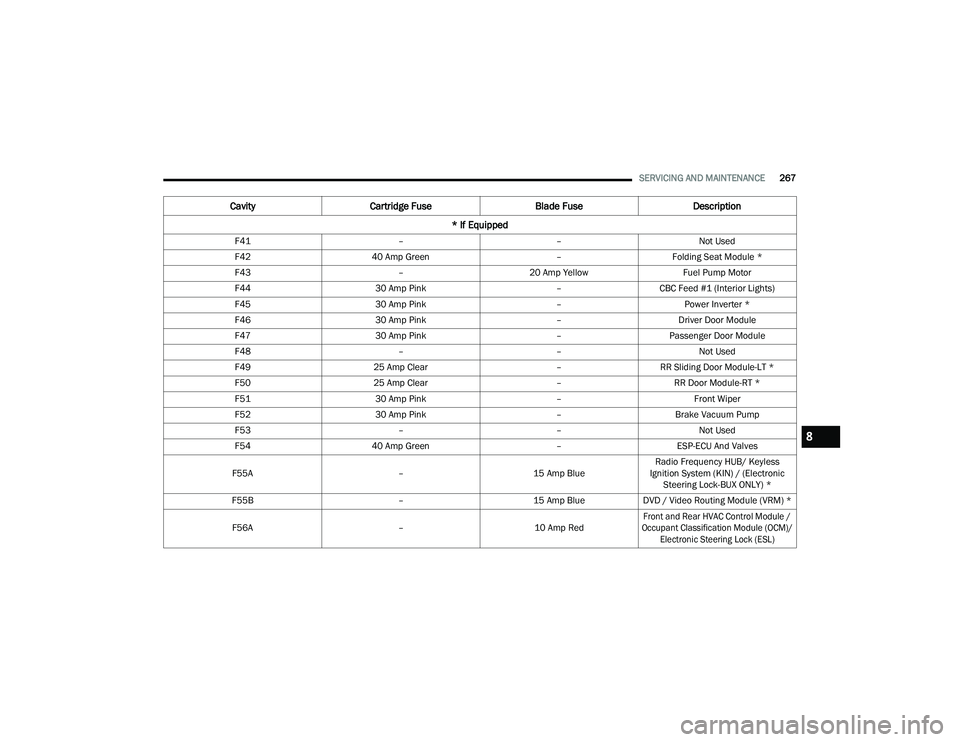
SERVICING AND MAINTENANCE267
F41 ––Not Used
F42 40 Amp Green –Folding Seat Module *
F43 –20 Amp Yellow Fuel Pump Motor
F44 30 Amp Pink –CBC Feed #1 (Interior Lights)
F45 30 Amp Pink –Power Inverter *
F46 30 Amp Pink –Driver Door Module
F47 30 Amp Pink –Passenger Door Module
F48 ––Not Used
F49 25 Amp Clear –RR Sliding Door Module-LT *
F50 25 Amp Clear –RR Door Module-RT *
F51 30 Amp Pink –Front Wiper
F52 30 Amp Pink –Brake Vacuum Pump
F53 ––Not Used
F54 40 Amp Green –ESP-ECU And Valves
F55A –15 Amp BlueRadio Frequency HUB/ Keyless
Ignition System (KIN) / (Electronic Steering Lock-BUX ONLY) *
F55B –15 Amp BlueDVD / Video Routing Module (VRM) *
F56A –10 Amp Red
Front and Rear HVAC Control Module /
Occupant Classification Module (OCM)/ Electronic Steering Lock (ESL)
Cavity Cartridge Fuse Blade FuseDescription
* If Equipped
8
22_RUVG_OM_EN_USC_t.book Page 267
Page 272 of 316

270SERVICING AND MAINTENANCE
F85 –20 Amp Yellow Cigar Lighter
F86 ––Not Used
F87 ––Not Used
F88 –20 Amp Yellow Front Heated Seats *
F89 –20 Amp Yellow Rear Heated Seats *
F90 ––Not Used
F91 –15 Amp BlueFront Ventilated Seats/Heated
Steering Wheel *
F92 –5 Amp Tan Security Gateway
F93 ––Not Used
F94 40 Amp Green –ESC Motor Pump
F95A –10 Amp RedUSB Charge Port — ACC RUN
F95B –10 Amp RedSelectable Fuse Location – USB IP
(Direct) B+
Cavity Cartridge Fuse Blade FuseDescription
* If Equipped
22_RUVG_OM_EN_USC_t.book Page 270
Page 307 of 316

305
INDEX
A
About Your Brakes..........................................295Adding Engine Coolant (Antifreeze).................259Additives, Fuel................................................. 298AdjustDown............................................................ 42Forward......................................................... 42Rearward...................................................... 42Up................................................................. 42Air Bag.............................................................185Air Bag Operation........................................187Air Bag Warning Light....................... 185, 187Driver Knee Air Bag..................................... 191Enhanced Accident Response.......... 195, 242Event Data Recorder (EDR).........................242Front Air Bag............................................... 187If Deployment Occurs................................. 194Knee Impact Bolsters................................. 191Maintaining Your Air Bag System................ 196Maintenance............................................... 196Redundant Air Bag Warning Light...............185Side Air Bags............................................... 192Transporting Pets........................................214Air Bag Light................................... 95, 185, 214Air Cleaner, Engine
(Engine Air Cleaner Filter)................................250
Air Conditioner Maintenance.......................... 251Air Conditioner Refrigerant.................... 251, 252Air Conditioner System................................... 251Air Conditioning Filter.............................. 66, 252Air Conditioning, Operating Tips.........................65Air Filter.......................................................... 250Air PressureTires........................................................... 283AlarmArm The System............................................19Disarm The System.......................................19Security Alarm...............................................98Alterations/ModificationsVehicle............................................................ 8Antifreeze (Engine Coolant)................... 258, 299Disposal..................................................... 260Anti-Lock Brake System (ABS)........................ 158Anti-Lock Warning Light.....................................98Assist, Hill Start.............................................. 162Audio Jack.........................................................69Audio Systems (Radio).................................... 140Auto Up Power Windows....................................73Automatic Dimming Mirror.................................48Automatic Headlights........................................55Automatic Transaxle....................................... 111Automatic Transmission................................. 113
Adding Fluid...................................... 262, 300Fluid And Filter Change............................... 262Fluid Change...............................................262Fluid Level Check........................................ 262Fluid Type......................................... 262, 300Special Additives........................................ 262AutoPark.........................................................105AUX Cord........................................................... 69Auxiliary Electrical Outlet (Power Outlet)........... 70Axle Lubrication...............................................300
B
Back-Up Camera.............................................126Battery..................................................... 95, 248Charging System Light.................................. 95Jump Starting.............................................234Keyless Key Fob Replacement..................... 13Battery Saver Feature....................................... 57Belts, Seat.......................................................214Blind Spot Monitoring.....................................164Body Mechanism Lubrication..........................253B-Pillar Location.............................................. 279Brake Assist System........................................ 159Brake Control System, Electronic....................159Brake Fluid...................................................... 300Brake System........................................ 261, 295Anti-Lock (ABS)...........................................295
11
22_RUVG_OM_EN_USC_t.book Page 305