2022 CHRYSLER VOYAGER run flat
[x] Cancel search: run flatPage 234 of 316
232IN CASE OF EMERGENCY
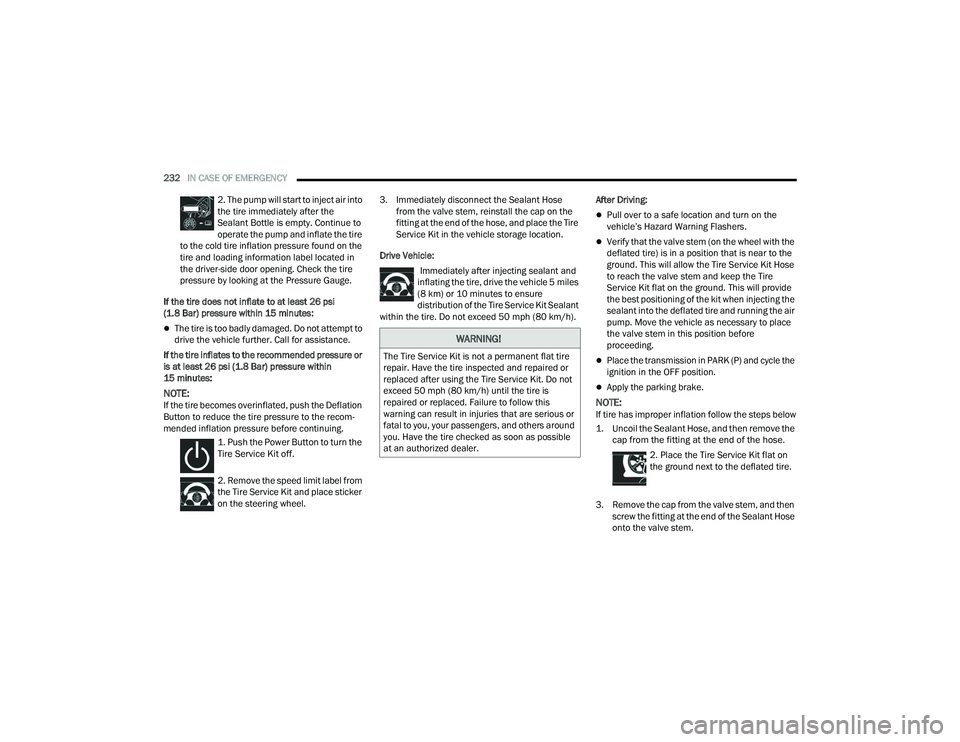
2. The pump will start to inject air into
the tire immediately after the
Sealant Bottle is empty. Continue to
operate the pump and inflate the tire
to the cold tire inflation pressure found on the
tire and loading information label located in
the driver-side door opening. Check the tire
pressure by looking at the Pressure Gauge.
If the tire does not inflate to at least 26 psi
(1.8 Bar) pressure within 15 minutes:
The tire is too badly damaged. Do not attempt to
drive the vehicle further. Call for assistance.
If the tire inflates to the recommended pressure or
is at least 26 psi (1.8 Bar) pressure within
15 minutes:
NOTE:If the tire becomes overinflated, push the Deflation
Button to reduce the tire pressure to the recom -
mended inflation pressure before continuing.
1. Push the Power Button to turn the
Tire Service Kit off.
2. Remove the speed limit label from
the Tire Service Kit and place sticker
on the steering wheel. 3. Immediately disconnect the Sealant Hose
from the valve stem, reinstall the cap on the
fitting at the end of the hose, and place the Tire
Service Kit in the vehicle storage location.
Drive Vehicle: Immediately after injecting sealant and
inflating the tire, drive the vehicle 5 miles
(8 km) or 10 minutes to ensure distribution of the Tire Service Kit Sealant
within the tire. Do not exceed 50 mph (80 km/h). After Driving:
Pull over to a safe location and turn on the
vehicle’s Hazard Warning Flashers.
Verify that the valve stem (on the wheel with the
deflated tire) is in a position that is near to the
ground. This will allow the Tire Service Kit Hose
to reach the valve stem and keep the Tire
Service Kit flat on the ground. This will provide
the best positioning of the kit when injecting the
sealant into the deflated tire and running the air
pump. Move the vehicle as necessary to place
the valve stem in this position before
proceeding.
Place the transmission in PARK (P) and cycle the
ignition in the OFF position.
Apply the parking brake.
NOTE:If tire has improper inflation follow the steps below
1. Uncoil the Sealant Hose, and then remove the
cap from the fitting at the end of the hose.
2. Place the Tire Service Kit flat on
the ground next to the deflated tire.
3. Remove the cap from the valve stem, and then screw the fitting at the end of the Sealant Hose
onto the valve stem.
WARNING!
The Tire Service Kit is not a permanent flat tire
repair. Have the tire inspected and repaired or
replaced after using the Tire Service Kit. Do not
exceed 50 mph (80 km/h) until the tire is
repaired or replaced. Failure to follow this
warning can result in injuries that are serious or
fatal to you, your passengers, and others around
you. Have the tire checked as soon as possible
at an authorized dealer.
22_RUVG_OM_EN_USC_t.book Page 232
Page 244 of 316

242IN CASE OF EMERGENCY
If you must use the accessories (wipers,
defrosters, etc.) while being towed, the ignition
must be in the ON/RUN mode, not the ACC mode.
NOTE:The Safehold feature will engage the Electric Park
Brake whenever the driver's door is opened (if the
ignition is ON, transmission is not in PARK, and
brake pedal is released). If you are towing this
vehicle with the ignition in the ON/RUN mode, you
must manually disable the Electric Park Brake
each time the driver's door is opened, by pressing
the brake pedal and then releasing the EPB.
If the key fob is unavailable or the vehicle's battery
is discharged, detailed instructions on shifting the
transmission out of PARK in order to move the
vehicle
Úpage 238.
ENHANCED ACCIDENT RESPONSE SYSTEM
(EARS)
This vehicle is equipped with an Enhanced
Accident Response System.
This feature is a communication network that
takes effect in the event of an impact
Úpage 195.
EVENT DATA RECORDER (EDR)
This vehicle is equipped with an event data
recorder (EDR). The main purpose of an EDR is to
record data that will assist in understanding how a
vehicle’s systems performed under certain crash
or near crash-like situations, such as an air bag
deployment or hitting a road obstacle
Úpage 196.
Recovery load should:
Be applied at constant speed.
Be applied parallel to the center line of the
length of the vehicle.
Not be an abrupt acceleration.
Be applied at constant speed.
Be applied parallel to the center line of the
length of the vehicle.
Not be an abrupt acceleration.
CAUTION!
CAUTION!
Do not use sling-type equipment when towing.
Vehicle damage may occur.
When securing the vehicle to a flatbed truck,
do not attach to front or rear suspension
components. Damage to your vehicle may
result from improper towing.
Ensure that the Electric Park Brake is
released, and remains released, while being
towed.
22_RUVG_OM_EN_USC_t.book Page 242
Page 286 of 316

284SERVICING AND MAINTENANCE
Consult an authorized tire dealer for tire repairs
and additional information.
Damaged Run Flat tires, or Run Flat tires that have
experienced a loss of pressure should be replaced
immediately with another Run Flat tire of identical
size and service description (Load Index and
Speed Symbol). Replace the tire pressure sensor
as well as it is not designed to be reused.
Run Flat Tires — If Equipped
Run Flat tires allow you the capability to drive
50 miles (80 km) at 50 mph (80 km/h) after a
rapid loss of inflation pressure. This rapid loss of
inflation is referred to as the Run Flat mode. A Run
Flat mode occurs when the tire inflation pressure is
of/or below 14 psi (96 kPa). Once a Run Flat tire
reaches the Run Flat mode it has limited driving
capabilities and needs to be replaced immediately.
A Run Flat tire is not repairable. When a Run Flat
tire is changed after driving with underinflated tire
condition, please replace the TPM sensor as it is
not designed to be reused when driven under run
flat mode 14 psi (96 kPa) condition.
NOTE:TPM Sensor must be replaced after driving the
vehicle on a flat tire condition. It is not recommended driving a vehicle loaded at
full capacity or to tow a trailer while a tire is in the
run flat mode
Úpage 171.
Tire Spinning
When stuck in mud, sand, snow, or ice conditions,
do not spin your vehicle's wheels above 30 mph
(48 km/h) or for longer than 30 seconds
continuously without stopping.
Tread Wear Indicators
Tread wear indicators are in the original equipment
tires to help you in determining when your tires
should be replaced.
Tire Tread
These indicators are molded into the bottom of the
tread grooves. They will appear as bands when the
tread depth becomes a 1/16 of an inch (1.6 mm).
When the tread is worn to the tread wear
indicators, the tire should be replaced
Úpage 285.
WARNING!
Fast spinning tires can be dangerous. Forces
generated by excessive wheel speeds may
cause tire damage or failure. A tire could
explode and injure someone. Do not spin your
vehicle's wheels faster than 30 mph (48 km/h)
for more than 30 seconds continuously when
you are stuck, and do not let anyone near a
spinning wheel, no matter what the speed.1 — Worn Tire
2 — New Tire
22_RUVG_OM_EN_USC_t.book Page 284
Page 308 of 316

306
Fluid Check
....................................... 261, 300Master Cylinder........................................... 261Parking....................................................... 109Warning Light................................................ 95Brake/Transmission Interlock.........................113Brightness, Interior Lights................................. 58Bulb Replacement................................. 272, 274Bulbs, Light.................................. 215, 272, 274
C
Camera........................................................... 126Camera, Rear..................................................126Capacities, Fluid..............................................299Caps, Filler Fuel.............................................................127Oil (Engine)................................................. 247Radiator (Coolant Pressure)........................259Car Washes..................................................... 292Carbon Monoxide Warning..............................216CargoVehicle Loading
............................................ 77Cargo Area Cover.............................................. 77Cargo CompartmentLuggage Carrier............................................ 77Cargo Load Floor............................................... 77Cargo Tie-Downs............................................... 77Cellular Phone................................................. 157Certification Label........................................... 128Chains, Tire..................................................... 289Change Oil Indicator.......................................... 87
Changing A Flat Tire........................................ 220Chart, Tire Sizing............................................. 276Check Engine Light
(Malfunction Indicator Light)........................... 103Checking Your Vehicle For Safety................... 213Checks, Safety................................................ 213Child Restraint................................................ 197Child RestraintsBooster Seats............................................. 200Center Seat LATCH..................................... 206Child Seat Installation....................... 208, 210How To Stow An unused ALR Seat Belt................................................ 207Infant And Child Restraints........................ 198Lower Anchors And Tethers For Children................................................. 201Older Children And Child Restraints........... 199Seating Positions....................................... 201Using The Top Tether Anchorage................ 211Clean Air Gasoline.......................................... 296CleaningWheels....................................................... 288Climate Control..................................................60Manual..........................................................60Rear..............................................................64Cold Weather Operation................................. 107Compact Spare Tire........................................ 287Computer, Trip/Travel........................................94Contract, Service............................................ 302Cooling Pressure Cap (Radiator Cap).............. 259
Cooling System...............................................258Adding Coolant (Antifreeze)........................259Coolant Level.............................................. 260Cooling Capacity.........................................299Disposal Of Used Coolant........................... 260Drain, Flush, And Refill............................... 258Inspection......................................... 258, 260Points To Remember..................................260Pressure Cap.............................................. 259Radiator Cap...............................................259Selection Of Coolant (Antifreeze)...... 258, 299Corrosion Protection.......................................292Cruise Control.................................................119Cruise Light.....................................................101Customer Assistance...................................... 301Cybersecurity.................................................. 140
D
Daytime Brightness, Interior Lights................... 58Daytime Running Lights.................................... 54
Dealer Service.................................................249Defroster, Windshield.....................................214Delay (Intermittent) Wipers............................... 58Diagnostic System, Onboard........................... 102Dimmer SwitchHeadlight...................................................... 54DipsticksOil (Engine).................................................248Disable Vehicle Towing...................................240
22_RUVG_OM_EN_USC_t.book Page 306