2022 CHRYSLER PACIFICA Start
[x] Cancel search: StartPage 325 of 384
SERVICING AND MAINTENANCE323
Installing The Rear Wiper
1. Lift the rear wiper arm pivot cap away from the glass to allow the rear wiper blade to be
raised off of the glass.
NOTE:The rear wiper arm cannot be fully raised off the
glass unless the wiper arm pivot cap is unsnapped
first. Attempting to fully raise the rear wiper arm
without unsnapping the wiper arm pivot cap may
damage the vehicle.
2. Lift the rear wiper arm fully off the glass.
3. Insert the wiper blade pivot pin into the opening on the end of the wiper arm. Grab the
bottom end of the wiper arm with one hand,
and press the wiper blade flush with the wiper
arm until it snaps into place.
4. Lower the wiper blade onto the glass and snap the wiper arm pivot cap back into place.
EXHAUST SYSTEM
The best protection against carbon monoxide entry
into the vehicle body is a properly maintained
engine exhaust system. If you notice a change in the sound of the exhaust
system; or if the exhaust fumes can be detected
inside the vehicle; or when the underside or rear of
the vehicle is damaged; have an authorized
technician inspect the complete exhaust system
and adjacent body areas for broken, damaged,
deteriorated, or mispositioned parts. Open seams
or loose connections could permit exhaust fumes
to seep into the passenger compartment. In
addition, have the exhaust system inspected each
time the vehicle is raised for lubrication or oil
change. Replace as required.
Under normal operating conditions, the catalytic
converter will not require maintenance. However, it
is important to keep the engine properly tuned to
ensure proper catalyst operation and prevent
possible catalyst damage.
WARNING!
Exhaust gases can injure or kill. They contain
carbon monoxide (CO), which is colorless and
odorless. Breathing it can make you uncon-
scious and can eventually poison you
Ú page 278.
A hot exhaust system can start a fire if you
park over materials that can burn, such as
grass or leaves, and those items can come
into contact with your exhaust system. Do not
park or operate your vehicle in areas where
your exhaust system can contact anything that
can burn.
CAUTION!
The catalytic converter requires the use of
unleaded fuel only. Leaded gasoline will
destroy the effectiveness of the catalyst as an
emissions control device and may seriously
reduce engine performance and cause
serious damage to the engine.
Damage to the catalytic converter can result if
your vehicle is not kept in proper operating
condition. In the event of engine malfunction,
particularly involving engine misfire or other
apparent loss of performance, have your
vehicle serviced promptly. Continued opera -
tion of your vehicle with a severe malfunction
could cause the converter to overheat,
resulting in possible damage to the converter
and vehicle.
8
22_RUP_OM_EN_USC_t.book Page 323
Page 326 of 384

324SERVICING AND MAINTENANCE
NOTE:Intentional tampering with emissions control
systems can result in civil penalties being
assessed against you.
In unusual situations involving grossly
malfunctioning engine operation, a scorching odor
may suggest severe and abnormal catalyst
overheating. If this occurs, stop the vehicle, turn off
the engine and allow it to cool. Service, including a
tune-up to the manufacturer specifications, should
be obtained immediately.
To minimize the possibility of catalytic converter
damage:
Do not interrupt the ignition when the transmis -
sion is in gear and the vehicle is in motion.
Do not try to start the vehicle by pushing or
towing the vehicle.
Do not idle the engine with any ignition compo -
nents disconnected or removed, such as when
diagnostic testing, or for prolonged periods
during very rough idle or malfunctioning oper -
ating conditions.
COOLING SYSTEM
Engine Coolant Checks
Check the engine coolant (antifreeze) protection
every 12 months (before the onset of freezing
weather, where applicable). If the engine coolant is
dirty, the system should be drained, flushed, and
refilled with fresh Organic Additive Technology
(OAT) coolant (conforming to MS.90032) by an authorized dealer. Check the front of the A/C
condenser for any accumulation of bugs, leaves,
etc. If dirty, clean by gently spraying water from a
garden hose vertically down the face of the
condenser.
Check the engine cooling system hoses for brittle
rubber, cracking, tears, cuts, and tightness of the
connection at the coolant recovery bottle and
radiator. Inspect the entire system for leaks. DO
NOT REMOVE THE COOLANT PRESSURE CAP
WHEN THE COOLING SYSTEM IS HOT.
Cooling System — Drain, Flush And Refill
NOTE:Some vehicles require special tools to add coolant
properly. Failure to fill these systems properly
could lead to severe internal engine damage. If any
coolant is needed to be added to the system
please contact an authorized dealer.
If the engine coolant (antifreeze) is dirty or
contains visible sediment, have an authorized
dealer clean and flush with Organic Additive
Technology (OAT) coolant (conforming to
MS.90032).
For the proper maintenance intervals
Úpage 310.
WARNING!
You or others can be badly burned by hot
engine coolant (antifreeze) or steam from your
radiator. If you see or hear steam coming from
under the hood, do not open the hood until the
radiator has had time to cool. Never open a
cooling system pressure cap when the radi -
ator or coolant bottle is hot.
Keep hands, tools, clothing, and jewelry away
from the radiator cooling fan when the hood is
raised. The fan starts automatically and may
start at any time, whether the engine is
running or not.
When working near the radiator cooling fan,
disconnect the fan motor lead or turn the igni -
tion to the OFF mode. The fan is temperature
controlled and can start at any time the igni -
tion is in the ON mode.
22_RUP_OM_EN_USC_t.book Page 324
Page 333 of 384

SERVICING AND MAINTENANCE331
F15 40 Amp Green –CBC / Power Locks
F16 –20 Amp Yellow ECM
F17 30 Amp Pink –Starter
F18 40 Amp Green –CBC / EXT LIGHTS
F19 25 Amp Clear –2nd Row Folding Seats Solenoid LT *
F20 –10 Amp Red A/C Compressor Clutch
F21 25 Amp Clear –2nd Row Folding Seat Solenoid RT *
F22 ––Not Populated
F23 ––Not Populated
F24 –20 Amp Yellow RR Wiper
F25 –10 Amp RedHands Free Dr Mod / Active Grille
Shutter / Pwr Mirror / VRM
F26 40 Amp Green –Front HVAC Blower Motor
F27 25 Amp Clear –RR Slide Door Module-RT *
F28 –10 Amp RedDiagnostic Port / USB+(IP) / Video
USB Port / Overhead DVD Player(Aftermarket)
F29 ––Not Populated
F30 –15 Amp BlueMedia HUB / Power Lumbar *
F31 ––Not Populated
F32 20 Amp Blue –ECM
CavityCartridge Fuse Blade FuseDescription
*If Equipped
8
22_RUP_OM_EN_USC_t.book Page 331
Page 359 of 384
SERVICING AND MAINTENANCE357
STORING THE VEHICLE
If you are storing your vehicle for more than three
weeks, we recommend that you take the following
steps to minimize the drain on your vehicle's
battery:
Disconnect the negative cable from battery.
Any time you store your vehicle or keep it out of
service (i.e., vacation) for two weeks or more,
run the air conditioning system at idle for about
five minutes in the fresh air and high blower
setting. This will ensure adequate system lubri-
cation to minimize the possibility of compressor
damage when the system is started again.
BODYWORK
PROTECTION FROM ATMOSPHERIC
A
GENTS
Vehicle body care requirements vary according to
geographic locations and usage. Chemicals that
make roads passable in snow and ice and those
that are sprayed on trees and road surfaces during
other seasons are highly corrosive to the metal in
your vehicle. Outside parking, which exposes your
vehicle to airborne contaminants, road surfaces on
which the vehicle is operated, extreme hot or cold
weather and other extreme conditions will have an
adverse effect on paint, metal trim, and underbody
protection. The following maintenance recommendations will
enable you to obtain maximum benefit from the
corrosion resistance built into your vehicle.
What Causes Corrosion?
Corrosion is the result of deterioration or removal
of paint and protective coatings from your vehicle.
The most common causes are:
Road salt, dirt and moisture accumulation
Stone and gravel impact
Insects, tree sap and tar
Salt in the air near seacoast localities
Atmospheric fallout/industrial pollutants
BODY AND UNDERBODY MAINTENANCE
Cleaning Headlights
Your vehicle is equipped with plastic headlights
and fog lights that are lighter and less susceptible
to stone breakage than glass headlights.
Plastic is not as scratch resistant as glass and
therefore different lens cleaning procedures must
be followed.
To minimize the possibility of scratching the lenses
and reducing light output, avoid wiping with a dry
cloth. To remove road dirt, wash with a mild soap
solution followed by rinsing.
Do not use abrasive cleaning components,
solvents, steel wool or other aggressive material to
clean the lenses.
PRESERVING THE BODYWORK
Washing
Wash your vehicle regularly. Always wash your
vehicle in the shade using Mopar® Car Wash, or
a mild car wash soap, and rinse the panels
completely with water.
If insects, tar, or other similar deposits have
accumulated on your vehicle, use Mopar®
Super Kleen Bug and Tar Remover to remove.
Use a high quality cleaner wax, such as Mopar®
Cleaner Wax to remove road film, stains and to
protect your paint finish. Use precautions to not
scratch the paint.
Avoid using abrasive compounds and power
buffing that may diminish the gloss or thin out
the paint finish.
CAUTION!
Do not use abrasive or strong cleaning mate
-
rials such as steel wool or scouring powder
that will scratch metal and painted surfaces.
Use of power washers exceeding 1,200 psi
(8,274 kPa) can result in damage or removal
of paint and decals.
8
22_RUP_OM_EN_USC_t.book Page 357
Page 363 of 384
TECHNICAL SPECIFICATIONS361
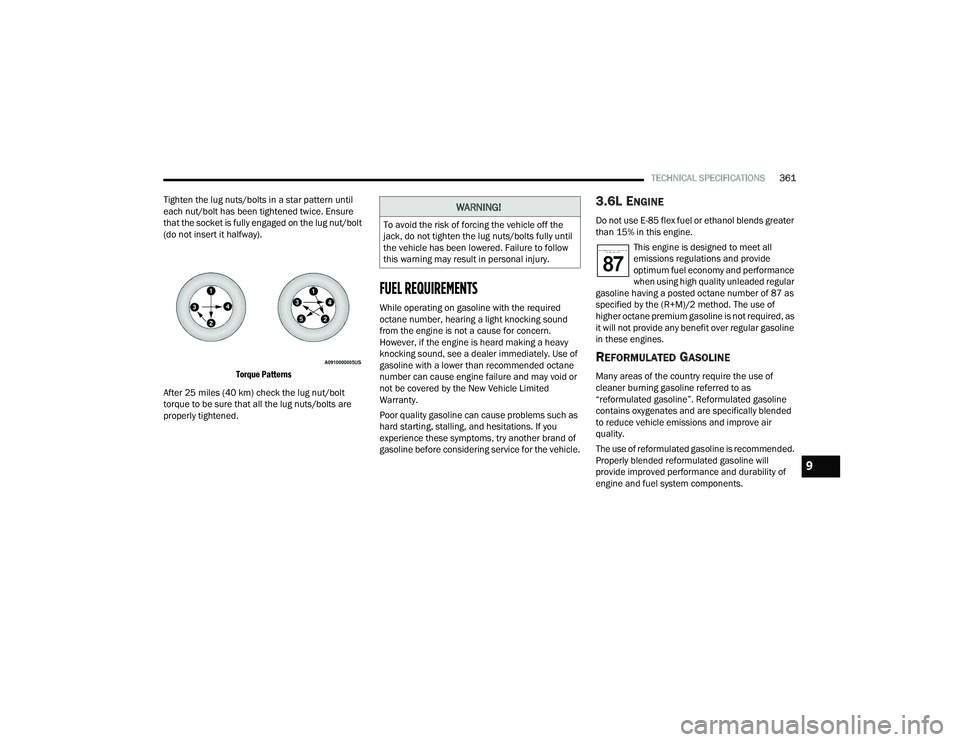
Tighten the lug nuts/bolts in a star pattern until
each nut/bolt has been tightened twice. Ensure
that the socket is fully engaged on the lug nut/bolt
(do not insert it halfway).
Torque Patterns
After 25 miles (40 km) check the lug nut/bolt
torque to be sure that all the lug nuts/bolts are
properly tightened.
FUEL REQUIREMENTS
While operating on gasoline with the required
octane number, hearing a light knocking sound
from the engine is not a cause for concern.
However, if the engine is heard making a heavy
knocking sound, see a dealer immediately. Use of
gasoline with a lower than recommended octane
number can cause engine failure and may void or
not be covered by the New Vehicle Limited
Warranty.
Poor quality gasoline can cause problems such as
hard starting, stalling, and hesitations. If you
experience these symptoms, try another brand of
gasoline before considering service for the vehicle.
3.6L ENGINE
Do not use E-85 flex fuel or ethanol blends greater
than 15% in this engine. This engine is designed to meet all
emissions regulations and provide
optimum fuel economy and performance
when using high quality unleaded regular
gasoline having a posted octane number of 87 as
specified by the (R+M)/2 method. The use of
higher octane premium gasoline is not required, as
it will not provide any benefit over regular gasoline
in these engines.
REFORMULATED GASOLINE
Many areas of the country require the use of
cleaner burning gasoline referred to as
“reformulated gasoline”. Reformulated gasoline
contains oxygenates and are specifically blended
to reduce vehicle emissions and improve air
quality.
The use of reformulated gasoline is recommended.
Properly blended reformulated gasoline will
provide improved performance and durability of
engine and fuel system components.
WARNING!
To avoid the risk of forcing the vehicle off the
jack, do not tighten the lug nuts/bolts fully until
the vehicle has been lowered. Failure to follow
this warning may result in personal injury.
9
22_RUP_OM_EN_USC_t.book Page 361
Page 364 of 384

362TECHNICAL SPECIFICATIONS
GASOLINE/OXYGENATE BLENDS
Some fuel suppliers blend unleaded gasoline with
oxygenates such as ethanol.
Problems that result from using gasoline
containing more than 15% ethanol (E-15) or
gasoline containing methanol are not the
responsibility of the manufacturer and may void or
not be covered under New Vehicle Limited
Warranty.
DO NOT USE E-85 IN NON-FLEX FUEL
V
EHICLES
Non-Flex Fuel Vehicles (FFV) are compatible with
gasoline containing up to 15% ethanol (E-15). Use
of gasoline with higher ethanol content may void
the New Vehicle Limited Warranty.
If a Non-FFV vehicle is inadvertently fueled with
E-85 fuel, the engine will have some or all of these
symptoms:
Operate in a lean mode
OBD II Malfunction Indicator Light on
Poor engine performance
Poor cold start and cold drivability
Increased risk for fuel system component
corrosion
CNG AND LP FUEL SYSTEM
M
ODIFICATIONS
Modifications that allow the engine to run on
Compressed Natural Gas (CNG) or Liquid Propane
(LP) may result in damage to the engine,
emissions, and fuel system components. Problems
that result from running CNG or LP are not the
responsibility of the manufacturer and may void or
not be covered under the New Vehicle Limited
Warranty.
METHYLCYCLOPENTADIENYL
M
ANGANESE TRICARBONYL (MMT) IN
G
ASOLINE
MMT is a manganese-containing metallic additive
that is blended into some gasoline to increase
octane. Gasoline blended with MMT provides no
performance advantage beyond gasoline of the
same octane number without MMT. Gasoline
blended with MMT reduces spark plug life and
reduces emissions system performance in some
vehicles. The manufacturer recommends that
gasoline without MMT be used in your vehicle. The
MMT content of gasoline may not be indicated on
the gasoline pump; therefore, you should ask your
gasoline retailer whether the gasoline contains
MMT. MMT is prohibited in Federal and California
reformulated gasoline.
CAUTION!
DO NOT use E-85, gasoline containing methanol,
or gasoline containing more than 15% ethanol
(E-15). Use of these blends may result in starting
and drivability problems, damage critical fuel
system components, cause emissions to exceed
the applicable standard, and/or cause the
Malfunction Indicator Light to illuminate. Please
observe pump labels as they should clearly
communicate if a fuel contains greater than
15% ethanol (E-15).
22_RUP_OM_EN_USC_t.book Page 362
Page 373 of 384

371
INDEX
A
About Your Brakes......................................... 360Adaptive Cruise Control (ACC)
(Cruise Control).................................... 146, 147Adding Engine Coolant (Antifreeze)............... 325Additives, Fuel............................................... 363AdjustDown........................................................... 47Forward....................................................... 47Rearward..................................................... 47Up................................................................ 47Air Bag........................................................... 251Air Bag Operation...................................... 252Air Bag Warning Light...................... 250, 252Driver Knee Air Bag................................... 257Enhanced Accident Response......... 260, 308Event Data Recorder (EDR)....................... 308Front Air Bag............................................. 252If Deployment Occurs................................ 259Knee Impact Bolsters................................ 256Maintaining Your Air Bag System.............. 261Maintenance............................................. 261
Redundant Air Bag Warning Light............. 251Side Air Bags............................................ 257Transporting Pets..................................... 279Air Bag Light................................ 121, 250, 279Air Cleaner, Engine
(Engine Air Cleaner Filter)............................. 316Air Conditioner Maintenance........................ 317Air Conditioner Refrigerant.................. 317, 318Air Conditioner System................................. 317Air Conditioning Filter..............................83, 318Air Conditioning, Operating Tips....................... 83Air Filter........................................................ 316Air PressureTires......................................................... 347AlarmArm The System.......................................... 22Disarm The System..................................... 22Security Alarm.......................................... 124All Wheel DriveTowing...................................................... 308All Wheel Drive (AWD)................................... 143Alterations/ModificationsVehicle......................................................... 10
Amazon FireTV..................................... 213, 218Amazon FireTV Built-In.................................. 213Antifreeze (Engine Coolant).................. 325, 364Disposal.................................................... 326Anti-Lock Brake System (ABS)....................... 223Anti-Lock Warning Light................................ 124Assist, Hill Start............................................. 227Audio Jack........................................................87Audio Systems (Radio).................................. 187Auto Up Power Windows..................................93Automatic Dimming Mirror...............................57Automatic Headlights.......................................67Automatic Temperature Control (ATC)..............82Automatic Transaxle..................................... 139Automatic Transmission................................ 140Adding Fluid..................................... 328, 366Fluid And Filter Change............................. 328Fluid Change............................................. 328Fluid Level Check...................................... 328Fluid Type........................................ 328, 366Special Additives...................................... 328
11
22_RUP_OM_EN_USC_t.book Page 371
Page 374 of 384

372 AutoPark
........................................................ 132AUX Cord.......................................................... 87Auxiliary Electrical Outlet (Power Outlet).......... 89AWD Towing....................................................... 308Axle Lubrication............................................. 366
B
Back-Up Camera............................................ 168Battery................................................. 121, 314Charging System Light............................... 121Jump Starting............................................ 300Keyless Key Fob Replacement.................... 15Battery Saver Feature...................................... 68Belts, Seat..................................................... 279Blind Spot Monitoring.................................... 229Body Mechanism Lubrication........................ 320B-Pillar Location............................................. 343Brake Assist System...................................... 224Brake Control System, Electronic.................. 224Brake Fluid.................................................... 366Brake System...................................... 327, 360Anti-Lock (ABS).......................................... 360Fluid Check..................................... 327, 366Master Cylinder......................................... 327Parking...................................................... 136Warning Light............................................ 122
Brake/Transmission Interlock...................... 140Brightness, Interior Lights................................ 69Bulb Replacement............................... 337, 338Bulbs, Light................................. 281, 337, 338
C
Camera......................................................... 168Camera, Rear....................................... 168, 169Capacities, Fluid........................................... 364Caps, FillerFuel.......................................................... 172Oil (Engine)............................................... 313Radiator (Coolant Pressure)..................... 326Car Washes................................................... 357Carbon Monoxide Warning............................ 281CargoVehicle Loading........................................ 100Cargo Area Cover.......................................... 100Cargo CompartmentLuggage Carrier........................................ 106Cargo Load Floor........................................... 100Cargo Tie-Downs........................................... 100Cellular Phone.............................................. 222Certification Label......................................... 173Chains, Tire................................................... 353Change Oil Indicator..................................... 114
Changing A Flat Tire...................................... 286Chart, Tire Sizing........................................... 340Check Engine Light
(Malfunction Indicator Light)......................... 130Checking Your Vehicle For Safety.................. 278Checks, Safety.............................................. 278Child Restraint.............................................. 262Child RestraintsBooster Seats........................................... 265Center Seat LATCH................................... 271Child Seat Installation...................... 273, 275How To Stow An unused ALR Seat Belt..... 272Infant And Child Restraints....................... 263Lower Anchors And Tethers For Children.......................................... 266Older Children And Child Restraints.......... 264Seating Positions...................................... 266Using The Top Tether Anchorage.............. 276Clean Air Gasoline......................................... 361CleaningWheels...................................................... 352Climate Control................................................72Automatic....................................................72Manual........................................................77Rear......................................................76, 81Cold Weather Operation................................ 134
22_RUP_OM_EN_USC_t.book Page 372