2022 CHEVROLET BOLT EV clock
[x] Cancel search: clockPage 259 of 316
Chevrolet BOLT EV Owner Manual (GMNA-Localizing-U.S./Canada-
15082216) - 2022 - CRC - 6/25/21
258 Vehicle Care
14. Turn the sealant/air hose (2)counterclockwise to remove it from the
tire valve stem.
15. Replace the tire valve stem cap.
16. Remove the tire sealant canister (4) from the slot on top of the compressor (6).
17. Turn the air only hose (10) counterclockwise to remove it from the
tire sealant canister inlet valve (1).
18. Turn the sealant/air hose (2) clockwise onto the sealant canister inlet valve (1)
to prevent sealant leakage.
19. Return the air only hose (10) and power plug (9) back to their original storage
location.
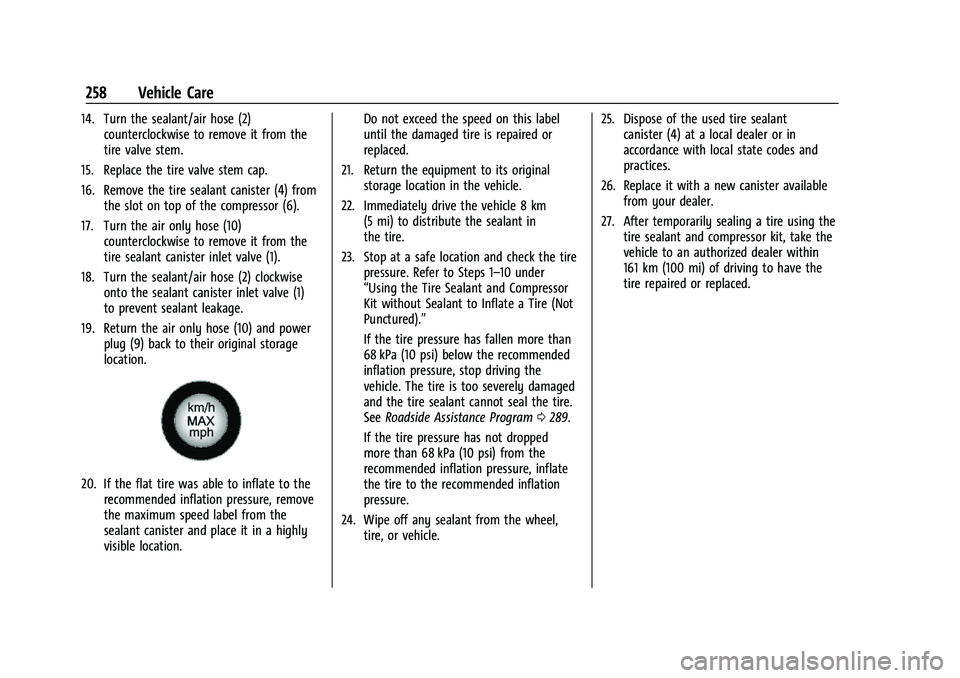
20. If the flat tire was able to inflate to therecommended inflation pressure, remove
the maximum speed label from the
sealant canister and place it in a highly
visible location. Do not exceed the speed on this label
until the damaged tire is repaired or
replaced.
21. Return the equipment to its original storage location in the vehicle.
22. Immediately drive the vehicle 8 km (5 mi) to distribute the sealant in
the tire.
23. Stop at a safe location and check the tire pressure. Refer to Steps 1–10 under
“Using the Tire Sealant and Compressor
Kit without Sealant to Inflate a Tire (Not
Punctured).”
If the tire pressure has fallen more than
68 kPa (10 psi) below the recommended
inflation pressure, stop driving the
vehicle. The tire is too severely damaged
and the tire sealant cannot seal the tire.
SeeRoadside Assistance Program 0289.
If the tire pressure has not dropped
more than 68 kPa (10 psi) from the
recommended inflation pressure, inflate
the tire to the recommended inflation
pressure.
24. Wipe off any sealant from the wheel, tire, or vehicle. 25. Dispose of the used tire sealant
canister (4) at a local dealer or in
accordance with local state codes and
practices.
26. Replace it with a new canister available from your dealer.
27. After temporarily sealing a tire using the tire sealant and compressor kit, take the
vehicle to an authorized dealer within
161 km (100 mi) of driving to have the
tire repaired or replaced.
Page 260 of 316
Chevrolet BOLT EV Owner Manual (GMNA-Localizing-U.S./Canada-
15082216) - 2022 - CRC - 6/25/21
Vehicle Care 259
Using the Tire Sealant and Compressor
Kit without Sealant to Inflate a Tire (Not
Punctured)
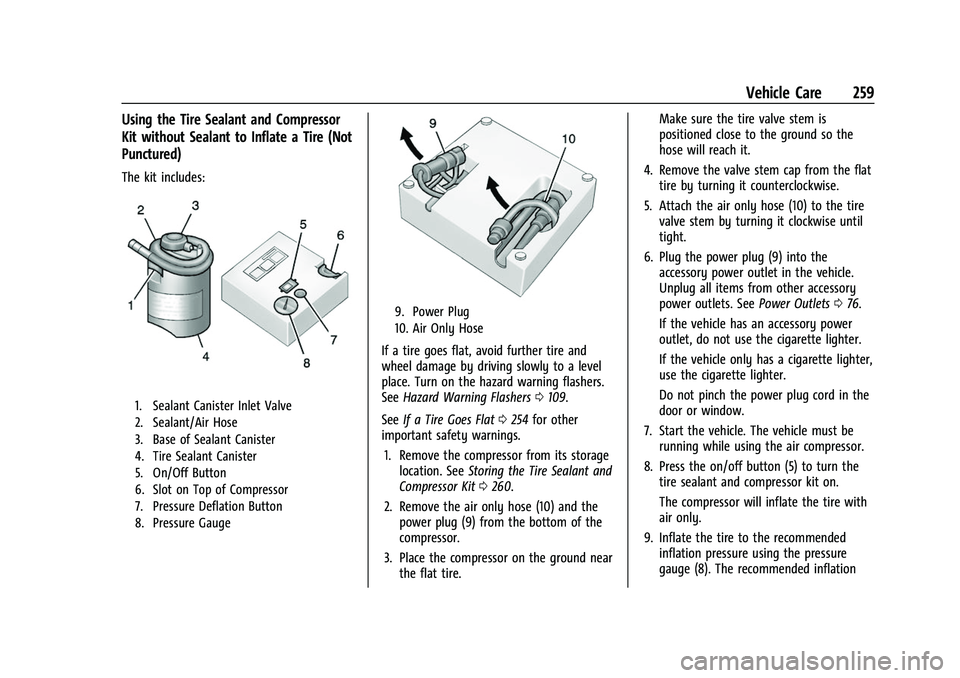
The kit includes:
1. Sealant Canister Inlet Valve
2. Sealant/Air Hose
3. Base of Sealant Canister
4. Tire Sealant Canister
5. On/Off Button
6. Slot on Top of Compressor
7. Pressure Deflation Button
8. Pressure Gauge
9. Power Plug
10. Air Only Hose
If a tire goes flat, avoid further tire and
wheel damage by driving slowly to a level
place. Turn on the hazard warning flashers.
SeeHazard Warning Flashers 0109.
See If a Tire Goes Flat 0254 for other
important safety warnings.
1. Remove the compressor from its storage location. See Storing the Tire Sealant and
Compressor Kit 0260.
2. Remove the air only hose (10) and the power plug (9) from the bottom of the
compressor.
3. Place the compressor on the ground near the flat tire. Make sure the tire valve stem is
positioned close to the ground so the
hose will reach it.
4. Remove the valve stem cap from the flat tire by turning it counterclockwise.
5. Attach the air only hose (10) to the tire valve stem by turning it clockwise until
tight.
6. Plug the power plug (9) into the accessory power outlet in the vehicle.
Unplug all items from other accessory
power outlets. See Power Outlets076.
If the vehicle has an accessory power
outlet, do not use the cigarette lighter.
If the vehicle only has a cigarette lighter,
use the cigarette lighter.
Do not pinch the power plug cord in the
door or window.
7. Start the vehicle. The vehicle must be running while using the air compressor.
8. Press the on/off button (5) to turn the tire sealant and compressor kit on.
The compressor will inflate the tire with
air only.
9. Inflate the tire to the recommended inflation pressure using the pressure
gauge (8). The recommended inflation
Page 261 of 316

Chevrolet BOLT EV Owner Manual (GMNA-Localizing-U.S./Canada-
15082216) - 2022 - CRC - 6/25/21
260 Vehicle Care
pressure can be found on the Tire and
Loading Information label. SeeTire
Pressure 0243.
The pressure gauge (8) may read higher
than the actual tire pressure while the
compressor is on. Turn the compressor
off to get an accurate pressure reading.
The compressor may be turned on/off
until the correct pressure is reached.
Caution
If the recommended pressure cannot be
reached after approximately 25 minutes,
the vehicle should not be driven farther.
The tire is too severely damaged and the
tire sealant and compressor kit cannot
inflate the tire. Remove the power plug
from the accessory power outlet and
unscrew the inflating hose from the tire
valve. See Roadside Assistance Program
0 289.
10. Press the on/off button (5) to turn the tire sealant and compressor kit off.
Be careful while handling the compressor
as it could be warm after usage.
11. Unplug the power plug (9) from the accessory power outlet in the vehicle. 12. Turn the air only hose (10)
counterclockwise to remove it from the
tire valve stem.
13. Replace the tire valve stem cap.
14. Return the air only hose (10) and power plug (9) back to their original storage
location.
15. Return the equipment to its original storage location in the vehicle.
The tire sealant and compressor kit has
accessory adapters located in a
compartment on the bottom of its housing
that can be used to inflate air mattresses,
balls, etc.
Storing the Tire Sealant and
Compressor Kit
To access the tire sealant and
compressor kit: 1. Open the liftgate. See Liftgate018.
2. Remove the load floor.
3. Remove the tire sealant canister (1) and the compressor (2).
To store the tire sealant canister and the
compressor, reverse the steps.
Jump Starting
Jump Starting - North America
For more information about the vehicle
battery, see Battery - North America 0224.
If the 12-volt battery has run down, try to
use another vehicle and some jumper cables
to start your vehicle. Be sure to use the
following steps to do it safely.
Page 308 of 316
Chevrolet BOLT EV Owner Manual (GMNA-Localizing-U.S./Canada-
15082216) - 2022 - CRC - 6/25/21
Index 307
Climate Control SystemsAutomatic . . . . . . . . . . . . . . . . . . . . . . . . . . . . . 148
Clock . . . . . . . . . . . . . . . . . . . . . . . . . . . . . . . . . . . . . 76
Cluster, Instrument . . . . . . . . . . . . . . . . . . . . . . . 79
Collision Damage Repair . . . . . . . . . . . . . . . . . 291
Compartment Underhood . . . . . . . . . . . . . . . . . . . . . . . . . . . . 220
Compartments Storage . . . . . . . . . . . . . . . . . . . . . . . . . . . . . . . . . 69
Compass . . . . . . . . . . . . . . . . . . . . . . . . . . . . . . . . . . .75
Compressor Kit, Tire Sealant . . . . . . . . . . . . . 255
Connected Services Connections . . . . . . . . . . . . . . . . . . . . . . . . . . . 302
Diagnostics . . . . . . . . . . . . . . . . . . . . . . . . . . . . 304
Navigation . . . . . . . . . . . . . . . . . . . . . . . . . . . . . 302
Connections
Connected Services . . . . . . . . . . . . . . . . . . . . 302
Control Traction and Electronic Stability . . . . . . . . 175
Control of a Vehicle . . . . . . . . . . . . . . . . . . . . . .158
Controls Steering Wheel . . . . . . . . . . . . . . . . . . . . . . . . . 114
Convex Mirrors . . . . . . . . . . . . . . . . . . . . . . . . . . . 20
Cooling . . . . . . . . . . . . . . . . . . . . . . . . . . . . . . . . . . 148
Cooling System . . . . . . . . . . . . . . . . . . . . . . . . . . . 221
Courtesy Lamps . . . . . . . . . . . . . . . . . . . . . . . . . . .110
Courtesy Transportation Program . . . . . . . . 290 Cover
Cargo . . . . . . . . . . . . . . . . . . . . . . . . . . . . . . . . . . . 70
Cruise Control . . . . . . . . . . . . . . . . . . . . . . . . . . . 176 Light . . . . . . . . . . . . . . . . . . . . . . . . . . . . . . . . . . . . 89
Cruise Control, Adaptive . . . . . . . . . . . . . . . . . .178
Cupholders . . . . . . . . . . . . . . . . . . . . . . . . . . . . . . . 69
Customer Assistance . . . . . . . . . . . . . . . . . . . . . 288 Offices . . . . . . . . . . . . . . . . . . . . . . . . . . . . . . . . . 287
Text Telephone (TTY) Users . . . . . . . . . . . . 288
Customer Information Publications Ordering Information . . . . . 293
Customer Satisfaction Procedure . . . . . . . . . 286
Cybersecurity . . . . . . . . . . . . . . . . . . . . . . . . . . . . 295
D
Damage Repair, Collision . . . . . . . . . . . . . . . . . 291
Danger, Warning, and Caution . . . . . . . . . . . . . .2
Data Collection OnStar . . . . . . . . . . . . . . . . . . . . . . . . . . . . . . . . . 296
Data Recorders, Event . . . . . . . . . . . . . . . . . . . 295
Daytime Running Lamps (DRL) . . . . . . . . . . . 108
Defensive Driving . . . . . . . . . . . . . . . . . . . . . . . . . 157
Delayed Charging Override . . . . . . . . . . . . . . 204
Delayed Locking . . . . . . . . . . . . . . . . . . . . . . . . . . .16
Diagnostics Connected Services . . . . . . . . . . . . . . . . . . . . 304
Distracted Driving . . . . . . . . . . . . . . . . . . . . . . . . . 157
Dome Lamps . . . . . . . . . . . . . . . . . . . . . . . . . . . . . .110 Door
Ajar Light . . . . . . . . . . . . . . . . . . . . . . . . . . . . . . . 90
Delayed Locking . . . . . . . . . . . . . . . . . . . . . . . . 16
Locks . . . . . . . . . . . . . . . . . . . . . . . . . . . . . . . . . . . . 15
Power Locks . . . . . . . . . . . . . . . . . . . . . . . . . . . . 16
Drive Unit Electric . . . . . . . . . . . . . . . . . . . . . . . . . . . . . . . . . 169
Driver Teen . . . . . . . . . . . . . . . . . . . . . . . . . . . . . . . . . . . 140
Driver Assistance Systems . . . . . . . . . . . . . . . .187
Driver Efficiency Gauge . . . . . . . . . . . . . . . . . . . 82
Driver Information Center (DIC) . . . . . . . . . . . 99
Driver Selected Operating Modes . . . . . . . . 168
Driving Assistance Systems . . . . . . . . . . . . . . . . . . . . 192
Defensive . . . . . . . . . . . . . . . . . . . . . . . . . . . . . . . 157
Hill and Mountain Roads . . . . . . . . . . . . . . 160
If the Vehicle is Stuck . . . . . . . . . . . . . . . . . 162
Impaired . . . . . . . . . . . . . . . . . . . . . . . . . . . . . . . 158
Loss of Control . . . . . . . . . . . . . . . . . . . . . . . . 159
Off-Road Recovery . . . . . . . . . . . . . . . . . . . . . 159
One-Pedal . . . . . . . . . . . . . . . . . . . . . . . . . . . . . . . 171
Vehicle Load Limits . . . . . . . . . . . . . . . . . . . . 162
Wet Roads . . . . . . . . . . . . . . . . . . . . . . . . . . . . . 160
Winter . . . . . . . . . . . . . . . . . . . . . . . . . . . . . . . . . . 161
Driving for Better Energy Efficiency . . . . . . 156