2022 CADILLAC ESCALADE weight
[x] Cancel search: weightPage 104 of 508

Cadillac Escalade Owner Manual (GMNA-Localizing-U.S./Canada/Mexico-
15567102) - 2022 - CRC - 11/17/21
STORAGE 103
Warning (Continued)
starts, sharp turns, sudden braking,
or abrupt maneuvers when carrying
cargo on the roof rack.
The weight of any cargo carried on the
roof rack system must be included in
calculating the loaded weight of the
vehicle. Do not exceed the maximum
vehicle capacity when loading the
vehicle, including cargo carried on the
roof rack system and passengers and
cargo carried in the vehicle. For more
information on vehicle capacity and
loading, see Vehicle Load Limits 0241.
Page 238 of 508

Cadillac Escalade Owner Manual (GMNA-Localizing-U.S./Canada/Mexico-
15567102) - 2022 - CRC - 11/17/21
DRIVING AND OPERATING 237
2. Shift into P (Park) and then restartthe engine.
.If driving uphill when the
vehicle stalls, shift to
R (Reverse), release the parking
brake, and back straight down.
.Never try to turn the vehicle
around. If the hill is steep
enough to stall the vehicle, it is
steep enough to cause it to
roll over.
.If you cannot make it up the
hill, back straight down the hill.
.Never back down a hill in
N (Neutral) using only the
brake. The vehicle can roll
backward quickly and you could
lose control.
.If driving downhill when the
vehicle stalls, shift to a lower
gear, release the parking brake,
and drive straight down the hill.
3. If the vehicle cannot be restarted after stalling, set the parking brake,
shift into P (Park), and turn the
vehicle off.
3.1. Leave the vehicle and seek help. 3.2. Stay clear of the path the
vehicle would take if it rolled
downhill.
.Avoid turns that take the vehicle
across the incline of the hill. A hill
that can be driven straight up or
down might be too steep to drive
across. Driving across an incline
puts more weight on the downhill
wheels, which could cause a
downhill slide or a rollover.
.Surface conditions can be a
problem. Loose gravel, muddy spots,
or even wet grass can cause the
tires to slip sideways, downhill.
If the vehicle slips sideways, it can
hit something that will trip it —a
rock, a rut, etc. —and roll over.
.Hidden obstacles can make the
steepness of the incline more
severe. If a rock is driven across
with the uphill wheels, or if the
downhill wheels drop into a rut or
depression, the vehicle can tilt
even more.
.If an incline must be driven across,
and the vehicle starts to slide, turn
downhill. This should help
straighten out the vehicle and
prevent the side slipping.
{Warning
Getting out of the vehicle on the
downhill side when stopped across
an incline is dangerous. If the
vehicle rolls over, you could be
crushed or killed. Always get out on
the uphill side of the vehicle and
stay well clear of the rollover path.
Driving in Mud, Sand, Snow,
or Ice
Use a low gear when driving in
mud —the deeper the mud, the
lower the gear. Keep the vehicle
moving to avoid getting stuck.
Traction changes when driving on
sand. On loose sand, such as on
beaches or sand dunes, the tires tend
to sink into the sand. This affects
steering, accelerating, and braking.
Drive at a reduced speed and avoid
sharp turns or abrupt maneuvers.
Page 242 of 508

Cadillac Escalade Owner Manual (GMNA-Localizing-U.S./Canada/Mexico-
15567102) - 2022 - CRC - 11/17/21
DRIVING AND OPERATING 241
Warning (Continued)
.Open a window about 5 cm (2 in)
on the vehicle side that is away
from the wind, to bring in
fresh air.
.Fully open the air outlets on or
under the instrument panel.
.Adjust the climate control
system to circulate the air inside
the vehicle and set the fan speed
to the highest setting. See
“Climate Control Systems.”
For more information about CO, see
Engine Exhaust 0252.
To save fuel, run the engine for short
periods to warm the vehicle and then
shut the engine off and partially close
the window. Moving about to keep
warm also helps.
If it takes time for help to arrive,
when running the engine, push the
accelerator pedal slightly so the
engine runs faster than the idle speed.
This keeps the battery charged to
restart the vehicle and to signal for
help with the headlamps. Do this as
little as possible, to save fuel.
If the Vehicle Is Stuck
Slowly and cautiously spin the wheels
to free the vehicle when stuck in sand,
mud, ice, or snow.
If stuck too severely for the traction
system to free the vehicle, turn the
traction system off and use the
rocking method. See Traction Control/
Electronic Stability Control 0265.
{Warning
If the vehicle's tires spin at high
speed, they can explode, and you or
others could be injured. The vehicle
can overheat, causing an engine
compartment fire or other damage.
Spin the wheels as little as possible
and avoid going above 56 km/h
(35 mph).
Rocking the Vehicle to Get it Out
Turn the steering wheel left and right
to clear the area around the front
wheels. Turn off any traction system.
Shift back and forth between
R (Reverse) and a low forward gear,
spinning the wheels as little as
possible. To prevent transmission wear, wait until the wheels stop
spinning before shifting gears. Release
the accelerator pedal while shifting,
and press lightly on the accelerator
pedal when the transmission is in
gear. Slowly spinning the wheels in
the forward and reverse directions
causes a rocking motion that could
free the vehicle. If that does not get
the vehicle out after a few tries, it
might need to be towed out. If the
vehicle does need to be towed out, see
Towing the Vehicle
0439.
Vehicle Load Limits
It is very important to know how
much weight the vehicle can carry.
This weight is called the vehicle
capacity weight and includes the
weight of all occupants, cargo, and
all nonfactory-installed options.
Two labels on the vehicle may
show how much weight it was
designed to carry, the Tire and
Loading Information label and the
Certification/Tire label.
Page 243 of 508

Cadillac Escalade Owner Manual (GMNA-Localizing-U.S./Canada/Mexico-
15567102) - 2022 - CRC - 11/17/21
242 DRIVING AND OPERATING
{Warning
Do not load the vehicle any
heavier than the Gross Vehicle
Weight Rating (GVWR),
or either the maximum front or
rear Gross Axle Weight Rating
(GAWR). This can cause
systems to break and change
the way the vehicle handles.
This could cause loss of control
and a crash. Overloading can
also reduce stopping
performance, damage the tires,
and shorten the life of the
vehicle.Tire and Loading Information Label
Label Example
A vehicle specific Tire and
Loading Information label is
attached to the center pillar
(B-pillar). The tire and loading
information label shows the
number of occupant seating
positions (1), and the maximum
vehicle capacity weight (2) in
kilograms and pounds. The Tire and Loading Information
label also shows the size of the
original equipment tires (3) and
the recommended cold tire
inflation pressures (4). For more
information on tires and inflation
see
Tires 0402 and
Tire Pressure 0409.
There is also important loading
information on the vehicle
Certification/Tire label. It may
show the Gross Vehicle Weight
Rating (GVWR) and the Gross Axle
Weight Rating (GAWR) for the
front and rear axles. See
“Certification/Tire Label” later in
this section.
“Steps for Determining Correct Load
Limit–
1.
Locate the statement "The
combined weight of occupants
and cargo should never exceed
XXX kg or XXX lbs." on your
vehicle’s placard.
Page 244 of 508

Cadillac Escalade Owner Manual (GMNA-Localizing-U.S./Canada/Mexico-
15567102) - 2022 - CRC - 11/17/21
DRIVING AND OPERATING 243
2.Determine the combined weight
of the driver and passengers
that will be riding in your
vehicle.
3.Subtract the combined weight
of the driver and passengers
from XXX kg or XXX lbs.
4.The resulting figure equals the
available amount of cargo and
luggage load capacity. For
example, if the "XXX" amount
equals 1400 lbs. and there will
be five 150 lb passengers in
your vehicle, the amount of
available cargo and luggage
load capacity is 650 lbs.
(1400-750 (5 x 150) = 650 lbs.)
5.Determine the combined weight
of luggage and cargo being
loaded on the vehicle. That
weight may not safely exceed
the available cargo and luggage
load capacity calculated in
Step 4.
6.If your vehicle will be towing a
trailer, load from your trailer
will be transferred to your
vehicle. Consult this manual to
determine how this reduces the
available cargo and luggage
load capacity of your vehicle.”
SeeTrailer Towing 0340 for important
information on towing a trailer,
towing safety rules, and trailering tips.
Example 1
1. Maximum Vehicle Capacity Weight for Example 1 = 453 kg
(1,000 lbs) 2. Subtract Occupant Weight @
68 kg (150 lbs) × 2 = 136 kg
(300 lbs)
3. Available Occupant and Cargo Weight = 317 kg (700 lbs)
Example 2
1. Vehicle Capacity Weight forExample 2 = 453 kg (1,000 lbs)
2. Subtract Occupant Weight @ 68 kg (150 lbs) × 5 = 136 kg
(750 lbs)
3. Available Cargo Weight = 113 kg (250 lbs)
Page 245 of 508
Cadillac Escalade Owner Manual (GMNA-Localizing-U.S./Canada/Mexico-
15567102) - 2022 - CRC - 11/17/21
244 DRIVING AND OPERATING
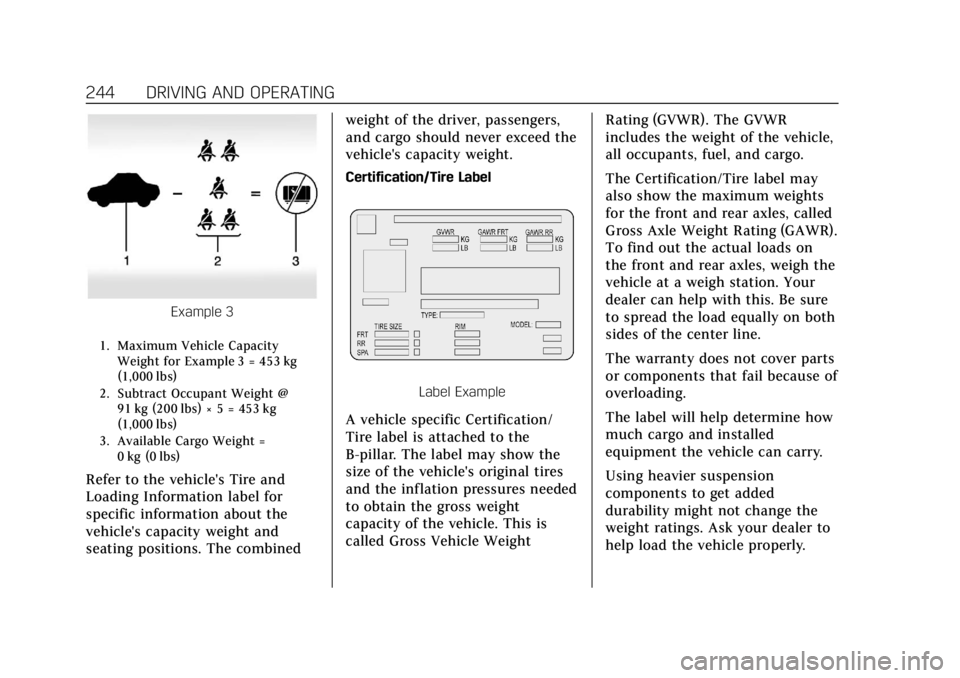
Example 3
1. Maximum Vehicle CapacityWeight for Example 3 = 453 kg
(1,000 lbs)
2. Subtract Occupant Weight @ 91 kg (200 lbs) × 5 = 453 kg
(1,000 lbs)
3. Available Cargo Weight = 0 kg (0 lbs)
Refer to the vehicle's Tire and
Loading Information label for
specific information about the
vehicle's capacity weight and
seating positions. The combined weight of the driver, passengers,
and cargo should never exceed the
vehicle's capacity weight.
Certification/Tire Label
Label Example
A vehicle specific Certification/
Tire label is attached to the
B-pillar. The label may show the
size of the vehicle's original tires
and the inflation pressures needed
to obtain the gross weight
capacity of the vehicle. This is
called Gross Vehicle Weight
Rating (GVWR). The GVWR
includes the weight of the vehicle,
all occupants, fuel, and cargo.
The Certification/Tire label may
also show the maximum weights
for the front and rear axles, called
Gross Axle Weight Rating (GAWR).
To find out the actual loads on
the front and rear axles, weigh the
vehicle at a weigh station. Your
dealer can help with this. Be sure
to spread the load equally on both
sides of the center line.
The warranty does not cover parts
or components that fail because of
overloading.
The label will help determine how
much cargo and installed
equipment the vehicle can carry.
Using heavier suspension
components to get added
durability might not change the
weight ratings. Ask your dealer to
help load the vehicle properly.
Page 246 of 508

Cadillac Escalade Owner Manual (GMNA-Localizing-U.S./Canada/Mexico-
15567102) - 2022 - CRC - 11/17/21
DRIVING AND OPERATING 245
{Warning
Things you put inside the
vehicle can strike and injure
people in a sudden stop or turn,
or in a crash.
.Put things in the cargo area
of the vehicle. Try to spread
the weight evenly.
.Never stack heavier things,
like suitcases, inside the
vehicle so that some of them
are above the tops of the
seats.
.Do not leave an unsecured
child restraint in the vehicle.
.When you carry something
inside the vehicle, secure it
whenever you can.
.Do not leave a seat folded
down unless you need to. There is also important loading
information for off-road driving in
this manual. See
“Loading the
Vehicle for Off-Road Driving”
under Off-Road Driving 0235.
Add-On Equipment
There may be a limit on how
many people can be inside the
vehicle when carrying removable
items. Be sure to weigh the vehicle
before buying and installing the
new equipment.
Caution
Overloading the vehicle may cause
damage. Repairs would not be
covered by the vehicle warranty. Do
not overload the vehicle.
Remember not to exceed the
Gross Axle Weight Rating (GAWR)
of the front or rear axle.
Starting and Operating
New Vehicle Break-In
Caution
The vehicle does not need an
elaborate break-in. But it will
perform better in the long run if
you follow these guidelines:
.Do not drive at any one constant
speed, fast or slow, for the first
800 km (500 mi). Do not make
full-throttle starts. Avoid
downshifting to brake or slow the
vehicle.
.Avoid making hard stops for the
first 300 km (200 mi) or so.
During this time the new brake
linings are not yet broken in.
Hard stops with new linings can
mean premature wear and earlier
replacement. Follow this
breaking-in guideline every time
you get new brake linings. (Continued)
Page 270 of 508

Cadillac Escalade Owner Manual (GMNA-Localizing-U.S./Canada/Mexico-
15567102) - 2022 - CRC - 11/17/21
DRIVING AND OPERATING 269
remain active. Otherwise, the vehicle
will start in Tour mode. Tow/Haul
mode turns on trailer sway control.
If equipped with a diesel engine,
exhaust braking is automatically
activated when Tow/Haul mode is
selected. The system will command
down shifts to reduce vehicle speed
when the brake is applied. The normal
tow/haul shift pattern will return once
the vehicle is on a low grade or when
the accelerator pedal is pressed. While
in the Electronic Range Select (ERS)
Mode (seeManual Mode 0256), grade
braking is deactivated, allowing the
driver to select a range, and limiting
the highest gear available.
For more information on trailer
weight specifications, see Towing
Equipment 0344.
gTerrain Mode : Use this mode
when traveling on very rough roads at
very low speeds, such as a two-track
or heavily rutted road. This mode can
also be used for pulling a boat out of
the water on a trailer. When in Terrain
mode, the vehicle shifts automatically,
but will hold a lower gear longer to
maximize engine torque. This mode has a unique pedal map and
transmission shift pattern for better
control at lower speeds and over
rough terrain. This mode modifies
accelerator pedal mapping,
transmission shift pattern, ride height,
and Electronic Limited-Slip
Differential (eSLD).
When the vehicle comes to a stop on
an upward grade, automatic vehicle
hold is engaged until the driver
presses the accelerator pedal. Stop/
Start and cruise control are disabled
in Terrain mode.
Active Braking during lift throttle will
be engaged. This feature automatically
applies light braking to simulate
heavy engine braking of
four-wheel-drive low. It also applies
light braking in D (Drive) until the
vehicle is at idle speeds. In L1 and L2
light braking will typically bring the
vehicle to a stop. Active Braking
during lift throttle also reduces trailer
braking.
Terrain mode automatically exits to
Tour mode if the brake temperatures
become too hot, electronic parking
brake becomes inoperable, or the
vehicle cannot perform braking or
vehicle hold.
For more information on off-road
driving, see
Off-Road Driving 0235 and
Hill and Mountain Roads 0239.
My Mode
My mode is used to personalize
everyday driving. This mode allows
the driver to configure the vehicle
system settings to their driving
preferences. My mode will remain
active every time the vehicle is
started. To customize My mode, see
“Drive Mode Customization.”
Drive Mode Customization
The vehicle is equipped to modify the
following settings based on vehicle
content. Through the center radio
display, select Vehicle Settings>Drive
Mode Customization to customize and
personalize My mode, or turn off or
on Visualization.
My Mode
These settings will be retained over
each key cycle, and do not have to be
reset each time the vehicle is started.