2021 TOYOTA YARIS CROSS weight
[x] Cancel search: weightPage 52 of 650
50
YARIS CROSS Owner's Manual_Europe_M52K60_en
1-2. Child safety
■When installing a child
restraint system to a front pas-
senger seat
For the safety of a child, install a
child restraint system to a rear seat.
When installing a child restraint
system to a front passenger seat is
unavoidable, adjust the seat as fol-
lows and install the child restraint
system:
Move the front seat fully rear-
ward.
Adjust the seat height to the
upper most position.
Adjust the seatback angle to the
most upright position.
When installing a forward-facing child
WARNING
●For effective protection in automo- bile accidents and sudden stops, a
child must be properly restrained, using a seat belt or child restraint system which is correctly installed.
For installation details, refer to the operation manual enclosed with the child restraint system. General
installation instruction is provided in this manual.
●Toyota strongly urges the use of a proper child restraint system that conforms to the weight and size of
the child, installed on the rear seat. According to accident statistics, the child is safer when properly
restrained in the rear seat than in the front seat.
●Holding a child in your or someone else’s arms is not a substitute for a child restraint system. In an acci-
dent, the child can be crushed against the windshield or between the holder and the interior of the
vehicle.
■Handling the child restraint sys-
tem
If the child restraint system is not properly fixed in place, the child or
other passengers may be seriously injured or even killed in the event of sudden braking, sudden swerving, or
an accident.
●If the vehicle were to receive a
strong impact from an accident, etc., it is possible that the child restraint system has damage that is
not readily visible. In such cases, do not reuse the restraint system.
●Depending on the child restraint system, installation may be difficult or impossible. In those cases,
check whether the child restraint system is suitable for installment in the vehicle. ( P.53) Be sure to
install and observe the usage rules after carefully reading the child restraint system fixing method in
this manual, as well as the opera- tion manual enclosed with the child restraint system.
●Keep the child restraint system properly secured on the seat even if
it is not in use. Do not store the child restraint system unsecured in the passenger compartment.
●If it is necessary to detach the child restraint system, remove it from the
vehicle or store it securely in the luggage compartment.
When using a child restraint
system
Page 55 of 650

53
1
YARIS CROSS Owner's Manual_Europe_M52K60_en
1-2. Child safety
For safety and security
■Child restraint system compat-
ibility for each seating posi-
tion
Compatibility of each seating posi-
tion with child restraint systems
( P.54) displays the type of child
restraint systems that can be used
and possible seating positions for
installation using symbols.
Also, the recommended child
restraint system that is suitable for
your child can be selected.
Otherwise, check [Recommended
child restraint systems lineup] for
recommended child restraint sys-
tems. ( P. 5 8 )
Check the selected child restraint
system together with the following
[Before confirming the compatibility
of each seating position with child
restraint systems].
■Before confirming the compat-
ibility of each seating position
with child restraint systems
1 Checking the child restraint sys-
tem standards.
Use a child restraint system that
conforms to UN (ECE) R44*1 or
UN (ECE) R129*1, 2.
The following approval mark is
displayed on child restraint sys-
tems which are conformed.
Check for an approval mark
attached to the child restraint
system.
Example of the displayed regulation
number
UN (ECE) R44 approval mark*3
The weight range of the child
who is applicable for an UN
(ECE) R44 approval mark is
WARNING
●Use child restraint system suitable to the age and size of the child and
install it to the rear seat.
●If the driver’s seat interferes with
the child restraint system and pre- vents it from being attached cor-rectly, attach the child restraint
system to the right-hand rear seat (left-hand drive vehicles) or the left-hand rear seat (right-hand drive
vehicles). ( P. 5 8 )
Child restraint system com-
patibility for each seating
position
Page 56 of 650
54
YARIS CROSS Owner's Manual_Europe_M52K60_en
1-2. Child safety
indicated.
UN (ECE) R129 approval
mark*3
The height range of the child
who is applicable as well as
available weights for an UN
(ECE) R129 approval mark is
indicated.
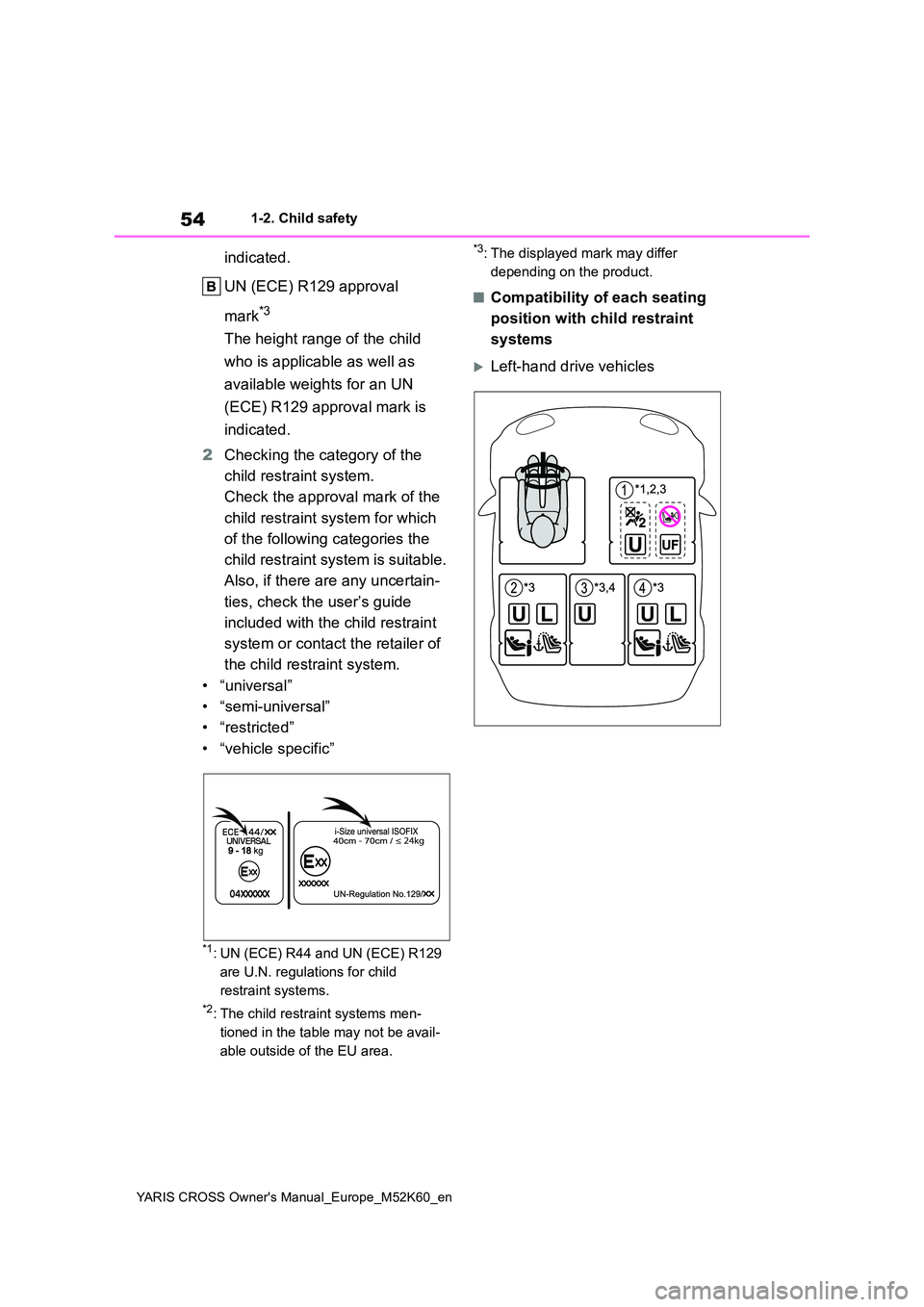
2 Checking the category of the
child restraint system.
Check the approval mark of the
child restraint system for which
of the following categories the
child restraint system is suitable.
Also, if there are any uncertain-
ties, check the user’s guide
included with the child restraint
system or contact the retailer of
the child restraint system.
•“universal”
• “semi-universal”
• “restricted”
• “vehicle specific”
*1: UN (ECE) R44 and UN (ECE) R129
are U.N. regulations for child
restraint systems.
*2: The child restraint systems men-
tioned in the table may not be avail-
able outside of the EU area.
*3: The displayed mark may differ
depending on the product.
■Compatibility of each seating
position with child restraint
systems
Left-hand drive vehicles
Page 59 of 650
57
1
YARIS CROSS Owner's Manual_Europe_M52K60_en
1-2. Child safety
For safety and security
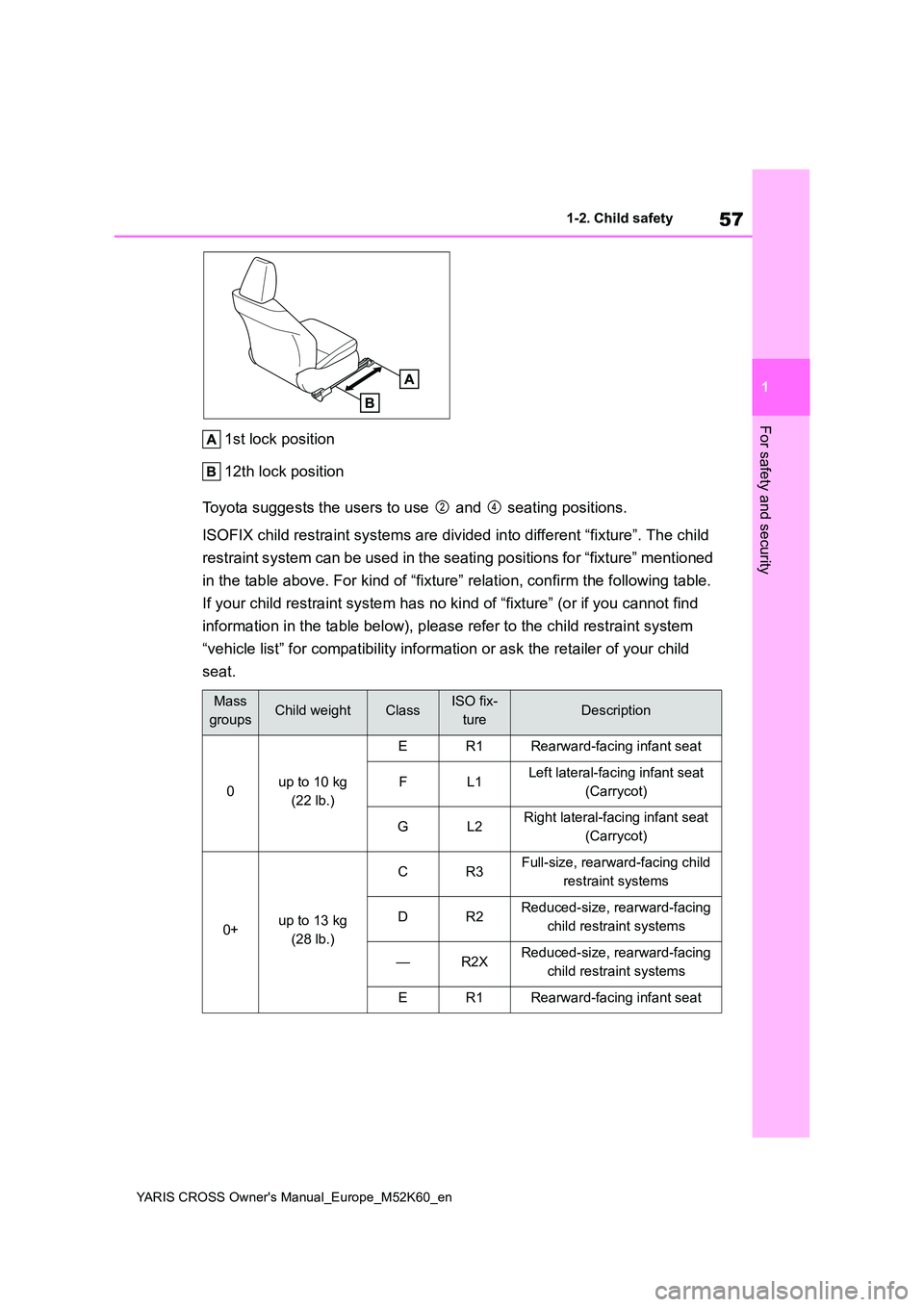
1st lock position
12th lock position
Toyota suggests the users to use and seating positions.
ISOFIX child restraint systems are divided into different “fixt ure”. The child
restraint system can be used in the seating positions for “fixt ure” mentioned
in the table above. For kind of “ fixture” relation, confirm the following table.
If your child restraint system ha s no kind of “fixture” (or if you cannot find
information in the table below), please refer to the child rest raint system
“vehicle list” for compatibility information or ask the retaile r of your child
seat.
Mass
groupsChild weightClassISO fix-
tureDescription
0up to 10 kg
(22 lb.)
ER1Rearward-facing infant seat
FL1Left lateral-facing infant seat
(Carrycot)
GL2Right lateral-facing infant seat
(Carrycot)
0+up to 13 kg
(28 lb.)
CR3Full-size, rearward-facing child
restraint systems
DR2Reduced-size, rearward-facing
child restraint systems
—R2XReduced-size, rearward-facing
child restraint systems
ER1Rearward-facing infant seat
Page 60 of 650
58
YARIS CROSS Owner's Manual_Europe_M52K60_en
1-2. Child safety
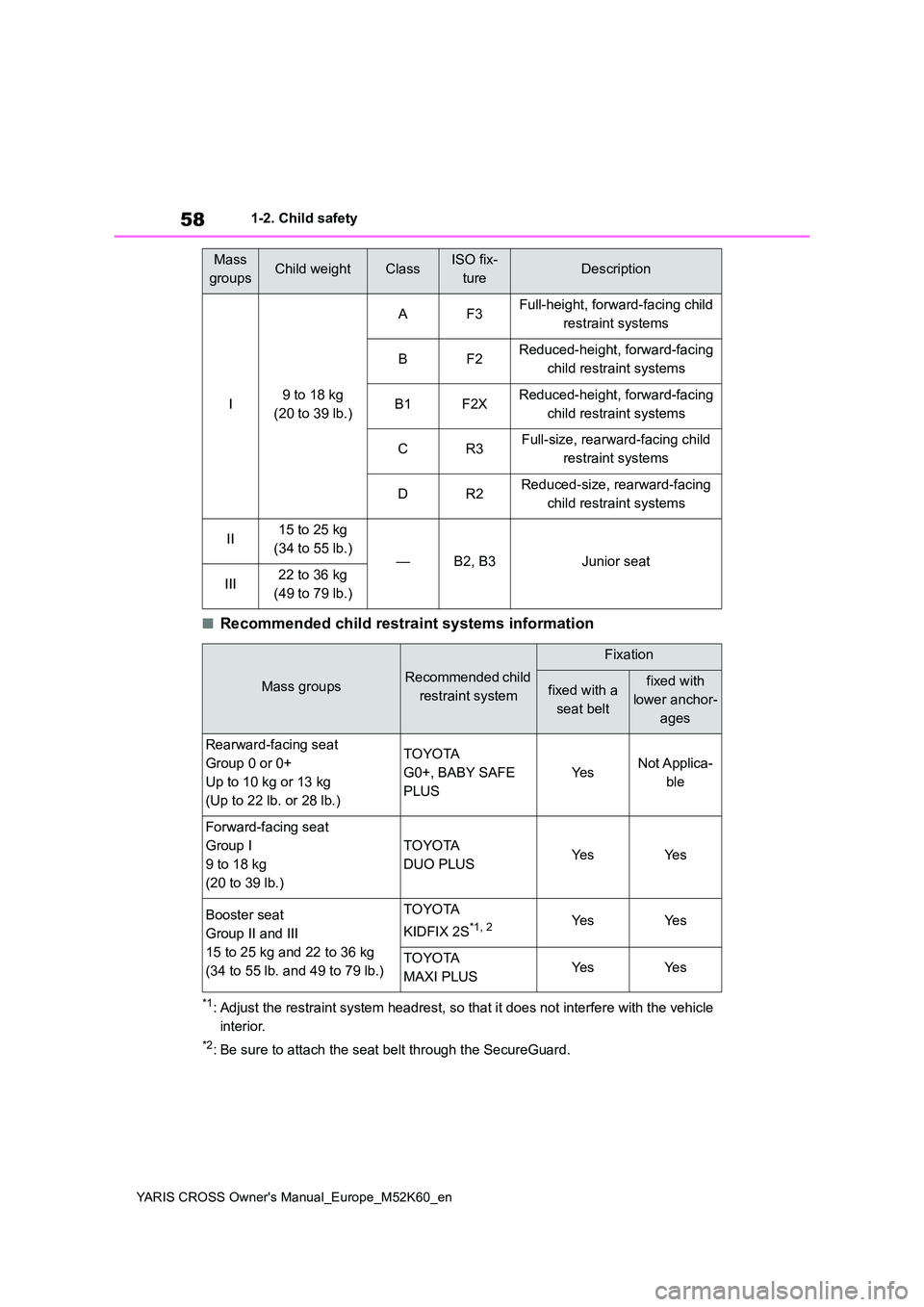
■Recommended child restraint systems information
*1: Adjust the restraint system headrest, so that it does not interfere with the vehicle
interior.
*2: Be sure to attach the seat belt through the SecureGuard.
I9 to 18 kg
(20 to 39 lb.)
AF3Full-height, forward-facing child
restraint systems
BF2Reduced-height, forward-facing
child restraint systems
B1F2XReduced-height, forward-facing
child restraint systems
CR3Full-size, rearward-facing child
restraint systems
DR2Reduced-size, rearward-facing
child restraint systems
II15 to 25 kg
(34 to 55 lb.)—B2, B3Junior seat
III22 to 36 kg
(49 to 79 lb.)
Mass groupsRecommended child
restraint system
Fixation
fixed with a
seat belt
fixed with
lower anchor-
ages
Rearward-facing seat
Group 0 or 0+
Up to 10 kg or 13 kg
(Up to 22 lb. or 28 lb.)
TOYOTA
G0+, BABY SAFE
PLUS
Ye sNot Applica-
ble
Forward-facing seat
Group I
9 to 18 kg
(20 to 39 lb.)
TOYOTA
DUO PLUSYe sYe s
Booster seat
Group II and III
15 to 25 kg and 22 to 36 kg
(34 to 55 lb. and 49 to 79 lb.)
TOYOTA
KIDFIX 2S*1, 2Ye sYe s
TOYOTA
MAXI PLUSYe sYe s
Mass
groupsChild weightClassISO fix-
tureDescription
Page 184 of 650
182
YARIS CROSS Owner's Manual_Europe_M52K60_en
4-1. Before driving
WARNING
●Secure all items in the occupant compartment.
●Never allow anyone to ride in the luggage compartment. It is not
designed for passengers. They should ride in their seats with their seat belts properly fastened.
■Load and distribution
●Do not overload your vehicle.
●Do not apply loads unevenly.Improper loading may cause deteri-
oration of steering or braking con- trol which may cause death or serious injury.
■When loading cargo on the roof luggage carrier (if equipped)
Observe the following precautions:
●Place the cargo so that its weight is distributed evenly between the front
and rear axles.
●If loading long or wide cargo, never
exceed the vehicle overall length or width. ( P.488)
●Before driving, make sure the cargo is securely fastened on the roof lug-gage carrier.
●Loading cargo on the roof luggage carrier will make the center of grav-
ity of the vehicle higher. Avoid high speeds, sudden starts, sharp turns, sudden braking or abrupt maneu-
vers, otherwise it may result in loss of control or vehicle rollover due to failure to operate this vehicle cor-
rectly and result in death or serious injury.
●If driving for a long distance, on rough roads, or at high speeds, stop the vehicle now and then
during the trip to make sure the cargo remains in its place.
●Do not exceed 60 kg (132.3 lb.) cargo weight on the roof luggage carrier.
Page 185 of 650
183
4
YARIS CROSS Owner's Manual_Europe_M52K60_en
4-1. Before driving
Driving
Check the allowable towing capac-
ity, GVM (Gross Vehicle Mass),
MPAC (Maximum Permissible Axle
Capacity), and permissible draw-
bar load before towing. ( P. 4 8 8 )
Toyota recommends the use of the
Toyota hitch/bracket for your vehi-
cle. Other products of a suitable
nature and comparable quality may
also be used.
For vehicle where the towing
device blocks any of the lights or
license plate, the following shall be
observed:
Do not use towing devices that
cannot be easily removed or
repositioned.
Towing devices must be
removed or repositioned when
not in use.
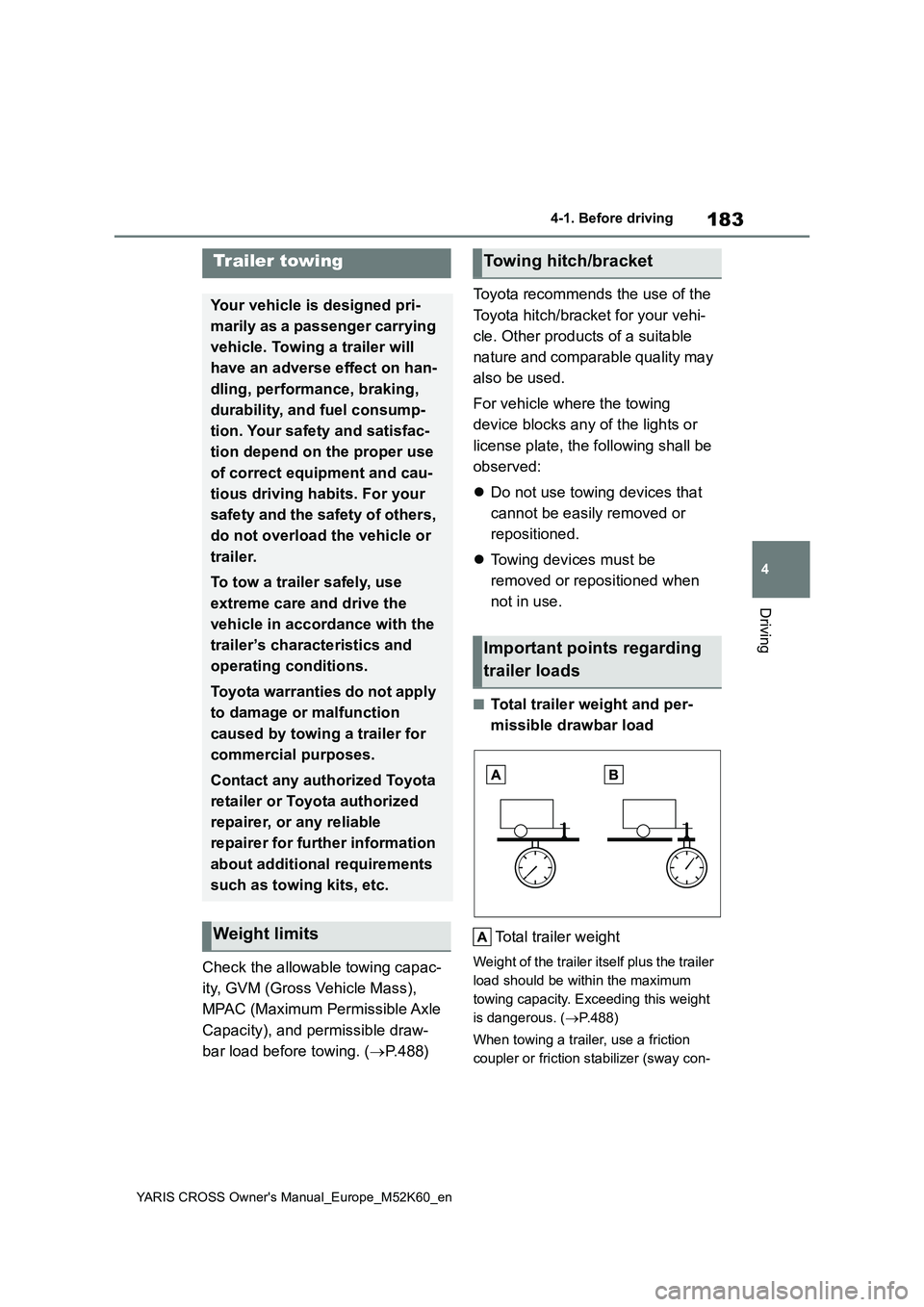
■Total trailer weight and per-
missible drawbar load
Total trailer weight
Weight of the trailer itself plus the trailer
load should be within the maximum
towing capacity. Exceeding this weight
is dangerous. ( P.488)
When towing a trailer, use a friction
coupler or friction stabilizer (sway con-
Trailer towing
Your vehicle is designed pri-
marily as a passenger carrying
vehicle. Towing a trailer will
have an adverse effect on han-
dling, performance, braking,
durability, and fuel consump-
tion. Your safety and satisfac-
tion depend on the proper use
of correct equipment and cau-
tious driving habits. For your
safety and the safety of others,
do not overload the vehicle or
trailer.
To tow a trailer safely, use
extreme care and drive the
vehicle in accordance with the
trailer’s characteristics and
operating conditions.
Toyota warranties do not apply
to damage or malfunction
caused by towing a trailer for
commercial purposes.
Contact any authorized Toyota
retailer or Toyota authorized
repairer, or any reliable
repairer for further information
about additional requirements
such as towing kits, etc.
Weight limits
Towing hitch/bracket
Important points regarding
trailer loads
Page 186 of 650
184
YARIS CROSS Owner's Manual_Europe_M52K60_en
4-1. Before driving
trol device).
Permissible drawbar load
Allocate the trailer load so that the
drawbar load is greater than 25 kg
(55.1 lb.) or 4% of the towing capacity.
Do not let the drawbar load exceed the
indicated weight. ( P.488)
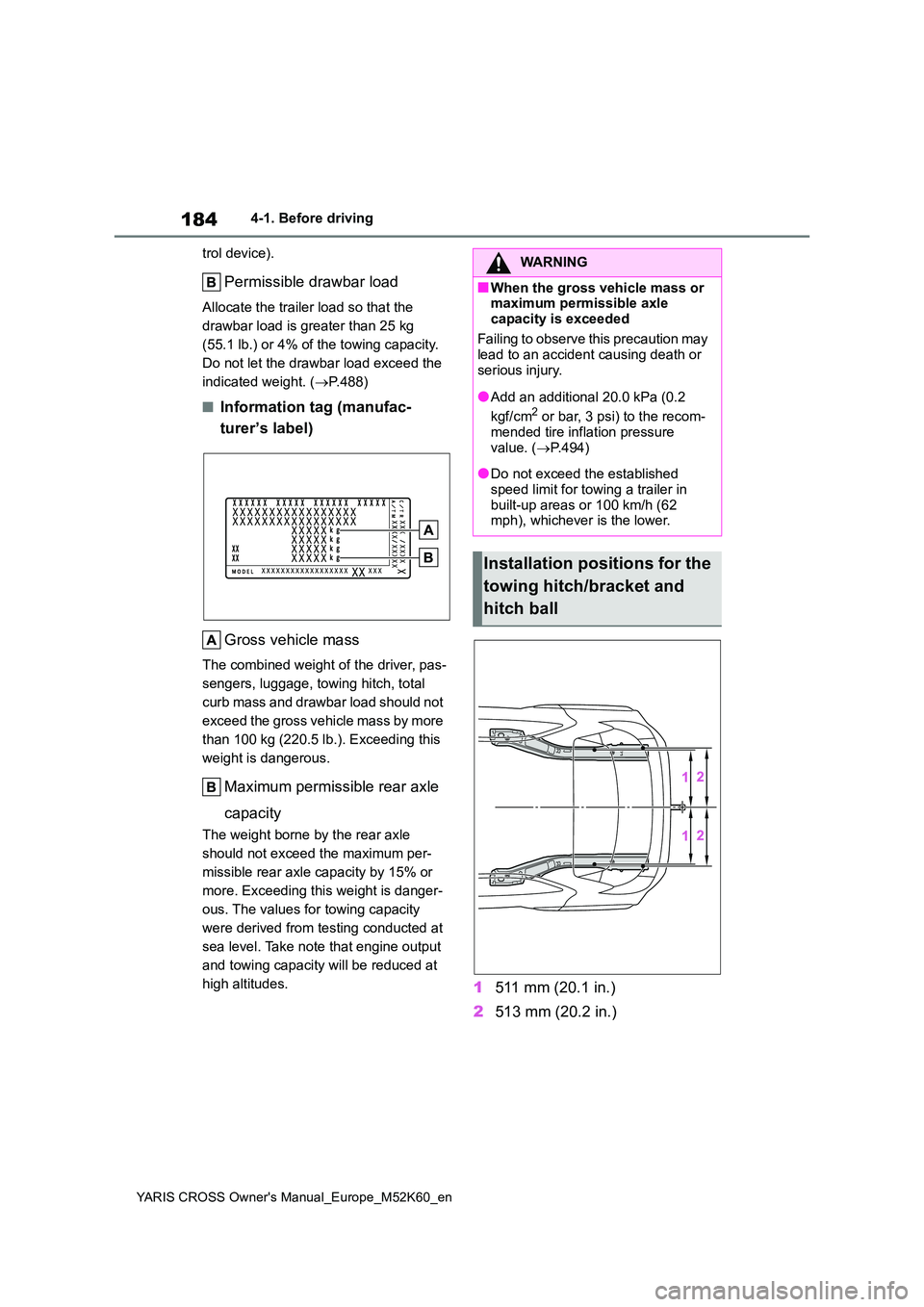
■Information tag (manufac-
turer’s label)
Gross vehicle mass
The combined weight of the driver, pas-
sengers, luggage, towing hitch, total
curb mass and drawbar load should not
exceed the gross vehicle mass by more
than 100 kg (220.5 lb.). Exceeding this
weight is dangerous.
Maximum permissible rear axle
capacity
The weight borne by the rear axle
should not exceed the maximum per-
missible rear axle capacity by 15% or
more. Exceeding this weight is danger-
ous. The values for towing capacity
were derived from testing conducted at
sea level. Take note that engine output
and towing capacity will be reduced at
high altitudes.1 511 mm (20.1 in.)
2 513 mm (20.2 in.)
WARNING
■When the gross vehicle mass or maximum permissible axle
capacity is exceeded
Failing to observe this precaution may lead to an accident causing death or
serious injury.
●Add an additional 20.0 kPa (0.2
kgf/cm2 or bar, 3 psi) to the recom- mended tire inflation pressure
value. ( P.494)
●Do not exceed the established
speed limit for towing a trailer in built-up areas or 100 km/h (62 mph), whichever is the lower.
Installation positions for the
towing hitch/bracket and
hitch ball