2021 TOYOTA RAV4 PHEV lock
[x] Cancel search: lockPage 30 of 666

28Pictorial index
■Interior (Right-hand drive vehicles)
SRS airbags ..................................................................................... P.39
Floor mats..................................................... ................................... P.32
Front seats........ ............................................................................. P.270
Rear seats ..................................................... ................................. P.271
Head restraints ................................................ .............................. P.276
Seat belts ..................................................... .................................... P.35
Console box .................................................... .............................. P.469
Inside lock buttons ............................................ ........................... P.208
Cup holders .................................................... ............................... P.470
Assist grips ................................................... ................................ P.484
Rear seat heater switches ...................................... ...................... P.463
A
B
C
D
E
F
G
H
I
J
K
Page 33 of 666

1
31
1
For safety and security
For safety and security
1-1. For safe use
Before driving ..................... 32
For safe driving ................... 33
Seat belts............................ 35
SRS airbags ....................... 39
Exhaust gas precautions .... 47
1-2. Child safety
Airbag manual on-off system
......................................... 48
Riding with children ............ 49
Child restraint systems ....... 50
1-3. Emergency assistance
eCall ................................... 65
1-4. Theft deterrent system
Immobilizer system ............. 76
Double locking system ........ 77
Alarm .................................. 78
Page 35 of 666

33
1
1-1. For safe use
For safety and security
Adjust the angle of the seatback
so that you are sitting straight up
and so that you do not have to
lean forward to steer. ( →P.270)
Adjust the seat so that you can
depress the pedals fully and so
that your arms bend slightly at
the elbow when gripping the
steering wheel. ( →P.270)
Lock the head restraint in place
with the center of the head
restraint closest to the top of
your ears. ( →P.276)
Wear the seat belt correctly.
( →P.36)
WARNING
●With the hybrid system stopped and
the shift lever in P, fully depress
each pedal to the floor to make sure it does not interfere with the floor
mat.
For safe driving
For safe driving, adjust the
seat and mirror to an appropri -
ate position before driving.
Correct driving posture
A
B
C
D
Page 36 of 666

341-1. For safe use
Make sure that all occupants are
wearing their sea t belts before driv-
ing the vehicle. ( →P.36)
Use a child restraint system appro -
priate for the chil d until the child
becomes large enough to properly
wear the vehicle’s seat belt.
( →P.50)
Make sure that you can see back -
ward clearly by adjusting the inside
rear view mirror (if equipped), Digi -
tal Rear-view Mirror (if equipped)
and outside rear view mirrors prop -
erly. ( →P.279, 280, 289)
WARNING
Observe the following precautions.
Failure to do so may result in death or
serious injury.
●Do not adjust the position of the
driver’s seat while driving.
Doing so could cause the driver to lose control of the vehicle.
●Do not place a cushion between the
driver or passenger and the seat - back. A cushion may prevent cor -
rect posture from being achieved,
and reduce the effectiveness of the seat belt and head restraint.
●Do not place anything under the front seats.
Objects placed und er the front
seats may become jammed in the seat tracks and stop the seat from
locking in place. This may lead to
an accident and the adjustment mechanism may also be damaged.
●Always observe the legal speed limit when driving on public roads.
●When driving over long distances, take regular breaks before you start
to feel tired.
Also, if you feel tired or sleepy while driving, do not force yourself to con -
tinue driving and take a break
immediately.
Correct use of the seat belts
Adjusting the mirrors
Page 38 of 666
361-1. For safe use
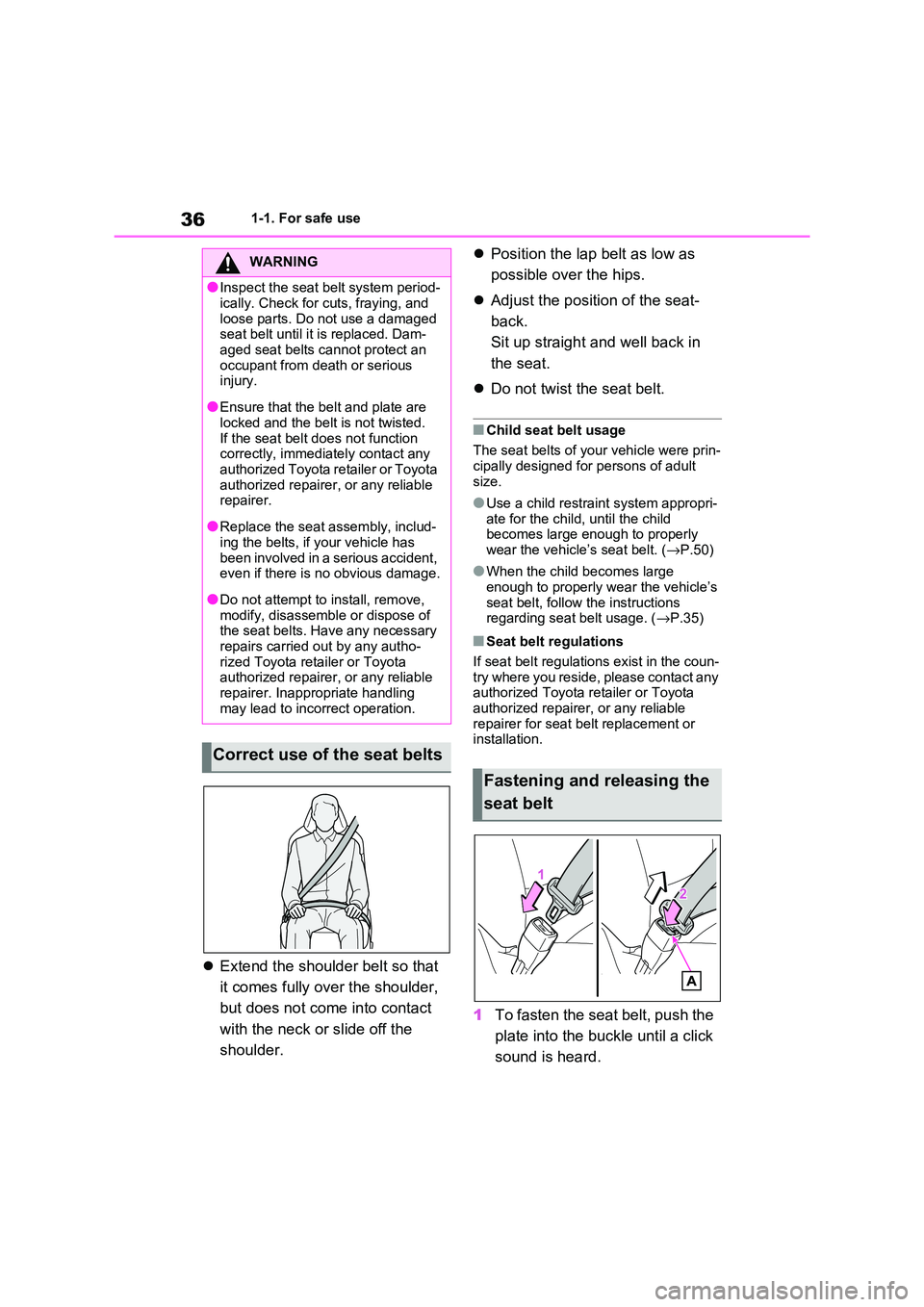
Extend the shoulder belt so that
it comes fully over the shoulder,
but does not come into contact
with the neck or slide off the
shoulder.
Position the lap belt as low as
possible over the hips.
Adjust the position of the seat-
back.
Sit up straight and well back in
the seat.
Do not twist the seat belt.
■Child seat belt usage
The seat belts of yo ur vehicle were prin- cipally designed for persons of adult
size.
●Use a child restraint system appropri -
ate for the child, until the child
becomes large enough to properly wear the vehicle’s seat belt. ( →P.50)
●When the child becomes large enough to properly wear the vehicle’s
seat belt, follow the instructions
regarding seat belt usage. ( →P.35)
■Seat belt regulations
If seat belt regulati ons exist in the coun-
try where you reside, please contact any
authorized Toyota r etailer or Toyota authorized repairer, or any reliable
repairer for seat belt replacement or
installation.
1 To fasten the seat belt, push the
plate into the buckle until a click
sound is heard.
WARNING
●Inspect the seat belt system period -
ically. Check for cu ts, fraying, and
loose parts. Do not use a damaged seat belt until it is replaced. Dam -
aged seat belts c annot protect an
occupant from death or serious injury.
●Ensure that the be lt and plate are
locked and the belt is not twisted. If the seat belt does not function
correctly, immediately contact any
authorized Toyota retailer or Toyota authorized repairer, or any reliable
repairer.
●Replace the seat assembly, includ -
ing the belts, if your vehicle has
been involved in a serious accident, even if there is no obvious damage.
●Do not attempt to install, remove, modify, disassemble or dispose of
the seat belts. Have any necessary
repairs carried out by any autho - rized Toyota ret ailer or Toyota
authorized repairer, or any reliable
repairer. Inappropriate handling may lead to incorrect operation.
Correct use of the seat belts
Fastening and releasing the
seat belt
Page 39 of 666

37
1
1-1. For safe use
For safety and security
2 To release the seat belt, press
the release button .
■Emergency locking retractor (ELR)
The retractor will lo ck the belt during a
sudden stop or on impact. It may also
lock if you lean forw ard too quickly. A slow, easy motion will allow the belt to
extend so that you can move around
fully.
1 Push the seat belt shoulder
anchor down while pressing the
release button .
2 Push the seat belt shoulder
anchor up while pressing the
release button .
Move the height adjuster up and down
as needed until you hear a click.
The pretensioners help the seat
belts to quickly restrain the occu -
pants by retracting the seat belts
when the vehicle is subjected to
certain types of severe frontal or
side collision.
The pretensioners do not activate in the
event of a minor frontal impact, a minor
side impact, a rear impact or a vehicle
rollover.
■Replacing the belt after the preten- sioner has been activated
If the vehicle is invol ved in multiple colli-
sions, the pretensioner will activate for the first collision, but will not activate for
the second or subsequent collisions.
Adjusting the seat belt
shoulder anchor height
(front seats)
A
A
A
:$51,1*
■Adjustable shoulder anchor
Always make sure the shoulder belt is
positioned across the center of your shoulder. The belt should be kept
away from your neck, but not falling
off your shoulder. Failure to do so could reduce the amount of protection
in an accident and cause death or
serious injuries in the event of a sud -
den stop, sudden swerve or accident.
Seat belt pretensioners
(front and outboard rear
seats)
Page 43 of 666

41
1
1-1. For safe use
For safety and security
“PASSENGER AIR BAG” indicator
The main SRS airbag system comp onents are shown above. The SRS air-
bag system is controlled by the airbag sensor assembly. As the airbags
deploy, a chemical reaction in t he inflators quickly fills the airbags with non-
toxic gas to help restrain t he motion of the occupants.
■If the SRS airbags deploy (inflate)
●Slight abrasions, burns, bruising etc.,
may be sustained from SRS airbags, due to the extrem ely high speed
deployment (inflation) by hot gases.
●A loud noise and white powder will be
emitted.
●Parts of the airbag module (steering
wheel hub, airbag cover and inflator)
as well as the fron t seats, parts of the front and rear pillars, and roof side
rails, may be hot for several minutes.
The airbag itself m ay also be hot.
●The windshield may crack.
●The hybrid system will be stopped and
fuel supply to t he engine will be
stopped. ( →P.98)
●All of the doors will be unlocked.
( →P.206)
●Vehicles with Secondary Collision
Brake: The brakes and stop lights will be controlled au tomatically. (→P.439)
●The interior lights will turn on automat- ically. ( →P.466)
●The emergency flashers will turn on automatically. ( →P.560)
■SRS airbag deployment conditions
(SRS front airbags)
●The SRS front airb ags will deploy in
the event of an impact that exceeds
the set threshold level (the level of force corresponding to an approxi -
mately 20-30 km/h [12-18 mph] frontal
collision with a fixed wall that does not move or deform).
However, this threshold velocity will be
considerably higher in the following situ -
ations:
• If the vehicle strikes an object, such as a parked vehicle or sign pole,
which can move or deform on impact
• If the vehicle is involved in an under -
ride collision, such as a collision in which the front of the vehicle under -
rides, or goes under , the bed of a
truck
●Depending on the type of collision, it is
possible that only the seat belt preten - sioners will activate.
■SRS airbag deployment conditions
(SRS side and cu rtain shield air-
bags)
●The SRS side and curtain shield air -
bags will deploy in the event of an impact that exceeds the set threshold
level (the level of force corresponding
to the impact forc e produced by an approximately 1500 kg [3300 lb.] vehi -
cle colliding with the vehicle cabin
from a direction perpendicular to the vehicle orientation at an approximate
speed of 20 -30 km/h [12 -18 mph]).
●Both SRS curtain shield airbags may
also deploy in the event of a severe
frontal collision.
■Conditions under which the SRS airbags may deploy (inflate), other
than a collision
The SRS front airbags and SRS curtain shield airbags may a lso deploy if a seri-
ous impact occurs to the underside of
your vehicle. Some e xamples are shown in the illustration.
●Hitting a curb, edge of pavement or hard surface
●Falling into or jumping over a deep hole
●Landing hard or falling
O
Page 51 of 666
49
1
1-2. Child safety
For safety and security
WARNING
■When installing a child restraint
system
For safety reasons , always install a child restraint system in a rear seat. In
the event that the rear seat cannot be
used, the front seat can be used as long as the airbag manual on-off sys-
tem is set to “OFF”.
If the airbag manual on-off system is
left on, the strong impact of the airbag deployment (inflation) may cause
serious injury or even death.
■When a child restr aint system is
not installed on the front passen -
ger seat
Ensure that the airbag manual on-off
system is set to “ON”.
If it is left off, the airbag may not deploy in the even t of an accident,
which may result in serious injury or
even death.
Riding with children
Observe the following precau -
tions when children are in the
vehicle.
Use a child restraint system
appropriate for the child, until
the child becomes large
enough to properly wear the
vehicle’s seat belt.
It is recommended that chil-
dren sit in the rear seats to
avoid accidental contact with
the shift lever, wiper switch,
etc.
Use the rear door child-protec-
tor lock or the window lock
switch to avoi d children open-
ing the door while driving or
operating the power window
accidentally. ( →P.209, 293)
Do not let small children oper-
ate equipment which may
catch or pinch body parts,
such as the power window,
hood, back door, seats, etc.