2021 TOYOTA RAV4 PHEV ECU
[x] Cancel search: ECUPage 43 of 666

41
1
1-1. For safe use
For safety and security
“PASSENGER AIR BAG” indicator
The main SRS airbag system comp onents are shown above. The SRS air-
bag system is controlled by the airbag sensor assembly. As the airbags
deploy, a chemical reaction in t he inflators quickly fills the airbags with non-
toxic gas to help restrain t he motion of the occupants.
■If the SRS airbags deploy (inflate)
●Slight abrasions, burns, bruising etc.,
may be sustained from SRS airbags, due to the extrem ely high speed
deployment (inflation) by hot gases.
●A loud noise and white powder will be
emitted.
●Parts of the airbag module (steering
wheel hub, airbag cover and inflator)
as well as the fron t seats, parts of the front and rear pillars, and roof side
rails, may be hot for several minutes.
The airbag itself m ay also be hot.
●The windshield may crack.
●The hybrid system will be stopped and
fuel supply to t he engine will be
stopped. ( →P.98)
●All of the doors will be unlocked.
( →P.206)
●Vehicles with Secondary Collision
Brake: The brakes and stop lights will be controlled au tomatically. (→P.439)
●The interior lights will turn on automat- ically. ( →P.466)
●The emergency flashers will turn on automatically. ( →P.560)
■SRS airbag deployment conditions
(SRS front airbags)
●The SRS front airb ags will deploy in
the event of an impact that exceeds
the set threshold level (the level of force corresponding to an approxi -
mately 20-30 km/h [12-18 mph] frontal
collision with a fixed wall that does not move or deform).
However, this threshold velocity will be
considerably higher in the following situ -
ations:
• If the vehicle strikes an object, such as a parked vehicle or sign pole,
which can move or deform on impact
• If the vehicle is involved in an under -
ride collision, such as a collision in which the front of the vehicle under -
rides, or goes under , the bed of a
truck
●Depending on the type of collision, it is
possible that only the seat belt preten - sioners will activate.
■SRS airbag deployment conditions
(SRS side and cu rtain shield air-
bags)
●The SRS side and curtain shield air -
bags will deploy in the event of an impact that exceeds the set threshold
level (the level of force corresponding
to the impact forc e produced by an approximately 1500 kg [3300 lb.] vehi -
cle colliding with the vehicle cabin
from a direction perpendicular to the vehicle orientation at an approximate
speed of 20 -30 km/h [12 -18 mph]).
●Both SRS curtain shield airbags may
also deploy in the event of a severe
frontal collision.
■Conditions under which the SRS airbags may deploy (inflate), other
than a collision
The SRS front airbags and SRS curtain shield airbags may a lso deploy if a seri-
ous impact occurs to the underside of
your vehicle. Some e xamples are shown in the illustration.
●Hitting a curb, edge of pavement or hard surface
●Falling into or jumping over a deep hole
●Landing hard or falling
O
Page 45 of 666

43
1
1-1. For safe use
For safety and security
repairer as soon as possible.
●Any of the SRS airbags have been
inflated.
●The front of the vehicle is damaged or
deformed, or was involved in an acci -
dent that was no t severe enough to cause the SRS front airbags to inflate.
●A portion of a door or its surrounding area is damaged, deformed or has
had a hole made in it, or the vehicle
was involved in an accident that was not severe enough to cause the SRS
side and curtain shield airbags to
inflate.
●The pad section of the steering wheel,
dashboard near the front passenger airbag or lower portion of the instru -
ment panel is scratched, cracked, or
otherwise damaged.
●The surface of the seats with the SRS
side airbag is scratched, cracked, or
otherwise damaged.
●The portion of the front pillars, rear pil -
lars or roof side rail garnishes (pad- ding) containing the SRS curtain
shield airbags inside is scratched,
cracked, or otherwise damaged.
WARNING
■SRS airbag precautions
Observe the following precautions
regarding the SRS airbags.
Failure to do so m ay cause death or serious injury.
●The driver and all passengers in the
vehicle must wear their seat belts properly.
The SRS airbags are supplemental
devices to be used with the seat belts.
Page 46 of 666

441-1. For safe use
WARNING
●The SRS driver airbag deploys with
considerable force, and can cause
death or serious injury especially if the driver is very close to the air-
bag.
Since the risk zone for the driver’s air -
bag is the first 50 - 75 mm (2 - 3 in.) of
inflation, placing yourself 250 mm (10
in.) from your drive r airbag provides
you with a clear margin of safety. This
distance is measured from the center
of the steering whee l to your breast-
bone. If you sit less than 250 mm (10
in.) away now, you can change your
driving position in several ways:
• Move your seat to the rear as far as
you can while still reaching the ped -
als comfortably.
• Slightly recline the back of the seat.
Although vehicle designs vary, many drivers can achieve the 250
mm (10 in.) distanc e, even with the
driver seat all th e way forward, sim- ply by reclining the back of the seat
somewhat. If reclin ing the back of
your seat makes i t hard to see the road, raise yourself by using a firm,
non-slippery cushion, or raise the
seat if your vehicle has that feature.
• If your steering wheel is adjustable,
tilt it downwa rd. This points the air- bag toward your chest instead of
your head and neck.
The seat should be adjusted as rec - ommended above, while still main -
taining control of the foot pedals,
steering wheel, and your view of the instrument panel controls.
●The SRS front passenger airbag also deploys with considerable
force, and can caus e death or seri-
ous injury especially if the front pas - senger is very clo se to the airbag.
The front passenger seat should be
as far from the airbag as possible with the seatback adjusted, so the
front passenger sits upright.
●Improperly seated and/or restrained
infants and children can be killed or
seriously injured by a deploying air - bag. An infant or child who is too
small to use a seat belt should be
properly secured using a child restraint system. Toyota strongly
recommends that all infants and
children be placed in the rear seats of the vehicle and properly
restrained. The rear seats are safer
for infants and children than the front passenger seat. ( →P.50)
●Do not sit on the edge of the seat or lean against the dashboard.
●Do not allow a child to stand in front of the SRS front passenger airbag
unit or sit on the knees of a front
passenger.
●Do not allow the front seat occu-
pants to hold items on their knees.
Page 47 of 666

45
1
1-1. For safe use
For safety and security
WARNING
●Do not lean against the door, the
roof side rail or the front, side and
rear pillars.
●Do not allow anyone to kneel on the
passenger seat toward the door or
put their head or hands outside the vehicle.
●Do not attach anything to or lean anything against areas such as the
dashboard, steering wheel pad and
lower portion of the instrument panel.
These items can become projec -
tiles when the SRS driver, front passenger and knee airbags
deploy.
●Do not attach anything to areas such as a door, windshield, side
windows, front or rear pillar, roof
side rail and assist grip. (Except for the speed limit label →P.585)
●Do not hang coat hangers or other hard objects on th e coat hooks. All
of these items c ould become pro-
jectiles and may cause death or serious injury, should the SRS cur -
tain shield airbags deploy.
●If a vinyl cover is put on the area
where the SRS knee airbag will
deploy, be sure to remove it.
●Do not use seat a ccessories which
cover the parts wh ere the SRS side airbags inflate as they may interfere
with inflation of t he SRS airbags.
Such accessories may prevent the SRS side airbags from activating
correctly, disabl e the system or
cause the SRS side airbags to inflate accidentally, resulting in
death or serious injury.
●Do not strike or apply significant
levels of force to the area of the
SRS airbag components or the front doors.
Doing so can cause the SRS air -
bags to malfunction.
●Do not touch any of the component
parts immediately after the SRS air -
bags have deployed (inflated) as they may be hot.
Page 49 of 666
47
1
1-1. For safe use
For safety and security
Exhaust gas precautions
Harmful substance to the
human body is included in
exhaust gases if inhaled.
WARNING
Exhaust gases contain harmful car -
bon monoxide (CO), which is color -
less and odorless. Observe the following precautions.
Failure to do so may cause exhaust
gases to enter the vehicle and may lead to an acciden t caused by light-
headedness, or may lead to death or
a serious health hazard.
■Important points while driving
●Keep the back door closed.
●If you smell exhaust gases in the
vehicle even when the back door is
closed, open the side windows and have the vehicle inspected at any
authorized Toyota retailer or Toyota
authorized repairer, or any reliable repairer as soon as possible.
■When parking
●If the vehicle is in a poorly venti -
lated area or a closed area, such as
a garage, stop t he hybrid system.
●Do not leave the vehicle with the
hybrid system opera ting for a long time.
If such a situation cannot be
avoided, park the vehicle in an open space and ensure that
exhaust fumes do not enter the
vehicle interior.
●Do not leave the hybrid system
operating in an area with snow build-up, or where it is snowing. If
snowbanks build up around the
vehicle while the hybrid system is operating, exhaust gases may col -
lect and enter the vehicle.
■Exhaust pipe
The exhaust system needs to be
checked periodically. If there is a hole
or crack caused b y corrosion, dam- age to a joint or abnormal exhaust
noise, be sure to have the vehicle
inspected and repai red by any autho- rized Toyota retaile r or Toyota autho-
rized repairer, or any reliable repairer.
Page 51 of 666
49
1
1-2. Child safety
For safety and security
WARNING
■When installing a child restraint
system
For safety reasons , always install a child restraint system in a rear seat. In
the event that the rear seat cannot be
used, the front seat can be used as long as the airbag manual on-off sys-
tem is set to “OFF”.
If the airbag manual on-off system is
left on, the strong impact of the airbag deployment (inflation) may cause
serious injury or even death.
■When a child restr aint system is
not installed on the front passen -
ger seat
Ensure that the airbag manual on-off
system is set to “ON”.
If it is left off, the airbag may not deploy in the even t of an accident,
which may result in serious injury or
even death.
Riding with children
Observe the following precau -
tions when children are in the
vehicle.
Use a child restraint system
appropriate for the child, until
the child becomes large
enough to properly wear the
vehicle’s seat belt.
It is recommended that chil-
dren sit in the rear seats to
avoid accidental contact with
the shift lever, wiper switch,
etc.
Use the rear door child-protec-
tor lock or the window lock
switch to avoi d children open-
ing the door while driving or
operating the power window
accidentally. ( →P.209, 293)
Do not let small children oper-
ate equipment which may
catch or pinch body parts,
such as the power window,
hood, back door, seats, etc.
Page 53 of 666

51
1
1-2. Child safety
For safety and security
• Fixed with an ISOFIX lower
anchorage: P.62
• Using a top tether anchorage:
P.63
Prioritize and observe the warn-
ings, as well as the laws and reg -
ulations for child restraint
systems.
Use a child restraint system until
the child becomes large enough
to properly wear the vehicle’s
seat belt.
Choose a child restraint system
appropriate to the age and size
of the child.
Note that not all child restraint
systems can fit in all vehicles.
Before using or purchasing a
child restraint system, check the
compatibility of the child restraint
system with seat positions.
( →P.54)
Points to remember
WARNING
■When a child is riding
Observe the following precautions.
Failure to do so may result in death or
serious injury.
●For effective protection in automo -
bile accidents and sudden stops, a child must be properly restrained,
using a seat belt or child restraint
system which is corre ctly installed. For installation details, refer to the
operation manual enclosed with the
child restraint system. General installation instructions are pro -
vided in this manual.
●Toyota strongly urges the use of a proper child restraint system that
conforms to the weight and size of
the child, installed on the rear seat. According to accident statistics, the
child is safer when properly
restrained in the rear seat than in the front seat.
●Holding a child in your or someone else’s arms is not a substitute for a
child restraint system. In an acci-
dent, the child can be crushed against the windshield or between
the holder and the interior of the
vehicle.
■Handling the child restraint sys -
tem
If the child restra int system is not
properly fixed in place, the child or
other passengers may be seriously injured or even killed in the event of
sudden braking, sudden swerving, or
an accident.
●If the vehicle were to receive a
strong impact from an accident, etc., it is possible that the child
restraint system has damage that is
not readily visible. In such cases, do not reuse the restraint system.
●Depending on the child restraint system, installation may be difficult
or impossible. In those cases,
check whether the child restraint system is suitable f or installment in
the vehicle ( →P.54). Be sure to
install and observe the usage rules after carefully reading the child
restraint system fixing method in
this manual, as we ll as the opera- tion manual enclosed with the child
restraint system.
●Keep the child restraint system properly secured on the seat even if
it is not in use. Do not store the
child restraint syst em unsecured in the passenger compartment.
Page 54 of 666
521-2. Child safety
■When installing a child
restraint system to a front pas -
senger seat
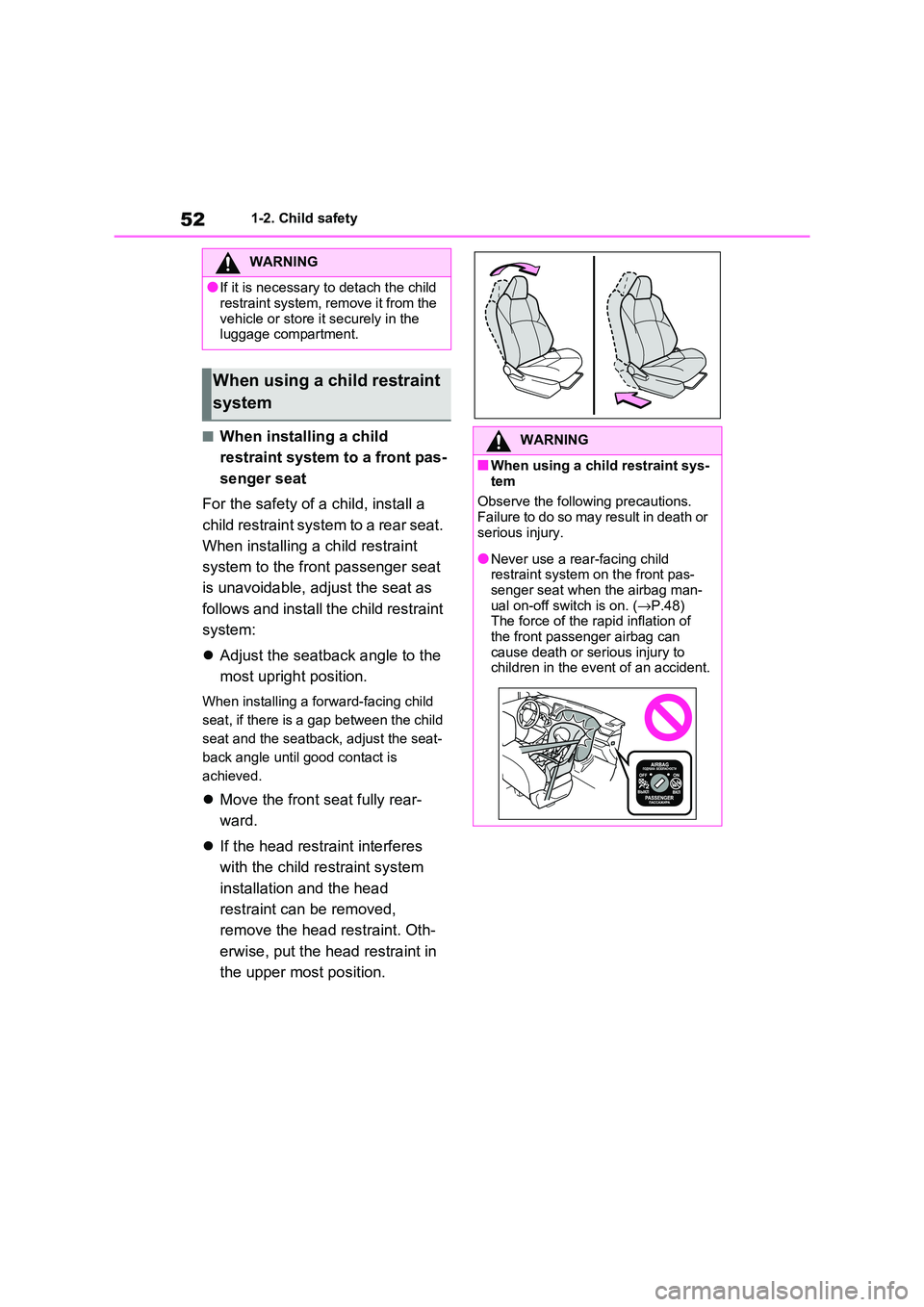
For the safety of a child, install a
child restraint system to a rear seat.
When installing a child restraint
system to the front passenger seat
is unavoidable, adjust the seat as
follows and install the child restraint
system:
Adjust the seatback angle to the
most upright position.
When installing a forw ard-facing child
seat, if there is a gap between the child
seat and the seatback, adjust the seat -
back angle until good contact is
achieved.
Move the front seat fully rear-
ward.
If the head restraint interferes
with the child re straint system
installation and the head
restraint can be removed,
remove the head restraint. Oth -
erwise, put the head restraint in
the upper most position.
WARNING
●If it is necessary t o detach the child
restraint system, remove it from the
vehicle or store it securely in the luggage compartment.
When using a child restraint
system
WARNING
■When using a child restraint sys -
tem
Observe the following precautions. Failure to do so may result in death or
serious injury.
●Never use a rear-facing child restraint system on the front pas-
senger seat when the airbag man -
ual on-off switch is on. ( →P.48) The force of the rapid inflation of
the front passenger airbag can
cause death or serious injury to children in the eve nt of an accident.