2021 TOYOTA AYGO fog light
[x] Cancel search: fog lightPage 236 of 546

2344-3. Operating the lights and wipers
AYGO_OM_Europe_OM9A012E
■ Automatic light off system (if equipped)
● When the light switch is in or :
The headlights and front fog lights turn off after the engine switch is turned
to the “LOCK” position (vehicles without a smart entry & start system) or off
(vehicles with a smart entry & start system).
● When the light switch is in :
The headlights and all lights turn off after the engine switch is turned to the
“LOCK” position (vehicles without a smart entry & start system) or off (vehi-
cles with a smart entry & start system).
■ Light reminder buzzer
Vehicles without a smart entry & start system
A buzzer sounds when the engine switch is turned to the “LOCK” position, the
driver’s door is opened while the lights are turned on.
Vehicles with a smart entry & start system
A buzzer sounds when the engine switch is turned off and the driver’s door is
opened while the lights are turned on.
■ Battery-saving function (if equipped)
In the following conditions, the remaining lights will go off automatically after
20 minutes in order to prevent the vehicle battery from being discharged:
● The headlights and/or tail lights are on.
● Vehicles without a smart entry & start system: The engine switch is turned to
the “ACC” position or turned off.
Vehicles with a smart entry & start system: The engine switch is turned to
ACCESSORY mode or turned off.
● The light switch is in or .
This function will be canceled in any of the following situations:
● Vehicles without a smart entry & start system: When the engine switch is
turned to the “ON” position.
Vehicles with a smart entry & start system: When the engine switch is turned
to IGNITION ON mode.
● When the light switch is operated.
● When a door is opened or closed.
NOTICE
■To prevent battery discharge
Do not leave the lights on longer than necessary when the engine is not
running.
Page 237 of 546
235
4
4-3. Operating the lights and wipers
Driving
AYGO_OM_Europe_OM9A012E
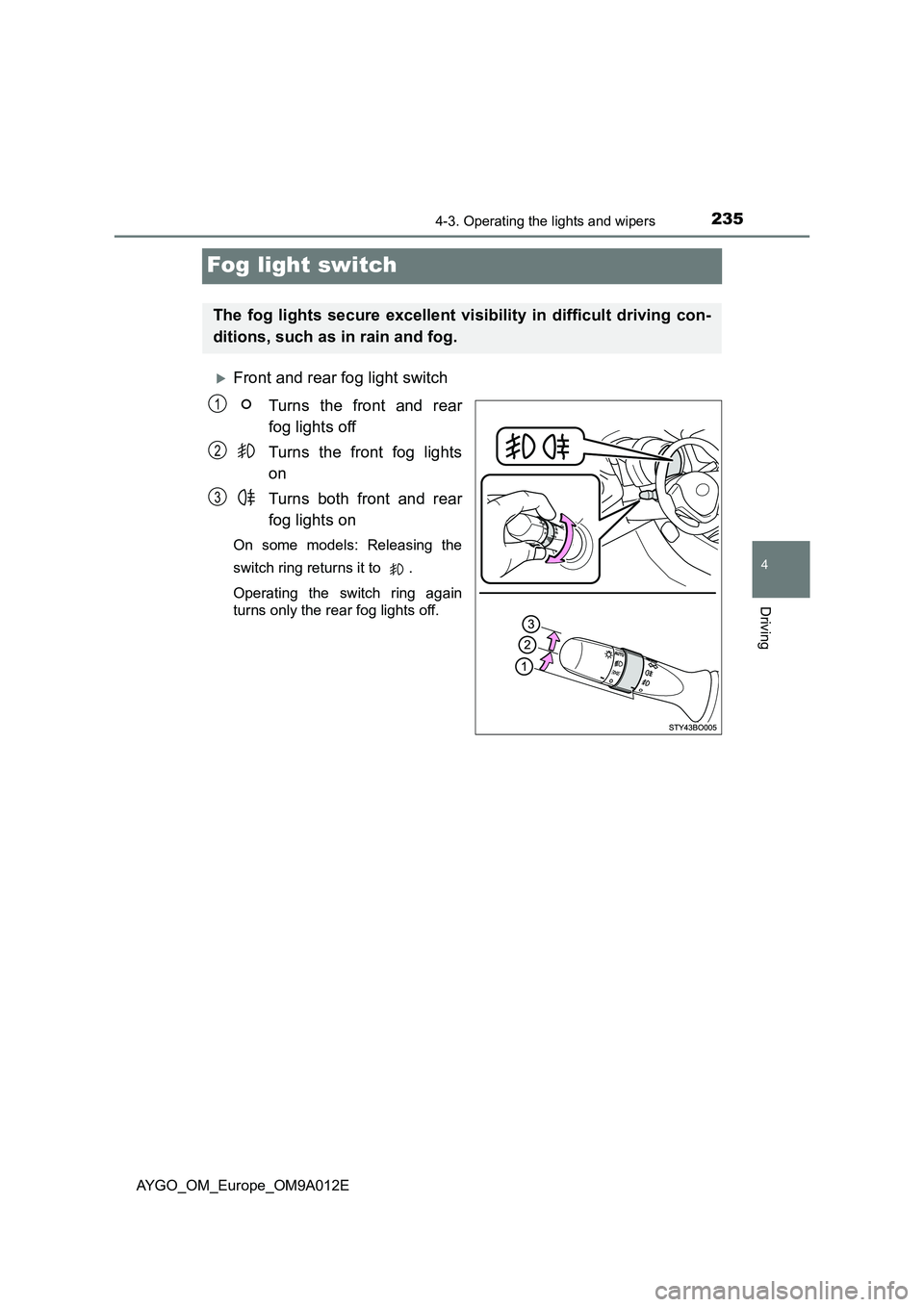
Fog light switch
Front and rear fog light switch
Turns the front and rear
fog lights off
Turns the front fog lights
on
Turns both front and rear
fog lights on
On some models: Releasing the
switch ring returns it to .
Operating the switch ring again
turns only the rear fog lights off.
The fog lights secure excellent visibility in difficult driving con-
ditions, such as in rain and fog.
1
2
3
Page 238 of 546
2364-3. Operating the lights and wipers
AYGO_OM_Europe_OM9A012E
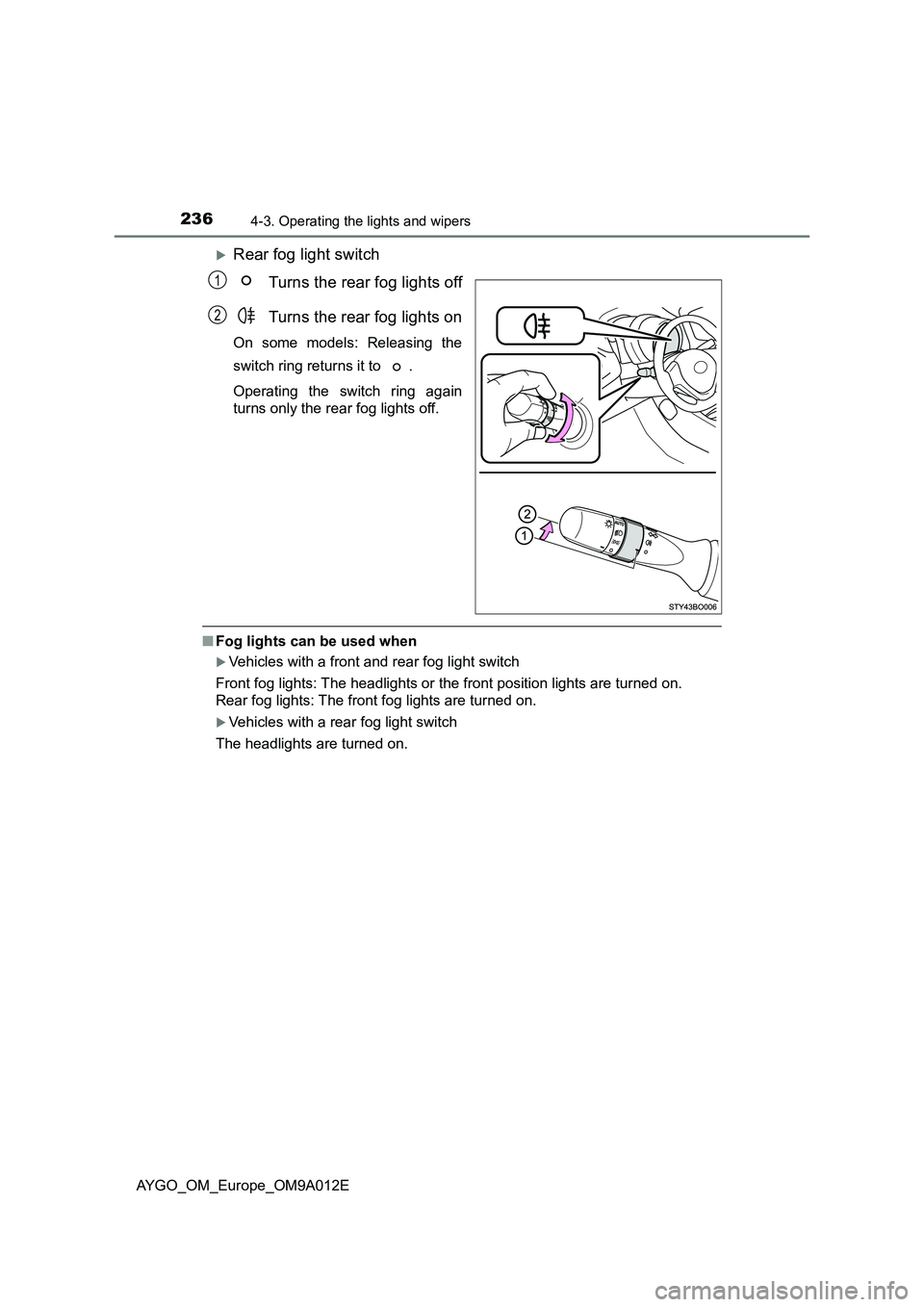
Rear fog light switch
Turns the rear fog lights off
Turns the rear fog lights on
On some models: Releasing the
switch ring returns it to .
Operating the switch ring again
turns only the rear fog lights off.
■Fog lights can be used when
Vehicles with a front and rear fog light switch
Front fog lights: The headlights or the front position lights are turned on.
Rear fog lights: The front fog lights are turned on.
Vehicles with a rear fog light switch
The headlights are turned on.
1
2
Page 251 of 546

2494-5. Toyota Safety Sense
4
Driving
AYGO_OM_Europe_OM9A012E
WARNING
■To avoid malfunction of the front sensor Observe the following precautions.
Otherwise, the front sensor may not operate properly, possibly leading to an
accident resulting in death or serious injury.
● Keep the windshield clean at all times. If the windshield is dirty or covered
with an oily film, water droplets, snow, etc., clear the windshield. If the
inner side of the windshield in front of the front sensor is dirty, contact any
authorized Toyota retailer or Toyota authorized repairer, or any reliable
repairer.
● If there is a large difference in temperature between the inside and outside
of the vehicle, such as in winter, t he windshield is likely to fog up easily. If
the part of the windshield in front of the front sensor is fogged up or cov-
ered with condensation or ice, the PCS warning light may illuminate and
the system may be temporarily disabled. In this case, use the windshield
defogger to remove the fog, etc. ( P. 354, 360)
●Do not attach objects, such as stickers,
transparent stickers, etc., and so forth,
to the outer side of the windshield in
front of the front sensor (shaded area in
the illustration).
A: From the top of the windshield to
approximately 10 cm (4.0 in.) below
the bottom of the front sensor
B: Approximately 20 cm (7.9 in.)
(Approximately 10 cm [4.0 in.] to the
right and left from the center of the
front sensor)
● Do not install or attach anything to the
inner side of the windshield under the
front sensor (shaded area in the illustra-
tion).
A: Approximately 10 cm (4.0 in.) (Start-
ing from the bottom of the front sen-
sor)
B: Approximately 20 cm (7.9 in.)
(Approximately 10 cm [4.0 in.] to the
right and left from the center of the
front sensor)
Page 252 of 546

2504-5. Toyota Safety Sense
AYGO_OM_Europe_OM9A012E
WARNING
●If the area of the windshield in front of the front sensor is covered with
water droplets, use the windshield wipers to remove them.
If the water droplets are not sufficiently removed, the performance of the
front sensor may be reduced.
● If water droplets cannot be properly removed from the area of the wind-
shield in front of the front sensor by the windshield wipers, replace the
wiper insert or wiper blade.
If the wiper inserts or wiper blades need to be replaced, contact any autho-
rized Toyota retailer or Toyota authorized repairer, or any reliable repairer.
● Do not attach window tinting to the windshield.
● Replace the windshield if it is damaged or cracked.
If the windshield needs to be replaced, contact any authorized Toyota
retailer or Toyota authorized repairer, or any reliable repairer.
● Do not install an antenna in front of the sensor.
● Do not get the front sensor wet.
● Do not allow bright lights to shine into the front sensor.
● Do not dirty or damage the front sensor.
When cleaning the inside of the windshi eld, do not allow glass cleaner to
contact the lens. Also, do not touch the lens.
If the lens is dirty or damaged, contact any authorized Toyota retailer or
Toyota authorized repairer, or any reliable repairer.
● Do not subject the front sensor to a strong impact.
● Do not change the installation position or direction of the front sensor or
remove it.
● Do not disassemble the front sensor.
● Do not install an electronic device or device that emits strong electric
waves near the front sensor.
● Do not modify any components of the vehicle around the front sensor
(inside rear view mirror, sun visors, etc.) or ceiling.
● Do not attach any accessories that may obstruct the front sensor to the
hood, front grille or front bumper. C ontact any authorized Toyota retailer or
Toyota authorized repairer, or any reliable repairer for details.
● If a surfboard or other long object is to be mounted on the roof, make sure
that it will not obstruct the front sensor.
● Do not modify the headlights or other lights.
● Do not attach anything to or place anything on the dashboard.
■ Installation area of front sensor on windshield
When the windshield is fogging up easily, the glass around the front sensor
may be hot due to the heater running. If the glass is touched, it may result in
burns.
Page 263 of 546
2614-5. Toyota Safety Sense
4
Driving
AYGO_OM_Europe_OM9A012E
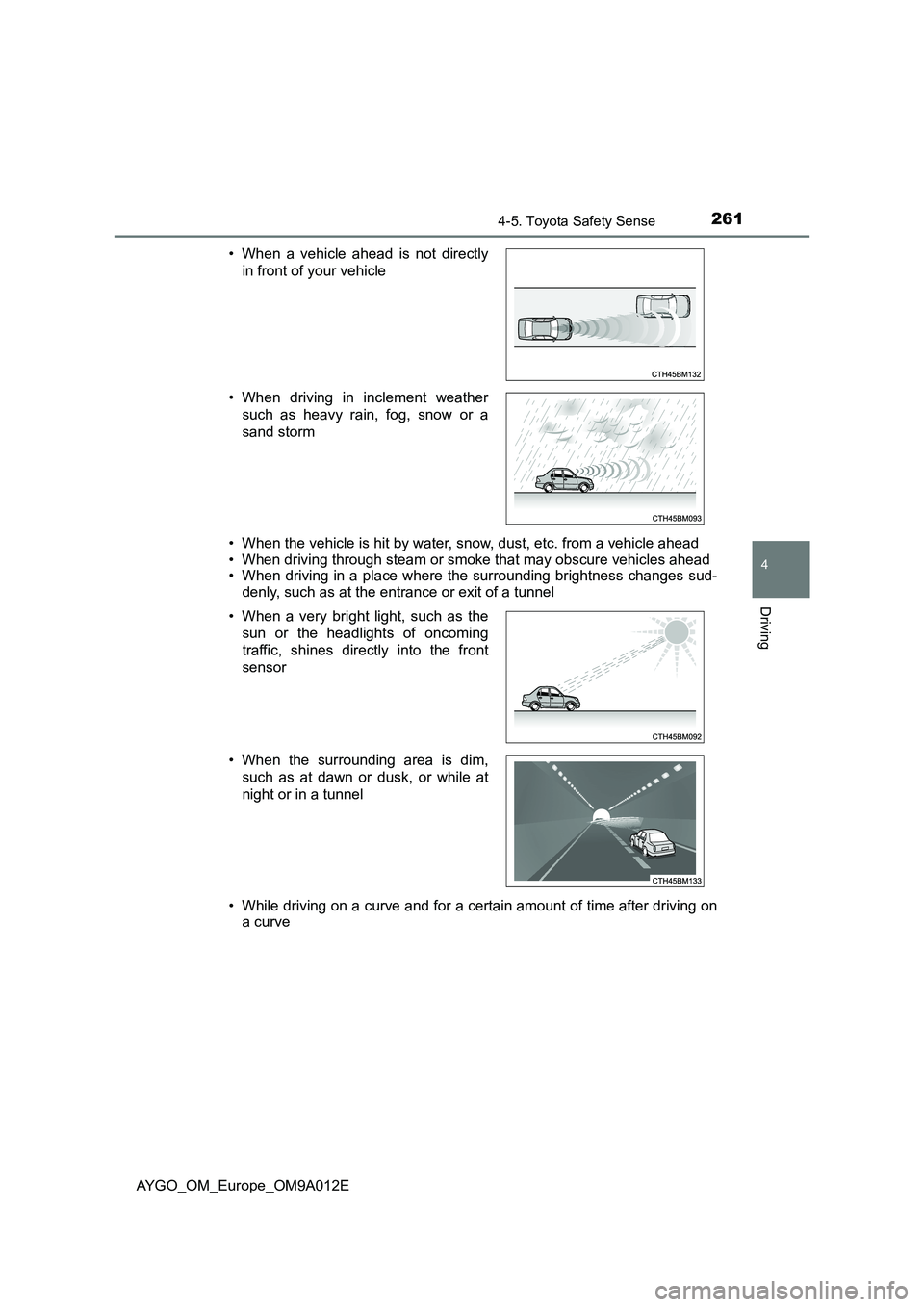
• When the vehicle is hit by water, snow, dust, etc. from a vehicle ahead
• When driving through steam or smoke that may obscure vehicles ahead
• When driving in a place where the surrounding brightness changes sud-
denly, such as at the entrance or exit of a tunnel
• While driving on a curve and for a certain amount of time after driving on
a curve
• When a vehicle ahead is not directly
in front of your vehicle
• When driving in inclement weather
such as heavy rain, fog, snow or a
sand storm
• When a very bright light, such as the
sun or the headlights of oncoming
traffic, shines directly into the front
sensor
• When the surrounding area is dim,
such as at dawn or dusk, or while at
night or in a tunnel
Page 265 of 546
2634-5. Toyota Safety Sense
4
Driving
AYGO_OM_Europe_OM9A012E■If the PCS warning light flashes or illuminates
The pre-collision system may be temporarily unavailable or there may be a
malfunction in the system.
●In the following situations, the warning light will be cleared and the system
will become operational when normal operating conditions return:
• When the area around the front sensor is hot, such as after the vehicle
has been parked in the sun
• When the windshield is fogged up or covered with condensation or ice
(P. 354, 360)
• When driving in conditions where the front sensor cannot detect an
object, such as in the dark (at night on a road without street lights or other
lights, etc.), when bright light is shining into the sensor, or in snow or fog.
• When the front sensor or the area around either sensor is cold, such as in
an extremely cold environment
• If the area in front of the front sensor is obstructed, such as when the
hood is open
●If the PCS warning light continues to flash or illuminate, the system may be
malfunctioning. Have the vehicle inspected by any authorized Toyota retailer
or Toyota authorized repairer, or any reliable repairer immediately.
■If VSC is disabled
●If TRC and VSC are disabled (P. 280), the pre-collision brake assist and
pre-collision braking functions are also disabled. However, the pre-collision
warning function will still operate.
●The PCS warning light illuminates.
Page 269 of 546
2674-5. Toyota Safety Sense
4
Driving
AYGO_OM_Europe_OM9A012E■Conditions in which the function may not operate correctly
In the following situations, the front sensor may be unable to recognize lane
markers causing the lane departure warning function to operate incorrectly.
However, this does not indicate a malfunction.
●When driving through an area, such as a tollbooth, a crossing or before a
ticket checkpoint
●When driving on a sharp curve
●When lane markers are extremely narrow or extremely wide
●When the vehicle leans to one side an unusual amount due to a heavy load
or improper tire inflation pressure
●When the following distance between your vehicle and the vehicle ahead is
extremely short
●When the lane markers are yellow (These may be more difficult for the sys-
tem to recognize compared to white markers.)
●When the lane markers are broken, Botts’ dots (raised pavement markers)
or stones
●When the lane markers are on a curb etc.
●When lane markers are obscured or partially obscured by sand, dirt, etc.
●When there are shadows on the road running parallel with lane markers, or
if a shadow covers the lane markers
●When driving on a particularly bright road surface, such as concrete
●When driving on a road surface that is bright due to reflected light
●When driving in a location where the light level changes rapidly, such as the
entrance to or exit from a tunnel
●When sunlight or the headlights of oncoming vehicles are shining directly
into the camera lens
●When driving on roads that are branching or merging
●When driving on a road surface that is wet due to rain, previous rainfall,
standing water, etc.
●When the vehicle experiences strong up-and-down motion such as when
driving on an extremely rough road or on a seam in the pavement
●When headlight brightness at nighttime is reduced due to dirt on the lenses,
or when the headlights are misaligned
●When driving on winding roads or roads that are uneven
●When driving on rough or unpaved roads
●When the windshield is dirty, or if raindrops, condensation or ice are adher-
ing to the windshield
●When the heater is blowing to the feet, the upper part of the windshield may
get fogged up and have a negative effect
●When cleaning the inside of the windshield, touching the lens or getting
glass cleaner on the lens may have a negative effect