2021 SUZUKI JIMNY Gas
[x] Cancel search: GasPage 21 of 421

FOR SAFE DRIVING
FOR SAFE DRIVING
-Floor mats (if equipped) ..................................................... 1-1
Front seats ........................................................................... 1-2
Rear seats ............................................................................ 1-5
Seat belts and child restraint systems .............................. 1-7
Child restraint system for countries applied
for UN Regulation No.16 ..................................................... 1-20
Supplemental restraint system (airbags) .......................... 1-35
Exhaust gas warning .......................................................... 1-49
Page 65 of 421

80J125
Impact from the side by a motorcycle or
bicycle
80J126
Collision with a utility pole or stumpage
FOR SAFE DRIVING
Side airbags and side curtain airbags do not inflate How the system works
80J120
• Impact from the rear
80J110
• Vehicle rollover
In a frontal collision, the crash sensors will detect rapid deceleration, and if the controller judges that the deceleration represents a severe frontal collision, the controller will trigger the infiators. If your vehicle is equipped with side airbags and side curtain airbags, crash sensors will detect a side collision, and if the controller judges that the side collision is severe enough, it will trigger the side airbag and side curtain airbag infiators. The infiators inflate the appropriate airbags with nitrogen or argon gas. The infiated airbags provide a cushion for your head (front airbags and side curtain airbags only) and upper body. The airbag inflates and defiates so quickly that you may not even realize that it has activated. The airbag will neither hinder your view nor make it harder to exit the vehicle.
Airbags must infiate quickly and forcefully in order to reduce the chance of serious or fatal injuries. However, an unavoidable consequence of the quick infiation is that the airbag may irritate bare skin, such as the facial area against a front airbag. Wash off any residue as soon as possible to prevent skin irritation. Also, upon inflation, a loud noise will occur and some powder and smoke will be released. These conditions are not harmful and do not indicate a fire in the vehicle. Be aware, however, that some airbag components may be hot for a while after infiation.
1-44
Page 70 of 421

.FOR SAFE DRIVING
Exhaust gas warning
52D334
A WARNING
Avoid breathing exhaust gases. Exhaust gases contain carbon monoxide, a potentially lethal gas that is colorless and odorless. Since carbon monoxide is difficult to detect by itself, take the following precautions to help prevent carbon monoxide from entering your vehicle. • Do not leave the engine running in garages or other confined areas. (Continued)
1-49
A WARNING
(Continued) • Do not park with the engine running for a long period of time, even i~ an open area. If it is necessary to s,t for a short time in a parked vehicle with the engine running, check that the air intake selector is set to "FRESH AIR" and the blower is at high speed. • Avoid operating the vehicle with the tailgate or trunk open. If it is necessary to do so, check that the sunroof (if equipped) and all windows are closed, and the blower is at high speed with the air intake selector set to "FRESH AIR". To allow proper operation of your vehicle's ventilation system, keep the air inlet grill in front of the windshield clear of snow, leaves or other obstructions at all times. • Keep the exhaust tailpipe area clear of snow and other material to help reduce the buildup of exhaust gases under the vehicle. This is particularly important when parked in blizzard conditions. Have the exhaust system inspected periodically for damage and leakage. Any damage or leakage should be repaired immediately.
Page 74 of 421
BEFORE DRIVING
Central door locking system
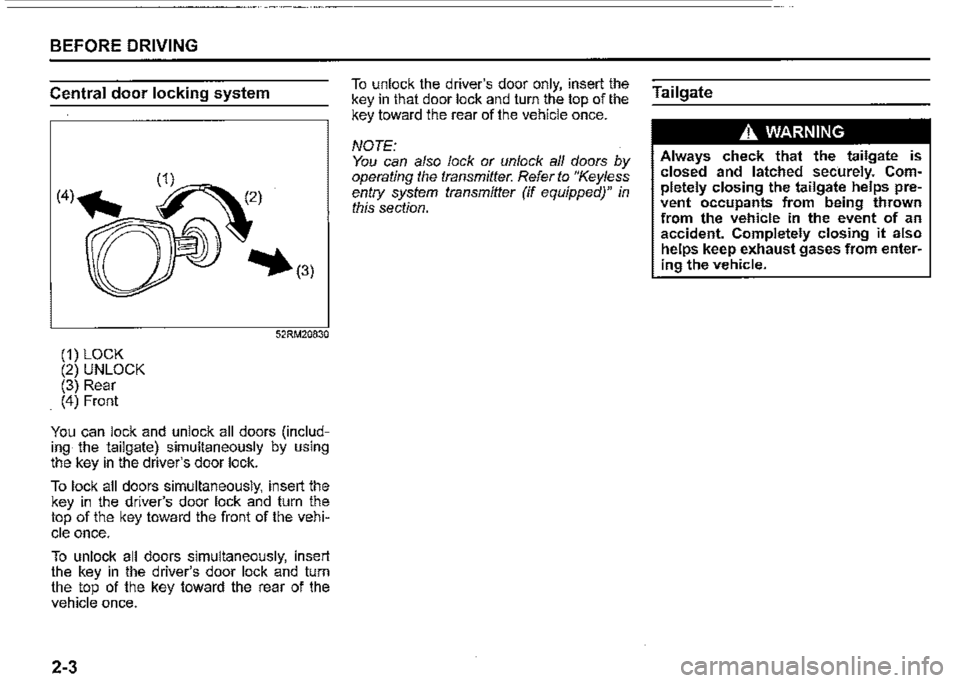
(1) LOCK (2) UNLOCK (3) Rear (4) Front
52RM20830
You can lock and unlock all doors (including the tailgate) simultaneously by using the key in the driver's door lock.
To lock all doors simultaneously, insert the key in the driver's door lock and turn the top of the key toward the front of the vehi
cle once.
To unlock all doors simultaneously, insert the key in the driver's door lock and turn the top of the key toward the rear of the vehicle once.
2-3
To unlock the driver's door only, insert the key in that door lock and turn the top of the key toward the rear of the vehicle once.
NOTE: You can also lock or unlock all doors by operating the transmitter. Refer to "Keyless entry system transmitter (if equipped)" in this section.
Tailgate
A WARNING
Always check that the tailgate is closed and latched sec·urely. Completely closing the tailgate helps prevent occupants from being thrown from the vehicle in the event of an accident. Completely closing it also helps keep exhaust gases from entering the vehicle.
Page 157 of 421

A WARNING
Always set the parking brake fully before leaving your vehicle or it may move, causing injury or damage. When parking, make sure the gearshift lever for manual transmission vehicles is in 1st gear or "R" (Reverse) and the gearshift lever for automatic transmission vehicles is in "P" (Park). Remember, even though the transmission is in gear or in Park, you must set the parking brake fully.
A WARNING
When parking the vehicle in extremely cold weather, the following procedure should be used: 1) Set the parking brake. 2) Manual transmission -turn off the engine, then shift into reverse or first gear. Automatic transmission -shift into "P" (Park) and turn off the engine. 3) Get out of the vehicle and put chocks under the wheels. 4) Release the parking brake. When you return to your vehicle, first set the parking brake, and then remove the wheel chocks.
A WARNING
Do not leave cigarette lighters, spray cans, soft drink cans or plastic arti~ cles (such as glasses, CD case, etc.) in sun-heated vehicle. The temperature inside the vehicle may cause as follows: Gas may leak from a cigarette lighter or spray can and may lead to a fire. The glasses, plastic cards or CD cases, etc. may deform or crack. Soft drink cans may fracture.
Parking brake reminder buzzer
A buzzer sounds intermittently to remind you to release the parking brake if you start the vehicle without fully releasing the parking brake. Check that the parking brake is fully released and the brake system warning light turns off.
OPERATING YOUR VEHICLE
Pedal
Manual transmission
80J2121
Automatic transmission
80J2122
3-6
Page 181 of 421

Situations where the system does not activate Under the following situations, the system does not activate. When the engine is off When dual sensor brake support indicator light and lane departure warning indicator light are initially lighting immediately after the ignition switch is turned to "ON". When the gearshift lever is in reverse gear When the ESP® system is activated (except the frontal collision warning) When the following switches are pushed and the system is turned off: -Dual sensor brake support OFF switch -ESP® OFF switch
When the dual sensor is temporarily stopped or malfunctioning
Situations where the system may not activate properly Under the following situations, the system may not activate. When the dual sensor cannot detect a vehicle or a pedestrian in front of your vehicle Refer to "Handling dual sensor" in the "OPERATING YOUR VEHICLE" section. When you take evasive action with the steering wheel or accelerator pedal
Situations where the vehicle may not decelerate properly Under the following situations, the vehicle may not decelerate properly even when the system is activated. When the outside temperature is low, or when the temperature of the brake is low such as right after starting When the brake is overheating and the brake effect is deteriorated due to continuing to travel on a downhill road When the brake effect is deteriorated due to passing over puddles or washing the vehicle When driving on the following roads -On sharp curves or extremely rough surfaces -On a steep slope When driving on the following slippery surfaces -Frozen or snow-covered surfaces -Over manholes or metal construction plates -Gravel When driving in a rainy day
OPERATING YOUR VEHICLE
Situations where the system may activate by chance Under the following situations, the dual sensor may judge that there is a vehicle or a pedestrian in front of you, and the system may activate. Drive carefully and calmly. When passing through a toll booth with more than recommended speeds Before the parking lot gates or railroad crossing gates are opened fully When operating on hills that have varying slopes When you suddenly accelerate and approach the vehicle in front of you or on neighboring lane Front visibility is poor due to that there is water vapor, sand or smoke or when the vehicle in front of you or on oncoming lane is surrounded by exhaust gas, water or snow When passing through masses of water vapor or smoke When stopping close to an obstacle in. front of you When passing through near a vehicle or obstacle
3-30
Page 192 of 421

OPERATING YOUR VEHICLE
Types of recognized traffic signs
Information Type of the traffic sign message
[l[I Speed limit begins/ends
~~
No overtaking begins/ends
Speed limit with supplemental mark (Displayed simultaneously with speed limit)
Supplemental mark exists
I
(Display example)
~
All canceled (All restrictions canceled. Returns to default road regu-lation.)
NOTE: The above traffic signs are representative examples. The traffic signs may be different in every country.
3-41
Situations where the dual sensor may not activate properly There may be high possibility not to detect the traffic signs by the dual sensor under the following situations. Also the function of the dual sensor may be stopped temporarily. When the situations are improved, the temporary stop of the function will be canceled. When there is bad weather such as heavy rain, fog or a blizzard When the dual sensor is hit by a bright light such as sunlight or the headlight of oncoming vehicle When there is a sight of similar tone and color such as a snowscape When the vehicle runs on the road which became bright by the reflected light, When there are no lights or lamps as street lamps, etc around in the dark Front visibility is poor due to that there is water vapor, sand or smoke or when the vehicle in front of you is surrounded by exhaust gas, water or snow When you drive in the dawn, the dusk and the night or when you drive in a dark place as an indoor parking lot When the vehicle direction to go ahead or the vehicle position was largely changed (for example, the lane change, left turn, or right turn), When the windshield is covered in fog, snow, ice or dirt
Page 200 of 421

OPERATING YOUR VEHICLE
A WARNING
Even when the detection conditions are satisfied, not all pedestrians may be detected by the dual sensor. In the following situations, there may be a high possibility of undetectable or delay of detection. Always drive in a safe manner. • A person who walks in a group • A person who walks beside a wall or another obstacle A person who has an umbrella up A person whose color is similar to the background and who is blended into the scenery • A person who has a big luggage • A person who walks with a stoop or who crouches. • A person who is lying down • A person who is in a dark place • A person who jumps out in front of you • A person at night
NOTE: As the function of the dual sensor brake support is different depending on some destinations or areas, there are type of vehicles with the function not to detect the pedestrians.
3-49
Situations where the dual sensor may not activate properly In the following situations, there may be a high possibility that the dual sensor cannot detect a vehicle, a pedestrian, an object of the high beam assist (such as the lights of the vehicle in front of you and street lamps, etc.), partition lines or traffic sign. Also the function of the dual sensor may be stopped temporarily. When the situations are improved, the temporary stop of the function will be canceled.
81M40380
When there is bad weather such as heavy rain, fog or a blizzard When the dual sensor is hit by a bright light such as sunlight or the headlight of oncoming vehicle When there is a sight of similar tone and color such as a snowscape When there is a dark place and no landmark around When front visibility is poor due to that there is water vapor, sand or smoke or when the vehicle in front of you is surrounded by exhaust gas, water or snow
• When your vehicle gets close to an object in a dark place such as at dusk, at dawn or an indoor parking lot When the windshield is covered in fog, snow, ice or dirt • When raindrop, water or dirt on the windshield is not wiped up enough While using the windshield washer When a wiper blade other than SUZUKI genuine parts, including short type wiper blade is used When lens of dual sensor is dirty or dam
aged
72M20423
When the vision of the dual sensor is obstructed with the followings: -A sticker or film on the windshield -An accessory on the windshield -A crack or scratch of the windshield -A long object such as a roof carrier or ski board on the roof